From Res Publica to Res Mercatoria: The Hollow Republic

by Donald S. Yarab

THOMAS COUTURE – Los Romanos de la Decadencia (Museo de Orsay, 1847)

Est igitur, inquit Africanus, res publica res populi; populus autem non omnis hominum coetus quoquo modo congregatus, sed coetus multitudinis iuris consensu et utilitatis communione sociatus.”

“Well, then, a commonwealth is the property of a people. But a people is not any collection of human beings brought together in any sort of way, but an assemblage of people in large numbers associated in an agreement with respect to justice and a partnership for the common good.”


Cicero, De Re Publica I.xxv (39), trans. Clinton W. Keyes-Marcus Tullius Cicero, De Re Publica


The Romans named the commonwealth the res publicathe public thing.
Ours has become the res mercatoriathe mercantile thing.

I. Form Without Spirit

Republics seldom die by sword or decree. They decay in silence—eroding first in spirit, then in habit, until only the forms remain. The flag still waves, oaths are still sworn, the Capitol dome still gleams in the sun. Yet beneath that marble permanence lies a slow petrification of the civic soul.

Cicero defined the res publica as “the property of the people”—a common good bound by shared agreement on law and justice. But when the people cease to agree on what law means, or what justice demands, the Republic endures only as silhouette. Its forms persist out of inertia, its substance preserved only in ritual memory.

We have reached that stage of endurance. The Republic survives, but uninhabited. Its spirit has withdrawn, its voice replaced by noise.

II. The Market’s Triumph Over the Polis

The hollowing began not in our politics but in our economy. The citizen was slowly replaced by the consumer; civic virtue yielded to commercial appetite.

This transformation did not occur by chance. It was conceived in the classrooms of Vienna and Chicago, where Friedrich Hayek and Milton Friedman re-imagined freedom itself as a function of the market. Their disciples translated this theory into policy through Ronald Reagan and their obedient acolytes, who proclaimed that government was the problem and private enterprise the measure of liberty.

The revolution was cultural as much as economic. In 1971, Lewis Powell—soon to be a Supreme Court Justice—sent a confidential memorandum to the U.S. Chamber of Commerce warning that American business faced an existential threat from critics of capitalism. His solution: a coordinated campaign to capture the institutions that shape public opinion—universities, media, courts, and legislatures. The result was a new institutional order: the Business Roundtable, the Heritage Foundation, the Cato Institute, and a constellation of think tanks and lobbying arms that would spend decades re-educating the political class in the gospel of deregulation, privatization, and permanent growth.

By the 1980s this ideology had become orthodoxy. The social compact that once bound liberty to responsibility was rewritten so that profit alone defined the good. The public good became whatever advanced shareholder value and citizenship became an economic function.

Thus the res publica—the public thing—was supplanted by the res mercatoria—the mercantile thing. The Romans had no such term, for they could not imagine a world in which commerce would claim sovereignty over the commonwealth. But the new condition requires a new name.

The irony of this transformation is ancient and bitter. For most of Christian history, the merchant stood outside the moral order—necessary, perhaps, but suspect. The early Church Fathers—Ambrose, Tertullian, Leo the Great—condemned merchants outright, inheriting from Plato (Republic) and Aristotle (Politics Book VII, Ch. IX, 1328b-1329a) the conviction that trade was ignoble and inimical to virtue. By the Middle Ages, this judgment had softened but not disappeared. Augustine warned extensively against avarice, that “uncleanness of heart” which weighed down the soul and bound it to perishing things (Sermon 177). Aquinas, centuries later, distinguished carefully: exchange for necessity was commendable, but trading for profit was “justly deserving of blame, because, considered in itself, it satisfies the greed for gain, which knows no limit and tends to infinity” (Summa Theologiae II-II, Q. 77, Art. 4). Such trading, he wrote, had “a certain debasement attaching thereto”—it engaged the mind too much with worldly cares and withdrew it from spiritual ones (Summa Theologiae II-II, Q. 77, Art. 4). Wealth was a burden to be borne, not a sign of virtue. The Gospels themselves spoke plainly: it is easier for a camel to pass through the eye of a needle than for a rich man to enter the kingdom of heaven (Matthew 19:24).

The Reformation reversed this judgment. Labor became a vocation, profit a sign of election, diligence and thrift the new sacraments of grace. The theological architecture of this reversal is visible in Calvin’s 1545 Letter on Usury, which systematically dismantled thirteen centuries of prohibition. Calvin reinterpreted Luke 6:35—”lend, expecting nothing in return”—as a call to charity toward the poor, not a ban on commercial lending. He dismissed Aquinas’s argument that money was sterile and consumed in its use as “too frivolous” and “childish,” insisting instead that money, like land, could legitimately generate return through productive employment. Most decisively, Calvin divorced usury from property rights and natural law, relocating its ethics in “equity” and “mutual benefit”—a standard flexible enough to bless commerce while condemning exploitation. Yet even Calvin betrayed unease: “it would be good to desire that usurers were expelled from the entire world,” he wrote, before immediately adding, “but since that is impossible we must submit to a common utility.” The tension was never resolved; it was merely buried beneath the momentum of markets.

What Max Weber would later identify as “the Protestant ethic” emerged: the doctrine of predestination created psychological need for visible signs of election, and worldly success became such a sign. Labor was no longer penance but calling; profit no longer suspect but evidence of grace rightly used. The Puritan divine Richard Baxter made this explicit: “If God shew you a way in which you may lawfully get more than in another way, (without wrong to your soul, or to any other) if you refuse this, and choose the less gainful way, you cross one of the ends of your Calling, and you refuse to be Gods Steward, and to accept his gifts, and use them for him when he requireth it” (Christian Directory, 1673).

In America, this theology found its most radical expression: a nation that declared itself divinely ordained to prosper, its wealth evidence of providence rather than plunder. The monastery yielded to the countinghouse, the community of faith to the individual of conscience; and the Temple to the money-lenders’ tables. The merchant was redeemed and enthroned, and the marketplace declared holy ground. Yet in this sanctification lay the seed of perversion. What had been a warning against excess became a theology of excess; what had been humility became self-justification. The camel, still unable to traverse the eye of the needle, now claims the needle has widened to accommodate its girth. Thus, through inversion disguised as progress, the old economy of salvation became the new salvation of economy.

Interlude: The Shining Hill and the Idol of Gold

Perhaps this explains the American paradox: the Republic imagined itself a shining city on a hill, a light unto nations. Yet what if that light was never the flame of civic virtue but the glitter of commerce—the reflected gleam of Mammon’s altar? The founders spoke of liberty, but liberty yoked to profit soon ceases to be freedom and becomes appetite enthroned. The idol of gold, once condemned by prophets, now governs the temples of exchange. Thus the Republic mistook the radiance of avarice for the light of grace, and called its marketplace a sanctuary.

If Mammon once ruled the countinghouse, he now reigns through the circuit and the screen.

III. The Digital Usurpation

If the market stripped the Republic of its moral substance, technology has stripped it of its perceptual one. The Internet, once envisioned as a global commons, has been enclosed by a handful of private empires: Meta, Alphabet, Amazon, Apple, and X.

These companies now mediate nearly every act of citizenship—our speech, assembly, education, even our perception of truth. They claim to connect the world, yet in practice divide it into markets of attention and identity.

Their infrastructures are not neutral. Algorithms decide what can be seen, heard, and believed. Platforms that once promised dialogue now amplify division because outrage is more profitable than understanding. Truth has been outcompeted by virality.

Consider the architecture of a Facebook feed. It does not present information chronologically or randomly, but according to a hidden formula designed to maximize “engagement”—a euphemism for time spent, which translates to advertising revenue. Posts that trigger anger, fear, or tribal affirmation rise to the top; nuance sinks. The algorithm knows no truth, only metrics of return. The result is a kind of epistemic Darwinism in which the most emotionally inflammatory content survives and the most thoughtful perishes unseen.

This is not a bug but the business model. The platform does not sell connection; it sells attention. And attention, in this economy, is harvested through the deliberate fragmentation of shared reality.

What Orwell feared as censorship has become something subtler: curation. The public square has been replaced by the private feed. We are no longer silenced—we are distracted. And distraction, as the tyrants of old never mastered, is the most perfect instrument of control.

IV. The Propaganda Apparatus

Every empire needs its heralds. In the modern order, propaganda no longer marches beneath banners; it wears the costume of journalism.

The Murdoch media empire—Fox News, The Wall Street Journal’s editorial arm, The New York Post, The Times and The Sun in Britain, Sky News in Australia—has perfected this form of propaganda as entertainment. It does not so much persuade as condition.

By flooding the public square with grievance, spectacle, and especially fear, it transforms political life into perpetual theater. Its message is not ideology but emotion: outrage as identity, resentment as belonging. The goal is not to convince the citizen, but to exhaust him—to make deliberation impossible by ensuring that no common truth remains to deliberate about.

The method is simpler than it appears: repeat the lie, normalize the outrage, monetize the attention. Truth becomes just another narrative competing for airtime—and in that competition, truth is structurally disadvantaged. It cannot offer the satisfactions of tribal belonging that propaganda provides. Thus the empire does not need to censor; it merely drowns signal in noise until citizens, exhausted by the effort of discernment, surrender their capacity for judgment altogether.

The old tyrannies burned books; this one drowns them in noise.

V. The Corporations as Princes

It is no longer sufficient to speak in abstractions. The hollowing of the Republic has addresses, headquarters, and quarterly reports.

Sphere of LifeDe Facto SovereignInstrument of Power
Speech & AssemblyMeta, X, AlphabetAlgorithmic reach, moderation, shadow banning
Commerce & SupplyAmazon, AppleInfrastructure, logistics, payments
Knowledge & MemoryGoogle, OpenAIIndexing, generation, curation of information
Currency & CapitalBlackRock, Vanguard, JPMorganFinancial concentration, policy leverage
Imagination & DesireDisney, Netflix, TikTokNarrative control, aesthetic conditioning
News & IdeologyFox News / News CorpManufactured outrage, narrative distortion

These are not metaphorical princes. They set policy without election, levy fees without representation, and administer justice without appeal—the very acts that once defined sovereignty.

Together they form what might be called The Architecture of Dominion: a network of powers that administer daily life more effectively than any elected government, yet without transparency, consent, or accountability.

VI. The Capture of the Political Class

The final conquest of the Republic occurred when its political machinery was wholly absorbed by the same forces that had already claimed its markets, media, and imagination.

The 2010 Supreme Court decision in Citizens United v. Federal Election Commission declared that corporations possess a First Amendment right to spend unlimited sums to influence elections. With that ruling, the barrier between wealth and sovereignty collapsed. Money became speech, and therefore power.

In the years that followed, the American two-party system—already in steady decline as a functional mechanism of representation—was captured outright by oligarchic interests. Campaigns became open auctions, legislators became bought investments, and policies became returns on capital. The parties now differ chiefly in the rhetoric by which they justify serving the same donors.

This demolished the Republic’s ancient defense against oligarchy: the principle that political power derives from citizenship, not property. The legal fiction that corporations are persons—a doctrine conjured by nineteenth-century courts without constitutional warrant—had long troubled the boundary between civic and commercial power. But by extending this extra-constitutional invention to include nearly unlimited political spending, and by declaring money itself to be speech, the Court completed a transformation built not on constitutional text but on judicial fiat. The voices of oligarchs and corporations alike could now be amplified a thousandfold, a millionfold, beyond those of ordinary citizens. When one man’s wealth can purchase more speech than a million voters combined, citizenship ceases to be a meaningful source of political power. What had been a legal convenience became a political weapon—the final triumph of cash over voice, of property over person, of the res mercatoria over the res publica.

This was the Republic’s silent coup. What had once been government of the people became government for the shareholders. The Republic remains as ritual; oligarchy rules in fact.

VII. The Cultural Surrender

While these structures were forming, the culture itself underwent a moral inversion. The intellectual skepticism of the twentieth century—postmodernism’s denial of objective truth—escaped the universities and entered the bloodstream of public discourse.

What began as critique of power became the abdication of reason. Truth was replaced by “personal narrative,” knowledge by “perspective,” and moral judgment by performative empathy. The result is not liberation but solipsism: each of us sovereign within our own unverifiable reality.

Hannah Arendt understood that totalitarianism does not begin with the camps but with the collapse of common worldliness—the destruction of the shared reality that binds men together. She called it organized loneliness: a condition in which individuals, isolated yet interconnected, are governed by narratives they no longer believe but cannot escape. It is the perfect soil for manipulation, for in such loneliness the appetite for belonging overwhelms the duty of thought. The algorithm merely perfected what ideology began: it manufactures isolation and then monetizes the yearning to escape it.

This is the perfect cultural soil for the new oligarchies. For when truth dissolves, authority no longer needs to justify itself—it merely needs to define what truth is today. The relativist becomes the authoritarian’s unwitting ally.

Thus language itself has been weaponized. Freedom means security; dissent becomes hate; lies become “alternative facts.” The corruption of meaning precedes the corruption of law, and the res publica fades from speech before it vanishes from life.

VIII. The Retreat of Education and Virtue

At the heart of every Republic lies paideia—the education of the soul toward wisdom and citizenship. We have replaced it with credentialing and metrics, with the pursuit of “outcomes” rather than understanding.

This transformation, too, bears a lineage. Milton Friedman’s 1955 essay, The Role of Government in Education, proposed the idea of school vouchers as a mechanism for privatization under the guise of parental choice. It took root during the backlash to desegregation in the 1960s and matured in the 1980s and 1990s as “school choice” and “charter reform.” Education was recast as a competitive market rather than a civic institution.

The language of civic formation gave way to the rhetoric of productivity. The so-called “education crisis” of the 1980s culminated in A Nation at Risk (1983), which declared that public schools were failing to serve the economy. From that moment, economic utility supplanted intellectual cultivation as the standard of success. The humanities—once the Republic’s nursery of conscience—were defunded, mocked as impractical, or harnessed to “skills-based learning.”

In higher education, the same logic prevailed. University boards filled with corporate executives who treat knowledge as a commodity and students as clients. The algorithm now decides who is admitted, how teaching is evaluated, and which disciplines survive. The classroom itself has become a data laboratory: outcomes tracked, performance engineered, curiosity quantified—education reduced to the management of metrics rather than the cultivation of mind.

A high-school English teacher is evaluated not by her students’ capacity for insight but by “value-added metrics” derived from standardized test scores—metrics that reduce King Lear to a datapoint in a district’s performance dashboard. A university professor knows that thoughtful, difficult texts will harm her evaluation scores, and that those scores will determine her career. The algorithm optimizes for satisfaction, not formation; for comfort, not growth. Thus the institutional incentive is to teach what pleases, not what challenges—to produce consumers of education rather than citizens capable of self-governance.

Washington, in his Farewell Address (1796), warned that morality and religion were the “indispensable supports” of political prosperity. Adams wrote in an October 1798 letter that the Constitution was made for a moral and religious people, and was inadequate to govern any other. We have tested that hypothesis—and proved them right.

IX. The Political Consequence: Empty Institutions

What remains of politics is theater. Legislatures deliberate for the camera; executives govern by fiat; courts arbitrate between corporate interests. Public authority survives as ceremony, while real power migrates to the unelected oligarchs: the financial houses, the data lords, the platform barons, and the propaganda merchants.

The façade of republican government still stands, but within it resides an empire of bureaucracy and capital—not the civil service devoted to civic stewardship, but the corporate bureaucracy of extraction and surveillance. The old tyrants ruled through fear; the new through dependency. The oath of allegiance has been replaced by the click of “I agree.”

We live under what Sheldon Wolin called inverted totalitarianism—a system in which corporate and governmental power fuse seamlessly while citizens, intoxicated by consumption and misled by propaganda, mistake submission for freedom.

X. The Present Condition: The Hollowing Complete

Consider the life now administered by algorithm: a gig worker’s income depends on maintaining a five-star rating from customers who can destroy his livelihood with a single click—customers who are themselves strangers with no accountability for the judgment they render. A young professional’s romantic prospects are curated by an app that reduces human beings to swipeable commodities, optimizing not for companionship but for the addictive dopamine loop that keeps users returning. A family’s access to housing hinges on a credit score calculated by a private company using undisclosed factors—a score that can deny them a home without explanation or appeal.

This is governance without government, sovereignty without accountability. We have comfort, but not character; connection, but not community; information, but not understanding. The Republic’s architecture remains, yet the light that once filled it—the shared moral imagination of a free people—has gone out.

This is not collapse but inversion: the Republic turned inside out, liberty administered by those who profit from dependence. The Republic endures as interface, its promise reduced to user experience, its citizens reborn as users—forever clicking “I agree.”

XI. Memory as Resistance

And yet, memory remains—the one province not yet colonized. Memory is the Republic’s last frontier: the remembrance that truth exists, that words have meaning, that citizenship is not consumption but conscience.

To remember rightly is to resist silently. For the memory of the Republic is not nostalgia but defiance: the assertion that what once was good need not remain lost.

Yet remembrance need not remain abstract; it begins in quiet acts of fidelity. The decision to read a book rather than scroll a feed. The choice to speak in full sentences rather than in slogans. The cultivation of attention in an economy designed to fragment it. The insistence that words still mean what they have always meant—that truth is not “my truth,” that justice is not self-interest dressed in virtue’s language, that freedom is not the absence of constraint but the capacity for self-government.

These are not grand gestures. They are the quiet practices by which a republic is inhabited rather than merely remembered. And from such practices, carried out by enough citizens in enough places, the Republic becomes possible again.

Within the small fidelities of teachers who still teach the canon, of local journalists who still pursue fact rather than traffic, of congregations that maintain common worship in an age of private spirituality, of small business owners who measure success by craft rather than scale, of librarians who curate knowledge rather than data, and of parents who guard their children’s attention from the platforms’ harvest—within these scattered practices, the memory of the Republic endures not as doctrine but as disposition, not as ideology but as habit.

XII. Coda: The Seed Beneath the Ashes

The form of the Republic may endure, but its substance has subsided into memory.

So it seems. Yet memory, if guarded, may become seed once more. The founders built not merely a machine of government, but a moral architecture designed to house what Lincoln called the better angels of our nature. The machine still stands. It awaits habitation.

The Republic will rise again only when its citizens once more deserve it—when they reclaim the courage to speak truth, to resist convenience, and to hold power, even digital, financial, and propagandistic power, accountable to the moral law that no algorithm or Supreme Court ruling can repeal.

Until then, the Republic remains—its monuments intact, its meaning in exile. But even exile is not extinction. For memory, like embers beneath the ash, waits for the breath of the living to make it flame again.

The question is not whether the forms of the Republic shall endure—they shall, embalmed in marble and lit by the flicker of screens. The question is whether we shall prove worthy to reinhabit them.

The Bewilderment of the Citizen: When RESPECT Was Written in Chalk

By Donald S. Yarab

“Thou shalt love thy neighbor as thyself.”
Matthew 22:39

“I hate them too. I really do. I hate them. I cannot stand them, because I really do believe they hate our country.”
President Donald J. Trump, July 3, 2025, Iowa State Fair, speaking of Democrats as the internal enemy

It is not the demagogues who bewilder me.
The political class, the oligarchs who sponsor them, and the ambitious mediocrities who ride their coattails—these I understand. Their motives are ancient and ever-recurring: power, wealth, the intoxicating delusion of being above others. History has never lacked for such befouled souls. What confounds me is not their corruption, but the ease with which so many of my fellow citizens—ordinary men and women raised in homes of decency—abandon their values, their civility, and even their reason to follow such selfish and manipulative men.

Reading Hannah Arendt’s The Origins of Totalitarianism brings a sense of recognition as much as revelation. Her breadth of learning and depth of judgment are immense, yet her insight feels uncomfortably near. She wrote of loneliness, of the dissolution of shared reality, of the loss of what she would later name “the common world.” These, she warned, are the preconditions of tyranny. Her warning about that loss recalls a time when the common world was still carefully, even tenderly, built in classrooms.

When I taught as an educator at a Catholic junior-high school years ago, I once wrote on the blackboard—in chalk, for those were chalk days—the single word RESPECT. My pupils were told that respect, for oneself and still more for others, was the foundation of our classroom and of the larger world. It need not be earned, but it could be lost. Respect was the first principle of civilization: acknowledgment of another’s humanity, even in disagreement or uncertainty.

In my religion class, that same word deepened through Christ’s commandment: “Thou shalt love thy neighbor as thyself.” Respect, I told them, was the beginning of that love—not the sentimental kind that flatters or excuses, but the disciplined recognition that others, too, are made in the image of God. Such love is not mere emotion but moral vision. It binds community, restrains cruelty, and demands humility; for I believed then, as I do now, that if children learned that lesson, the rest would follow—discipline, fairness, empathy, and truth.

Yet today, the nation seems one in which respect has eroded into mockery, disagreement into contempt. Men and women who once prized civic decency now sneer at simple kindness as weakness and mistake public cruelty for laudable candor. Forgotten are the lessons once taught by parents and teachers—forgotten that respect is not submission but recognition, not indulgence but acknowledgment that every person bears the image of something sacred.

Arendt helps to explain part of this descent. She wrote that the ideal subject of totalitarian rule is not the convinced ideologue but the person “for whom the distinction between fact and fiction (i.e., the reality of experience) and the distinction between true and false (i.e., the standards of thought) no longer exist.” In our time, that confusion has been engineered deliberately by those who control mass media, public discourse, and civic conversation. Facts are now optional, reality malleable, and truth a commodity sold to the highest bidder. Noise replaces discernment; pundits and influencers, preachers of grievance and merchants of outrage, fill every silence until the ordinary citizen, weary of discerning, yields to the comfort of belonging. To be part of a movement—any movement—feels safer than standing alone amid uncertainty in an increasingly fragmented civic community.

But belonging comes at a cost. The price is moral collapse. Once fear replaces thought, hatred becomes easy. Once truth becomes relative, cruelty seems justified. Once self-respect erodes, submission feels like relief. It is with great grief that one watches people trade the humility of faith for the arrogance of fanaticism, the rigor of science for the comfort of superstition, the patience of democracy for the immediacy of mob emotion.

Some will say it is economics—that poverty, inequality, and insecurity drive people to such extremes. There is truth in that, but not the whole truth. Others will say it is ignorance, the failure of education. That too plays its part. Yet beneath both lies a deeper malady: spiritual exhaustion, a weariness with freedom itself. To think for oneself, to weigh evidence intelligently, to question authority doggedly—these require effort and courage. Many—perhaps most—prefer the narcotic of certainty. It is easier to be told what is true than to bear the burden of finding out responsibly.

That is why propaganda works—not because people are fools, but because they are tired, frightened, and longing for meaning. The demagogue offers them belonging, moral clarity, and enemies to hate. He tells them their failures are someone else’s fault. He gives them a cause grand enough to drown their doubts. And in surrendering to him, they mistake obedience for faith, vengeance for virtue, and ignorance for authenticity.

Hannah Arendt understood this weariness well. She observed that “mass propaganda discovered that its audience was ready at all times to believe the worst, no matter how absurd, and did not particularly object to being deceived, because it held every statement to be a lie anyhow.” That insight reaches beyond politics into the realm of spirit. When cynicism becomes habitual, truth itself grows unbelievable; when every statement is assumed false, the liar becomes prophet, and the soul, deprived of trust, welcomes its own deception.

What bewilders most is not the malice of my fellow citizens but their forgetfulness. Gone is the decency of parents, the moral instruction of their faiths, the civics once taught in schools, the respect once owed to fact, reason, and one another. Forgotten is that fear corrodes the soul and that hatred is the cheapest imitation of strength. Forsaken is the understanding that self-government depends not on leaders but on citizens—on the willingness to think, to listen, to doubt, and to care for one another.

Fifty years from now, scholars will no doubt write of these years with the detachment of hindsight. They will trace the algorithms, the demography, the disinformation networks, and the economic despair. They will find causes, correlations, and turning points. Yet they will still struggle to answer the simplest question: how did so many, knowing better, choose worse again and again?

For the manipulators, history has an answer—ambition, greed, vanity. For the manipulated, the explanation is more tragic: surrender not out of evil but out of weariness; not out of ignorance but out of fear; not because the way was lost, but because memory failed.

That is the lesson of our time. Evil will always exist; it requires only opportunity. But tyranny of the spirit—this quiet decay of conscience—thrives only when the many forget that decency is a daily act, not a tribal badge.

This reflection is written not to condemn but to plead—for remembrance. To remember what was taught when we were young: that truth matters, that kindness binds, that facts are not partisan, that faith without humility is idolatry, and that freedom demands thought.

When RESPECT was written on that blackboard years ago, it was in the belief that children were being prepared for a world that valued it. That belief endures—if enough choose to live as if it were true. For if it is forgotten, then no constitution, no scripture, no science can save us. We will have undone ourselves, not by conquest, but by consent.

The Danger of Literalist Thinking in the Face of Rising Authoritarianism in the United States

The Perils of Legalistic Literalism

Throughout history, authoritarianism has rarely invaded democracies through dramatic coups but rather through the gradual erosion of norms and institutions. This erosion is often enabled by what might be called “legalistic literalism”—a mindset that fixates on procedural adherence while remaining blind to broader patterns of democratic decay. This approach creates a dangerous paradox: by the time literalists acknowledge an authoritarian threat has crossed their arbitrary legal threshold, democratic safeguards have often already been fatally compromised.

The United States offers a compelling case study of this phenomenon. From the normalization of anti-democratic rhetoric during the current president’s first campaign to the institutional paralysis surrounding the January 6th insurrection and subsequent Supreme Court decisions expanding presidential immunity, literalist thinking has consistently undermined effective resistance to democratic deterioration. Now, with the current administration’s return to office, the administration has embraced an explicitly authoritarian approach. It has weaponized the Justice Department and haphazardly dismantled government agencies without required Congressional authorization—at times so maliciously and haphazardly that certain closures had to be reversed. Public servants have been fired, impeding the delivery of essential services to senior citizens, veterans, those seeking enforcement of their civil rights, and other citizens. Some, identified as the “other,” have been sent to what can only be described as concentration camps (in the British historical tradition thus far) in foreign countries or literally “lawless” territories under U.S. control (in the American historical tradition alas) pending their final disposition. Meanwhile, Congress has been marginalized, and executive orders are treated as beyond the oversight of Congress or the judiciary under the novel unitary executive theory propounded by the administration.

This pattern follows a recognizable trajectory observed in other democracies that have declined into authoritarian rule. What makes the American case particularly instructive is how adherence to procedural norms—supposedly the safeguard of democracy—has paradoxically accelerated democratic erosion by delaying meaningful resistance until institutional damage becomes nearly irreversible. Examining this process reveals not just the mechanics of democratic decline but also potential strategies for arresting it before critical democratic guardrails are wholly destroyed.

This essay examines how literalist thinking enables authoritarianism by exploring these key moments of institutional failure and draws lessons for preserving democratic systems against such threats.

The Warning Signs: Early Responses to Authoritarian Signals

The Normalization Phase (2015-2016)

When he emerged as a political figure, his rhetoric displayed clear authoritarian tendencies: praising dictators like Vladimir Putin and Kim Jong-un, threatening political opponents with imprisonment, attacking the press as “enemies of the people,” and suggesting he might not accept election results. These statements represented textbook warning signs familiar to scholars of democratic decline.

Yet the response from most institutional actors was profoundly literalist. Major media outlets normalized his rhetoric by treating it as conventional political hyperbole rather than dangerous authoritarianism. Legal scholars reassured the public that constitutional guardrails would hold. Political opponents dismissed him as unserious. The common refrain—“take him seriously, not literally”—embodied this literalist fallacy, suggesting that dangerous rhetoric was inconsequential until manifested in specific legal violations.

This response ignored historical lessons from democratic backsliding in countries like Hungary, Turkey, and Venezuela, where authoritarian leaders signaled their intentions through rhetoric long before implementing institutional changes. The literalist mindset demanded concrete proof before acknowledging threat—effectively demanding democracy show fatal symptoms before allowing preventative treatment.

Constitutional Optimism as Denial (2017-2019)

Once in office, he tested democratic guardrails through actions that challenged norms without clearly violating laws: firing FBI Director James Comey while citing the Russia investigation, demanding loyalty from law enforcement officials, attacking judges who ruled against him, and claiming “absolute immunity” from investigation.

The literalist response from many institutions was to examine each action in isolation rather than as part of a pattern of democratic erosion. This compartmentalization prevented the recognition of the cumulative threat. Many mainstream legal scholars maintained that since each action could be technically defended through creative legal interpretation, the system was holding.

This faith in procedural safeguards reflected a fundamental misunderstanding of how democracies die in the 21st century. As scholars Steven Levitsky and Daniel Ziblatt note in How Democracies Die, modern authoritarian leaders typically dismantle democracies through legal channels—exploiting ambiguities in legal systems rather than openly violating them. The literalist’s insistence on clear legal violations as the threshold for concern thus creates a perfect blind spot for detecting authoritarian encroachment.

This blindspot would prove particularly damaging as his presidency progressed, setting the stage for increasingly bold challenges to democratic norms that would eventually culminate in the events surrounding the 2020 election.

Institutional Paralysis: January 6th and Its Aftermath

The events surrounding January 6th, 2021, represent perhaps the clearest example of how literalist thinking enables authoritarianism. For months, he and his allies laid groundwork to overturn the election: filing dozens of baseless lawsuits, pressuring state officials to “find” votes, attempting to manipulate the Justice Department, and promoting alternative slates of electors.

The Failure of Preventative Response

Despite these clear warning signs, many institutions remained paralyzed by literalist reasoning. Political leaders insisted on waiting for an unambiguous “red line” to be crossed. Law enforcement agencies, despite intelligence warnings about violence, hesitated to prepare adequately for January 6th partly due to concerns about appearing to take sides in what was framed as a “political dispute” rather than an attempted coup.

This paralysis extended to Congress, where even after the Capitol was breached, a significant number of legislators proceeded with objections to electoral votes—adhering to a procedural approach even as the violent consequences of that approach unfolded around them.

The Accountability Gap

In the aftermath, literalist thinking continued to impede accountability. Criminal prosecutions moved at a glacial pace, constrained by procedures designed for ordinary criminal cases rather than threats to democracy itself. The impeachment process failed when many senators cited procedural objections about impeaching a former president—a literalist reading that ignored the purpose of impeachment as a safeguard against future threats to democracy.

Perhaps most concerning was the judiciary’s response. Courts processing January 6th cases often treated them as ordinary criminal matters rather than components of an attempted coup, focusing on specific statutory violations while avoiding broader questions about democracy and insurrection. This procedural compartmentalization helped normalize an unprecedented assault on democratic transition.

As Daniel Ziblatt observed, the January 6th attack and his subsequent pardoning of rioters highlighted two cardinal rules of a healthy democracy: You have to accept election results, win or lose, and you cannot engage in violence or threaten violence to hold onto power. The failure to enforce these principles further illustrates how literalist hesitation in addressing democratic threats emboldens authoritarian actors.

This failure of accountability created a dangerous precedent, setting the stage for the next phase of democratic erosion: the judiciary’s formal expansion of executive power beyond democratic constraints.

Judicial Complicity and the Supreme Court’s Role

The Supreme Court’s decision in Trump v. United States (2024) exemplifies how literalist legal reasoning can provide cover for authoritarianism. By granting unprecedented immunity to presidents, the Court elevated a narrow textual reading over consideration of how such immunity would affect democratic accountability.

The ruling effectively places presidents above the law, making future accountability nearly impossible. While meticulously parsing eighteenth-century texts and precedents, the Court showed remarkable blindness to the real-world impact: a president who had already attempted to overturn an election was being granted expanded immunity just as he prepared to potentially retake office with explicit promises of retribution against opponents.

This decision represented the culmination of a years-long process of judicial capture that extended well beyond this single ruling. Justices Samuel Alito and Clarence Thomas had been implicated in significant ethics scandals, including undisclosed luxury vacations, private jet travel, and real estate deals with billionaires who had interests before the Court. Rather than addressing these clear conflicts of interest through meaningful ethics reforms, the Court responded with voluntary, unenforceable guidelines that preserved the appearance of judicial independence while allowing substantive corruption to continue.

These ethics scandals revealed a deeper problem: the Court’s legitimacy was being undermined not just by individual rulings but by both the perception and reality that justices were entangled with wealthy interests seeking to reshape American governance. The corruption evident in these scandals aligned key justices with the very oligarchic forces backing authoritarian politics—creating a dangerous alliance between judicial power and anti-democratic wealth.

The Oligarchic Capture of Democratic Institutions

The literalist approach fails not only through procedural blindness but also by ignoring the economic power dynamics that increasingly shape American governance. The same oligarchic network supporting judicial capture has also backed authoritarian political movements and organizations, such as the Federalist Society, recognizing that an authoritarian turn benefits economic elites through deregulation, tax policies, and suppression of labor rights.

Congress’ failure to act against judicial corruption stems not merely from procedural timidity but from financial entanglement with the same oligarchs and corporate interests that have corrupted the courts. This same timidity was on display in Senate Minority Leader Chuck Schumer’s decision to support a Republican-crafted Continuing Resolution (CR) to extend government funding, despite opposition from within his own party and others opposed to authoritarian encroachment. His rationale—that blocking the bill would allow the president and his oligarchic side-kick to seize more power through a government shutdown—illustrates how institutional leaders often capitulate to authoritarian pressure rather than risk direct confrontation. This type of preemptive surrender, justified through procedural pragmatism, ultimately facilitates democratic erosion rather than preventing it.

The assumption that democratic institutions operate independently of economic influence is a dangerous literalist fallacy. The reality is that concentrated wealth has created a feedback loop where economic power translates into political influence, which in turn creates policies that further concentrate wealth. This cycle has accelerated democratic erosion by ensuring that institutional responses to authoritarianism remain weak and ineffective, constrained by the same economic interests that benefit from democratic decline.

The Road Ahead

Democracy in the U.S. is at a precarious moment. The literalist approach to democratic defense has repeatedly failed to prevent authoritarian encroachment. The path forward requires:

  1. Recognizing that democracy dies through legal channels, not just through obvious coups.
  2. Understanding that economic oligarchy and political authoritarianism are mutually reinforcing threats.
  3. Prioritizing substantive democratic values over procedural formalism.
  4. Building coalitions willing to take political risks to preserve democratic governance.

For citizens, this means moving beyond the assumption that legal procedures alone will protect democracy. For institutions, it means developing the courage to defend democratic principles even when doing so challenges conventional interpretations of their role.

Effective resistance to authoritarianism requires not just procedural vigilance but moral courage—the willingness to recognize patterns of democratic erosion before they manifest in unambiguous legal violations. It requires understanding that democracy depends not just on rules but on shared commitments to democratic values that transcend legalistic interpretations.

By the time an authoritarian breaks the law, they have already rewritten the rules. The fight for democracy must begin long before that point.

The Oligarchic Turn: Wealth, Power, and the Decline of American Democracy

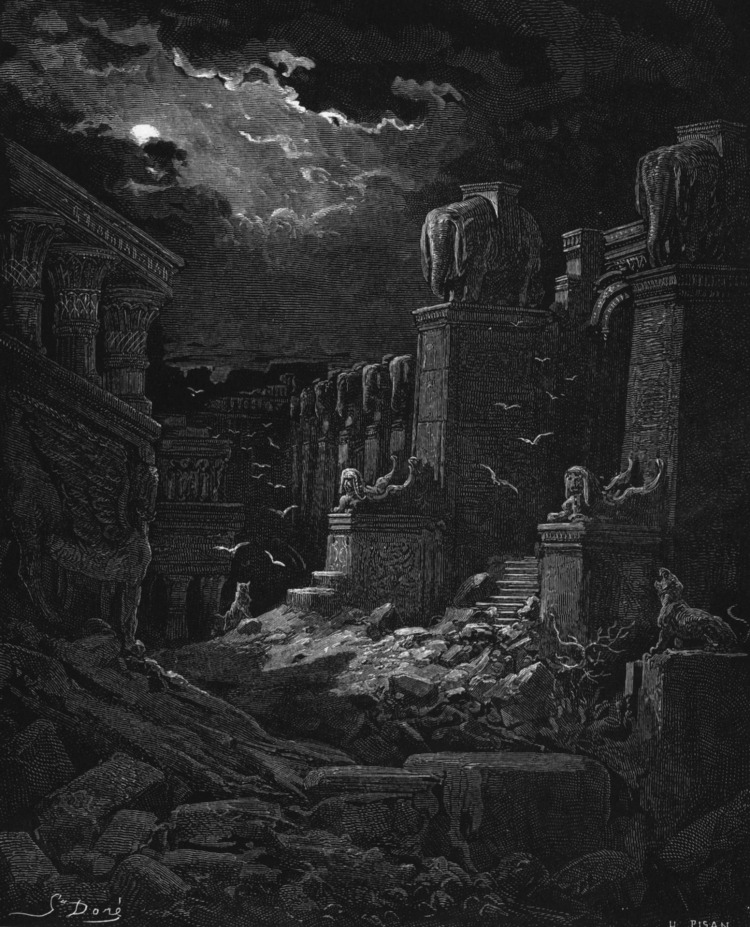
Gustave Doré – The Fall of Babylon (1866)

I. The Abdication of Democracy

The United States was founded as a democratic republic, a nation where governance was entrusted to the people and their elected representatives. Yet, in the present age, democracy appears increasingly untenable, not because of external threats, but because the citizenry itself seems willing to surrender its role in self-governance. Rather than engaging in the messy and difficult work of democracy, Americans have increasingly deferred power to an elite class—oligarchs whose wealth, status, and influence have elevated them beyond the reach of ordinary accountability. In doing so, we have embraced a political theology that anoints the rich as our rightful rulers, sanctifying economic disparity as though it were ordained by divine providence.

A key factor in this transformation is the theological justification for inequality, particularly through the Prosperity Gospel—a strain of Christianity that equates material wealth with divine favor. If wealth is a sign of God’s blessing, then poverty must be a mark of moral or spiritual failure. This belief, deeply embedded in the American consciousness, has provided a convenient ideological foundation for the rise of oligarchy. The result is a republic in name only, where the wealthy govern without meaningful challenge, and where democracy is tolerated only to the extent that it does not threaten the interests of the ruling elite.

Alexis de Tocqueville, in Democracy in America, warned that “the aristocracy of manufacturers… are one of the most dangerous that has ever appeared in the world” because they hold power over the masses without obligation or accountability. Likewise, James Madison in The Federalist No. 10 cautioned that factions dominated by economic interests would threaten the republic, as “the most common and durable source of factions has been the various and unequal distribution of property.”

II. The Historical Cycle: Republics in Decline

America is not the first republic to slide into oligarchy. The Roman Republic offers a particularly illuminating parallel. Beginning as a relatively participatory system after the expulsion of its kings, Rome’s republic gradually concentrated power in the hands of wealthy patricians. By the late republic, a handful of families controlled vast estates worked by slaves, while formerly independent farmers were displaced into a dependent urban proletariat. The final century of the republic saw repeated attempts at reform by populist leaders like the Gracchi brothers, who were assassinated for proposing land redistribution. When Julius Caesar crossed the Rubicon in 49 BC, the republic that had stood for nearly 500 years had already been hollowed out by economic inequality.

Venice provides another instructive example. The Republic of Venice began with a relatively broad-based Great Council of citizens. However, in 1297, the Serrata (closure) of the Great Council permanently fixed membership to established families, creating a hereditary aristocracy. Over time, even within this oligarchy, power concentrated further into the hands of the Council of Ten and eventually the three State Inquisitors. What began as a merchant republic gradually calcified into rule by the few, with elaborate ceremonies maintaining the fiction of the Serenissima Respublica (Most Serene Republic) while actual democratic elements withered.

The Weimar Republic’s collapse demonstrates how economic crisis can accelerate democratic decline. The hyperinflation of 1923 and the Great Depression devastated Germany’s middle class, traditionally democracy’s strongest supporters. As economic security vanished, so did commitment to democratic processes, with many seeking salvation in authoritarian alternatives. Alarmingly, in contemporary America, we witness similar anti-democratic impulses despite experiencing nothing remotely comparable to Weimar’s catastrophic conditions—suggesting that our democratic erosion stems not from genuine economic devastation but from manufactured grievance and the deliberate exploitation of social divisions.

But what fuels this manufactured grievance? Unlike the desperate economic collapse of Weimar Germany, today’s American discontent is stoked less by material suffering and more by a carefully cultivated sense of resentment. The modern oligarchy has perfected the art of distraction, channeling public anger away from corporate excess and systemic inequality and toward cultural and ideological battles that serve no economic interest for the working and middles classes. Instead of demanding higher wages, we are encouraged to fight over identity politics. Instead of questioning why billionaires pay lower tax rates than teachers, Americans are bombarded with outrage over books in libraries. Economic anxiety is repackaged into tribal conflict, ensuring that the real architects of inequality remain unchallenged.

This strategy is not accidental—it is the logical evolution of the media landscape. As traditional journalism declines, political entertainment thrives. Once, the press served as a check on power; now, it too is absorbed into the machinery of grievance, owned by the very oligarchs it should scrutinize. The consolidation is staggering: 90% of U.S. media is now controlled by just six corporations, compared to 50 companies in the 1980s.[1] This concentration has decimated local journalism while amplifying voices that serve oligarchic interests. The electorate is not simply disengaged—it is actively misled, encouraged to see fellow citizens as enemies rather than those who rule over them. This is not the erosion of democracy through neglect, but through engineering.

The success of this model is evident in voter behavior. Discontent no longer translates into economic reform movements or policy advocacy; instead, it is absorbed into personality-driven politics, where would-be strongmen are seen as righteous warriors against manufactured threats. The shift from democracy to oligarchy is not imposed—it is sold, marketed, and ultimately, embraced.

In this light, the warnings of America’s founders appear remarkably prescient. Thomas Jefferson warned against an “aristocracy of monied corporations” and stated, “I hope we shall… crush in its birth the aristocracy of our monied corporations which dare already to challenge our government to a trial of strength, and bid defiance to the laws of our country” (Letter to George Logan, November 12, 1816). Yet today, we have embraced the very model the Founders feared, allowing economic elites to determine policy, shape culture, and control the mechanisms of governance. The people, rather than resisting this transformation, have largely accepted it—guided in part by a religious narrative that equates power with virtue and poverty with failure.

III. The New Oligarchy: Wealth as Divine Favor

The modern American oligarchy is not merely composed of the wealthy, but of those who have successfully positioned themselves as figures of admiration and near-worship. Silicon Valley billionaires, hedge fund magnates, and political dynasties have become the new aristocracy, justified not by noble birth but by financial success. What separates today’s oligarchs from the robber barons of the past is not their wealth alone, but the theological and cultural framework that has shielded them from critique.

The concentration of wealth has reached unprecedented levels. According to Federal Reserve data, the top .1 percent of Americans—just 330,000 individuals—now hold 12.5% of the wealth, a staggering 40% increase from 8.9% in 2010. Meanwhile, the bottom 50% of Americans—165 million people—now hold only 5.5%.[2] This means the richest one-thousandth of the population controls more than twice the wealth of half the entire country. This marks a historic reversal of the post-WWII economic order. Yet rather than prompting concern, this concentration is often celebrated as evidence of entrepreneurial success and innovation.

This oligarchic influence extends beyond domestic borders. Foreign billionaires and sovereign wealth funds increasingly shape American policy and economic priorities through strategic investments, lobbying efforts, and ownership of U.S. assets. The globalization of capital has created a transnational oligarchic class whose interests often align regardless of nationality, further removed from democratic accountability. While domestic oligarchs at least feign the pretense of national loyalty, foreign wealth operates with even fewer constraints, treating American democracy as simply another market to be influenced or manipulated for profit.

The Prosperity Gospel, a uniquely American theological development, has played a significant role in this transformation. This doctrine teaches that material success is evidence of God’s blessing, while poverty signals a lack of faith or effort. In this view, wealth is not merely economic—it is moral. This ideology serves as a powerful deterrent to any redistributionist impulse, as it frames economic disparity as a reflection of divine will rather than systemic injustice.

Consider concrete manifestations of this oligarchic power: Congressional studies show that policy outcomes overwhelmingly align with the preferences of the wealthy. The Princeton study by Gilens and Page (2014) concluded that “economic elites and organized groups representing business interests have substantial independent impacts on U.S. government policy, while average citizens and mass-based interest groups have little or no independent influence.”[3] This influence is maintained through campaign finance—in the 2020 election cycle alone, the top 20 billionaire donors collectively spent $2.3 billion, more than twice as much as Joe Biden’s entire campaign, with a single billionaire contributing over half that sum.[4] Our democracy has effectively been captured by a donor class whose interests dictate policy priorities.

This capture extends to the very institutions designed to safeguard democracy. The judiciary, once a bulwark against concentrated power, has been systematically reshaped through strategic appointments and massive funding of judicial campaigns. Supreme Court decisions like Citizens United have equated money with speech, unleashing unprecedented corporate (thus oligarchic) influence in elections. Meanwhile, elected officials increasingly depend on wealthy donors and corporate PACs to fund ever-more-expensive campaigns, creating a system where access and influence are directly proportional to financial contributions. The result is a government formally elected by the people but functionally beholden to monied interests.

We see this play out in specific policies. The 2017 Tax Cuts and Jobs Act delivered massive benefits to corporations and wealthy individuals while adding $1.9 trillion to the national debt. Meanwhile, proposals for universal healthcare, student debt relief, or expanded social services—policies that would benefit the broader citizenry—face insurmountable opposition despite popular support. The revolving door between Wall Street and government regulatory agencies ensures that financial regulations are written by and for the financial elite. Figures like Steven Mnuchin, who moved from Goldman Sachs to hedge fund companies to Treasury Secretary, or Gary Gensler, who went from Goldman Sachs to Assistant Treasury Secretary, Under Secretary of the Treasury, Chair of the Commodity Futures Trading Commission, Commissioner of the U.S. Securities and Exchange Commission, and Chair of the Securities and Exchange Commission, exemplify how the line between regulator and regulated has blurred beyond recognition. When financial institutions faced collapse in 2008, they received immediate bailouts, while millions of Americans lost their homes with minimal assistance.

The tax system itself has been shaped to benefit the oligarchy. In 2021, ProPublica revealed that the 25 richest Americans paid an effective tax rate of just 3.4% between 2014-2018, while the average American paid around 14%.[5] This disparity did not occur by accident but through deliberate policy choices that allow the wealthy to categorize income as capital gains, exploit loopholes, and shield assets through complex financial structures unavailable to ordinary citizens.

Yet, the same religious justifications that elevate the wealthy conveniently overlook the conduct of those at the top. The modern oligarchs are often anything but paragons of virtue. Their lifestyles, filled with excess, exploitation, and moral as well as often legal bankruptcy, are far removed from the Christian ideals of humility, charity, and service. As Jesus himself warned in Matthew 19:24, “Again I tell you, it is easier for a camel to go through the eye of a needle than for someone who is rich to enter the kingdom of God.” And yet, the rich are celebrated, while the poor—often vilified as lazy or undeserving—are left to navigate a system rigged against them.

IV. The Willing Servitude of the Electorate

This transition from democracy to oligarchy has not been solely imposed from above; it has been embraced from below. A significant portion of the American electorate has come to see governance not as a participatory duty, but as a spectacle—one in which wanna-be strongmen and billionaires are revered as saviors rather than as figures to be held accountable.

Some defend this system as a meritocracy, where wealth reflects productivity and innovation. Yet Federal Reserve data shows that, using historically typical rates of return, inherited rather than earned wealth may account for over half of total wealth, undermining the narrative that economic status is purely the result of individual effort.[6] When nearly half of all wealth comes through inheritance, the myth of pure meritocracy becomes impossible to maintain. Nevertheless, the electorate continues to defend a system that increasingly resembles the hereditary aristocracies our founders sought to abolish.

The cultural obsession with wealth, combined with religious narratives that equate prosperity with righteousness, has dulled the instinct for democratic engagement. Why question the morality of economic inequality when it is perceived as a reflection of God’s order? Proverbs 22:7 states, “The rich rule over the poor, and the borrower is slave to the lender.” Why demand accountability from the ruling class when they are seen as divinely chosen stewards of the nation’s fate?

This abdication of democratic responsibility has been significantly accelerated by the capture of media institutions by the same oligarchic interests. Independent, objective news sources have largely disappeared from citizens’ lives, replaced by conglomerates owned by the very elites whose power should be scrutinized. What passes for journalism often amounts to ideologically laden content designed to reinforce existing power structures while appearing to inform. The resulting information ecosystem leaves citizens simultaneously overwhelmed with content yet starved of the context and critical analysis necessary for meaningful democratic participation. This theological deference to wealth has allowed democracy to wither, not through violent overthrow, but through active acquiescence.

The illusion of consumer choice masks growing corporate concentration, where 75% of household items are now controlled by just ten corporations.[7] When we believe we are making free market choices, we are often simply selecting between products owned by the same conglomerate. This mirrors our increasingly limited political choices, where candidates across the spectrum rely on the same donor base and serve similar corporate interests despite superficial differences in rhetoric.

Consider Amazon’s successful opposition to unionization efforts in Bessemer, Alabama (2021-2022), where billions in corporate resources were deployed to defeat workers seeking basic protections and better wages.[8] Rather than seeing this as class conflict, many Americans defend corporate interests against their own economic self-interest, having internalized a worldview where the market is sacrosanct and labor organization is somehow un-American. This represents the culmination of decades of ideological cult conditioning that has separated Americans from their own civic and economic power.

V. The Disappearance of Ethics in Public Life

If the Prosperity Gospel were true to Christianity, it would demand that the wealthy adhere to moral obligations—generosity, humility, and justice. Yet the reality is quite the opposite. The modern oligarchy exploits faith not to guide ethical behavior, but to silence dissent.

Throughout history, faith has been a force for challenging power—from the Social Gospel movement’s advocacy for labor rights to Martin Luther King Jr.’s invocation of Christian morality in the fight for civil rights. Dr. King warned, “We must rapidly begin the shift from a ‘thing-oriented’ society to a ‘person-oriented’ society” (Beyond Vietnam: A Time to Break Silence, April 4, 1967), criticizing the worship of material success over human dignity.

Yet today, much of American Christianity has been hollowed out, transformed into a vehicle for wealth-worship rather than a challenge to injustice. The teachings of Jesus, who spoke of the poor inheriting the kingdom of God and the moral dangers of riches, have been replaced by a doctrine that tells the poor they simply need to pray harder and wait their turn.

VI. The Oligarchs’ America

The American experiment in democracy appears to be in retreat, not because of foreign invaders or external threats, but because we have abandoned the very principles that sustain it. A democracy requires engaged citizens, yet we have become a nation content to let the wealthy govern without challenge. A republic requires accountability, yet we have deified billionaires and accepted their dominion as inevitable, if not righteous.

The Prosperity Gospel and its ideological offshoots have played a crucial role in this transformation. By equating wealth with divine favor, they have given a theological foundation to inequality and sanctioned the rise of oligarchy. This ideology has not only justified the unchecked power of the rich, but has also pacified the poor, persuading them that their struggles are personal failings rather than structural injustices.

If America is to reclaim its democratic aspirations, it must first confront the myths that have enabled its decline. We the People must remember that wealth is not virtue. Power is not righteousness. And democracy is not sustainable when its people cease to believe in their own right to govern. Until these truths are recognized, the nation will remain in the hands of those who have been deemed, by wealth and by providence, our betters.

History shows that oligarchic rule is not an inevitability. From the antitrust reforms of the early 20th century to the labor movements that shaped the New Deal, democratic resurgence is possible when citizens recognize their own power. But this requires first dispelling the myths that sustain the status quo: that wealth equals virtue, that political change is impossible, and that democracy is someone else’s responsibility.


[1] Ashley Lutz, “These 6 Corporations Control 90% of the Media in America,”’ Business Insider, June 14, 2012.

[2] Board of Governors of the Federal Reserve System, “Distributional Financial Accounts,” Q3 2024 Distribution of Wealth, accessed March 4, 2025,https://www.federalreserve.gov/releases/z1/dataviz/dfa/

[3] Martin Gilens and Benjamin I. Page. “Testing Theories of American Politics: Elites, Interest Groups, and Average Citizens.” Perspectives on Politics 12, no. 3 (2014), 565.

[4] Michela Tindera, “These Billionaire Donors Spent The Most Money On The 2020 Election,” Forbes, February 25, 2021, updated April 16, 2021, https://www.forbes.com/sites/michelatindera/2021/02/25/these-billionaire-donors-spent-the-most-money-on-the-2020-election/ 

[5] Jesse Eisinger, Jeff Ernsthausen, and Paul Kiel. “The Secret IRS Files: Trove of Never-Before-Seen Records Reveal How the Wealthiest Avoid Income Tax.” ProPublica, June 8, 2021. https://www.propublica.org/article/the-secret-irs-files-trove-of-never-before-seen-records-reveal-how-the-wealthiest-avoid-income-tax

[6] Laura Feiveson and John Sabelhaus. “How Does Intergenerational Wealth Transmission Affect Wealth Concentration?” Federal Reserve FEDS Notes, June 1, 2018.

[7] Oxfam. “Behind the brands: Food justice and the ‘Big 10’ food and beverage companies.” Oxfam International, 2013, https://www-cdn.oxfam.org/s3fs-public/file_attachments/bp166-behind-the-brands-260213-en_2.pdf

[8] Karen Weise. “Amazon Workers Vote Down Union Drive at Alabama Warehouse,” The New York Times, April 9, 2021.  https://www.nytimes.com/2021/04/09/technology/amazon-defeats-union.html?smid=url-share

The Shattered Eagle: A Poetic Reflection on Democracy

Introduction

The Shattered Eagle is a poignant examination of constitutional crisis and democratic decay in modern America. Through vivid imagery and elegiac tone, it traces the symbolic fall of the American Republic, using the eagle as a metaphor for a nation once soaring with purpose but now battered by corruption, authoritarianism, and civic erosion. This meditation on institutional collapse examines the deterioration of checks and balances, the rise of illiberal power, and the fraying of democratic norms.

Themes and Significance

The poem critiques the erosion of constitutional democracy, judicial independence, and legislative integrity. It reflects on how demagoguery, partisan dysfunction, and the corruption of public institutions have undermined democratic ideals and the rule of law. Through its exploration of societal polarization and institutional decay, it captures the zeitgeist of a republic in crisis.

Yet amid constitutional peril and democratic backsliding, the poem poses a crucial question about renewal. Its final stanzas challenge readers to consider whether civic restoration is possible through recommitment to democratic principles and constitutional values.

A Poem for Our Times

Rich in metaphor and steeped in political philosophy, The Shattered Eagle invites readers to confront the realities of democratic erosion while contemplating paths to institutional renewal. Drawing on the tradition of great political poetry like Yeats’s The Second Coming and Auden’s September 1, 1939, this work speaks to the universal struggle to preserve constitutional democracy and the rule of law in an age of mounting illiberalism.


The Shattered Eagle

Once soared an eagle, wings outspread,
Its cry a clarion, freedom bred.
From gilded heights, it carved the skies,
Its dreams a nation dared to rise.

Yet winds of discord tore its plume,
Ambition’s torch became its tomb.
The golden thread of union frayed,
As shadows deepened, hope decayed.

Where laws were forged by reason’s might,
Now darkness shrouds their guiding light.
Once sworn to serve the commonweal,
They sold their oaths for power’s appeal.

The halls once rang with measured voice,
Where reason swayed the public choice.
Yet now the chambers echo lies,
As honeyed tongues weave thin disguise.

No laws they craft, but favors they sell,
To oligarchs who cast their spell.
Once stewards strong, they now kneel low,
To serve a leader’s fleeting glow.

The scales of justice, firm and true,
Now tilt, corrupted, favoring the few.
Once blind, now stained with partisan hue,
They take their bribes in plainest view.

No fealty now to law's command,
But whispers guide the justices’ hand.
From lofty heights, the court descends,
A tool for power, not amends.

The eagle's perch, the people's trust,
Now yields to one with tyrannous lust.
The laurels fall, the wreath departs,
A crown is forged for lawless hearts.

No equal here, a king ascends,
While truth dissolves and honor bends.
The oath betrayed, the power abused,
A throne of lies by fear infused.

The wheels once turned to serve the land,
Now falter at one man’s command.
Where duty reigned with steady hand,
Now chaos thrives and rot expands.

The gears once turned with steady grace,
Impartial hands for every case.
Now oiled with fear, the cogs obey,
A sovereign’s whims, the people's dismay.

No law to guide, no truth to bind,
The constitution lies maligned.
The servants sworn to guard the land
Now yield to lash at one command.

Ideals once held as shining beacons,
Now crumble ‘neath the weight of treasons.
Their lofty light, now dimmed and lost,
Is bartered for ambition’s cost.

The shining hill, a beacon high,
Now shrouded 'neath a darkened sky.
Its lofty dreams by greed betrayed,
By hands of those whose hearts decayed.

No vision guides, no ideals inspire,
But petty aims and base desire.
The noble pact, to truth once sworn,
Now trampled, tattered, and forlorn.

A fractured land, a shattered will,
Where hatred reigns and hearts grow still.
What union stood now falls apart,
Its seams undone by poisoned hearts.

The land now split by faction’s line,
Where rancor festers, hopes decline.
The brother turns on brother’s hand,
And hatred scorches all the land.

No union binds, no concord stays,
But discord reigns in endless days.
Society rent, uncivil, torn,
A weary people, broken, worn.

...

A weary people, broken, worn,
Where shadows fall and freedoms mourn.
Yet seeds may bloom, if hearts remain,
Resolved to rise through toil and pain.