

Bread, Balance, and the Burden of Freedom in Dostoevsky’s The Grand Inquisitor

A Meditation on the Grand Inquisitor in Light of Metaphor and Meaning

“Man seeks not so much God as the miraculous… For man seeks not so much freedom as someone to bow before.”
The Grand Inquisitor, The Brothers Karamazov
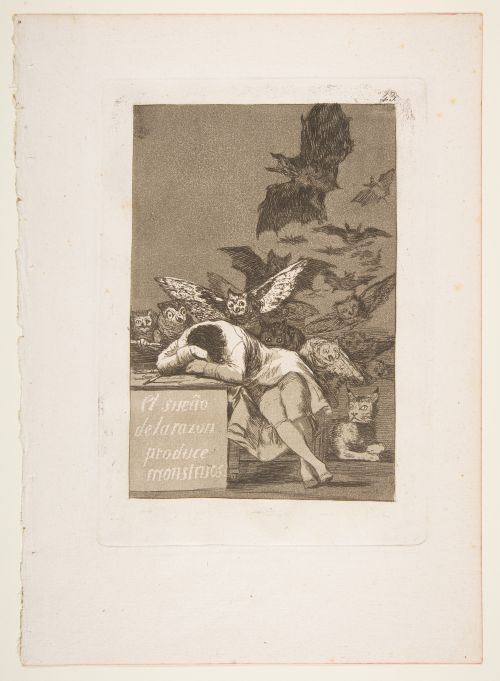
Francisco Goya’s The Sleep of Reason Produces Monsters (1799)—an image of what emerges when the mind abdicates its responsibility: not freedom, but fantasy; not peace, but nightmare. Where reason sleeps, the trinity of miracle, mystery, and authority awakens to devour.

In Dostoevsky’s The Brothers Karamazov, the tale of the Grand Inquisitor remains one of the most unsettling parables in modern literature. Told by Ivan Karamazov to his younger brother Alyosha, the fable imagines Christ returning during the Spanish Inquisition—only to be arrested and silenced by the Church. The Inquisitor, a cardinal of imposing intellect and grave compassion, does not accuse Christ of falsehood, but of cruelty: You gave them freedom, he says, when they needed bread. You gave them mystery, when they needed answers. You gave them love, when they needed order.

There was a time, decades ago, in the earnest conviction of my youth, when I found myself perplexed by the Grand Inquisitor’s logic. I did not admire him, nor excuse his authoritarianism, but I recognized the ache that underpinned his argument. Bread matters. Peace matters. Even then, I sensed the moral gravity of the dilemma he posed: How does one respond to suffering in a world that is often brutal, hungry, and unforgiving?

But I also responded viscerally to something else: the pen of Dostoevsky was not just crafting a fable, but weaponizing a caricature. The Inquisitor was not simply a tragic figure—he was also a polemic against Catholicism, a projection of Dostoevsky’s own religious bigotry. As someone educated within the Catholic tradition, I saw the ugliness beneath the fable—the prejudice tucked behind the parable’s grandeur. The critique was not only of power, but of Rome. The Inquisitor’s mitre bore the unmistakable weight of Jesuit anti-types, cloaked in suspicion and veiled accusation. My disquiet, then, was not only with the Inquisitor’s words, but with the frame within which they were uttered.

And yet, despite its polemical underpinnings, the parable remains one of the most profound meditations on freedom and faith in modern literature. Its imaginative force exceeds its prejudices. The Inquisitor endures not only as a critique, but as a haunting embodiment of the human temptation to trade liberty for comfort.

And that temptation has not faded. The Grand Inquisitor endures because he gives voice to something deeply human, and psychologically real: the desire for security, for certainty, for order amidst chaos. It is a desire that remains active—arguably ascendant—in our own time. One hears the Inquisitor’s voice today in populist strongmen, in the cynical strategist’s smirk, in the media apparatus that soothes while it divides, and in slogans that promise greatness through obedience—Make America Great Again, for instance, the rallying cry of a leader who proclaimed, “I am the only one who can save this nation,” inviting not deliberation, but devotion. The trinity he offers—miracle, mystery, and authority—is the very catechism of modern demagoguery.

This reflection, then, is not a defense of the Inquisitor, but an attempt to understand his appeal, and to reclaim the concepts he distorts. In my recent essay on literalism, metaphor, and balance, I sought to describe the menace of the literalist disposition—a mentality that cannot live with ambiguity, that flees from the poetic, and that finds in surface meaning a shield against the deeper, riskier call of the soul. Here, I apply that lens to the Inquisitor’s three pillars.

Miracle and the Tyranny of the Literal

The Inquisitor offers miracle as literal spectacle: bread conjured from stone, laws suspended, proof offered to silence doubt. He rebukes Christ for refusing to perform such signs in the desert, calling His restraint an act of cruelty rather than spiritual wisdom.

Even as a young reader, I did not mistake the Inquisitor’s miracle for holiness. But I understood that hunger cannot be spiritualized away. In a world where the body is often broken before the spirit can rise, the refusal to give bread seems harsh.

What I have since come to understand is that bread must be shared, not wielded—and that miracles, if they mean anything at all, must point beyond themselves. A miracle that ends conversation is not a miracle but a manipulation.

We have seen modern versions of such miracles: promises made and spectacles staged not to elevate understanding, but to prove power. Consider the border wall—hailed not merely as a policy, but as a singular, salvific act. Its construction, real or exaggerated, was brandished as proof of providence, as the visible sign that the nation could be made great, pure, and safe again. Nor was it the only such “miracle.” Similar wonders were promised: the immediate end of the Russian invasion of Ukraine, the revival of a fading industrial economy, the return of jobs long gone, and the rapid reordering of the global market in our favor. These, too, were presented as guarantees—not to be debated, but to be believed. And like the Inquisitor’s miracles, they have largely yet to be seen.

In my essay on literalism and metaphor, I argued that literalism becomes a menace when it displaces metaphor—when it insists on one meaning, one proof, one visible sign. The Inquisitor’s miracles are precisely that: spectacles that end the need for faith. They are miracles without meaning.

Mystery and the Collapse of Metaphor

The Inquisitor’s use of mystery is a case study in spiritual containment. Mystery becomes the guarded unknown, parceled out by clerical authority to pacify rather than provoke. It is not a sacred unknowing, but a fog of confusion meant to keep the people docile.

But true mystery, like true metaphor, does not confuse—it illuminates by depth. It renders the world porous to truth. It refuses finality not because it is evasive, but because it is more honest than premature closure allows.

I did not reject mystery in youth, nor do I now. But I reject the collapse of mystery into secrecy, the transformation of the ineffable into the inaccessible. Metaphor must breathe. Mystery must invite. When weaponized, they become not sacred, but sinister.

In our current dysfunctional era, mystery is often replaced by conspiracy—a counterfeit that plays the same psychological role, offering significance without wisdom, awe without humility. The literalist disposition, fearing true complexity, gravitates toward these shallow depths. Conspiracy is mystery stripped of humility. It retains the trappings of hidden knowledge but closes the mind rather than opening it. It flatters the believer with secrets while shielding them from ambiguity. It is not reverence for the unknown, but a refuge from the supposed unbearable complexity of reality.

We see this vividly in the ecosystem of conspiracy theories surrounding Trump’s political movement. Whether it is the belief that a global cabal of elites and pedophiles is secretly running the world (QAnon), or that massive voter fraud orchestrated by shadowy networks altered the outcome of the 2020 election, or that figures like Barack Obama, Hillary Clinton, or George Soros are puppet-masters in an international scheme to undermine American sovereignty—each offers an illusion of secret insight in place of the real work of understanding. These narratives are not pursued for their truthfulness but for their emotional certainty. They replace sacred mystery with a kind of gnosis—fierce, insular, and self-reinforcing.

And like the Inquisitor’s mystery, they are not shared to free the soul, but to bind it—to a worldview, to a figure (whether cult, religious, or political leader, a distinction without merit or significance), to a sense of exceptionalist belonging. The effect is not illumination but containment.

Authority and the Displacement of Balance

The Inquisitor’s authority is final, paternal, and brutal in its compassion. It replaces freedom with peace, conscience with obedience. Its appeal lies not only in its force, but in its promise: You no longer have to choose. I will choose for you. And I will feed you.

As I have aged, I have come to see that this vision is not merely imposed—it is desired. Much of the populace is psychologically predisposed to respond favorably to such authority, whether it comes in vestments or slogans. It offers relief from the burden of discernment. It relieves the anxiety of paradox.

This recognition—that the hunger for certainty is as much internal as external—has shaped my own philosophical trajectory.

And that is where the menace lies. This is not a top-down problem alone, but a convergence of design and desire. The Inquisitor gives the people what they already, in some meaningful manner, want: a world made safe through submission. The leader becomes the sole interpreter of truth, the guarantor of safety, the vessel of meaning. Authority becomes a theology in itself.

We have seen this in our time, where devotion to a figure supplants loyalty to principle. When a leader proclaims “I am the only one who can save this nation,” and is met not with unease but with cheers, authority has ceased to be a mediating presence and has become a metaphysical claim. It no longer balances tension; it obliterates it.

In contrast, the authority I defended in my earlier essay was not coercive, but mediating—a balancing presence, a harmonizing voice. It does not dominate or dismiss. It holds the tension without collapsing it. It does not provide peace through closure, but through co-suffering. It listens. It waits.

The Bread and the Burden

So no, I did not approve of the Grand Inquisitor—not in youth, not now. But I acknowledged, and still acknowledge, the ache beneath his argument. It was not cruelty that made him persuasive, but compassion twisted into control—a desire to ease pain by removing the possibility of choice.

What I now see more clearly is that this fable is not merely a theological drama. It is a psychological map. The Grand Inquisitor is the high priest of the literalist disposition—offering miracle that silences, mystery that obscures, authority that absolves.

That disposition is not confined to Dostoevsky’s century. It is at work now—in every movement that prefers spectacle to sign, dogma to dialogue, power to presence. It thrives in political rhetoric, in media narratives, in spiritual systems that replace grace with control.

Dostoevsky does not argue against it. Christ does not rebut it. He answers with a kiss.

A kiss without domination.
A kiss that respects freedom.
A kiss that does not resolve the tension, but chooses to love within it.

That is the burden of freedom: not only to bear it ourselves, but to offer it to others, knowing they may prefer their chains.

To offer bread, but not as bribe.
To teach, but not as demand.
To speak, but not to silence.
To live, still and quietly,
within the balance that resists the Inquisitor’s call.

To refuse the miracle that enslaves,
To offer bread and still preserve the soul,
That is the quiet defiance the world most needs.

The Real Armageddon: Musk’s DOGE and the Dismantling of Public Trust

Photo by Chris F on Pexels.com

“If you read the news, it feels like Armageddon. I can’t walk past a TV without seeing a Tesla on fire,” Elon Musk said recently at a Tesla all-hands meeting. “I understand if you don’t want to buy our product, but you don’t have to burn it down. That’s a bit unreasonable.”1

The quote is evocative—perhaps designed to stir sympathy. Yet it invites a measure of irony. While vandalism against Tesla properties is, of course, deplorable, it is neither as widespread nor as catastrophic as Musk, and biased media reporting, would have the public believe. Fewer than a dozen reported incidents—at Tesla dealerships or Supercharger stations—have resulted in fires, graffiti, or property damage. In nearly all of these cases, suspects have been arrested and charged.2

In a country of over 330 million people, where more than 200,000 vehicle fires and 500,000 structure fires occur annually,3 and where Florida and Texas alone report nearly 3,000 murders each year,4 these incidents—while serious—are statistically insignificant. What Musk decries as “Armageddon” is, in national context, a series of isolated acts that have been swiftly addressed by law enforcement.

Meanwhile, under Musk’s leadership of the Trump administration’s Department of Government Efficiency (DOGE), far greater destruction is being wrought—not upon property and government subsidized business interests, but upon the institutions designed to serve the American people.

According to Reuters, the Department of Veterans Affairs (VA) is expected to lose over 80,000 employees under DOGE’s efficiency plan.5 Already, this downsizing is disrupting vital services: clinics are understaffed, appointments are delayed, and mental health services—already under strain—are faltering.6

This is not bureaucratic “streamlining.” The VA currently serves over 18 million veterans,7 many of whom depend on timely and specialized care for physical and mental trauma, service-connected disabilities, and long-term support. Disabling this infrastructure in the name of “efficiency” is not neutral policy—it is institutional abandonment.

The Social Security Administration (SSA) has not fared better. Facing mandates to reduce its workforce by up to 50%, the SSA is bracing for a collapse in the timely delivery of services to more than 70 million Americans, including over 50 million seniors.8 Already, SSA field offices in major cities have shortened hours, laid off staff, and seen processing times for benefits skyrocket.

Federal workers have responded with urgency. In San Francisco and other metropolitan areas, SSA and VA employees have staged public protests, warning of the catastrophic impact these cuts will have on their most vulnerable clients.9 Their message is clear: public service cannot survive on ideology alone.

Thus, while Musk’s Teslas may burn in isolated incidents, the real fire is the one now consuming the administrative state (the means by which public servants deliver public services to the citizens they serve pursuant to laws passed by Congress). The irony is sharp. Musk’s complaint—“You don’t have to burn it down”—could just as easily be addressed to himself. If you do not like the structure or scale of government, you do not have to dismantle its capacity to serve. That, too, is a bit unreasonable.

What Musk labels as terrorism when directed at his private enterprise is tolerated—even celebrated—when inflicted upon public institutions. Yet the human cost of the latter is infinitely greater. The quiet collapse of service infrastructure—untelevised and untheatrical—is the more insidious disaster.

In the end, the real “Armageddon” may not be a vandalized Tesla on a TV screen. It may be the veteran denied timely access to urgent medical care. The senior citizen waiting months for a critical in-person meeting at a Social Security office. The single parent lost in a phone queue with no one left to answer.

These are not symbolic gestures. These are lives.


Notes

  1. Pras Subramanian, “Tesla’s Elon Musk Holds Surprise All-Hands Meeting to Assuage Employees and Investors,” MSN Money, March 21, 2025.
  2. New York Post, “Pam Bondi Announces Charges Against 3 in Tesla Attacks,” March 20, 2025.
  3. National Fire Protection Association, “Vehicle Fires,” 2024.
  4. Federal Bureau of Investigation, Crime in the United States, 2021.
  5. Reuters, “US Plans to Fire 80,000 Veterans Affairs Workers,” March 5, 2025.
  6. Reuters, “VA Shake-up Disrupts Mental Health Services,” March 20, 2025.
  7. Pew Research Center, “The Changing Face of America’s Veteran Population,” November 8, 2023; Reuters, “VA Shake-up Disrupts Mental Health Services,” March 20, 2025.
  8. Sara Dorn, “Here’s Where Trump’s Government Layoffs Are,” Forbes, February 21, 2025.
  9. San Francisco Chronicle, “Federal Workers Protest Musk-Led Government Cuts,” March 14, 2025.

The Danger of Literalist Thinking in the Face of Rising Authoritarianism in the United States

The Perils of Legalistic Literalism

Throughout history, authoritarianism has rarely invaded democracies through dramatic coups but rather through the gradual erosion of norms and institutions. This erosion is often enabled by what might be called “legalistic literalism”—a mindset that fixates on procedural adherence while remaining blind to broader patterns of democratic decay. This approach creates a dangerous paradox: by the time literalists acknowledge an authoritarian threat has crossed their arbitrary legal threshold, democratic safeguards have often already been fatally compromised.

The United States offers a compelling case study of this phenomenon. From the normalization of anti-democratic rhetoric during the current president’s first campaign to the institutional paralysis surrounding the January 6th insurrection and subsequent Supreme Court decisions expanding presidential immunity, literalist thinking has consistently undermined effective resistance to democratic deterioration. Now, with the current administration’s return to office, the administration has embraced an explicitly authoritarian approach. It has weaponized the Justice Department and haphazardly dismantled government agencies without required Congressional authorization—at times so maliciously and haphazardly that certain closures had to be reversed. Public servants have been fired, impeding the delivery of essential services to senior citizens, veterans, those seeking enforcement of their civil rights, and other citizens. Some, identified as the “other,” have been sent to what can only be described as concentration camps (in the British historical tradition thus far) in foreign countries or literally “lawless” territories under U.S. control (in the American historical tradition alas) pending their final disposition. Meanwhile, Congress has been marginalized, and executive orders are treated as beyond the oversight of Congress or the judiciary under the novel unitary executive theory propounded by the administration.

This pattern follows a recognizable trajectory observed in other democracies that have declined into authoritarian rule. What makes the American case particularly instructive is how adherence to procedural norms—supposedly the safeguard of democracy—has paradoxically accelerated democratic erosion by delaying meaningful resistance until institutional damage becomes nearly irreversible. Examining this process reveals not just the mechanics of democratic decline but also potential strategies for arresting it before critical democratic guardrails are wholly destroyed.

This essay examines how literalist thinking enables authoritarianism by exploring these key moments of institutional failure and draws lessons for preserving democratic systems against such threats.

The Warning Signs: Early Responses to Authoritarian Signals

The Normalization Phase (2015-2016)

When he emerged as a political figure, his rhetoric displayed clear authoritarian tendencies: praising dictators like Vladimir Putin and Kim Jong-un, threatening political opponents with imprisonment, attacking the press as “enemies of the people,” and suggesting he might not accept election results. These statements represented textbook warning signs familiar to scholars of democratic decline.

Yet the response from most institutional actors was profoundly literalist. Major media outlets normalized his rhetoric by treating it as conventional political hyperbole rather than dangerous authoritarianism. Legal scholars reassured the public that constitutional guardrails would hold. Political opponents dismissed him as unserious. The common refrain—“take him seriously, not literally”—embodied this literalist fallacy, suggesting that dangerous rhetoric was inconsequential until manifested in specific legal violations.

This response ignored historical lessons from democratic backsliding in countries like Hungary, Turkey, and Venezuela, where authoritarian leaders signaled their intentions through rhetoric long before implementing institutional changes. The literalist mindset demanded concrete proof before acknowledging threat—effectively demanding democracy show fatal symptoms before allowing preventative treatment.

Constitutional Optimism as Denial (2017-2019)

Once in office, he tested democratic guardrails through actions that challenged norms without clearly violating laws: firing FBI Director James Comey while citing the Russia investigation, demanding loyalty from law enforcement officials, attacking judges who ruled against him, and claiming “absolute immunity” from investigation.

The literalist response from many institutions was to examine each action in isolation rather than as part of a pattern of democratic erosion. This compartmentalization prevented the recognition of the cumulative threat. Many mainstream legal scholars maintained that since each action could be technically defended through creative legal interpretation, the system was holding.

This faith in procedural safeguards reflected a fundamental misunderstanding of how democracies die in the 21st century. As scholars Steven Levitsky and Daniel Ziblatt note in How Democracies Die, modern authoritarian leaders typically dismantle democracies through legal channels—exploiting ambiguities in legal systems rather than openly violating them. The literalist’s insistence on clear legal violations as the threshold for concern thus creates a perfect blind spot for detecting authoritarian encroachment.

This blindspot would prove particularly damaging as his presidency progressed, setting the stage for increasingly bold challenges to democratic norms that would eventually culminate in the events surrounding the 2020 election.

Institutional Paralysis: January 6th and Its Aftermath

The events surrounding January 6th, 2021, represent perhaps the clearest example of how literalist thinking enables authoritarianism. For months, he and his allies laid groundwork to overturn the election: filing dozens of baseless lawsuits, pressuring state officials to “find” votes, attempting to manipulate the Justice Department, and promoting alternative slates of electors.

The Failure of Preventative Response

Despite these clear warning signs, many institutions remained paralyzed by literalist reasoning. Political leaders insisted on waiting for an unambiguous “red line” to be crossed. Law enforcement agencies, despite intelligence warnings about violence, hesitated to prepare adequately for January 6th partly due to concerns about appearing to take sides in what was framed as a “political dispute” rather than an attempted coup.

This paralysis extended to Congress, where even after the Capitol was breached, a significant number of legislators proceeded with objections to electoral votes—adhering to a procedural approach even as the violent consequences of that approach unfolded around them.

The Accountability Gap

In the aftermath, literalist thinking continued to impede accountability. Criminal prosecutions moved at a glacial pace, constrained by procedures designed for ordinary criminal cases rather than threats to democracy itself. The impeachment process failed when many senators cited procedural objections about impeaching a former president—a literalist reading that ignored the purpose of impeachment as a safeguard against future threats to democracy.

Perhaps most concerning was the judiciary’s response. Courts processing January 6th cases often treated them as ordinary criminal matters rather than components of an attempted coup, focusing on specific statutory violations while avoiding broader questions about democracy and insurrection. This procedural compartmentalization helped normalize an unprecedented assault on democratic transition.

As Daniel Ziblatt observed, the January 6th attack and his subsequent pardoning of rioters highlighted two cardinal rules of a healthy democracy: You have to accept election results, win or lose, and you cannot engage in violence or threaten violence to hold onto power. The failure to enforce these principles further illustrates how literalist hesitation in addressing democratic threats emboldens authoritarian actors.

This failure of accountability created a dangerous precedent, setting the stage for the next phase of democratic erosion: the judiciary’s formal expansion of executive power beyond democratic constraints.

Judicial Complicity and the Supreme Court’s Role

The Supreme Court’s decision in Trump v. United States (2024) exemplifies how literalist legal reasoning can provide cover for authoritarianism. By granting unprecedented immunity to presidents, the Court elevated a narrow textual reading over consideration of how such immunity would affect democratic accountability.

The ruling effectively places presidents above the law, making future accountability nearly impossible. While meticulously parsing eighteenth-century texts and precedents, the Court showed remarkable blindness to the real-world impact: a president who had already attempted to overturn an election was being granted expanded immunity just as he prepared to potentially retake office with explicit promises of retribution against opponents.

This decision represented the culmination of a years-long process of judicial capture that extended well beyond this single ruling. Justices Samuel Alito and Clarence Thomas had been implicated in significant ethics scandals, including undisclosed luxury vacations, private jet travel, and real estate deals with billionaires who had interests before the Court. Rather than addressing these clear conflicts of interest through meaningful ethics reforms, the Court responded with voluntary, unenforceable guidelines that preserved the appearance of judicial independence while allowing substantive corruption to continue.

These ethics scandals revealed a deeper problem: the Court’s legitimacy was being undermined not just by individual rulings but by both the perception and reality that justices were entangled with wealthy interests seeking to reshape American governance. The corruption evident in these scandals aligned key justices with the very oligarchic forces backing authoritarian politics—creating a dangerous alliance between judicial power and anti-democratic wealth.

The Oligarchic Capture of Democratic Institutions

The literalist approach fails not only through procedural blindness but also by ignoring the economic power dynamics that increasingly shape American governance. The same oligarchic network supporting judicial capture has also backed authoritarian political movements and organizations, such as the Federalist Society, recognizing that an authoritarian turn benefits economic elites through deregulation, tax policies, and suppression of labor rights.

Congress’ failure to act against judicial corruption stems not merely from procedural timidity but from financial entanglement with the same oligarchs and corporate interests that have corrupted the courts. This same timidity was on display in Senate Minority Leader Chuck Schumer’s decision to support a Republican-crafted Continuing Resolution (CR) to extend government funding, despite opposition from within his own party and others opposed to authoritarian encroachment. His rationale—that blocking the bill would allow the president and his oligarchic side-kick to seize more power through a government shutdown—illustrates how institutional leaders often capitulate to authoritarian pressure rather than risk direct confrontation. This type of preemptive surrender, justified through procedural pragmatism, ultimately facilitates democratic erosion rather than preventing it.

The assumption that democratic institutions operate independently of economic influence is a dangerous literalist fallacy. The reality is that concentrated wealth has created a feedback loop where economic power translates into political influence, which in turn creates policies that further concentrate wealth. This cycle has accelerated democratic erosion by ensuring that institutional responses to authoritarianism remain weak and ineffective, constrained by the same economic interests that benefit from democratic decline.

The Road Ahead

Democracy in the U.S. is at a precarious moment. The literalist approach to democratic defense has repeatedly failed to prevent authoritarian encroachment. The path forward requires:

  1. Recognizing that democracy dies through legal channels, not just through obvious coups.
  2. Understanding that economic oligarchy and political authoritarianism are mutually reinforcing threats.
  3. Prioritizing substantive democratic values over procedural formalism.
  4. Building coalitions willing to take political risks to preserve democratic governance.

For citizens, this means moving beyond the assumption that legal procedures alone will protect democracy. For institutions, it means developing the courage to defend democratic principles even when doing so challenges conventional interpretations of their role.

Effective resistance to authoritarianism requires not just procedural vigilance but moral courage—the willingness to recognize patterns of democratic erosion before they manifest in unambiguous legal violations. It requires understanding that democracy depends not just on rules but on shared commitments to democratic values that transcend legalistic interpretations.

By the time an authoritarian breaks the law, they have already rewritten the rules. The fight for democracy must begin long before that point.

The Dismantling of the U.S. Department of Education: A Calculated Assault on the Nation’s Future

Abandoned classroom. Photo by Pixabay on Pexels.com

The destruction of the U.S. Department of Education is not merely a bureaucratic restructuring or an attempt at governmental efficiency. It is, rather, a brutal, ideologically driven attack on public and higher education itself—an assault decades in the making. The immediate consequences, such as the callous firing of over 1,300 employees and the gutting of its Office for Civil Rights, are alarming, but they are only symptoms of a broader effort to delegitimize and dismantle the tradition of public education in America. This is no accident; it is a deliberate and malicious campaign waged by reactionary forces who have long sought to annihilate the very concept of education as a public good.

Before addressing the broader catastrophe, it is essential to recognize the dedicated public servants whose careers have been abruptly and callously ended. These were not faceless bureaucrats but individuals who dedicated their lives to ensuring access to quality education, protecting civil rights, and supporting students, parents, and teachers. They are the ones who worked tirelessly to administer federal student aid, enforce anti-discrimination laws, and uphold policies meant to ensure that education remained a pathway to opportunity rather than a privilege of the few. To see them falsely maligned and slandered while being discarded so cruelly is an injustice, not only to them but to the nation they so nobly served.

To understand the scope of this travesty, one must acknowledge that public education in the United States has been under sustained assault—not from bureaucrats, not from educators, and certainly not from the imagined “woke” enemies that conservative demagogues irrationally scream about—but from the anti-public education, anti-higher education agenda of the right-wing forces that have festered in the American political landscape since Brown v. Board of Education so deeply outraged the bigoted sensibilities of many Americans. This movement, which cloaks itself in deceptive terms like “school choice” and “parental rights,” is nothing more than a long-running campaign to dismantle public education in favor of a reactionary, privatized system that siphons resources from the many to enrich the few.

Milton Friedman, the sinister patron saint of the libertarian free-market fantasy, provided the economic blueprint for this war on public education. His advocacy for school vouchers was never about “improving education” or “empowering parents”—it was about facilitating the exodus of white children from integrated schools while redirecting public funds into private, often exclusionary institutions. The modern conservative attack on public education is a direct continuation of this shameful tradition, now infused with fresh venom as it seeks to erase any federal coordination, civil rights protections, and guarantee of equal access to education.

And now, with breathtaking ruthlessness, this agenda is reaching its culmination at the hands of pusillanimous politicians hiding behind false narratives. The elimination of nearly half the workforce of the Department of Education within the first two months of the second reign of incompetence is an unmistakable step toward the total obliteration of the department. The Office for Civil Rights, already struggling to process the nearly 25,000 complaints of discrimination it receives from the public yearly and one of the last remaining institutional bulwarks against discrimination in schools—has been slashed to the bone, ensuring that students with disabilities and others who are discriminated against, whether on sex or race or national origin, will have nowhere to turn for timely relief when their rights are trampled. This is not accidental; this is the plan.

The current Education Secretary, in the grand Orwellian tradition of this administration, has assured the public that these cuts will somehow improve “efficiency” and “accountability.” Such statements are not merely disingenuous—they are outright lies, designed to mask the true intent behind this evisceration: to dismantle any federal structure that protects education as a right rather than a privilege reserved for the wealthy and well-connected.

Adding further insult to this grievous injury, the most aggrieved one has handed the reins of this demolition project to none other than our billionaire tech overlord. This grotesque display of plutocratic interference sees our billionaire tech overlord—who has no experience in education policy but plenty of experience in exploiting workers—granted unfettered access to sensitive government data and decision-making power over federal agencies. Under the laughable guise of “efficiency,” his Technokratische Jugend has set about dismantling the very institutions that serve as the backbone of public education, further centralizing power in the hands of the ultra-rich while leaving working Americans to suffer the consequences.

But let us be clear: this is not just an attack on those in public service. It is an attack on the very principle that education should be accessible to all, that an informed citizenry is essential to democracy, that knowledge should not be hoarded by the privileged few. It is an attack on the American future, a calculated and malevolent act of national sabotage designed to entrench ignorance and subjugation. Presently, the enlightened pro-choice anti-education agenda of our political elite has delivered unto us a nation where 54 percent of adults read only at the 6th grade level—imagine a decade hence where we will be!

Public education is not a luxury; it is the foundation of an equitable society. The destruction of the U.S. Department of Education is not about “efficiency” or “streamlining” government—it is about ensuring that the levers of power remain in the hands of a select few while the masses are kept ignorant, powerless, and too overwhelmed to fight back. This is a crisis of democracy, and it will have consequences that reverberate for generations.

The wreckage of this assault will be vast and far-reaching. Higher education costs will continue to increase as many institutions shutter their doors, vocational training programs will wither, and civil rights enforcement in schools will become an afterthought, if it exists at all. Meanwhile, a handful of oligarchs and right-wing ideologues will gloat over their victory, having successfully reduced one of the last bastions promoting American progress into a smoldering ruin. And continue to pay attention to the war on institutions of higher education, our overlords are not done reducing our heirs into ignorance.

The Gulf of Mexico Renaming: A Shift Toward Authoritarianism

Perhaps historians, social commentators, and others have overlooked the significance of the official renaming of the Gulf of Mexico by the U.S. government. In retrospect, this single action—more than all the other actions of the recent past—may be the clearest indication that the Republic has slid into authoritarianism.

Consider this: every other action undertaken recently, no matter how heinous, illegal, or unconstitutional, was not truly surprising. These actions were long planned—rooted in old hatreds of people, ideas, and ideologies that have been debated in this country for decades, if not longer.

But to the point—he had a thought, perhaps fleeting, perhaps deliberate, to arbitrarily rename the Gulf. This was not a longstanding controversy, not a battle waged over decades. No committee debated it, no scholars weighed in, no political factions fought over it. It had never been considered or raised. It is not a point of hate or ideology. It was simply arbitrary, irrational, and ahistorical. And yet—voilà—it was done. No resistance. No hesitation. The act was obeyed with the same mechanical efficiency as in North Korea, the Soviet Union, Communist China, Nazi Germany, or Fascist Spain.

It was a test. Could he control thought, speech, and language itself without resistance? Yes. He could.

There were no legal battles, no protests, no challenges. The Gulf of Mexico was not—and had never been—an issue of public contention or even a discussion. Yet this renaming was an exercise in raw, unchecked power. And no one even stopped to ask, Wait—what? Why?

Thus, the Authoritarian States of America arrived. The Republic can be declared dead as of the day the U.S. government—or, at the latest, Google Maps—recognized the change.

Orwell warned us. Read Nineteen Eighty-Four. Read Politics and the English Language.