
The Cooling of the Flame: On the Intellectualization of Emotion from Petrarch to the Modern Mind

Amor, che ‘ncende il cor d’ardente zelo,
di gelata paura il tèn constretto,
et qual sia più, fa dubbio a l’intelletto,
la speranza o ‘l temor, la fiamma o ‘l gielo.

Love that lights ardent zeal in the heart,
constrains it also with an icy fear,
and leaves the mind uncertain which is greater,
the hope or the fear, the flame or the frost.
— Francesco Petrarca, Canzoniere 182

I. The Divided Heart

Few poets have so perfectly distilled the contradictory essence of love as Petrarch. In four lines, he sets the human heart ablaze and in the same breath subdues it with frost. Love, that “ardent zeal,” becomes inseparable from the chill of fear; the intellect, summoned to arbitrate between hope and terror, finds itself immobilized in doubt. The flame illuminates even as it freezes.

The quatrain serves not merely as an emblem of courtly love but as a mirror of the reflective soul—the soul that, once conscious of its passion, cannot help but analyze it. Every act of self-awareness introduces distance; every act of comprehension tempers immediacy. To understand what one feels is already to stand outside the feeling. Thus, the Petrarchan heart is forever divided: inflamed by emotion, yet cooled by the very intellect that seeks to grasp it.
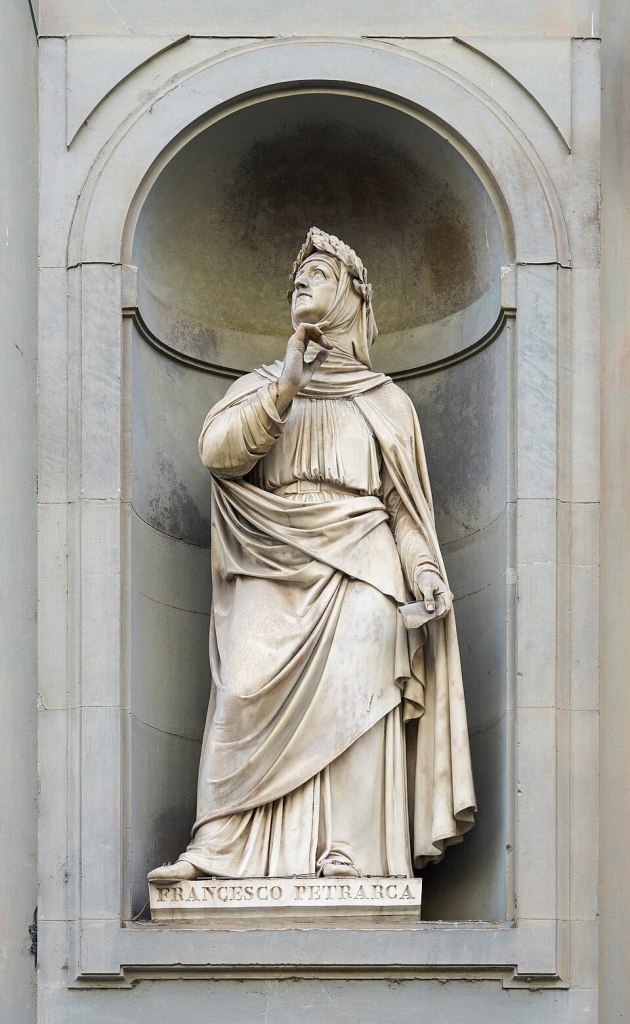
12 ⁄ 13 Download this file Large (664×1080 px) Download View in browser Attribution You need to attribute the author Plain HTML By Wikibusters - Own work, CC BY-SA 4.0, https://commons.wikimedia.org/w/index.php?curid=119935288 By Wikibusters - Own work, CC BY-SA 4.0, https://commons.wikimedia.org/w/index.php?curid=119935288​ Copy More details Statue of Petrarch on the Uffizi Palace, in Florence
Statue of Petrarch on the Uffizi Palace, in Florence

II. Petrarch’s Paradox—Flame and Frost

In Canzoniere 182, Amore is no mere sentiment but a force of cosmic ambivalence—a sacred fire that binds as much as it liberates. The heart, seized by ardente zelo, is at once inspired and constrained by gelata paura; passion and dread are inseparable twins. But what gives the poem its enduring power is the final turn: fa dubbio a l’intelletto—it makes the intellect uncertain.

This uncertainty is not simple indecision; it is the very mechanism by which passion becomes reflection. The lover’s flame, examined, begins to cool—and that cooling assumes distinct forms.

First, love cools by comprehension. The instant it is understood, passion becomes object rather than subject. The flame is enclosed in glass: it still glows, but it no longer burns.

Second, love cools by doubt of itself. Reflection turns inward, questioning its own authenticity: Is this love true, or merely imagined? In this moment, feeling erodes under the acid of self-consciousness.

Third, love cools by doubt of the beloved. The intellect, unable to sustain idealization, wonders whether the object of devotion merits such intensity. The beloved becomes an emblem—not a person of flesh and breath, but a mirror of perfection that no reality can equal.

Fourth, love cools by doubt of the lover’s worthiness. The heart fears it is unworthy of its own longing. Humility becomes paralysis, and passion folds inward upon itself.

These four modes of cooling form the architecture of Petrarch’s inner world—the endless oscillation between fervor and fear, adoration and self-doubt. He writes not to resolve this tension but to dwell within it. Each sonnet is a chamber where flame and frost coexist, where thought is both confessor and executioner of feeling.

III. Dante and the Alchemy of the Intellect

Dante offers a luminous counterpoint. In La Vita Nuova and the Paradiso, intellect and love are not adversaries but allies; the mind becomes the means by which love ascends. L’amor che move il sole e l’altre stelle—the love that moves the sun and the other stars—does not cool but sanctifies. In Dante, the intellect transforms passion into vision—the earthly beloved into divine wisdom. The flame does not die; it becomes light.

Consider the climactic moment of Paradiso XXXIII, where Dante’s vision finally encompasses the divine mystery. His intellect, far from diminishing his love, becomes the very instrument of its perfection. He describes how his desire and will are turned like a wheel by the love that moves the sun and the other stars. Here, understanding completes rather than constrains. The mind does not freeze the heart; it liberates it into comprehension of the Eternal. Beatrice herself, who began as an earthly beloved, becomes through the intellect’s mediation a guide to the Beatific Vision. Her smile, growing ever brighter as they ascend through the spheres of Paradise, finally becomes too radiant for mortal sight—not because love has cooled, but because it has been refined into pure illumination.

Petrarch inherits Dante’s vocabulary but not his cosmos. His world is one step further from heaven, one degree cooler. Where Dante’s intellect completes love by raising it to the eternal, Petrarch’s intellect contains it, interrogates it, doubts it. He lives in the afterglow of revelation—the warmth still present, but the fire withdrawn. As the Paradiso closes, Dante’s vision resolves into the final harmony of understanding and desire—l’amor che move il sole e l’altre stelle—the line that unites intellect and love in a single act of divine motion. Petrarch cannot reach this synthesis. His flame flickers in the middle distance, neither extinguished nor transcendent.

IV. The Modern Inheritance—Reflection and Alienation

From Petrarch descends the long lineage of reflective melancholy that characterizes the modern mind. His was the first great experiment in self-conscious passion—the attempt to inhabit feeling and analyze it at once. After him, love and thought could no longer coexist in innocence; the very act of awareness altered the nature of what was felt.

Montaigne and the Essay of the Self

Montaigne inherits this disposition and turns it into method. In his Essais, feeling is no longer confessed in the lyric key but dissected in the prose of observation. The heart becomes a field for inquiry, and what was once sung becomes tested, weighed, compared. It is telling that Montaigne quotes Petrarch approvingly: “He who can say how he burns with love, has little fire.” (Chi può dir com’ egli arde, è in picciol fuoco, Canzoniere 137). The aphorism might well serve as Montaigne’s motto, for he, too, knows that passion explained is passion already cooling.

His genial skepticism marks the first full tempering of Petrarch’s flame: affection survives, but only as reflection. The essay replaces the sonnet as the vessel of interior life; emotion, distilled into thought, becomes the study of itself. In Montaigne, we see the completion of a transformation begun in Petrarch—the lover becomes the anatomist of his own heart, and the page becomes not a transcript of feeling but a laboratory for its examination. The warmth of passion is not extinguished but transmuted into the steady light of self-knowledge.

Wordsworth and Emotion Recollected

Wordsworth, centuries later, restores emotion to poetry, yet only by containing it within the frame of recollection. His famous dictum—”emotion recollected in tranquillity”—is itself a Petrarchan paradox, though less tormented. He admits that to write of passion is to have already survived it. The poet stands at a contemplative distance from his own fervor, translating immediacy into memory, fire into afterglow. What once consumed now instructs.

In the Prelude (XII), Wordsworth describes the “spots of time” that preserve the intensity of past experience, yet the very act of preservation requires temporal remove. The flame of immediate experience has cooled into the steady glow of retrospective understanding. Wordsworth does not lament this cooling as loss; rather, he discovers in it a new kind of beauty—the beauty of consciousness reflecting upon its own depths.

Eliot and the Fragments of Feeling

By the time we reach T.S. Eliot, the process is complete. In The Waste Land, the flame is nearly ash. His lines of “memory and desire” register not passion itself but its echo—reverberations in a chamber long since emptied of direct experience. Emotion is mediated through quotation, irony, and allusion; the self no longer speaks but curates its fragments.

Consider the hyacinth girl passage, where memory itself fails to sustain emotion: “I could not / Speak, and my eyes failed, I was neither / Living nor dead, and I knew nothing.” The speaker recalls a moment that should have been transcendent—arms full of flowers, hair wet—but the recollection brings only paralysis, a kind of death-in-life. Even memory cannot resurrect the feeling; it can only gesture toward its absence. The modern condition is not the absence of feeling but its overexposure, its reduction to artifact. The poem becomes the museum of emotion, its vitrines polished and sterile. Where Petrarch’s flame still flickered with real heat, and Wordsworth’s embers still glowed warm, Eliot presents us with the cold remains—fragments shored against ruins. Where Petrarch doubts his own worthiness to feel, Eliot doubts feeling itself. The circle has closed; intellect now governs even absence.

The Progressive Abstraction

Between Montaigne’s self-observation, Wordsworth’s recollected emotion, and Eliot’s fractured memory, one can trace the progressive abstraction of the human heart. Each represents a further remove from Petrarch’s immediacy: what began as a dialogue between love and intellect becomes a monologue of intellect about love. The warmth remains, but it is remembered warmth—the lingering heat of stones long after the fire has gone out.

And yet, in each of these figures, the Petrarchan spark persists. Montaigne’s curiosity, Wordsworth’s reverence for inward life, Eliot’s yearning for spiritual coherence—all descend from that first poet who dared to make consciousness itself his subject. The flame may cool, but its light passes on, refracted through centuries of minds still haunted by the desire to feel purely and the impossibility of doing so once thought begins.

V. The Cooling of the Flame—A Personal Reflection

It is impossible, for some temperaments, to escape this inheritance. Emotion arises, and almost immediately the mind begins to interpret it—weighing, contextualizing, seeking its meaning. In doing so, it drains the warmth from the moment even as it preserves it in memory.

To intellectualize emotion is to betray and to honor it at once. The betrayal lies in the loss of immediacy; the honor lies in the act of remembrance. What the heart cannot sustain, the mind attempts to eternalize. The flame cools into an image—but in that cooling, it endures.

Perhaps the intellect is not the enemy of passion but its afterlife. Every poem, every meditation, every recollection is a small resurrection of a feeling that once burned uncontrollably. The fire itself is gone, but its light remains, steady now, capable of illuminating others.

This is the paradox Petrarch teaches: that the lover who cannot stop thinking destroys the ecstasy of love but gains, in its place, the wisdom of love. To understand one’s passion is to lose it; yet without understanding, it would pass unnoticed, leaving no trace but ashes.

VI. The Light of the Ashes

Petrarch’s quatrain ends in uncertainty, but not in despair. His is not the extinguished flame, but the tempered one. Love and fear, hope and doubt, flame and frost—these are not enemies but necessary contraries. The human soul, poised between ardor and intellect, must learn to bear the tension rather than resolve it.

In the end, intellect does not annihilate feeling; it refines it. The cooled flame still gives light. That light—pale but enduring—is the radiance of thought born from passion, the steady glow of what once burned brightly.

We live by such embers. To love is to burn; to remember is to cool; to think is to preserve. Between these three acts, the heart makes its pilgrimage from fire to frost to flame again—each transformation both loss and grace.

Against Magical Thinking: Contemplation, Conspiracy, and the Abuse of Sacred Language


Early manuscript
Photo by silvia lusetti on Pexels.com

Recently, I read with great interest Hari Kunzru’s article “Doing Their Own Research” in the New York Review of Books (May 29, 2025). It is a piercing, sometimes surreal examination of the strange coalition now shaping American political and spiritual culture: a “New Weird Fusionism” of right-wing conspiracy, countercultural wellness, and mystical absolutism. The portrait he offers—of a society increasingly shaped by magical thinking, selective paranoia, and a weaponized imagination—was as disturbing as it was insightful.

But what struck me most was the realization that the cultural atmosphere Kunzru describes makes it increasingly likely that contemplative works like my recent Liber Agglutivi will be not merely misread—but conscripted into the very worldview they seek to resist.

In that work, framed as a fictional medieval treatise on sacred language, I explore how language, when approached with reverence and silence, becomes not a tool of communication but a site of presence—how it may not only speak about reality, but participate in it. Yet as I read Kunzru’s analysis of conspirituality—the synthesis of conspiracy and New Age belief—I saw an eerie proximity between certain rhetorical structures in Liber Agglutivi and the thought patterns of this cultural formation: secrecy, marginalia, hidden knowledge, the recovery of “true” language lost to corruption.

The danger is real: in an age where every form of mystery gets weaponized, how do we distinguish between authentic contemplative practice and its paranoid simulacra?

It is precisely here that the contrast must be made explicit.

The Liber is not a manual for decoding reality through esoteric symbols or a codebook for revealing global plots. It is not a mystical justification for control, nor an invitation to gnostic certainty. Its words are not “keys” to hidden truths in the paranoid sense Kunzru describes. Rather, it is a contemplative experiment—a poetic, philosophical invitation to see language as something we enter with humility, not something we wield with certainty.

What conspirituality offers is often a form of linguistic inflation: a conviction that to name something is to master it, that to imagine is to manifest, that hidden truths are personal weapons in a war against “them.” This is not reverence for mystery but inflation through proximity to it. The practitioner of conspirituality approaches mystery as a puzzle to be solved, a code to be cracked that will grant power over reality itself.

By contrast, the Liber offers a theology of kenosis—a self-emptying approach to speech in which the word is not a sword, but a veil; not a control mechanism, but a site of transfigured listening. Where conspirituality seeks to decode, contemplation seeks to be changed by what it encounters.

Consider the difference in practice. A conspirituality adherent might read the Liber’s phrase about “memory that knows not what it remembers” as a hint toward recovering suppressed historical truths or accessing forbidden knowledge that “they” do not want you to have.

A contemplative reader approaches the same phrase as an invitation to sit with unknowing itself—to let the mystery remain mysterious while allowing it to transform one’s relationship to knowledge. The first approach inflates the ego; the second empties it.

Kunzru’s analysis is especially compelling in its treatment of magical thinking across the domains of politics, religion, and economics. It is alarming to witness the persistence of the nineteenth-century “mind-cure” tradition—the belief that reality is downstream of personal attitude—now manifesting as national governance logic.

That Donald Trump, among others, internalized Norman Vincent Peale’s message of mental affirmation to the point that factuality became irrelevant is not merely a character trait—it is a symptom of an epistemological crisis. Similarly, the self-help gospel of The Secret, evangelical prosperity teachings, and the memetic evangelism of internet conspiracists all illustrate a culture in which to believe is to make it so.

The boundary between wish and world is not merely blurred—it is denied.

The Liber Agglutivi, by contrast, insists that language’s creative power arises not from assertive will but from contemplative reception. The phrase “word that becomes the thing” does not mean that the self wills reality into being. It means that, in sacred silence, the word discloses what is already most true.

This is a fundamentally different ontology. It is not manifestation; it is reverent participation.

Kunzru rightly notes how easily mystical language can be conscripted by paranoid styles. The idea that “everything is connected,” which in contemplative practice leads to compassion and humility, in conspiracy often leads to reductionism and scapegoating.

The Liber speaks of memory that “knows not what it remembers”—a phrase meant to evoke mystery and presence, not cognitive shortcuts to hidden truths.

So while Kunzru’s essay is not a critique of my work, it felt like a necessary caution about the times in which such a work might be read. In an age of epistemic confusion and symbolic inflation, sacred language must be handled with even greater care.

We must distinguish between language as control and language as communion; between the voice that silences others and the voice that emerges from deep silence. We must recognize that in our current moment, the very practices that might lead us toward wisdom—attention to mystery, reverence for hidden dimensions of experience, suspicion of surface explanations—can be corrupted into tools of manipulation and division.

The Liber Agglutivi may look like a book of secrets, but it is really a book about unknowing—about hearing the spaces where speech begins. And in a world where every utterance is increasingly co-opted for political or psychological leverage, the commitment to silence, reverence, and the mystery of meaning may itself be the most radical stance available to us.

Words that reign do so only when they have ceased to serve the self.
In our age of weaponized mysticism, that may be the difference between wisdom and delusion, between contemplation and conspiracy.

The First Wonder of the Day

By Donald S. Yarab


Rotary dial wall phone
Photo by Rafael Duran on Pexels.com

What is the most mundane thing we can contemplate as we begin our day?

If we can find wonder in that—and I am certain that we can—then we may find both purpose and beauty in the entirety of the day.

So, as I rise, I may peer out the bedroom window. The sun may be shining, or the rain falling softly, greying the morning light. Either is wondrous. Or perhaps I catch sight of the automobiles scurrying along the street. What a marvel—internal combustion engines and electric motors, their complexity tucked beneath the quiet hum of daily ritual. When my grandfather was born, such machines were not part of his everyday world.

I may repair to the bathroom and avail myself of indoor plumbing—another miracle. I recall that my other grandfather, raised on a farm in his teenage years, spent that portion of his youth relying on an outhouse, as well as drawing water from a pump. What comfort we possess without second thought.

In the kitchen, I open the refrigerator. Its quiet, steady hum speaks of a world preserved—meats, fruit, leftovers—all waiting in climate-controlled stillness. My grandmothers told me of the icebox, and the blocks of ice melting slowly with the day. What we now take for granted once required vigilance and care.

I may glance at the telephone—though now it is not on the wall, but in my pocket, answering to no cord. And yet I remember the telephone of my earliest childhood: one line, fixed to the wall, with a coiled cord and no screen. No call waiting. No voicemail. Only the ring, the voice, the taking turns. We managed. We even cherished it.

And when we sought knowledge, we turned to the bookshelf. A full set of encyclopedias, already well out of date, stood like solemn guardians of learning. We flipped through pages, cross-referenced entries, sometimes found what we sought. And if not—we went to the library. The card catalog was our compass, the stacks our pilgrimage. The answers came more slowly, but the seeking deepened our understanding.

I remember it all: a single television with three channels that went dark each night, a record player, a radio that belonged to my father and was not to be touched. I wore hand-me-down clothes from older cousins on the first day of school, and my mother sewed my pants with love and care. And we felt rich.

And now? A world of convenience surrounds us—lights, warmth, water, knowledge, sound, connection—available in an instant. But it is easy to forget that each of these was once impossible, then improbable, then a luxury.

Today, some cry out in anger for a past that never truly existed. They long for a myth, not a memory. But I find more strength, and far more truth, in simply being present—and being grateful.

To begin the day in wonder is to begin it rightly. For wonder is not the fruit of novelty, but of attention. It is not found in having more, but in seeing more deeply.

To begin in wonder is to begin in gratitude. And to begin in gratitude is to begin in truth.

A Handful of Dust, A Handful of Light

Detail highlighting the dust motes from “Støvkornenes dans i solstrålerne” (Dust Motes Dancing in the Sunbeams, 1900)
By Vilhelm Hammershøi (1864-1916)
Oil on canvas, 70 cm × 59 cm
Ordrupgaard Museum. Photograph Public Domain.

Dust lingers in the ruins of empires, in the fading footprints of the past. It clings to the forgotten, settles upon the broken. T.S. Eliot’s The Waste Land declares “I will show you fear in a handful of dust,” evoking a profound existential dread—the terror of insignificance, the finality of death in a world where nothing endures. Shelley’s Ozymandias presents the cruel irony that even the mightiest fall into dust, their ambitions erased by time. Shakespeare reinforces this democratic nature of mortality in Cymbeline, reminding us that: “Golden lads and girls all must, / As chimney-sweepers, come to dust” (Act IV, Scene 2). The biblical refrain, “For dust you are, and to dust you shall return” (Genesis 3:19) serves as a humbling reminder of human mortality—our bodies fated to mingle with soil and ruin.

This narrative of dust as dissolution has dominated our cultural consciousness for millennia. Yet beneath this interpretation lies a profound irony: the very science that revealed our cosmic insignificance also offers us a path to transcendence.

As we began to understand the origins of matter itself, a counternarrative emerged. The spectrographic analysis of stars, the discovery of nucleosynthesis, and the mapping of elemental creation within stellar lifecycles revealed an unexpected truth: the dust of our being is not merely the residue of life lost but the particulate remnants of stars long dead.

This scientific revelation transforms our relationship with dust. No longer just the symbol of our inevitable decay, it becomes evidence of our cosmic lineage. In this expanded understanding, we are made of elements forged in stellar cores—carbon, oxygen, nitrogen, iron—the ashes of ancient supernovae. As Carl Sagan elaborated: “The nitrogen in our DNA, the calcium in our teeth, the iron in our blood, the carbon in our apple pies were made in the interiors of collapsing stars.” (Cosmos, 1980)

The death of those stars gave birth to us. Thus, when our bodies return to dust, they are not returning to nothingness, but to the infinite. This is a poetic inversion of the traditional dread associated with dust. Instead of entropy as a reduction to meaninglessness, it becomes a return to something larger than the self.

Where Eliot shows us fear in dust, Carl Sagan tells us: “The cosmos is within us. We are made of star-stuff.” Lawrence M. Krauss echoes this sentiment: “Every atom in your body came from a star that exploded…. You are all stardust… the carbon, nitrogen, oxygen, iron …. They were created in the nuclear furnaces of stars.” (A Universe from Nothing, 2009)

The Paradox of Cosmic Fear

If one understands oneself as a finite being, bound to decay, dust is terrifying—it signifies loss. But if one understands oneself as an ephemeral expression of the universe, momentarily coalesced and destined to dissolve back into the great celestial flow, then there is no reason for fear. The end is not the end, but a return to origins.

So why does existential dread persist? Perhaps it is the ego’s reluctance to let go of selfhood. Perhaps it is the mind’s inability to accept that individual consciousness does not endure. Perhaps it is because dust, unlike stars, is silent. A ruined city, a forgotten name, a scattering of bones—all speak of oblivion, not grandeur.

As William Blake advised in The Proverbs of Hell, we “Drive [our] cart and [our] plow over the bones of the dead,” suggesting our instinctive fear of becoming that which is trampled and forgotten. Jorge Luis Borges captures this anxiety when he writes that “time is a river which sweeps me along, but I am the river”—we are both the eroder and the eroded, the dust-maker and the dust.

Yet, as a poem once attributed to Emily Dickinson but now considered of uncertain authorship reminds us: “Ashes denote that fire was; / Revere the grayest pile / For the departed creature’s sake / That hovered there awhile.” Dust does not truly vanish. It transforms.

Yet if the erasure of self is what we fear, we must ask: is selfhood truly lost, or merely transformed? If dust dissolves, does it vanish—or does it scatter into something greater?

From Dust to Light: The Redemption of Stardust

Yet if we understand dust not as an annihilation of self but as the very fabric of renewal, the fear dissolves. The metaphor itself must be rewritten: From dust we are made, from stardust we are formed. To dust we return, to the stars we return.

Walt Whitman intuited this cycle when he wrote: “I bequeath myself to the dirt to grow from the grass I love.” (Song of Myself, LII) His biological understanding of transformation prefigures our cosmic one—matter recycled through systems larger than ourselves.

If the metaphor itself shifts, then the meaning shifts with it. We do not fall into dust; we rise into radiance. We do not vanish into the void; we dissolve into the cosmos, as much a part of the next great supernova as we once were of the last. Even in knowing that we return to the stars, a quiet unease remains: what of the self? If I dissolve into light, is there still an “I”?

This cosmic transformation demands a new poetic language—one that recasts the traditional imagery of dust not as a symbol of loss but as a promise of renewal. If we are to truly grasp this shift in understanding, we must reimagine the very metaphors through which we comprehend our mortality. In the spirit of this reframing, I offer these verses that trace our journey from stardust to dust and back again:

From dust we are made—
  Not of earth, but embered light,
  Forged in stellar furnace bright,
  A whisper of stars in the cosmic shade.

To dust we return—
  Not to silence, not to loss,
  But scattered bright across the gloss
  Of galaxies that twist and burn.

Fear not the handful of dust—
  It is not death, nor mere decay,
  But embers cast upon the way,
  To rise once more in cosmic trust.

Thus, the fear in Eliot’s handful of dust dissolves when we see it not as an end, but as a beginning of something else. In the vast cosmic cycle, there is no finality—only motion, only transformation. The Rubaiyat of Omar Khayyam gestures toward this understanding when it speaks of being “Star-scatter’d on the Grass”—our elements returning to the cosmos from which they came. If all that we are, all that we love, all that we create ultimately returns to the stars, is that not immortality?

The Choice of Understanding

We return to the beginning, as dust does. The words of Genesis remind us: “For dust you are, and to dust you shall return.”

Yet now, having traced the journey of dust from earth to stars, we hear these words anew. Through the narrow human lens, we interpret them as a grim certainty—dust as ruin, silence, and the erasure of memory. We see only decay, the dissolution of self, the inevitable fading of all things into oblivion.

But through the enlightened cosmic lens, we recognize a deeper truth. Dust is not an end, but a transformation. It is not absence, but renewal. It is potential, energy, and the foundation of new worlds.

As Jorge Luis Borges reflects in We Are the Time:

“We are the time. We are the famous
metaphor from Heraclitus the Obscure.
We are the water, not the hard diamond,
the one that is lost, not the one that stands still.
We are the river and we are that Greek
who looks himself in the river.”

Borges, invoking Heraclitus’ ever-flowing river, offers a vision of existence as movement, dissolution, and renewal. We are not fixed, immutable beings; we are the water, ever-changing, ever-returning to the whole. If we are dust, then we are not the dust that settles, but the dust that travels—the dust that, like the stars, finds itself scattered only to be reshaped into something new.

To understand this is to grasp something beyond the immediate and the visible. It is to move past fear into recognition: that what was once bound into form returns to the vastness, not in loss, but in continuation. That what dissolves is not diminished but remade, part of a cycle stretching beyond human time. What Yeats called “a terrible beauty” is born in this transformation—terrible in its finality, beautiful in its cosmic potential.

Perhaps it is our task, then, to choose how we understand our own dust—not as the extinguishing of life, but as its return to the great fire from which it came. In this cosmic understanding, we are not merely dust returning to dust, but light returning to light—briefly kindled, then scattered again, not into oblivion, but into reunion with the luminous whole from which we emerged.