

The Cooling of the Flame: On the Intellectualization of Emotion from Petrarch to the Modern Mind

Amor, che ‘ncende il cor d’ardente zelo,
di gelata paura il tèn constretto,
et qual sia più, fa dubbio a l’intelletto,
la speranza o ‘l temor, la fiamma o ‘l gielo.

Love that lights ardent zeal in the heart,
constrains it also with an icy fear,
and leaves the mind uncertain which is greater,
the hope or the fear, the flame or the frost.
— Francesco Petrarca, Canzoniere 182

I. The Divided Heart

Few poets have so perfectly distilled the contradictory essence of love as Petrarch. In four lines, he sets the human heart ablaze and in the same breath subdues it with frost. Love, that “ardent zeal,” becomes inseparable from the chill of fear; the intellect, summoned to arbitrate between hope and terror, finds itself immobilized in doubt. The flame illuminates even as it freezes.

The quatrain serves not merely as an emblem of courtly love but as a mirror of the reflective soul—the soul that, once conscious of its passion, cannot help but analyze it. Every act of self-awareness introduces distance; every act of comprehension tempers immediacy. To understand what one feels is already to stand outside the feeling. Thus, the Petrarchan heart is forever divided: inflamed by emotion, yet cooled by the very intellect that seeks to grasp it.
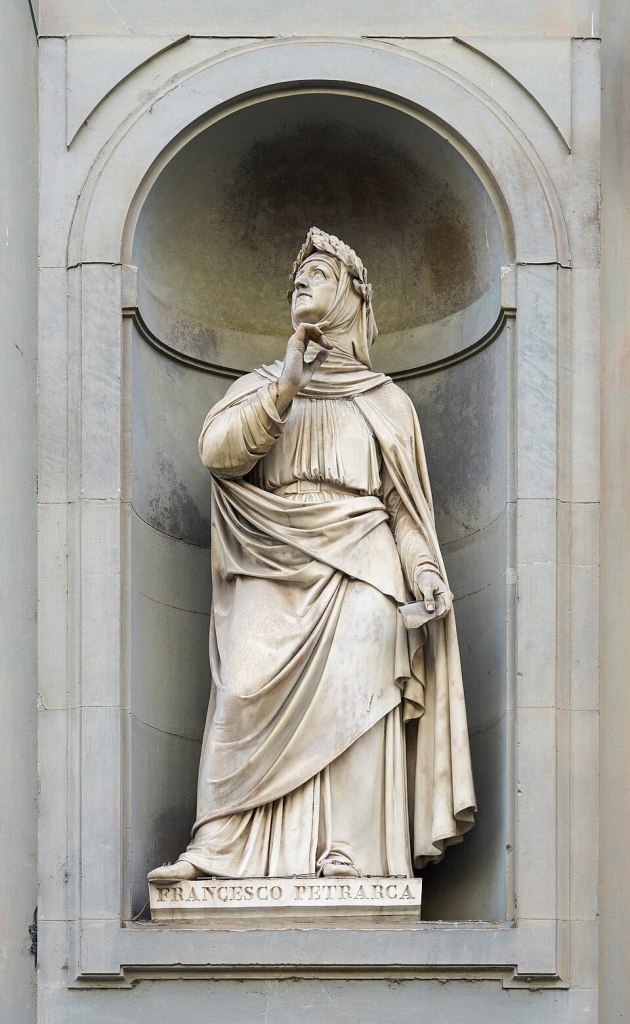
12 ⁄ 13 Download this file Large (664×1080 px) Download View in browser Attribution You need to attribute the author Plain HTML By Wikibusters - Own work, CC BY-SA 4.0, https://commons.wikimedia.org/w/index.php?curid=119935288 By Wikibusters - Own work, CC BY-SA 4.0, https://commons.wikimedia.org/w/index.php?curid=119935288​ Copy More details Statue of Petrarch on the Uffizi Palace, in Florence
Statue of Petrarch on the Uffizi Palace, in Florence

II. Petrarch’s Paradox—Flame and Frost

In Canzoniere 182, Amore is no mere sentiment but a force of cosmic ambivalence—a sacred fire that binds as much as it liberates. The heart, seized by ardente zelo, is at once inspired and constrained by gelata paura; passion and dread are inseparable twins. But what gives the poem its enduring power is the final turn: fa dubbio a l’intelletto—it makes the intellect uncertain.

This uncertainty is not simple indecision; it is the very mechanism by which passion becomes reflection. The lover’s flame, examined, begins to cool—and that cooling assumes distinct forms.

First, love cools by comprehension. The instant it is understood, passion becomes object rather than subject. The flame is enclosed in glass: it still glows, but it no longer burns.

Second, love cools by doubt of itself. Reflection turns inward, questioning its own authenticity: Is this love true, or merely imagined? In this moment, feeling erodes under the acid of self-consciousness.

Third, love cools by doubt of the beloved. The intellect, unable to sustain idealization, wonders whether the object of devotion merits such intensity. The beloved becomes an emblem—not a person of flesh and breath, but a mirror of perfection that no reality can equal.

Fourth, love cools by doubt of the lover’s worthiness. The heart fears it is unworthy of its own longing. Humility becomes paralysis, and passion folds inward upon itself.

These four modes of cooling form the architecture of Petrarch’s inner world—the endless oscillation between fervor and fear, adoration and self-doubt. He writes not to resolve this tension but to dwell within it. Each sonnet is a chamber where flame and frost coexist, where thought is both confessor and executioner of feeling.

III. Dante and the Alchemy of the Intellect

Dante offers a luminous counterpoint. In La Vita Nuova and the Paradiso, intellect and love are not adversaries but allies; the mind becomes the means by which love ascends. L’amor che move il sole e l’altre stelle—the love that moves the sun and the other stars—does not cool but sanctifies. In Dante, the intellect transforms passion into vision—the earthly beloved into divine wisdom. The flame does not die; it becomes light.

Consider the climactic moment of Paradiso XXXIII, where Dante’s vision finally encompasses the divine mystery. His intellect, far from diminishing his love, becomes the very instrument of its perfection. He describes how his desire and will are turned like a wheel by the love that moves the sun and the other stars. Here, understanding completes rather than constrains. The mind does not freeze the heart; it liberates it into comprehension of the Eternal. Beatrice herself, who began as an earthly beloved, becomes through the intellect’s mediation a guide to the Beatific Vision. Her smile, growing ever brighter as they ascend through the spheres of Paradise, finally becomes too radiant for mortal sight—not because love has cooled, but because it has been refined into pure illumination.

Petrarch inherits Dante’s vocabulary but not his cosmos. His world is one step further from heaven, one degree cooler. Where Dante’s intellect completes love by raising it to the eternal, Petrarch’s intellect contains it, interrogates it, doubts it. He lives in the afterglow of revelation—the warmth still present, but the fire withdrawn. As the Paradiso closes, Dante’s vision resolves into the final harmony of understanding and desire—l’amor che move il sole e l’altre stelle—the line that unites intellect and love in a single act of divine motion. Petrarch cannot reach this synthesis. His flame flickers in the middle distance, neither extinguished nor transcendent.

IV. The Modern Inheritance—Reflection and Alienation

From Petrarch descends the long lineage of reflective melancholy that characterizes the modern mind. His was the first great experiment in self-conscious passion—the attempt to inhabit feeling and analyze it at once. After him, love and thought could no longer coexist in innocence; the very act of awareness altered the nature of what was felt.

Montaigne and the Essay of the Self

Montaigne inherits this disposition and turns it into method. In his Essais, feeling is no longer confessed in the lyric key but dissected in the prose of observation. The heart becomes a field for inquiry, and what was once sung becomes tested, weighed, compared. It is telling that Montaigne quotes Petrarch approvingly: “He who can say how he burns with love, has little fire.” (Chi può dir com’ egli arde, è in picciol fuoco, Canzoniere 137). The aphorism might well serve as Montaigne’s motto, for he, too, knows that passion explained is passion already cooling.

His genial skepticism marks the first full tempering of Petrarch’s flame: affection survives, but only as reflection. The essay replaces the sonnet as the vessel of interior life; emotion, distilled into thought, becomes the study of itself. In Montaigne, we see the completion of a transformation begun in Petrarch—the lover becomes the anatomist of his own heart, and the page becomes not a transcript of feeling but a laboratory for its examination. The warmth of passion is not extinguished but transmuted into the steady light of self-knowledge.

Wordsworth and Emotion Recollected

Wordsworth, centuries later, restores emotion to poetry, yet only by containing it within the frame of recollection. His famous dictum—”emotion recollected in tranquillity”—is itself a Petrarchan paradox, though less tormented. He admits that to write of passion is to have already survived it. The poet stands at a contemplative distance from his own fervor, translating immediacy into memory, fire into afterglow. What once consumed now instructs.

In the Prelude (XII), Wordsworth describes the “spots of time” that preserve the intensity of past experience, yet the very act of preservation requires temporal remove. The flame of immediate experience has cooled into the steady glow of retrospective understanding. Wordsworth does not lament this cooling as loss; rather, he discovers in it a new kind of beauty—the beauty of consciousness reflecting upon its own depths.

Eliot and the Fragments of Feeling

By the time we reach T.S. Eliot, the process is complete. In The Waste Land, the flame is nearly ash. His lines of “memory and desire” register not passion itself but its echo—reverberations in a chamber long since emptied of direct experience. Emotion is mediated through quotation, irony, and allusion; the self no longer speaks but curates its fragments.

Consider the hyacinth girl passage, where memory itself fails to sustain emotion: “I could not / Speak, and my eyes failed, I was neither / Living nor dead, and I knew nothing.” The speaker recalls a moment that should have been transcendent—arms full of flowers, hair wet—but the recollection brings only paralysis, a kind of death-in-life. Even memory cannot resurrect the feeling; it can only gesture toward its absence. The modern condition is not the absence of feeling but its overexposure, its reduction to artifact. The poem becomes the museum of emotion, its vitrines polished and sterile. Where Petrarch’s flame still flickered with real heat, and Wordsworth’s embers still glowed warm, Eliot presents us with the cold remains—fragments shored against ruins. Where Petrarch doubts his own worthiness to feel, Eliot doubts feeling itself. The circle has closed; intellect now governs even absence.

The Progressive Abstraction

Between Montaigne’s self-observation, Wordsworth’s recollected emotion, and Eliot’s fractured memory, one can trace the progressive abstraction of the human heart. Each represents a further remove from Petrarch’s immediacy: what began as a dialogue between love and intellect becomes a monologue of intellect about love. The warmth remains, but it is remembered warmth—the lingering heat of stones long after the fire has gone out.

And yet, in each of these figures, the Petrarchan spark persists. Montaigne’s curiosity, Wordsworth’s reverence for inward life, Eliot’s yearning for spiritual coherence—all descend from that first poet who dared to make consciousness itself his subject. The flame may cool, but its light passes on, refracted through centuries of minds still haunted by the desire to feel purely and the impossibility of doing so once thought begins.

V. The Cooling of the Flame—A Personal Reflection

It is impossible, for some temperaments, to escape this inheritance. Emotion arises, and almost immediately the mind begins to interpret it—weighing, contextualizing, seeking its meaning. In doing so, it drains the warmth from the moment even as it preserves it in memory.

To intellectualize emotion is to betray and to honor it at once. The betrayal lies in the loss of immediacy; the honor lies in the act of remembrance. What the heart cannot sustain, the mind attempts to eternalize. The flame cools into an image—but in that cooling, it endures.

Perhaps the intellect is not the enemy of passion but its afterlife. Every poem, every meditation, every recollection is a small resurrection of a feeling that once burned uncontrollably. The fire itself is gone, but its light remains, steady now, capable of illuminating others.

This is the paradox Petrarch teaches: that the lover who cannot stop thinking destroys the ecstasy of love but gains, in its place, the wisdom of love. To understand one’s passion is to lose it; yet without understanding, it would pass unnoticed, leaving no trace but ashes.

VI. The Light of the Ashes

Petrarch’s quatrain ends in uncertainty, but not in despair. His is not the extinguished flame, but the tempered one. Love and fear, hope and doubt, flame and frost—these are not enemies but necessary contraries. The human soul, poised between ardor and intellect, must learn to bear the tension rather than resolve it.

In the end, intellect does not annihilate feeling; it refines it. The cooled flame still gives light. That light—pale but enduring—is the radiance of thought born from passion, the steady glow of what once burned brightly.

We live by such embers. To love is to burn; to remember is to cool; to think is to preserve. Between these three acts, the heart makes its pilgrimage from fire to frost to flame again—each transformation both loss and grace.

Bread, Balance, and the Burden of Freedom in Dostoevsky’s The Grand Inquisitor

A Meditation on the Grand Inquisitor in Light of Metaphor and Meaning

“Man seeks not so much God as the miraculous… For man seeks not so much freedom as someone to bow before.”
The Grand Inquisitor, The Brothers Karamazov

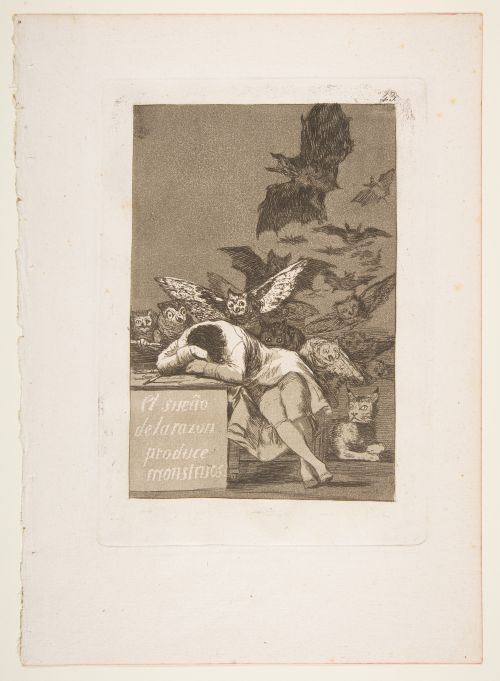
Francisco Goya’s The Sleep of Reason Produces Monsters (1799)—an image of what emerges when the mind abdicates its responsibility: not freedom, but fantasy; not peace, but nightmare. Where reason sleeps, the trinity of miracle, mystery, and authority awakens to devour.

In Dostoevsky’s The Brothers Karamazov, the tale of the Grand Inquisitor remains one of the most unsettling parables in modern literature. Told by Ivan Karamazov to his younger brother Alyosha, the fable imagines Christ returning during the Spanish Inquisition—only to be arrested and silenced by the Church. The Inquisitor, a cardinal of imposing intellect and grave compassion, does not accuse Christ of falsehood, but of cruelty: You gave them freedom, he says, when they needed bread. You gave them mystery, when they needed answers. You gave them love, when they needed order.

There was a time, decades ago, in the earnest conviction of my youth, when I found myself perplexed by the Grand Inquisitor’s logic. I did not admire him, nor excuse his authoritarianism, but I recognized the ache that underpinned his argument. Bread matters. Peace matters. Even then, I sensed the moral gravity of the dilemma he posed: How does one respond to suffering in a world that is often brutal, hungry, and unforgiving?

But I also responded viscerally to something else: the pen of Dostoevsky was not just crafting a fable, but weaponizing a caricature. The Inquisitor was not simply a tragic figure—he was also a polemic against Catholicism, a projection of Dostoevsky’s own religious bigotry. As someone educated within the Catholic tradition, I saw the ugliness beneath the fable—the prejudice tucked behind the parable’s grandeur. The critique was not only of power, but of Rome. The Inquisitor’s mitre bore the unmistakable weight of Jesuit anti-types, cloaked in suspicion and veiled accusation. My disquiet, then, was not only with the Inquisitor’s words, but with the frame within which they were uttered.

And yet, despite its polemical underpinnings, the parable remains one of the most profound meditations on freedom and faith in modern literature. Its imaginative force exceeds its prejudices. The Inquisitor endures not only as a critique, but as a haunting embodiment of the human temptation to trade liberty for comfort.

And that temptation has not faded. The Grand Inquisitor endures because he gives voice to something deeply human, and psychologically real: the desire for security, for certainty, for order amidst chaos. It is a desire that remains active—arguably ascendant—in our own time. One hears the Inquisitor’s voice today in populist strongmen, in the cynical strategist’s smirk, in the media apparatus that soothes while it divides, and in slogans that promise greatness through obedience—Make America Great Again, for instance, the rallying cry of a leader who proclaimed, “I am the only one who can save this nation,” inviting not deliberation, but devotion. The trinity he offers—miracle, mystery, and authority—is the very catechism of modern demagoguery.

This reflection, then, is not a defense of the Inquisitor, but an attempt to understand his appeal, and to reclaim the concepts he distorts. In my recent essay on literalism, metaphor, and balance, I sought to describe the menace of the literalist disposition—a mentality that cannot live with ambiguity, that flees from the poetic, and that finds in surface meaning a shield against the deeper, riskier call of the soul. Here, I apply that lens to the Inquisitor’s three pillars.

Miracle and the Tyranny of the Literal

The Inquisitor offers miracle as literal spectacle: bread conjured from stone, laws suspended, proof offered to silence doubt. He rebukes Christ for refusing to perform such signs in the desert, calling His restraint an act of cruelty rather than spiritual wisdom.

Even as a young reader, I did not mistake the Inquisitor’s miracle for holiness. But I understood that hunger cannot be spiritualized away. In a world where the body is often broken before the spirit can rise, the refusal to give bread seems harsh.

What I have since come to understand is that bread must be shared, not wielded—and that miracles, if they mean anything at all, must point beyond themselves. A miracle that ends conversation is not a miracle but a manipulation.

We have seen modern versions of such miracles: promises made and spectacles staged not to elevate understanding, but to prove power. Consider the border wall—hailed not merely as a policy, but as a singular, salvific act. Its construction, real or exaggerated, was brandished as proof of providence, as the visible sign that the nation could be made great, pure, and safe again. Nor was it the only such “miracle.” Similar wonders were promised: the immediate end of the Russian invasion of Ukraine, the revival of a fading industrial economy, the return of jobs long gone, and the rapid reordering of the global market in our favor. These, too, were presented as guarantees—not to be debated, but to be believed. And like the Inquisitor’s miracles, they have largely yet to be seen.

In my essay on literalism and metaphor, I argued that literalism becomes a menace when it displaces metaphor—when it insists on one meaning, one proof, one visible sign. The Inquisitor’s miracles are precisely that: spectacles that end the need for faith. They are miracles without meaning.

Mystery and the Collapse of Metaphor

The Inquisitor’s use of mystery is a case study in spiritual containment. Mystery becomes the guarded unknown, parceled out by clerical authority to pacify rather than provoke. It is not a sacred unknowing, but a fog of confusion meant to keep the people docile.

But true mystery, like true metaphor, does not confuse—it illuminates by depth. It renders the world porous to truth. It refuses finality not because it is evasive, but because it is more honest than premature closure allows.

I did not reject mystery in youth, nor do I now. But I reject the collapse of mystery into secrecy, the transformation of the ineffable into the inaccessible. Metaphor must breathe. Mystery must invite. When weaponized, they become not sacred, but sinister.

In our current dysfunctional era, mystery is often replaced by conspiracy—a counterfeit that plays the same psychological role, offering significance without wisdom, awe without humility. The literalist disposition, fearing true complexity, gravitates toward these shallow depths. Conspiracy is mystery stripped of humility. It retains the trappings of hidden knowledge but closes the mind rather than opening it. It flatters the believer with secrets while shielding them from ambiguity. It is not reverence for the unknown, but a refuge from the supposed unbearable complexity of reality.

We see this vividly in the ecosystem of conspiracy theories surrounding Trump’s political movement. Whether it is the belief that a global cabal of elites and pedophiles is secretly running the world (QAnon), or that massive voter fraud orchestrated by shadowy networks altered the outcome of the 2020 election, or that figures like Barack Obama, Hillary Clinton, or George Soros are puppet-masters in an international scheme to undermine American sovereignty—each offers an illusion of secret insight in place of the real work of understanding. These narratives are not pursued for their truthfulness but for their emotional certainty. They replace sacred mystery with a kind of gnosis—fierce, insular, and self-reinforcing.

And like the Inquisitor’s mystery, they are not shared to free the soul, but to bind it—to a worldview, to a figure (whether cult, religious, or political leader, a distinction without merit or significance), to a sense of exceptionalist belonging. The effect is not illumination but containment.

Authority and the Displacement of Balance

The Inquisitor’s authority is final, paternal, and brutal in its compassion. It replaces freedom with peace, conscience with obedience. Its appeal lies not only in its force, but in its promise: You no longer have to choose. I will choose for you. And I will feed you.

As I have aged, I have come to see that this vision is not merely imposed—it is desired. Much of the populace is psychologically predisposed to respond favorably to such authority, whether it comes in vestments or slogans. It offers relief from the burden of discernment. It relieves the anxiety of paradox.

This recognition—that the hunger for certainty is as much internal as external—has shaped my own philosophical trajectory.

And that is where the menace lies. This is not a top-down problem alone, but a convergence of design and desire. The Inquisitor gives the people what they already, in some meaningful manner, want: a world made safe through submission. The leader becomes the sole interpreter of truth, the guarantor of safety, the vessel of meaning. Authority becomes a theology in itself.

We have seen this in our time, where devotion to a figure supplants loyalty to principle. When a leader proclaims “I am the only one who can save this nation,” and is met not with unease but with cheers, authority has ceased to be a mediating presence and has become a metaphysical claim. It no longer balances tension; it obliterates it.

In contrast, the authority I defended in my earlier essay was not coercive, but mediating—a balancing presence, a harmonizing voice. It does not dominate or dismiss. It holds the tension without collapsing it. It does not provide peace through closure, but through co-suffering. It listens. It waits.

The Bread and the Burden

So no, I did not approve of the Grand Inquisitor—not in youth, not now. But I acknowledged, and still acknowledge, the ache beneath his argument. It was not cruelty that made him persuasive, but compassion twisted into control—a desire to ease pain by removing the possibility of choice.

What I now see more clearly is that this fable is not merely a theological drama. It is a psychological map. The Grand Inquisitor is the high priest of the literalist disposition—offering miracle that silences, mystery that obscures, authority that absolves.

That disposition is not confined to Dostoevsky’s century. It is at work now—in every movement that prefers spectacle to sign, dogma to dialogue, power to presence. It thrives in political rhetoric, in media narratives, in spiritual systems that replace grace with control.

Dostoevsky does not argue against it. Christ does not rebut it. He answers with a kiss.

A kiss without domination.
A kiss that respects freedom.
A kiss that does not resolve the tension, but chooses to love within it.

That is the burden of freedom: not only to bear it ourselves, but to offer it to others, knowing they may prefer their chains.

To offer bread, but not as bribe.
To teach, but not as demand.
To speak, but not to silence.
To live, still and quietly,
within the balance that resists the Inquisitor’s call.

To refuse the miracle that enslaves,
To offer bread and still preserve the soul,
That is the quiet defiance the world most needs.