This past week found me felled by a viral affliction. Partaking neither in food nor drink, and scarcely participating in sensible cognition, I was confined to bed for more days than I care to recall. Yet, as the affliction ebbed and fragments of normalcy returned, I turned instinctively to the rejuvenating essays of Montaigne and Ralph Waldo Emerson—sources of intellectual nourishment I revisit whenever my spirit requires renewal.
Immersed in their timeless prose, I found myself drifting into a peculiar, lyrical state of mind. Suspended between the lingering exhaustion of illness and the clarity that accompanies recovery, I began reflecting on the seasons of life as illuminated by these great essayists. One restless night, as I contemplated the transformations we undergo from youth to old age, a thought emerged: our lives might be divided into three distinct seasons. The first is the boundless optimism of youth, the second the tempered cynicism of middle age, and the third, a kind of amiable reconciliation in later years.
Initially, I intended to encapsulate each season in a simple couplet, but inspiration soon carried me beyond that modest aim. Each season grew into a stanza, and those stanzas evolved into lyrics for a song. To the surprise of anyone familiar with my usual preferences, I envisioned the piece as a folk-country ballad—an entirely unexpected departure. Adding a touch of mischief, I deliberately included a non-grammatical line to irk a particular friend who finds such lapses intolerable to his Germanic sensibilities. With lyrics in hand, I collaborated with Udio.com to set the lyrics I had written to music. The result is a short composition titled Three Seasons We Live.
This song traces the journey of life through its phases: from the bright-eyed optimism of youth, through the shadows of midlife cynicism, and ultimately into the serenity of autumnal reflection. Its brevity is telling of my still-recovering stamina; I am reserving my energy for Vitruvian Man Unbound, a work that remains in need of substantial emendation, refining, revising, reorganizing—and likely, the painful excision of several dozen eight-line stanzas. I simply got carried away with the iambic pentameter once I got started.
In the meantime, as Monty Python would say, “And now for something completely different.” I invite you to listen to this heartfelt piece, an unexpected blend of introspection and melody, crafted during a week marked by convalescence and quiet inspiration.
The Good God and the Evil God met on the mountaintop. The Good God said, “Good day to you, brother.” The Evil God did not answer. And the Good God said, “You are in bad humor today.” “Yes,” said the Evil God, “for of late I have often been mistaken for you, called by your name, and treated as if I were you, and it ill-pleases me.” And the Good God said, “But I too have been mistaken for you and called by your name.” The Evil God walked away, cursing the stupidity of man.
In my youth, I eschewed the simplistic notion that humanity was innately good or evil. Rather, I opined that humanity was innately confused—a collective of beings adrift in the vast ocean of existence, grappling with the manifold complexities of our condition. In those earlier days, my worldview was perhaps influenced by the idealism of youth, a belief that clarity could be found in the pursuit of knowledge and understanding.
Now, decades later, having traversed the cacophony of life’s myriad experiences and having engaged with countless multitudes of my fellow beings, I have arrived at a more somber conclusion. The confusion I once recognized as a fundamental aspect of our nature has revealed itself as a fertile ground upon which the basest and blackest of motives take root. It is not merely that we are confused, but that this confusion often serves as a pretext for succumbing to base emotions—emotions that, when left unchecked, lead us to actions driven by hatred, fear, and greed. Those driven by a lust for power know how to play upon, manipulate, and inflame these emotions to their advantage.
Over the past thirty or forty years, I have borne witness to the pernicious effects of these emotions, observing how they fester and metastasize within individuals and societies alike. In my professional and personal endeavors, I have encountered those whose actions are fueled by malignant self-interest, an insatiable hunger for power, or a profound disdain for “the other.” These observations have led me to a troubling realization: that the very forces that drive individuals in their personal lives—those same dark and destructive impulses—also drive nations, shaping the course of history in ways both overt and subtle.
It is here that Aleksandr Solzhenitsyn’s reflection in The Gulag Archipelago resonates with particular poignancy: “If only there were evil people somewhere insidiously committing evil deeds, and it were necessary only to separate them from the rest of us and destroy them. But the line dividing good and evil cuts through the heart of every human being.” Solzhenitsyn’s insight challenges the comforting illusion that evil is an external force, embodied in others who can be isolated and eradicated. Instead, he exposes the profound and unsettling truth that this dichotomy of good and evil resides within each of us. It is a truth that underscores the very essence of our internal struggles—a reflection of the chiaroscuro that defines the human soul.
This inner conflict and the murkiness of moral judgment were starkly impressed upon me during my youth by a singular event: the assassination of Archbishop Oscar Romero in El Salvador. Romero, a man of deep faith and profound courage, became the voice for the oppressed, the spokesman for the innocents caught in the crossfire of a brutal civil conflict. His murder, carried out while he was celebrating Mass, was not merely an act of violence; it was an act of profound darkness, a chilling reminder of the depths to which humanity can sink when driven by fear and hatred.
Chiaroscuro – Light and Shadow within Our Souls (The music which I created using Udio.com that inspired this essay, then this video, dedicated to the memory of St. Oscar Romero.)
Romero was assassinated in 1980 less than a month after he wrote the U.S. president as follows: “I am very worried by the news that the government of the United States is studying a form of abetting the arming of El Salvador…. The present junta government and above all the armed forces and security forces unfortunately have not demonstrated their capacity to resolve, in political and structural practice, the grave national problems. In general they have only reverted to repressive violence, producing a total of deaths and injuries much greater than in the recent military regimes whose systematic violation of human rights was denounced by the Inter-American Committee on Human Rights. … As archbishop of the Archdiocese of San Salvador I have an obligation to see that faith and justice reign in my country, (so) I ask you, if you truly want to defend human rights, to prohibit the giving of [U.S.] military aid to the Salvadoran government.” His plea was a direct appeal to the moral conscience of those who held the power to influence the course of the conflict, an appeal which was ignored.
What made this tragedy all the more harrowing was its connection to misguided American foreign policy—we are, after all, the “good guys.” In our fear of communism, a fear that pervaded the geopolitics of the era, we chose to support the bleakest and most ruthless elements within El Salvador with over $5 billion in military and economic aid after the assassination of Romero (equivalent to over $12 billion in 2024). In a population of under five million—of which nearly one million fled the country and nearly 85,000 were killed during the conflict—that level of spending did little for the people but clearly enriched the greed-driven American military-industrial complex and the wealthy in El Salvador. The irony was bitter: in our quest to combat what we perceived as a greater evil, we found ourselves complicit in the oppression and murder of the very innocents we claimed to protect. The financial and military support we provided did not foster peace or justice; instead, it fueled a cycle of violence and repression that devastated a nation, while enriching those who profited from the machinery of war.
Similarly, the events of September 11 unleashed a torrent of rage and hatred—emotions so blinding that they allowed those who led us to manipulate the nation into engaging in war, torture, and atrocities against parties who had no involvement in the tragic events of that day. But beyond the emotions of hate and fear, there lay another, more insidious motivation: greed. The subsequent war in Iraq, which tore asunder communities, families, and an entire nation—even if it did result in the removal of a dictator—was driven not by a quest for justice related to September 11 but by the lure of access to oil, as openly admitted by administration officials and policy documents. The opportunity to test weapons and expand the influence of the military-industrial complex was also a significant factor, furthering the interests of those who profit from conflict, which cost over $1.1 trillion. Our collective hatred blinded us to these underlying motives, distorting our perception of reality and leading us down a path of destruction. The legacy of this blindness is writ large in the deaths of thousands, tens of thousands, and even hundreds of thousands of innocent lives, as well as in the horrors of the torture that occurred at Abu Ghraib prison under our watch and the ongoing moral quagmire of Guantanamo Bay, now in its twenty-second year.
And today, we are witnessing yet another iteration of this tragic cycle in the ongoing conflict between Israel and the Palestinian people. The world watches as Israel, a nation born from the ashes of the Holocaust, wages war upon the open-air concentration camps that confine the Palestinian people—a war supported and funded in large part by the United States. The threats posed to Israel are real and must be addressed, but the hatred and fear that fuel this conflict have become so pervasive, so deeply entrenched, that they have rendered many unable to distinguish between a targeted response to the provocation of October 7, 2023, and a war of extermination against the Palestinian people. As of August 14, 2024, approximately 40,000 Palestinians have been killed and 97,000 wounded, while approximately 1,140 Israelis have been killed and 8,700 wounded. Though it should be evident, it is not, due to the lens of hatred and fear through which so many view the world—most of the dead and wounded are, in every conceivable way, innocents.
Yet, beyond hatred and fear, the influence of greed is once again unmistakable. The military-industrial complex (a fancy way to say the wealthy and greedy) profits handsomely from the $12.5 billion in military aid being funneled to Israel from the U.S. in this current crisis. This unrestrained flow of arms and support, justified by the rhetoric of defense and security, serves to perpetuate the cycle of violence, ensuring that the conflict remains unresolved and that the profits of war continue to flow.
This inability to discern between combatants and innocents, this failure to grasp the complexities and realities of the situation, has led to a bloodthirsty campaign that is as disheartening as it is devastating. The complicity of our own government, and thus ourselves, in this unrestrained violence, in this systematic destruction of lives and communities, is a burden that weighs heavily on the conscience. It is a stark reminder of the perils of allowing fear, hatred, and greed to dictate our actions, of the moral abyss we approach when we fail to temper our instincts with reason and compassion.
These events serve as powerful reminders of the perilous consequences of allowing fear, hatred, and greed to dictate our actions. They underscore the importance of vigilance, of constantly reexamining the moral implications of our choices, both as individuals and as a society. As Carol Matas so eloquently captures in Daniel’s Story: “We are alive. We are human, with good and bad in us. That’s all we know for sure. We can’t create a new species or a new world. That’s been done. Now we have to live within those boundaries. What are our choices? We can despair and curse, and change nothing. We can choose evil like our enemies have done and create a world based on hate. Or we can try to make things better.” Matas’s words are a reminder that, while we may not possess the power to reshape the world or our fundamental nature, we do have the capacity to choose how we respond to the darkness within and around us.
In this context, the chiaroscuro of human existence becomes not merely a passive observation of the interplay between light and shadow, but a call to engage actively in the struggle. It is a reminder that we must strive, both individually and collectively, to make deliberate choices that reflect our higher aspirations rather than our baser instincts. The battle between good and evil may cut through the heart of every human being, but it is within our power to choose which side we will nurture and which we will resist.
To choose despair is to abdicate this responsibility, to allow the shadows to overwhelm the light. To choose hate is to perpetuate the very evils we decry, to create a world more steeped in darkness. But to choose to make things better—to educate ourselves, to act with integrity, to engage with the world around us in a spirit of compassion and understanding—is to affirm the light, to hold fast to the belief that, despite the confusion and the darkness, redemption is always possible.
In the end, it is this choice—this daily, often arduous choice—to strive toward the light that defines our humanity. It is this struggle, this tension between what we are and what we aspire to be, that forms the heart of Chiaroscuro, both as a musical composition and as a reflection on the human condition.
In an earlier posting I explored the origins of the Yarab surname, tracing it back to the Slovak surname Jaráb, which is related to the Czech word for crane, jeřáb. That essay also discussed the Eurasian crane, significant in Slovak culture, and explored the symbolic traits associated with cranes across various cultures. Such traits include wisdom, vigilance, mercy, and grace. Cranes also feature prominently in the mythology and folklore of many civilizations, including the Bashghirds, Arabs, Greeks, Koreans, and Japanese. After investing so much time in the research, I decided to write a poem, or lyrics, and set it to music using Udio.com. The result is above. For a detailed understanding of the various references in the lyrics of the song, please visit the posting at On The Origins of the Yarab Surname.
The content details the historical events surrounding the rise and fall of Eumenes III, also known as Aristonicus, in the kingdom of Pergamum. It explores the political turmoil and power struggles involving Rome, rebellions, and military confrontations. The narrative also touches upon the potential for a compelling play or opera based on these events, with a focus on the character development of key figures. The text is supplemented with an excerpt from a possible libretto, where Aristonicus reflects on his fate. Overall, it provides rich material for dramatic storytelling, combining historical significance with personal introspection.
A snippet of Aristonicus’ story as “opera.”
The Roman Prequel: Tiberius Gracchus and the Bequest of Attalus III
In the late 130s BC, Tiberius Gracchus, serving as a tribune in Rome, emerged as a polarizing figure through his vigorous advocacy for the passage of the lex agraria. This legislation aimed to redistribute land from the affluent elite to the impoverished masses, engendering substantial animosity among the propertied interests. Reflecting the entrenched hostility of these interests, the Roman Senate obstructed the law’s implementation by withholding the requisite funding, thus stymying Gracchus’ reformist agenda.
In 133 BC, the political tensions reached a crescendo when Tiberius Gracchus “accepted” the bequest of Attalus III of Pergamum. Upon his death, Attalus III bequeathed his kingdom, personal treasure, and royal estates to the Roman people. This testament explicitly excluded the city of Pergamum, other Greek cities with their respective territories, and temple lands from the bequest. Gracchus sought to employ this newfound wealth to finance his agrarian reforms, viewing it as an opportunity to alleviate social inequalities. However, his opponents perceived this maneuver as an audacious encroachment upon the Senate’s prerogatives and an exacerbation of the threat to property rights and societal propriety.
Kingdom of Pergamum circa 188 B.C. under the Attalid Dynasty The Kingdom of Pergamum, located in Asia Minor, was ruled by the Hellenistic Attalid Dynasty. This dynasty was founded by Philetairos, who ruled from approximately 282 to 263 B.C. In 188 B.C., the kingdom greatly benefited from the Treaty of Apamea, whereby the Roman Senate granted Pergamum extensive territories formerly held by the defeated Seleucid Empire.
In the wake of these escalating tensions, Gracchus’ adversaries felt justified in resorting to extralegal measures. In a purported “defense” of property and societal order, they orchestrated the murder of Tiberius Gracchus and unceremoniously disposed of his body in the Tiber River. A subsequent purge of his followers from the political sphere ensued, marking a dark chapter in Rome’s history. This brutal response underscored the lengths to which the conservative elite were willing to go to preserve their privileges and stifle reformist efforts.
The Challenge to Attalus III’s Bequest in Pergamum: Rise of Aristonicus
The statue of Aristonicus, known as Eumenes III, King of Pergamum between 133-129 BC, which stands in the city of Pergamum, now known as the city of Bergama, Turkey.
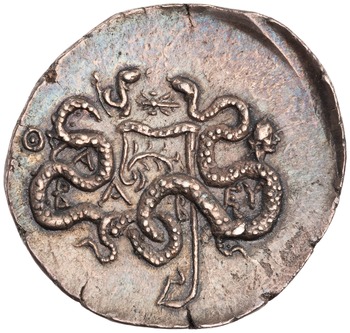
Meanwhile, in Pergamum, Aristonicus, the half-brother of Attalus III and son of Eumenes II and a harpist or lyre-player from Ephesus, declared his intention to seize the throne of Pergamum by right of his lineage, irrespective of the intentions of Attalus III and the Romans. Adopting the regnal name Eumenes III, Aristonicus garnered significant support, amassing both troops and ships, and commenced his campaign to conquer the kingdom of Pergamum. Initially, he achieved notable successes both on land and at sea. He raised the standard of uprising at Leucase, Phocaea joined him, and he conquered Colophon, Notium, Samos, and Myndus. His efforts were further bolstered by his ability to secure sufficient precious metals and strike them into coinage, as evidenced by the cistophorus illustrated below. The coinage series, and its significance, is discussed in an interesting 2021 article written by Lucia Carbone, “A New-ish Cistophorus for the Rebel Aristonicus.”
Reverse of AR cistophorus of Eumenes III of Pergamun featuring two coiled serpents between bow-case and bow. BA EY, a winged thunderbolt above the bow-case and a beardless male head in field right.ANS 1944.100.37579 American Numismatic Society
Roots and Support of Aristonicus’ Uprising
Aristonicus’ uprising was fundamentally rooted in the succession crisis following the death of Attalus III. As an illegitimate son of Eumenes II, Aristonicus claimed the throne of Pergamon under the name Eumenes III, challenging the Roman claim based on Attalus III’s testament. His campaign can be viewed through several lenses:
Dynastic Claim: Aristonicus presented himself as the rightful heir to the Pergamene throne, contesting the Roman-imposed transition. This dynastic legitimacy resonated with certain segments of the population who were loyal to the Attalid lineage.
Social and Economic Grievances: The uprising tapped into widespread discontent among various social groups, including disenfranchised citizens, slaves, and other marginalized populations. Aristonicus’ promise of social reform and liberation found a receptive audience among those dissatisfied with the existing social and economic order.
Anti-Roman Sentiment: There was considerable resentment towards Roman interference and the impending direct control over Pergamon. Aristonicus’ resistance symbolized a broader opposition to the expansionist policies of Rome and its impact on local autonomy.
Support Base
Aristonicus’ supporters came from diverse backgrounds, reflecting the multi-faceted nature of the uprising:
Disenfranchised Individuals and Slaves: A significant portion of Aristonicus’ forces consisted of slaves and lower-class citizens. The promise of freedom and a more equitable society motivated these groups to join the uprising. Aristonicus’ vision of a utopian society, often referred to as “Citizens of the Sun” (Heliopolitae), aimed to create an egalitarian state that resonated with these marginalized groups [Recent scholarship provides ample grounds to re-evaluate the significance and meaning of the Heliopolitae titulature and the role of slaves/disenfranchised individuals. (see Daubner in sources below)].
Local Greek Cities: While some Greek cities in Asia Minor supported Rome, others were sympathetic to Aristonicus, driven by a desire to preserve their autonomy and resist Roman dominance. These cities provided crucial support in terms of resources and manpower.
Mercenaries and Soldiers: Aristonicus also attracted professional soldiers and mercenaries who saw an opportunity in the conflict. Their military expertise was vital in the early successes of the uprising.
Eumenes III (Aristonicus): The Struggle for Support and Survival
Eumenes III (Aristonicus) faced significant challenges in his bid to consolidate power. Despite his initial successes, he failed to win over many citizens of the city of Pergamum itself and was unable to conquer the city. It is plausible that the citizens believed they would be better off freed from royal governance and trusted that the Romans would honor Attalus III’s will by not incorporating them directly under Roman rule. Furthermore, Eumenes III did not gain the support of the kings of neighboring Hellenistic kingdoms, all of whom marched against him at Rome’s behest. These neighboring monarchs, wary of Aristonicus’ revolutionary ideals and eager to maintain favorable relations with Rome, aligned themselves against him.
Despite this formidable opposition, Rome’s local allies initially struggled to subdue Eumenes III. His forces proved resilient and capable, inflicting notable casualties on their adversaries. A significant moment in the conflict was the death of Ariarathes V of Cappadocia, who perished in battle against Aristonicus’ forces, underscoring the intensity and ferocity of the resistance. The support Aristonicus garnered from disenfranchised groups, including slaves and lower-class citizens, played a crucial role in sustaining his campaign against the combined might of Rome and its allies.
By 131 BC, the Romans were compelled to dispatch an army under the command of the consul Publius Licinius Crassus Mucianus to confront the challenge posed by Eumenes III and secure the legacy bequeathed to them by Attalus III. However, Crassus Mucianus was captured by Eumenes’ forces and, after striking one of his captors, was killed. His decapitated head was sent to Eumenes III, marking a grim turn in the conflict. This event underscored the determination and ferocity of Aristonicus’ resistance, significantly alarming Rome and its allies.
The Beginning of the End for Aristonicus
Although the defeat of a Roman army could have signaled the beginning of success for Eumenes III, it was, in fact, the onset of his decline. This turn of fortune came not at the hands of the Romans, but from Ephesus. Unsettled by the new king’s numerous naval victories and conquests, Ephesus armed a fleet and engaged Eumenes III in battle off the coast of Cyme in Aeolis. The outcome was decisive, forcing Eumenes to abandon the coast and withdraw into the interior.
This defeat also marked a transformation in the character of Eumenes III’s reign. In an effort to broaden his appeal and replenish his forces, he called upon peasants from royal domains, slaves, and others whom historians characterize as underprivileged. To the slaves, he promised freedom; to the others, economic relief. His appeal was successful, and multitudes responded to his call. He named his new followers Heliopolitae [Ἡλιοπολῖται], Citizens of the Sun.[1] This utopian vision of a society based on equality and justice resonated deeply with those disenfranchised by the existing order.
Ideological Influences: Blossius of Cumae and the Heliopolitae
One must wonder if Eumenes was motivated in the “social program” of his recruitment campaign (e.g., emancipation and economic relief) by his reported association at this point with the Stoic philosopher Blossius of Cumae, a devoted ally of Tiberius Gracchus. Blossius had fled Rome after Tiberius’ murder and attached himself to Eumenes. Some historians perceive Blossius’ ideological influence in the Heliopolitae movement. Blossius, having been a proponent of the Gracchan reforms, likely brought with him a philosophical foundation that emphasized social justice and the alleviation of inequality. His presence in Eumenes III’s court suggests a continuity of the radical ideas that had stirred Rome, now transplanted to Asia Minor and adapted to the local context.
The Final Defeat and Capture of Eumenes III
In the wake of Crassus’ defeat in 130 B.C., the Roman Senate dispatched the consul Marcus Perperna to subdue Eumenes III and secure the Kingdom of Pergamum for Rome. Perperna promptly arrived, assembled his troops, and marched into the interior, where he decisively defeated Eumenes. Aristonicus had expanded his campaign inland, focusing on regions such as Lydia and Mysia, including the strategic city of Kyzikos. His efforts in these areas were marked by a combination of military engagements and political maneuvering to gain the support of local populations. Despite these efforts, Eumenes was ultimately outmatched by the superior Roman forces. Following his defeat, he fled to the city of Stratonicea, where the Romans besieged him. The siege was marked by a protracted struggle, as the Romans systematically cut off supplies, starving the city and its defenders into submission. Ultimately, Eumenes was captured and sent to Rome in chains. In 129 B.C., the Senate decreed his execution by strangulation, thus extinguishing his challenge to Roman authority.
Consolidation of Roman Rule and the Fate of the Heliopolitae
Following the capture of Eumenes III, the Romans proceeded to organize the new province of Asia, despite ongoing resistance from the remnants of the Heliopolitae. These remnants, inspired by the egalitarian ideals of Aristonicus, continued to resist Roman domination. However, their defiance was brutally quashed by the Romans, who resorted to poisoning the water supplies of their impregnable strongholds—a tactic even they considered disgraceful. By 129 B.C., or 127 B.C. at the latest, the Romans had likely secured their Attalid inheritance, fully integrating the territory into the Roman Republic.
Is there a libretto or play in the story above?
This exposition is recited with confidence that it provides rich source material for a compelling play or opera. Indeed, I have begun work on such a project, sketching the broad outlines of a libretto—acts and scenes—and have already written substantial portions. Recognizing my weaknesses in character development, I am focusing on refining this aspect. However, I am pleased with one section I have written. After Aristonicus has been captured and is in chains, he contemplates his situation. Below is a scene I have written, set to music so I have a sense of the possibilities:
Audio Music file of Aristonicus in Chains (Lyrics by D.S. Yarab, Music created using Udio.com)
Aristonicus in Chains
Setting: A dark Roman dungeon. Aristonicus, bound in chains, reflects on his fate and the enduring spirit of his cause.
Aristonicus (Recitative):
Oh fate, thou art a cruel mistress, To wrest my dreams and cast them low. Yet here I stand, though bound in chains, My spirit soars, untouched by woe.
Aristonicus (Aria):
In chains, my spirit stands free, No Roman yoke shall master me. For in my heart, a kingdom lives, A beacon bright, the Sun still gives.
Oh, Citizens of the Sun, Your hope was mine, our battle won, Not in the fields where we did fall, But in the hearts that heeded our call.
From Pergamum’s hills to the wide sea, Our dream of freedom shall always be. Though walls of stone around me rise, The Sun shall never set on skies.
Oh, Perpernas, behold my fate, A king unbowed by Roman hate. For even in this darkest hour, My will remains, my soul has power.
(Bridge):
To the poor and enslaved, my voice shall reach, In every heart, our cause I’ll teach. No chains can hold what is divine, Our struggle, our dream, forever shine.
(Aria da capo):
In chains, my spirit stands free, No Roman yoke shall master me. For in my heart, a kingdom lives, A beacon bright, the Sun still gives.
Oh, Citizens of the Sun, Your hope was mine, our battle won, Not in the fields where we did fall, But in the hearts that heeded our call.
(Recitative):
So take me now, to Rome’s great halls, But know this truth, as empire falls: A dream once born, can never die, In chains, my spirit soars the sky.
SOURCES:
Africa, T. W. (1961). Aristonicus, Blossius, and the City of the Sun. International Review of Social History, 6(1), 110-124.
Daubner, F. (2006). Bellum Asiaticum: Der Krieg der Römer gegen Aristonikos von Pergamon und die Einrichtung der Provinz Asia (2nd ed., Quellen und Forschungen zur Antiken Welt 41). München: Herbert Utz Verlag. [*Daubner’s work is the current definitive study on the Aristonicus uprising and the establishment of the Roman province of Asia. It challenges many of the outlines of the traditional scholarship over the past century (including much presented in my post above) and concludes that there is extraordinarily little evidence to suggest that he was the utopian social reformer that earlier scholars feared or lionized in their writings.In a sense, his scholarship is sober prose based on all the current and continuously emerging evidence whereas what came before (and what I write above) is akin to romantic poetry based on the then sparse antiquarian fragments. Yet, some scholars still adhere to the older interpretations of Aristonicus as a social reformer. See the work by Mesihović , below, as an example.]
Hochard, P.O. (2021). Quand Aristonicos s’écrit avec un E. Bulletin De La Société Française De Numismatique, 76(02), 47–54.
Magie, D. (1950). Roman Rule in Asia Minor (Vol. 1). Princeton University Press, 147-158.
Mesihović, S. (2017). Aristonik i država Sunca (Drugi dio: Aristonicus Solis Reform). Radovi Filozofskog fakulteta u Sarajevu, Knjiga XX, 2017.[Mesihović, without taking note of – let alone attempting to address – Daubner’s scholarship, reiterates the argument that Aristonicus’s movement was fundamentally reform-oriented and revolutionary. He iterates that the movement aimed to challenge the existing social and political structures by advocating for social and democratic reforms, thereby attracting support from the lower classes and slaves. He stresses that Aristonicus’ movement was not merely a struggle for control of the Attalid kingdom but had a significant ideological dimension, seeking to establish an egalitarian and communal society, which posed a substantial threat to the established order of both local elites and the Roman authorities. The views encompassed in this work serve as the basis for an operatic libretto, as it is poetic, but may have been superseded as scholarship.]
Thonemann, P. (2013). Attalid Asia Minor: Money, International Relations and the State. Cambridge University Press. [Of particular note is how Thonemann’s first chapter characterizes the Attalid state as an innovative and unique monarchy that emerged in the second century BC. The Attalids transformed their kingdom from a small city-state into a major territorial power, characterized by a non-charismatic and decentralized style of rule. They implemented a federative model, portraying their state as a coalition of free cities rather than a centralized monarchy, and emphasized civic participation and local governance. This approach was reflected in their economic policies, such as the introduction of the cistophoric coinage, which supported the kingdom’s administrative and fiscal autonomy. The expansion of the state was largely a result of the Treaty of Apameia in 188 BC, which redistributed Seleukid territories to the Attalids, significantly enlarging their realm and elevating their political status.]
The concept of the Heliopolitae, or “Citizens of the Sun,” is a central theme in understanding Aristonicus’ revolt. This term embodies the utopian and revolutionary ideals that Aristonicus promoted to garner support from various disenfranchised groups.
Symbolism and Ideals: The name “Heliopolitae” is symbolic of Aristonicus’ vision for a new society based on equality and justice. It represents a community united under the metaphor of the Sun, which signifies enlightenment and purity. This ideological framework was used to attract slaves, the poor, and other marginalized groups by promising them freedom and a better social order.
Historical Accounts: Strabo and Diodorus provide key historical accounts that describe how Aristonicus retreated into the interior regions of Lydia after a naval defeat and rallied the oppressed classes, including slaves, around his cause. Strabo mentions that Aristonicus promised freedom to these groups, who then became known as the Heliopolitae.
Scholarly Debate: The article highlights the debate among scholars regarding the nature and significance of the Heliopolitae. Some view it as evidence of a broader social revolution, akin to other slave revolts in antiquity, while others argue it was a strategic move by Aristonicus to consolidate his power. The text suggests that while there is evidence to support both views, the primary aim was likely to use ideological rhetoric to strengthen Aristonicus’ claim and unify his diverse followers.
Religious and Utopian Context: The term “Heliopolitae” also carries religious connotations, linking the movement to solar worship and the Hellenistic tradition of divine kingship. This religious aspect provided additional legitimacy to Aristonicus’ rule and helped create a cohesive identity among his supporters. The use of the term is compared to other utopian experiments, but the article emphasizes that Aristonicus’ movement was distinct in its context and execution.
In the throes of insomnia, an exceptionally long time ago, I found myself roused at the early hour of three in the morning. Seized by a fervent and despairing impulse, I wrote with unrelenting urgency about the anguish of unrequited love and being single. The despair, as is its wont, eventually dissipated, leaving in its wake a legacy of lines imbued with melancholy. These lines, born of nocturnal desolation, now seem well-suited to be transformed into music, evoking the same poignant emotions that inspired their creation. The original lines read as follows after I cleaned it up slightly:
“If, as the saints of Assisi, Francis and his companion Giles aver, It is better to love than to be loved, Then I am a most fortunate man indeed. If this be a jest, verily, I am well mocked. My heart, encumbered with unanswered love, Holds those affections deep within, Some as faintly glowing embers, Others as white-hot coals.
Contrary to the lyrics of poetry, The artifice of novels, and the drama of screen, There is no soaring inspiration or felicity In unrequited love, Only a sore appreciation For knowing that I possess humanity, The capacity to give of myself Without the expectation of reciprocation.
In truth, perpetual aloneness, To be unloved, Is a tragedy from an individual perspective, Yet a trivial banality from a societal view, As uncountable multitudes have lived and died alone, Without affectionate human touch, Long before me, And will long after me.”
“A Tale Oft Told” – Lyric by Donald S. Yarab
Lyrics to “A Tale Oft Told” by Donald S. Yarab
If, as the saints of Assisi proclaim,
Francis and Giles with hearts both the same,
It’s better far to love than to be loved,
Then I am blessed, by heaven's grace, beloved.

If this be jest, then jest, indeed, is true,
My heart has felt no lover’s steadfast view.
Unanswered love has planted seeds of fire,
Some as faint embers, some as hot desire.

Not like the verse in poet’s crafted lore,
Nor novels, screens, with tales that promise more,
In unrequited love, the truth is clear,
A sore yet noble proof that I am here.

Though solitude may mark a tragic plight,
To one, it’s pain, to many, common sight:
A tale oft told, in ancient times and now,
For countless souls alone did live somehow.

If love's a gift that’s given without claim,
Then I am rich in heart, though poor in name.
For in the silence of unspoken dreams,
My soul finds strength in love's relentless beams.

The night, it whispers secrets to the stars,
Of solitary hearts and hidden scars.
Though love unreturned brings shadows near,
It carves within a path to persevere.

In dreams, I wander through the fields of time,
Where love’s soft echoes linger, so sublime.
Each heartbeat sings a song of love unshown,
Yet in the pain, a deeper truth is known.

For every tear that falls from longing's eye,
A testament to love that cannot die.
Though unrequited, love remains so pure,
A testament to what the heart endures.

And so, I cherish every silent cry,
Each whispered wish beneath the moonlit sky.
For in this love, though met with quiet ache,
I find a strength that time cannot unmake.






 Northcoast Antiquarian