“Ponder, O Morpheus, the Night Sky” arose from a meditation on the nature of dreams, consciousness, and the silent mysteries that lie beyond both. Rather than seeking to instruct, this poetic work offers a dialogue — between mortal longing and divine wonder, between question and silence. In addressing Morpheus, the god of dreams, the poem invites not sleep, but contemplation: a shared pondering of the night sky, where the known fades into the unknown, and where even gods may pause in awe before the infinite. It is my hope that this work may serve as a quiet companion for those who have found themselves, at least once, standing beneath the stars, asking questions for which no easy answers are given — and finding, in the asking, a kind of sacred beginning.
Sleep by Jean Bernard Restout (c. 1771). Oil on canvas, 129.5 x 96.5 cm (38 x 51 in). Cleveland Museum of Art. Depicting Morpheus
Ponder, O Morpheus, the Night Sky
“Beyond dreams lies a silence where even gods wonder.”
Prelude: The Summoning of Morpheus
Morpheus, Keeper of the Silent Looms, hear now the summons not of those who seek forgetfulness, nor of those who plead for soft illusions to cradle their weary minds— but of one who, standing alone beneath the immeasurable firmament, dares to bid thee ponder.
Ponder, thou Weaver of Shadows, the night sky: the endless, ink-deep vault where Orion’s belt cinches the waist of darkness, where scattered fires—blue, white, and ancient red— whisper of secrets too vast for mortal tongues.
Not for dreams of idle comfort do I call thee forth, but for contemplation; to set aside for a moment thy ceaseless crafting of mortal visions and lift thine ancient gaze upward, where the silent percussion of dying stars beats out the hidden music of creation.
For if thou, master of phantoms and bringer of luminous memories, shouldst pause to wonder at that boundless mystery, then perhaps the soul of man, frail and flickering though it be, might dare likewise to ask:
Who dreams the dreamers, O Morpheus? Whence come the visions thou bestowest? And what lies beyond the last dream, beyond the last star, beyond the last breath of sleep?
Thus the greater query is born, trembling on the tongue of the sleepless, yearning toward the silence that gathers all speech.
The Greater Query: A Dialogue with Morpheus
Soul: If thou, O Shaper of Phantoms, canst be stilled by wonder, then hear the questions borne upon my waking breath, fragile as they are, yet earnest as the stars are ancient:
Who first whispered the dream into being, before ever thou didst fashion it? From what unseen wellspring do the rivers of vision flow? Are the dreams of men but fractured echoes of a deeper song, or do they weave even now the hidden fabric of worlds yet unborn?
Morpheus (in thought): Dreams are the trembling of the soul against the veil of the infinite. They are not born of my will alone, Seeker, but arise from the deep soil where memory, longing, and the first light entwine. I but give them form; I do not summon them from the abyss. Some dreams, frail though they seem, stitch the very edges of what is to be. Mortals, in dreaming, unknowingly shape the unborn dawn.
Soul: Is it given to us—dust briefly animated, clay granted momentary breath— to pierce that veil? Or must we first unmake ourselves, falling through forgetting, to be remembered by the nameless light?
Morpheus: Beyond all dreams there is a silence older than stars and deeper than death. A silence not of absence, but of fullness, where neither waking nor sleeping holds dominion, and the soul, naked and unafraid, beholds itself as it was before all weaving began.
There the true Dreamer dwells— not I, but He whom none can name, the source of all dreams, the end of all seeking, the unspoken, the unseen.
Soul: And if we seek it, do we not risk all—memory, longing, even self itself?
Morpheus: It is the risk of being lost to be found, the surrender of knowledge to come to knowing. To seek the Silent One is to set sail upon a sea without stars, to abandon the safe shores of image and name, to become at last what thou hast always been: a breath upon the waters of infinity.
Ponder well, O Seeker, for in the seeking, thou thyself becomest the dream, the dreamer, and the silence beyond.
The Blessing of Morpheus: The Sending Forth
Morpheus: Go forth, Child of Earth and Stars, go forth lightly, as one who walks upon waters not yet created. Carry no burden save the yearning that kindled thy question; bind no certainty to thy brow, nor shelter fear within thy breast.
Let dreams fall from thee like withered leaves; let even the constellations become but distant embers, for thou seekest now what neither dream nor waking thought can compass.
Take not with thee the names men have carved into the bones of the world, for names shatter against the face of the nameless. Take not the proud trophies of reason, nor the soft nets of hope, for these will tear upon the thorns of the infinite.
Instead, take this only: a heart made naked in wonder, a mind made silent in awe, and feet made light as wind upon waters unseen.
And know this, O Soul: thou art neither lost nor found in this seeking, for to seek the Silent One is to be gathered even now into His dreaming.
Thus do I, Morpheus, who weaves the veils of sleep, send thee forth beyond all veils, beyond all sleep, beyond the last trembling breath of mortal wonder. Go, and become the question thou hast dared to ask.
Epilogue: The Pondering of Morpheus
And Morpheus stood long in the hush of the night, his ancient hands unclasped, his brow unburdened of dreams.
He lifted his gaze once more to the immeasurable vault, where scattered fires—blue, white, and red— burned against the black breast of infinity.
He pondered— not as god to mortal, nor as master to servant, but as wonder to wonder, breathless before a mystery he too could not wholly grasp.
In the stillness beyond weaving and shaping, he glimpsed, as in the faintest shimmer of distant nebulae, a vastness where even gods must bow their heads, where even dreams dissolve like mist before the morning sun.
And in that silence, older than all his songs, Morpheus smiled— not because he understood, but because he wondered still.
He felt a pang—brief and piercing— a mortal ache for the fleeting fierceness of human wonder, so bright and brief.
And so he pondered, and the night pondered with him, until speech was stilled, and he was lost—and found—within the endless deep.
A Meditation on the Grand Inquisitor in Light of Metaphor and Meaning
“Man seeks not so much God as the miraculous… For man seeks not so much freedom as someone to bow before.” — The Grand Inquisitor, The Brothers Karamazov
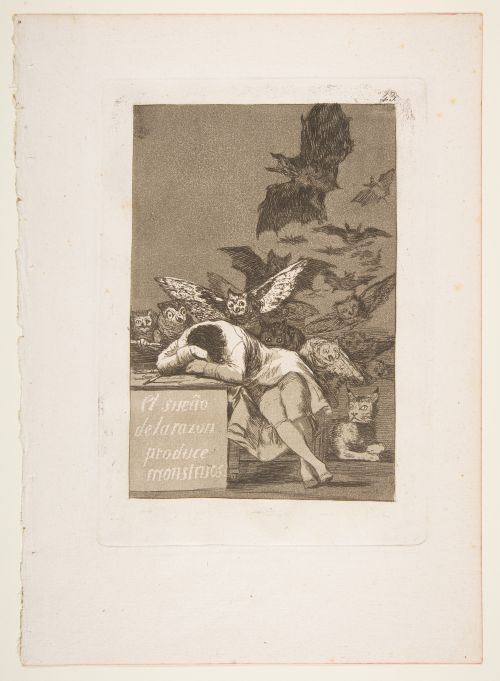
Francisco Goya’s The Sleep of Reason Produces Monsters (1799)—an image of what emerges when the mind abdicates its responsibility: not freedom, but fantasy; not peace, but nightmare. Where reason sleeps, the trinity of miracle, mystery, and authority awakens to devour.
In Dostoevsky’s The Brothers Karamazov, the tale of the Grand Inquisitor remains one of the most unsettling parables in modern literature. Told by Ivan Karamazov to his younger brother Alyosha, the fable imagines Christ returning during the Spanish Inquisition—only to be arrested and silenced by the Church. The Inquisitor, a cardinal of imposing intellect and grave compassion, does not accuse Christ of falsehood, but of cruelty: You gave them freedom, he says, when they needed bread. You gave them mystery, when they needed answers. You gave them love, when they needed order.
There was a time, decades ago, in the earnest conviction of my youth, when I found myself perplexed by the Grand Inquisitor’s logic. I did not admire him, nor excuse his authoritarianism, but I recognized the ache that underpinned his argument. Bread matters. Peace matters. Even then, I sensed the moral gravity of the dilemma he posed: How does one respond to suffering in a world that is often brutal, hungry, and unforgiving?
But I also responded viscerally to something else: the pen of Dostoevsky was not just crafting a fable, but weaponizing a caricature. The Inquisitor was not simply a tragic figure—he was also a polemic against Catholicism, a projection of Dostoevsky’s own religious bigotry. As someone educated within the Catholic tradition, I saw the ugliness beneath the fable—the prejudice tucked behind the parable’s grandeur. The critique was not only of power, but of Rome. The Inquisitor’s mitre bore the unmistakable weight of Jesuit anti-types, cloaked in suspicion and veiled accusation. My disquiet, then, was not only with the Inquisitor’s words, but with the frame within which they were uttered.
And yet, despite its polemical underpinnings, the parable remains one of the most profound meditations on freedom and faith in modern literature. Its imaginative force exceeds its prejudices. The Inquisitor endures not only as a critique, but as a haunting embodiment of the human temptation to trade liberty for comfort.
And that temptation has not faded. The Grand Inquisitor endures because he gives voice to something deeply human, and psychologically real: the desire for security, for certainty, for order amidst chaos. It is a desire that remains active—arguably ascendant—in our own time. One hears the Inquisitor’s voice today in populist strongmen, in the cynical strategist’s smirk, in the media apparatus that soothes while it divides, and in slogans that promise greatness through obedience—Make America Great Again, for instance, the rallying cry of a leader who proclaimed, “I am the only one who can save this nation,” inviting not deliberation, but devotion. The trinity he offers—miracle, mystery, and authority—is the very catechism of modern demagoguery.
This reflection, then, is not a defense of the Inquisitor, but an attempt to understand his appeal, and to reclaim the concepts he distorts. In my recent essay on literalism, metaphor, and balance, I sought to describe the menace of the literalist disposition—a mentality that cannot live with ambiguity, that flees from the poetic, and that finds in surface meaning a shield against the deeper, riskier call of the soul. Here, I apply that lens to the Inquisitor’s three pillars.
Miracle and the Tyranny of the Literal
The Inquisitor offers miracle as literal spectacle: bread conjured from stone, laws suspended, proof offered to silence doubt. He rebukes Christ for refusing to perform such signs in the desert, calling His restraint an act of cruelty rather than spiritual wisdom.
Even as a young reader, I did not mistake the Inquisitor’s miracle for holiness. But I understood that hunger cannot be spiritualized away. In a world where the body is often broken before the spirit can rise, the refusal to give bread seems harsh.
What I have since come to understand is that bread must be shared, not wielded—and that miracles, if they mean anything at all, must point beyond themselves. A miracle that ends conversation is not a miracle but a manipulation.
We have seen modern versions of such miracles: promises made and spectacles staged not to elevate understanding, but to prove power. Consider the border wall—hailed not merely as a policy, but as a singular, salvific act. Its construction, real or exaggerated, was brandished as proof of providence, as the visible sign that the nation could be made great, pure, and safe again. Nor was it the only such “miracle.” Similar wonders were promised: the immediate end of the Russian invasion of Ukraine, the revival of a fading industrial economy, the return of jobs long gone, and the rapid reordering of the global market in our favor. These, too, were presented as guarantees—not to be debated, but to be believed. And like the Inquisitor’s miracles, they have largely yet to be seen.
In my essay on literalism and metaphor, I argued that literalism becomes a menace when it displaces metaphor—when it insists on one meaning, one proof, one visible sign. The Inquisitor’s miracles are precisely that: spectacles that end the need for faith. They are miracles without meaning.
Mystery and the Collapse of Metaphor
The Inquisitor’s use of mystery is a case study in spiritual containment. Mystery becomes the guarded unknown, parceled out by clerical authority to pacify rather than provoke. It is not a sacred unknowing, but a fog of confusion meant to keep the people docile.
But true mystery, like true metaphor, does not confuse—it illuminates by depth. It renders the world porous to truth. It refuses finality not because it is evasive, but because it is more honest than premature closure allows.
I did not reject mystery in youth, nor do I now. But I reject the collapse of mystery into secrecy, the transformation of the ineffable into the inaccessible. Metaphor must breathe. Mystery must invite. When weaponized, they become not sacred, but sinister.
In our current dysfunctional era, mystery is often replaced by conspiracy—a counterfeit that plays the same psychological role, offering significance without wisdom, awe without humility. The literalist disposition, fearing true complexity, gravitates toward these shallow depths. Conspiracy is mystery stripped of humility. It retains the trappings of hidden knowledge but closes the mind rather than opening it. It flatters the believer with secrets while shielding them from ambiguity. It is not reverence for the unknown, but a refuge from the supposed unbearable complexity of reality.
We see this vividly in the ecosystem of conspiracy theories surrounding Trump’s political movement. Whether it is the belief that a global cabal of elites and pedophiles is secretly running the world (QAnon), or that massive voter fraud orchestrated by shadowy networks altered the outcome of the 2020 election, or that figures like Barack Obama, Hillary Clinton, or George Soros are puppet-masters in an international scheme to undermine American sovereignty—each offers an illusion of secret insight in place of the real work of understanding. These narratives are not pursued for their truthfulness but for their emotional certainty. They replace sacred mystery with a kind of gnosis—fierce, insular, and self-reinforcing.
And like the Inquisitor’s mystery, they are not shared to free the soul, but to bind it—to a worldview, to a figure (whether cult, religious, or political leader, a distinction without merit or significance), to a sense of exceptionalist belonging. The effect is not illumination but containment.
Authority and the Displacement of Balance
The Inquisitor’s authority is final, paternal, and brutal in its compassion. It replaces freedom with peace, conscience with obedience. Its appeal lies not only in its force, but in its promise: You no longer have to choose. I will choose for you. And I will feed you.
As I have aged, I have come to see that this vision is not merely imposed—it is desired. Much of the populace is psychologically predisposed to respond favorably to such authority, whether it comes in vestments or slogans. It offers relief from the burden of discernment. It relieves the anxiety of paradox.
This recognition—that the hunger for certainty is as much internal as external—has shaped my own philosophical trajectory.
And that is where the menace lies. This is not a top-down problem alone, but a convergence of design and desire. The Inquisitor gives the people what they already, in some meaningful manner, want: a world made safe through submission. The leader becomes the sole interpreter of truth, the guarantor of safety, the vessel of meaning. Authority becomes a theology in itself.
We have seen this in our time, where devotion to a figure supplants loyalty to principle. When a leader proclaims “I am the only one who can save this nation,” and is met not with unease but with cheers, authority has ceased to be a mediating presence and has become a metaphysical claim. It no longer balances tension; it obliterates it.
In contrast, the authority I defended in my earlier essay was not coercive, but mediating—a balancing presence, a harmonizing voice. It does not dominate or dismiss. It holds the tension without collapsing it. It does not provide peace through closure, but through co-suffering. It listens. It waits.
The Bread and the Burden
So no, I did not approve of the Grand Inquisitor—not in youth, not now. But I acknowledged, and still acknowledge, the ache beneath his argument. It was not cruelty that made him persuasive, but compassion twisted into control—a desire to ease pain by removing the possibility of choice.
What I now see more clearly is that this fable is not merely a theological drama. It is a psychological map. The Grand Inquisitor is the high priest of the literalist disposition—offering miracle that silences, mystery that obscures, authority that absolves.
That disposition is not confined to Dostoevsky’s century. It is at work now—in every movement that prefers spectacle to sign, dogma to dialogue, power to presence. It thrives in political rhetoric, in media narratives, in spiritual systems that replace grace with control.
Dostoevsky does not argue against it. Christ does not rebut it. He answers with a kiss.
A kiss without domination. A kiss that respects freedom. A kiss that does not resolve the tension, but chooses to love within it.
That is the burden of freedom: not only to bear it ourselves, but to offer it to others, knowing they may prefer their chains.
To offer bread, but not as bribe. To teach, but not as demand. To speak, but not to silence. To live, still and quietly, within the balance that resists the Inquisitor’s call.
To refuse the miracle that enslaves, To offer bread and still preserve the soul, That is the quiet defiance the world most needs.




 Northcoast Antiquarian