
Method and Meaning in an Unteachable World

Prefatory Note

The following are two companion reflections—On Truth and Empirical Fact and No Arc, No Lessons—presented together under the shared heading Method and Meaning in an Unteachable World. Though each may stand alone, they are best read in conversation with one another. Both essays resist the comforting notion that history, literature, or art functions as teacher or guide, and instead consider interpretation as an act of encounter—provisional, situated, and shaped as much by silence as by statement.

The first essay explores the distinction between fact and truth, exploring how memory, intention, and metaphor complicate the act of knowing. The second rejects the idea that history bends toward moral instruction or cumulative wisdom, and instead proposes a posture of reflective attention to the recurring patterns and failures of the human condition.

Versions of both essays with full citations and scholarly apparatus are in preparation for future publication. What follows here is intended for open reading and contemplation.


On Truth and Empirical Fact

“You cannot step into the same river twice.”
—Heraclitus (Fragment 91, DK B91)

In the course of recent reflection, a distinction long known, but not always properly honored, must be drawn again: that between truth and empirical fact. Though often conflated in casual discourse, these are not synonymous—nor should they be.

An empirical fact is a datum: observed, measured, verified. It is the yield of experiment, the result of record, the artifact of sensory perception. That water boils at one hundred degrees Celsius at sea level is a fact. That a coin weighs 3.2 grams and bears a cross upon its reverse is a fact. That a battle was fought in the year 1066 may be supported by a host of facts: chronicles, bones, weaponry, et cetera. Such facts, when properly corroborated, are not unimportant. But they are not truth.

Truth, if it exists at all, is something larger, more elusive, more alive—not constructed by us, but encountered when consciousness prepares itself to receive what appears. It does not come when summoned, but when the conditions for its appearing have been made ready: doubt, humility, attention. It is apprehended in this prepared openness, grasped in the space between what is seen and what is understood.

Philosophers have long attended to this disjunction. Plato distinguished between the world of appearances and the world of eternal Forms, the former unstable, the latter enduring. Augustine found truth not in the fluctuating realm of sensory report, but in the divine Logos. Nietzsche, ever unsettling, dismissed truth as a “mobile army of metaphors”—useful, yes, but neither objective nor stable. Heidegger, resisting the reduction of truth to correctness, instead spoke of aletheia—not truth as correspondence, but as unconcealment, as that which emerges into view. And Gadamer—whose influence upon this approach is not accidental—taught that truth emerges in understanding itself, not as a proposition but as a happening, shaped by dialogue and historical consciousness.

Facts may be marshaled. Truth, by contrast, is survived.

Even intention, often treated as the surest witness to truth, must be interrogated. The poet’s intent, the author’s purpose, the painter’s design—these are not fixed coordinates but shifting recollections. Memory does not preserve; it reconstructs. And with each return to the well of what was once meant, the water tastes slightly different. Heraclitus observed that one cannot step into the same river twice—not only because the river flows, but because the self who steps in is no longer the same. So it is with intention. If asked now what was intended in a particular line or gesture, one may offer a reply—but it is a construction, shaped by who speaks now, not by who once acted. Intention, like truth, is not preserved in stillness—it is shaped in motion. It, too, is not possessed, but pursued.

In the poem At the Crossing, the aim was not to name truth—such a thing cannot be done—but to describe the space it haunts. The poem speaks of words that fracture, colors that deceive, touches that both reveal and withdraw. It ends not in assertion, but in a trembling, a silence where meaning nearly forms but does not solidify. A reader once dismissed it: “Life is too brief,” he said, “to spend in the space where meaning almost forms.” The impulse is understood. But the objection must be declined.

For it is in that space—that trembling margin—that life does happen. To live fully is not to claim truth as possession, but to encounter it as presence. Not to seal it in certainty, but to allow it to move, shadowlike, across the inner walls of the soul.

Empirical facts anchor us to the world. But truth is not what anchors—it is the thread we follow across the abyss.

And we follow it not with measuring tape, but with metaphor, with memory reshaped each time it stirs, with intention half-forgotten, and with the courage to walk where the light breaks, not where it rests.


No Arc, No Lessons: On Method, Encounter, and the Tragic Repetition of History

“To articulate the past historically does not mean to recognize it ‘the way it really was’… It means to seize hold of a memory as it flashes up at a moment of danger.”
—Walter Benjamin, Theses on the Philosophy of History

Each age brings forth its own imperative—shaped by its wounds, haunted by its questions, driven by its unspoken needs. The present is no exception. Whether in the study of history, the contemplation of art, or the exegesis of sacred or poetic texts, interpretation does not arise in a vacuum. It emerges from a condition: the place, the moment, the unease that calls forth inquiry. And yet, though each generation may believe itself newly burdened or singularly illuminated, the recurring gestures of human life belie that novelty. There are patterns, yes—but these do not confirm progress. They reveal persistence.

The idea that history bends—toward justice, truth, wisdom—is seductive. It offers shape to the shapeless, comfort to the anguished, and direction to the lost. But there is no arc. The metaphor distorts by promising what experience consistently denies. If history teaches, its students are unteachable. The same motives recur, the same errors repeat, the same vanities endure. Progress, when claimed, is often little more than a rearrangement of circumstance. The root remains.

The players do not change. Their names shift, their languages evolve, but their roles remain remarkably constant. Power is sought, justified, and abused. Fear is stoked and traded for security. Hope is minted into symbols, then worn threadbare. Love, loss, betrayal, glory, shame—these are the constants. The stages differ: the scenery updated, the choreography modernized. But the script draws upon ancient instincts. And the audience, again and again, forgets the last performance, believing the story to be new.

Images of Warsaw Ghetto 1943 and Gaza 2925 ruins ... same destruction, different players, same human patterns.

Interpretation, then, cannot rest on the assumption that knowledge leads to virtue or that understanding necessarily yields transformation. It may. But often it does not. History is not a teacher. Art is not a moralist. Scripture does not condescend to pedagogy. If anything is revealed, it is revealed despite the will to ignore, deny, or disfigure it.

This position echoes Walter Benjamin’s image of the Angel of History, whose face is turned toward the wreckage of the past even as a storm drives him blindly into the future—what we call progress. It stands also in contrast to the historicism that treats the past as lesson-book or path to telos. Gadamer reminds us that understanding is not methodical recovery, but an event of fusion between past and present. Yet this fusion must be entered with humility, not control.

Given the absence of reliable progress and the persistence of human patterns, interpretation requires a different posture—one that recognizes repetition, resists despair, and permits meaning to arise without demand. Method, in this context, must be understood not as a tool of conquest, but as a lens—no more authoritative than another, yet capable of bringing certain essences to the surface. Every method is partial, shaped by its assumptions, animated by its framing questions. No method sees the whole. Each reveals what it is attuned to find. Truth, if it appears at all, does so not as result, but as event—as something glimpsed when the interpreter is prepared to receive, not to impose.

Three words mark the contours of a fitting approach: nexus, interaction, and reflection.

Nexus identifies the place of convergence—where past and present, text and reader, artifact and witness intersect. It is not discovered in isolation, but emerges through relation. Interaction marks the dynamic movement within that convergence. Meaning is not fixed; it arises through tension, difference, and engagement. Reflection follows—contemplative, fragmentary, often incomplete. It does not assert finality but honors process. It acknowledges that memory reshapes what it recalls, that intention fades into approximation, and that even the most careful exegesis remains provisional.

This echoes the work of Paul Ricoeur, who reminds us that narrative, memory, and identity are always under construction—never final, always revised in the act of remembering. Warburg’s concept of Nachleben der Antike—the afterlife of antiquity—reveals how cultural symbols and images recur across historical periods not as static forms but as charged fragments, reanimated under new conditions, carrying both continuity and transformation in their repetitions. This persistence of symbolic forms across time exemplifies the broader pattern: not progress, but recurrence with variation.

From art, history, and sacred text, nothing must be demanded. They may instruct, but only when they are permitted to resist instruction. They may illuminate, but not on command. They may wound, they may deceive, or they may pass in silence. The encounter must be enough.

Empirical facts can be gathered. Archives can be organized. But truth, if it comes, does not arrive catalogued. It appears only when conditions are ready—when the reader or viewer stands not with certainty, but with openness. Not as master, but as interlocutor.

Too often, only the facts are preserved. They are worn as tokens of knowledge while the truth behind them—uncomfortable, paradoxical, demanding—is left behind. The lesser lesson becomes the badge of wisdom; the deeper truth is dismembered for convenience.

No arc. No grand instruction. Just the repetition of roles, the echo of stories, the persistence of hunger. Meaning, when it comes, comes not as reward, but as grace.

And yet, even in refusal, in distortion, in failure, there remains something sacred in the effort to attend. To see the pattern, not to worship it. To hear the old lines in new voices. To walk the ruins with open eyes, knowing that the script will be performed again.

Giambattista Vico, Metaphorical Language, and the Darmok episode of Star Trek: The Next Generation

Giambattista Vico, an influential figure in the 18th century, has gained recognition for his work on historical imagination. His opus “The New Science,” published in 1744, has contributed significantly to various disciplines, including philosophy, anthropology, literary criticism, and psychology. Vico’s views have influenced notable thinkers and writers, such as Wilhelm Dilthey, Karl Marx, R.G. Collingwood, and James Joyce. Understanding Vico’s perspective on metaphorical language sheds light on the significance of ancient literary and artistic works. This understanding resonates with the “Darmok” episode in Star Trek, where the encounter between two species with different languages reflects Vico’s ideas. The implications of language and culture on human advancement continue to be a subject of debate and analysis.

Giambattista Vico

Of late, the insights and importance of Giambattista Vico, an eighteenth century Neapolitan, especially as they relate to historical imagination, have attracted my attention.  To plumb the depths of the significance of his work, which are far deeper than I initially imagined, I obtained and read a translation of his opus Scienza Nuova seconda (or simply The New Science, the title under which the definitive version published in 1744 is known today).  The translation I obtained was published by Yale University Press in 2020, translated by Jason Taylor and Robert C. Miner, with an introduction by Giuseppe Mazzotta.  It is the third English translation of The New Science and is both well-notated and highly readable.   

Book Cover: The New Science by Giambattista Vico

Giovanni Battista Vico was born in Naples on June 23, 1668.  He received his education at local grammar schools, from Jesuit tutors, and at the University of Naples from which he graduated in 1694 as Doctor of Civil and Canon Law.  Although he never succeeded in obtaining the chair of Jurisprudence at the University of Naples, which he long desired, he did obtain a professorship in Rhetoric at the University, which he held until 1741.  Vico died in Naples in January 1744, at the age of 75. 

In his lifetime Vico’s works were largely unremarked, however, by the nineteenth century his extraordinary insights began to make a significant impression on philosophers, historians, and other intellectuals.  Vico’s ideas reached a wider audience with a German translation of The New Science by W.E. Weber which appeared in 1822, and, more significantly, through a French translation by Jules Michelet in 1824.  Subsequently, Vico’s views influenced the work of Wilhelm Dilthey, Karl Marx, R.G. Collingwood, and James Joyce, who used The New Science to structure Finnegans Wake.  The Stanford Encyclopedia of Philosophy notes that “ … an appreciation of Vico’s thought has spread far beyond philosophy, and his ideas have been taken up by scholars within a range of contemporary disciplines, including anthropology, cultural theory, education, hermeneutics, history, literary criticism, psychology, and sociology. Thus despite obscure beginnings, Vico is now widely regarded as a highly original thinker who anticipated central currents in later philosophy and the human sciences.”

When I was searching for guidance on understanding Vico, I quickly found that some of the greatest intellects of the twentieth century had both lectured and written on him.  For instance, the political philosopher Leo Strauss had lectured on him in Autumn Quarter 1963 at the University of Chicago.  Audio files of the lectures are available at the University’s Leo Strauss Center website; however, the quality of the audio files is uneven and, in many instances, poor.  But not to fear, a comprehensive and helpful written summary of the lectures is available here.  More helpful, and the immediate impetus for this posting, is the second guide I utilized for Vico: the writings by the intellectual historian Isaiah Berlin collected in the work entitled, Three Critics of the Enlightenment – Vico, Hamann, Herder (with a foreword by Jonathan Israel), Second Edition, edited by Henry Hardy, which was published by Princeton University Press in 2013.

Bookcover: Isaiah Berlin's Three Critics of the Enlightenment Vico Haman Herder

From the latter work, Three Critics of the Enlightenment, Berlin wrote a masterful section summarizing Vico’s attitude towards an appropriate historical understanding of humanity’s use of metaphorical language that immediately gave me a greater understanding and appreciation of both Vico’s genius and insight as well as brought to my mind with particular force many different literary and artistic works which I had previously experienced, but in a new and more vivid light.  First, the lengthy extract from Berlin’s essay:

“We normally distinguish between the literal and the metaphorical use of language.  To be literal is to call things by their appropriate names, and describe them in plain, simple terms; to use metaphor is a sophisticated or poetical way of embellishing or heightening such plain usage for the sake of giving pleasure or of creating vivid imaginative effects, or of demonstrating verbal ingenuity; this is usually considered the product of conscious elaboration which could, with enough effort, always be translated back into the plain or literal sense of which it is merely an artificially heightened expression.  Metaphor and simile, even allegory, are not for Vico, deliberate artifices.  They are natural ways of expressing a vision of life different from ours.  Men once thought, according to him, in images rather than concepts, and ‘attributed senses and passions […]to bodies as vast as sky sea and earth’.  What for us a less or more conscious use of rhetorical devices was their sole means of ordering, connecting and conveying what they sensed, observed, remembered, imagined, hoped, feared, worshiped – in short their entire experience.  This is what Vico calls ‘poetic logic’, the pattern of language and thought in the age of heroes.  The metaphorical use precedes – and must precede – the ‘literal’ use of words, as poetry must come before prose, as song is earlier than spoken speech; ‘the source of all poetic locution are two: poverty of language and need to explain and be understood’.  Early man, animist and anthropomorphist, thought in terms of what we now call metaphor as naturally and inevitably as we now think in ‘literal’ phrases.  Hence a great deal of what now passes for literal speech incorporates dead metaphors, the origins of which are so little remembered that they are no longer felt – even faintly – as such.  Since the changing structure of a language ‘tells us the histories of the institutions signified by the words’, we can glean from it something of how their world looked to our ancestors.  Because primitive man cannot abstract, ‘metaphor makes up the great body of the language among all nations’ at that time.  Vico supposed that such men used similes, images and metaphors much as people, to this day, use flags, or uniforms, or Fascist salutes – to convey something directly; this is a use of signs which it would today seem unnatural to call either metaphorical or literal.  Vico maintains that when a primitive man said ‘the blood boils in my heart’, where we should say ‘I am angry’, his ‘metaphorical’ phrase is a uniquely valuable evidence of the way in which such a man though, perceived and felt.  What he felt when he spoke of blood boiling seemed to him – and indeed was – more directly related to his perception of water in a heated cauldron than our sensation of anger would seem to us today.  The marvellous images, the immortal phrases coined by early poets are, according to Vico, due not to conscious flights of fancy but to the fact that the imaginations of such men and their capacity for direct sensations were so much stronger than ours as to be different in kind, while their capacity for precise analogies and scientific observations was far less developed.  Hence, if we are to understand their world, we must try to project ourselves into minds very remote from our own and endowed with these unfamiliar powers.  A world in which men naturally talk of the lip of a cup, the teeth of a rake, the mouth of a river, a neck of land, handfuls of one thing, the heart of another, veins of minerals, bowels of the earth, murmuring waves, whistling winds, smiling skies, groaning tables and weeping willows – such a world must be deeply and systemically different from any in which such phrases are felt, even remotely, to be metaphorical, as contrasted with so-called literal speech.  This is one of Vico’s most revolutionary discoveries.”

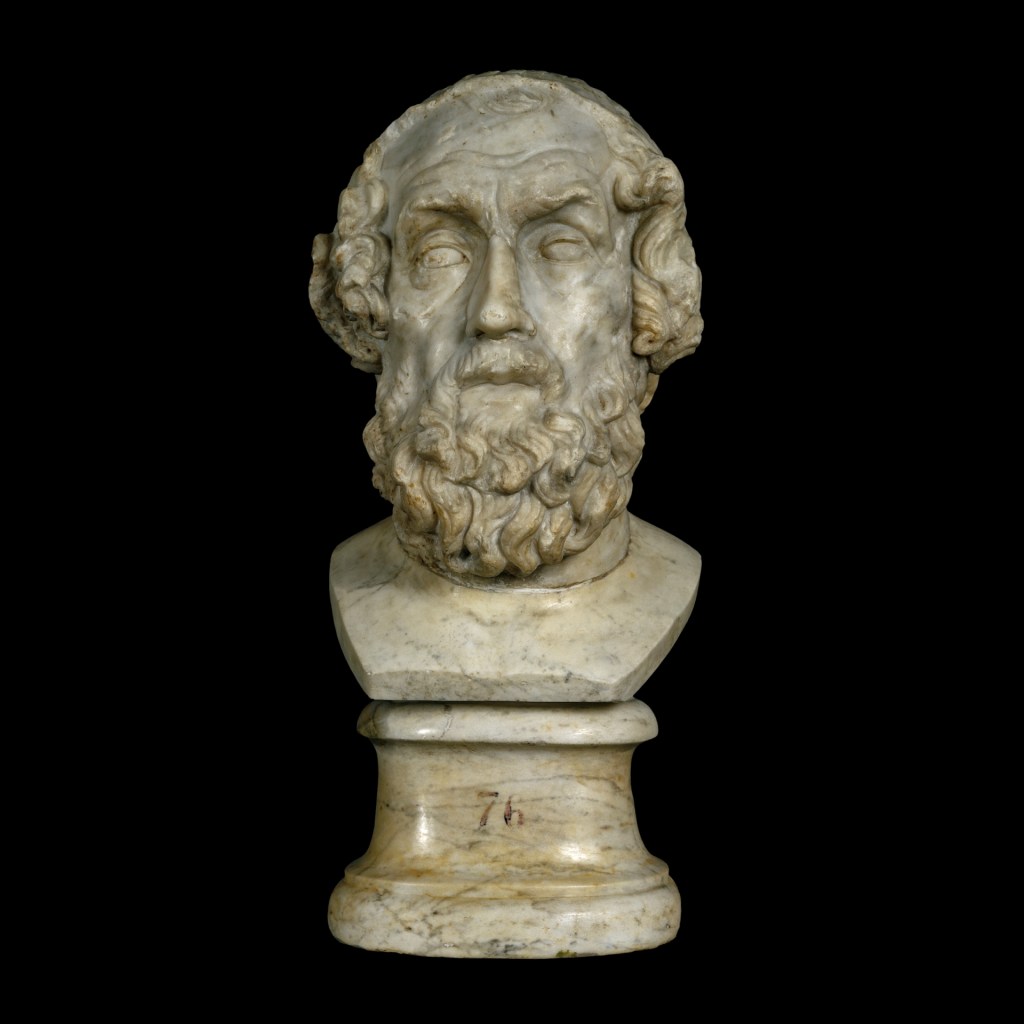
A Roman copy of a Hellenistic image of the poet Homer, author of the Iliad and Odyssey, sculpted in white marble between 150 and 125 BC.  Copyright ©Museo Nacional del Prado

Revolutionary indeed!  Who cannot but grasp even a scintilla of the foregoing and not know that reading the Iliad or Gilgamesh will be even more instinctually meaningful and powerful if read with this understanding of how those works struck the ears and core of our ancestors so many thousands of years ago?  And this, finally, brings me to the Darmok episode, which came to mind quite readily as I read the above on metaphorical speech.

A Trekkie I am not.  However, I do recall being struck by the brilliance of the Darmok episode when I first saw it decades ago.  The episode summary: Starfleet, a species known as speaking a literal language, interacts with a species (Tamarians) that uses a metaphorical language.  As a result of the language disconnect, the two species are initially unable to understand each other with tragic consequences as they engage in an ‘epic’ struggle with a hostile predator.  Ultimately, Picard, using the metaphorical language of Gilgamesh, communicates his understanding, such as it is, with the other species, thereby extending a tenuous bridge between the species … with optimistic portents for future relations. Star Trek often had ‘primitive’ species zipping across the universe with advance technology.  As such, it is not surprising that a species capable only of metaphorical language would be capable of interstellar flight in the Star Trek universe.  In Vico’s universe, however, such a primitive state of humanity (for he could conceive only of humanity) would not be capable of such advanced technological achievements.

An Atlantic article published in 2014 noted that many Trekkies also argued that the Tamarians would be unable to be so advanced given the limitations imposed by their metaphorical language. However, the author of the article, Ian Bogost, countered that the Tamarian language was sufficient, if compared, not to metaphor, but perhaps to allegory or, better yet, was understood as an abstraction, that is, a form of logic, which could be best described as a strategy. His argument is, to my sensibilities, convoluted, complex, and unattractive, but worth reviewing.