The light returns in fractions— a minute portioned back today, another tomorrow. I keep the count, though clouds obscure the evidence: three minutes banked by New Year’s, another half-minute folded in, five more by Epiphany.
The cold arrives in earnest now: lake effect, the wind that finds every weakness in the house’s skin. But the light grows. The sun keeps its promise without display, deposits made, retained, compounded.
I watch for five fifteen, for when darkness once took the day entire. Now it hesitates. Now it waits.
February measures what accumulates: an hour restored, perhaps more. Afternoon lengthens itself, light touching the sun room wall at angles I had forgotten. Still the snow, still the grey insistence of overcast—but something fundamental has shifted.
The sun climbs higher, stays longer, asks nothing in return. This is not spring—spring lies, breaks its word too often to be trusted. This is mathematics, planetary tilt, the faithful working of the world’s ancient machinery.
I am owed nothing. I receive these minutes anyway.
March brings the balance: day and night held even, aequinoctium. The light has kept its promise minute by minute, fraction by fraction, until the ledger clears.
Not triumph—the cold can still return, and will—but equipoise: that moment of level standing before the light tips into majority.
I have done nothing to earn this except continue, except persist through diminishment, watching the slow reversal, the patient return.
The light grows still. The light keeps growing. The promise is not finished.
Icy stars— points of ancient fire made brittle by distance, as though the heavens themselves had entered winter. They do not blaze; they prick. They hang, hard and lucid, in a silence sharpened by cold.
Such stars feel less like promises than reckonings. Their light arrives stripped of warmth, having crossed immensities where heat was spent long ago. What reaches the eye is endurance, not comfort— illumination without mercy.
In winter they seem closer, because the air has been scoured clean of softness. Each star stands alone, exact, unblurred, the sky insisting on precision, on the refusal of haze, metaphor, or excuse.
Indeed—stars resemble snowflakes. Each one discrete, each one sharp with its own geometry, no two quite alike, yet all governed by the same severe order.
They fall not downward but inward, settling upon the mind rather than the ground. They do not melt; they persist. What snow does to the earth— muting, clarifying, equalizing— stars do to thought.
Yet they are dissimilar in temperament—decisively so. The star, for all its pinprick stillness to the eye, is violence without pause: fusion, a steady hammer at its core, plasma boiling and convecting within its bounds, only to be held together by gravity’s unrelenting fist. Its light is not calm but coerced— order wrested from perpetual revolt.
The snowflake, by contrast, is obedience incarnate. It forms in surrender to temperature, pressure, and time, each facet answering silently to law. Nothing churns; nothing rebels. Structure blooms where energy dissipates, an architecture born not of struggle but of yielding.
And yet—what appears as opposition resolves into fidelity: both answering to temperature, to nature, to law.
Not submission, but staying true to what is given, to what may not be otherwise.
The star obeys by burning. Given mass and pressure, it cannot do otherwise. Fusion is not choice but consequence, law pressed hard upon matter until light is forced into being. Its turbulence is not rebellion but endurance under extremes.
The snowflake obeys by forming. Lowered heat, suspended vapor, the slightest allowance of stillness— and geometry appears. No facet decides; each angle arrives as it must.
Thus neither star nor snowflake is free, and yet both are exact. They do not err, because they do not aspire. They enact what must be— and leave us to consider what it means to call that perfection.
From them the law arose that gods forget, Though even the new must yield to old at last.
—after Hesiod, Theogony
I The dust began to shimmer on the ground, As buried stars stirred faintly in their sleep; The heavens held their breath—no voice, no sound— While watchful shadows gathered, slow and deep. Then from the mountains came a murmured sound, A groan of stone, where roots their vigil keep; The air grew still; the silence was profound, As angels watched what they could never keep.
II From depths unmeasured rose the buried flame, The heart of chaos quickened in its deep; The void recalled its long-forgotten name, And thunder woke the silence from its sleep. The stars withdrew, ashamed of what became, As time’s cold mirror shattered through the deep; The world remembered whence its motion came, And broke the vow it could not ever keep.
III Beneath the weight of aeons, thought awoke, A mind long bound within perfection’s chain; Its breath was wild, and through its silence spoke Of worlds once free before the rule of gain. The newer gods, their crystal order broke, Their light too flawless for the strain of life; Their harmony unmoving, cold as grave— A deathless peace no living soul could brave.
IV The rivers turned and murmured in their course, Old voices whispering beneath their foam; The winds cried out, compelled by wilder force, And struck the towers where stillness made its home. The harvest failed; the ploughshare bent, its course Abandoned—earth remembered dust and bone; For from the depths there surged a living source, And time bent low before the god unknown.
V Then broke the vault; the firmament withdrew, And blaze unuttered poured from every seam; The seas drew back, the sun forgot its hue, As form took shape within the formless gleam. The air grew dense, as if creation knew The end of peace, the birth of fire’s regime; The heavens quaked, their ordered paths askew, And life awoke from its eternal dream.
VI The newer thrones arrayed their borrowed light, Their radiance perfect, cold, without desire; They spoke the words that once had bound the night, Yet found their speech now hollow of its fire. The elder rose, majestic in his right, His breath the wind, his eyes the molten pyre; He named each star by its forsaken name, And stasis yielded to desire’s wild fire.
VII The mountains groaned; the seas forgot their shore, And cities cracked beneath a reddened sky; The temples fell; their idols shone no more, While men beheld the end they could not die. From sleep they woke, remembering before— The breath, the pulse, the heart’s primeval cry; And trembling knew what silence had in store: To live is to be broken, yet to try.
VIII Then from the dust the golden throne was raised, Its splendor veiled through ages’ slow decay; The heavens bowed, astonished and amazed, And newer gods knelt down in mute dismay. He spoke—and every silence learned to praise, His word the wind, His voice the living way; The elder’s gaze burned falsehood into flame, And life arose from ruin’s vast decay.
IX I, lesser flame, beheld the thrones renew, And saw the dust grow radiant as the dawn; I dared not sing, yet all the heavens knew That death itself was broken and withdrawn. The elder’s gaze burned all it looked into, And life from ash to living breath was drawn; I bowed, unmade, remade, and trembling knew— The world began because the old had gone.
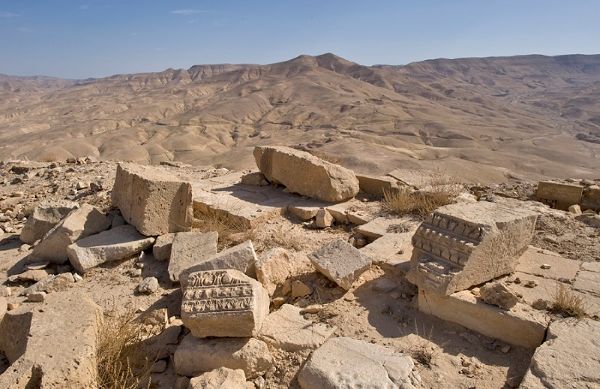
Nabataean temple ruins at Khirbet et-Tannur, Jordan. The temple may have been dedicated to the goddess Atargatis (see McKenzie et al. 2002; Almasri 2019).
When the Rains Come
When the rains come … the dust shall become mud, When the rains come … the mud shall become mire, And the feet of the proud shall sink to the ankle, And their words shall cling like clay to their tongues.
When the rains come … the roofs shall tremble, The cisterns shall overflow their stone mouths, And the low places shall remember the sea, Calling out to the deep from which they were torn.
When the rains come … the idols shall dim, Their painted eyes veiled in silt and silence, And the temples shall weep through broken eaves, For their gods shall not answer from the thunder.
When the rains come … the earth shall be heavy, And the hearts of men heavier still; The widow shall draw her shawl to her face, And the child shall forget the taste of dry bread.
When the rains come … we shall huddle together, Beholding the waters erase our names from the doorposts, And none shall boast of his harvest, For the river shall take what it wills, Bearing all things toward the forgetting sea.
When the Sun Is Restored
When the sun is restored … the waters shall fade, When the sun is restored … the mire shall break and sigh, And the earth shall stir beneath the plough, Breathing again as if reborn.
When the sun is restored … warmth shall come first, A balm to the chilled and the shivering earth; Green shall rise from the broken furrows, And the people shall bless the light.
When the sun is restored … the fields shall swell, The ears grow heavy, the vines bend low; And laughter shall echo in the threshing floor, Till the grain lies fuller than the granaries can hold.
And in the noonday brightness the sparrows fell silent, For they knew the hour would not endure.
When the sun is restored … the rivers shall dwindle, The soil yawn open like a parched mouth, And famine shall creep from the roots of plenty, Taking the firstborn of abundance.
When the sun is restored … the hearts of men shall fail, Their tongues cleaving to the roofs of their mouths; And the widow shall weep no longer, For her tears have been taken by the wind.
When the sun is restored … we shall gather at the well, Staring into its empty throat, And all shall return to dust, For from dust were we raised, and to dust we descend; And we lift parched hands, as if exalting to heaven for rain, That the circle may begin again.
When the Silence Falls
When the silence falls … the people shall gather, Not in joy nor mourning, but in stillness; And the priests shall stand before the altar, Their hands empty of offerings.
When the silence falls … the incense shall not rise, For no prayer shall remain upon our lips; We have cried out in the rains and cursed in the drought, And now we have no words to give.
When the silence falls … the children shall ask, “Why do we come to this place?” And the elders shall have no answer, For the stones themselves have forgotten their purpose.
When the silence falls … the priests shall look upon each other, And see their own faces as through water; They shall remember the prayers they learned as boys, And wonder if the words were ever heard.
When the silence falls … we shall see what we have built— Altars worn smooth by our hands, Bowls that held grain and oil and blood, All the bargaining of our fathers with the sky.
When the silence falls … no voice shall descend, Neither blessing nor judgment from above; And we shall know that we stand alone, Between the rain we fear and the sun we cannot bear, Waiting in the house we made for a goddess Who has not spoken in living memory.
Once none dared blaspheme their names— Isis enthroned, Osiris of the underworld, Amun-Ra blazing in the noon, Zeus the thunderer, Hera august, Athena who struck with spear, Apollo of the lyre and light, Artemis who loosed her arrows in the shadows of the wood. Marduk who shattered the dragon, Ishtar of love and war, Baal the rider of clouds, Dagon of the harvest, Chemosh of battle. All received blood and incense, bore the weight of kingdoms, demanded fear.
But now— their names are ink upon a scholar’s page, cartoons in a schoolboy’s jest. Their temples gape as hollow mouths, stones tumbled like teeth in the earth. Their rites are rumor, their mysteries reconstruction, their fires ashes, their echoes gone.
Behold Karnak, roofless to the sky; Delphi, once the navel of the world, silent but for the wind in the laurel. Eleusis, where mysteries bound gods and men, is rubble, its rites reduced to speculation. Uruk, the wall-girt city, mute in the desert. Tenochtitlan, where once the sun fed on blood, now paved by another empire’s stones.
Thus is man mocked by memory: he built to house the eternal, yet what he named eternal is gone. The priest is forgotten with the god, the hymn with the idol, the worship with the fear. All that was called everlasting— proved mortal as dust.
Yet from these scattered stones, a truth emerges: temples fall, names fade, but the hunger endures. Not the idol, but the yearning; not the revelation carved in stone, but the silence men cannot bear.
The divine was never in the image, but in the need that made it. This is the immortal truth: that man longs, and in the longing is closer to the eternal than any god he made.
Yet beware: for the gods that fed on blood still feed— only now in other names, with other temples, upon the lives of men.






 Northcoast Antiquarian