Every Angel is Terrifying

By Donald S. Yarab

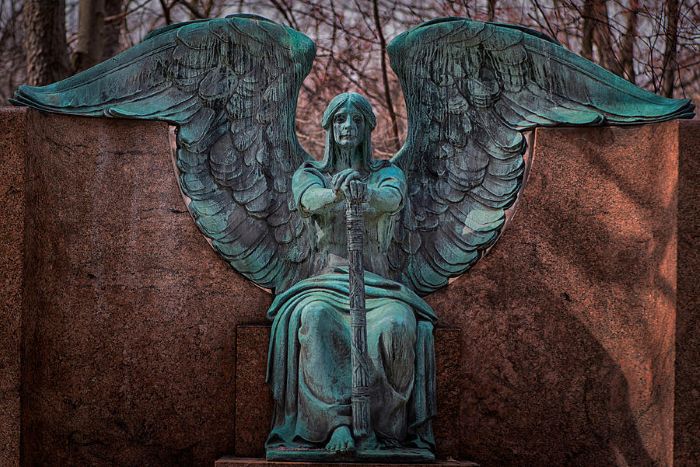
The Angel of Death Victorious is a bronze funerary sculpture with a marble base, created in 1923 by Herman Matzen. It was commissioned by Francis Henry Haserot after his wife's passing and is located in Lake View Cemetery, Cleveland Heights, Ohio. The photograph was taken by Rosette Doyle.
The Angel of Death Victorious is a bronze funerary sculpture with a marble base, created in 1923 by Herman Matzen. It was commissioned by Francis Henry Haserot after his wife’s passing and is located in Lake View Cemetery, Cleveland, Ohio.
The photograph was taken by Rosette Doyle.

Yet we keep calling them down,
hoping for comfort,
dreaming of radiance.

They arrive without warning,
bearing weight, not mercy:
the silence that collapses sound,
the gaze that unravels marrow.

We tremble,
for their wings are woven
of light we cannot bear to see,
of shadow we cannot learn to name.

What they touch is never the same.
A tree becomes flame.
A breath becomes prayer.
A man becomes dust.

But is this terror for one heart alone?
No—their shadow falls on cities and nations,
their silence unsettles centuries.

They do not stoop to whisper comfort.
They stride through millennia,
their wings stirring wars and kingdoms,
their silence heavier than empires.

Temples tremble,
mountains bow down,
a bell falls silent in the square,
the proud are unmade
by a glance that knows no compromise.

Still, we call them down,
for without their terror we would never glimpse
the depth of beauty,
nor know that awe and fear
are one.

Awe belongs not to possession,
nor fear to a single soul,
but to the common lot of mortals
who stand together before the unendurable.

The Gods in Dust

Once none dared blaspheme their names—
Isis enthroned, Osiris of the underworld,
Amun-Ra blazing in the noon,
Zeus the thunderer, Hera august,
Athena who struck with spear,
Apollo of the lyre and light,
Artemis who loosed her arrows in the shadows of the wood.
Marduk who shattered the dragon,
Ishtar of love and war,
Baal the rider of clouds,
Dagon of the harvest, Chemosh of battle.
All received blood and incense,
bore the weight of kingdoms,
demanded fear.

But now—
their names are ink upon a scholar’s page,
cartoons in a schoolboy’s jest.
Their temples gape as hollow mouths,
stones tumbled like teeth in the earth.
Their rites are rumor,
their mysteries reconstruction,
their fires ashes, their echoes gone.

Behold Karnak, roofless to the sky;
Delphi, once the navel of the world,
silent but for the wind in the laurel.
Eleusis, where mysteries bound gods and men,
is rubble, its rites reduced to speculation.
Uruk, the wall-girt city,
mute in the desert.
Tenochtitlan, where once the sun fed on blood,
now paved by another empire’s stones.

Thus is man mocked by memory:
he built to house the eternal,
yet what he named eternal is gone.
The priest is forgotten with the god,
the hymn with the idol,
the worship with the fear.
All that was called everlasting—
proved mortal as dust.

Yet from these scattered stones, a truth emerges:
temples fall, names fade,
but the hunger endures.
Not the idol, but the yearning;
not the revelation carved in stone,
but the silence men cannot bear.

The divine was never in the image,
but in the need that made it.
This is the immortal truth:
that man longs,
and in the longing is closer to the eternal
than any god he made.

Yet beware:
for the gods that fed on blood
still feed—
only now in other names,
with other temples,
upon the lives of men.


How to Circle a Square When Containing a Triangle

The Poem of a Lunatic

I drew a line that would not bend—
it laughed and curled into a ring.
A square it was, or had been once,
before the circle taught it spring.

I found a triangle trapped within,
three voices sharp, all pointing out:
One cried ascend, one whispered cut,
one wept and wound itself in doubt.

The square stood firm, its angles proud—
it would not move, it could not yield.
But circles sang of higher forms,
of truths beyond the compass wheel’d.

So round I walked the stubborn frame,
with chalk and ash and blood and thread.
I danced its edge in perfect curve,
till even stone believed it bled.

The triangle flared and broke its cage,
its apex tearing through the seams—
and then the square, now pale and wide,
lay softened in the light of dreams.

A circle formed—no start, no end—
around what once was harsh and true.
And in its midst, the threefold flame
still flickered where the angles flew.

So mark me mad, and mark me wise:
to circle square, let triangle rise.

Silence as Falling

By Donald S. Yarab

ὁδὸς ἄνω κάτω μία καὶ ὡυτή

“The way up and the way down are one and the same.”
—Heraclitus, Fragment 60 (Diels–Kranz); cf. Fragment 69 (Kirk & Raven)

When the mind enclosed reels, the frame gives way—
No border left to mark the night from day.
No cry, no anchor, only this descent
Where meaning bleeds and thought is all but spent.

It is not drift, but failure to remain—
The loosening of self from shape, from name.
It does not seek, nor struggle, nor insist—
It simply ceases, lost beyond all reach.

No wind attends, no witness marks the trace,
No voice declares the vanishing of place.
The silence is not peace, but what survives
When all the scaffolds break, and none revives.

No hand to hold, no vow left to defend—
One thought still clings—then breaks before the bend.
Just falling, falling, not to sky or land,
But into being none can understand.

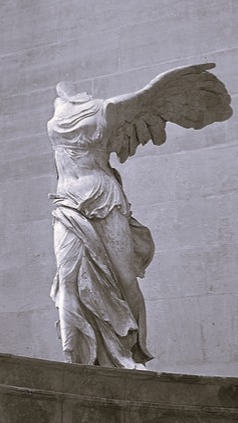
Victoire de Samothrace – Musee du Louvre

Ode to the Deep


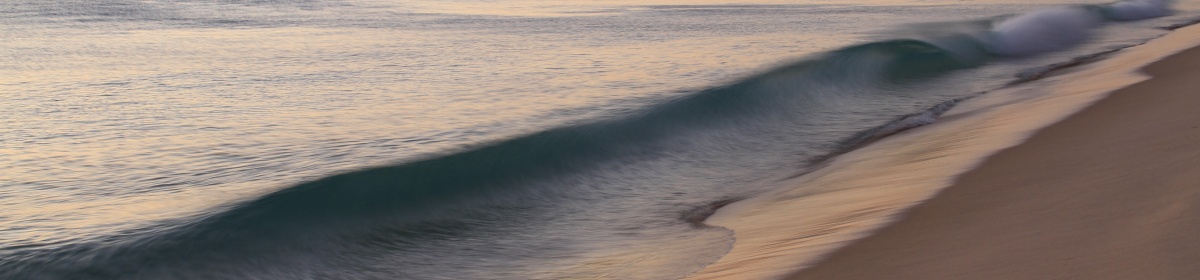
Photo by Sebastian Voortman on Pexels.com

I. Stillness Before the Descent
What stirs in silence but the thought of falling?
The soul leans forward at the edge of time,
Where earth gives way to rhythm without measure—
No firmament beneath, no axis left to climb.
The wind is absent here. The light, unsure.
All motion trembles on the breath of stillness.
We speak of peace, yet dread the calmest shore—
For we have built our gods from fear and witness.

II. The Water Below
Not storm, not wave, nor tempest’s hissing swell,
But quiet depth—the fathomless unknown,
Uncoiling silence from a buried bell
Where light has never touched the sea-worn stone.
Here dwell no monsters, save the mind’s own eye.
The fear is not of drowning, but of seeing—
That which reflects not sky, but self, and why
The soul recoils from naked being.

III. The Humbling
The sea does not instruct with word or wind—
It shapes the soul by salt and slow erosion.
A kneeling cliff, worn smooth where waves have pinned
Each boast to sand, each name to dark devotion.
The deeper still you go, the less you hold—
No torch remains, no doctrine, no command.
The deep forgives, but never does it fold—
It presses wonder into trembling hand.

IV. What Remains
So is the fear a gift, once held aright—
A trembling compass on the soul’s long chart.
For he who feared the deep, yet dared its night,
Returns not wise—but hollowed, whole of heart.
He cannot speak of what he saw below,
Only that silence taught him how to kneel.
And those who know will know. The rest may go
To read their truths upon a turning wheel.