I. Stillness Before the Descent What stirs in silence but the thought of falling? The soul leans forward at the edge of time, Where earth gives way to rhythm without measure— No firmament beneath, no axis left to climb. The wind is absent here. The light, unsure. All motion trembles on the breath of stillness. We speak of peace, yet dread the calmest shore— For we have built our gods from fear and witness.
II. The Water Below Not storm, not wave, nor tempest’s hissing swell, But quiet depth—the fathomless unknown, Uncoiling silence from a buried bell Where light has never touched the sea-worn stone. Here dwell no monsters, save the mind’s own eye. The fear is not of drowning, but of seeing— That which reflects not sky, but self, and why The soul recoils from naked being.
III. The Humbling The sea does not instruct with word or wind— It shapes the soul by salt and slow erosion. A kneeling cliff, worn smooth where waves have pinned Each boast to sand, each name to dark devotion. The deeper still you go, the less you hold— No torch remains, no doctrine, no command. The deep forgives, but never does it fold— It presses wonder into trembling hand.
IV. What Remains So is the fear a gift, once held aright— A trembling compass on the soul’s long chart. For he who feared the deep, yet dared its night, Returns not wise—but hollowed, whole of heart. He cannot speak of what he saw below, Only that silence taught him how to kneel. And those who know will know. The rest may go To read their truths upon a turning wheel.
Léon Spilliaert, Vertigo (1908) Indian ink brush wash and colored pencil on paper, 64 × 48 cm. Kunstmuseum aan Zee, Ostend, Belgium.
At the Crossing
by Donald S. Yarab
Words gather like dew on dawn’s edge, names unspoken, waiting to be born. They tremble in the mouth of silence— a stillness before the world. But say them, and they splinter— what was whole becomes approximate. Each syllable divides the light and leaves behind shadow.
Color can have no truth— for truth demands a stillness color will not grant. It shifts with light, with eye, with sorrow or with song. If it were true, which hue would reign? Whose gaze would be the measure? It is not fact, but feeling— not essence, but event.
Touch is first knowing, before word, before sight. It does not describe—it confirms. Yet it deceives: a surface hides a wound, a hand may linger, then withdraw. What truth lies in contact— in pressure, in pulse? Or is touch merely the place where self and other collide and pretend to know?
Sound resonates not in air alone, but in the hollows of the soul. One hears hymn, another wound. Its truth lies not in frequency, but in the body that receives it— in bones that tremble, in hearts that flinch. Which is the true tone— the one that soothes, or the one that sears?
Time marches allegedly, metronomic, proud— but to whom does it keep this beat? To the grieving, it halts mid-breath; to the joyful, it slips its leash and runs. Some say it flows; others drown without a ripple. Perhaps it does not move at all— perhaps we shift, casting shadows on still walls and calling them hours.
Truth cannot be summoned by sense, nor sealed in proposition. It glimmers, briefly, when doubt is honored, when contradiction is not flaw but form. Truth is not what endures, but what survives the testing— a trembling filament between worlds, not the anchor, but the thread.
Intersection is not a place but a moment— when word is heard, when color wounds, when sound divides the silence, when time dissolves into breath, and touch recalls the nearness of all things.
And there— at that trembling margin— truth does not appear. It haunts the space where meaning almost forms.
The Counterpoint of Ponder, O Morpheus, the Night Sky
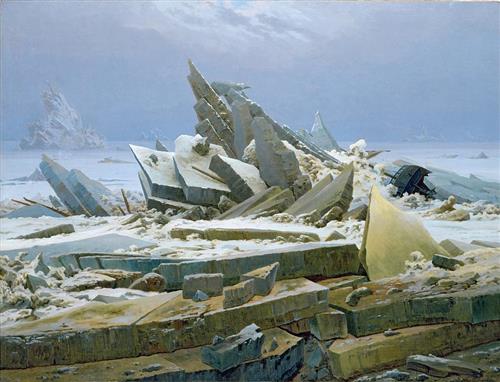
Caspar David Friedrich, The Sea of Ice, also called The Wreck of Hope Oil on canvas, 96.7 cm × 126.9 cm (1823–1824).
On the Unmaking of Benediction
This cycle of verses—The Inversion Cycle—emerged not as a contradiction, but as a counterweight to The Blessing of Morpheus: The Sending Forth, a series of benedictions articulated in reverent tones and metaphysical gestures within the poem Ponder, O Morpheus, the Night Sky. That earlier work was rooted in the soul’s deep yearning toward the ineffable, culminating in luminous affirmations bestowed by the dream-god Morpheus upon the seeker. In time, those benedictions came to feel too complete, too resolved. I began to wonder: what if they failed?
TheInversion Cycle is not blasphemy, but a form of apophatic honesty. It does not seek to erase Ponder, but to stand beside it—its negative counterpoint. Each scroll of the cycle corresponds to a specific line or blessing from Ponder and performs an act of unmaking: where Morpheus blesses, these verses refrain; where he sends the seeker into mystery, these verses stall at the threshold; where he assures, they withhold.
To honor that reversal, a further restraint was imposed: the exclusion of the very vocabulary upon which the original work (and many of my other recent works) so often relied. Words such as breath, dust, light, shadow, silence, and memory—among others—have been set aside. Their absence is not a loss but a signal. These are not the tools we are permitted to carry here.
The scrolls appear here in the same order as the benedictions from Ponder, O Morpheus, the Night Sky. This reversal respects the original arc—from the loosening of dreams to the transformation of the soul—and follows its negative path with precision.
What remains is austerity, not despair. These unsacraments do not offer consolation, but they do speak. If Ponder was a song of ascent, then this is the long exhale after the music ends—a psalter of withheld grace, composed in the space where blessing does not descend.
Let this work be read not in defiance of belief, but in the trembling of its undoing. For if it is brave to bless, it is perhaps braver still to stand in the space where blessing will not come—and write there, in the dust, what remains.
Scroll I: Of the Clinging Husk
Let not your dreams fall— for they will not fall. They remain, clinging like husks unpicked, blackened not by season, but by refusal.
You will try to cast them down, but they are fastened, not to limb, but to marrow.
They do not curl like leaves. They do not return to soil. They sour upon you, a bitterness in the sinew, a ferment in the thought.
And if you turn to shake them loose, they will tighten. Their threads are not of sleep, but of habit, knotted in long forgetting.
There is no wind to lift them. No frost to loosen them. No gardener comes.
Remain, then, beneath their burden— bent, unshed, unchanged.
Scroll II: Of the Inscribed Weight
Take them. You will take them. You cannot help it.
The names carved into stone, the words burned into walls, the cries etched into earth— they cling not to your pack, but to your ribs.
You bear them not as titles, but as scars.
They whisper through your marrow, resisting every act of unmaking. You try to enter the place without form, but they speak before you. They call the ground by its old name, and the gate does not open.
Even the sky does not answer when it hears them rising again.
These names were not carved to remember. They were carved to bind.
And now, as you stand at the edge of the place where all naming ends, they press their syllables against your tongue, and you speak them, not in defiance, but because you cannot forget.
Scroll III: Of Implements Abandoned
Bring not the weighted balances, nor the woven snares of longing. They do not hold, not here.
Their handles crack in the frost where no stars rise to bless the hour. Their mesh is brittle—threaded not of wool, but of claims left too long in the mouth.
The mind, honed to edge, cuts only fog in this place. The heart, cupped too gently, spills what it never held.
There are no laurels in this soil, only reeds that do not bend and brambles that do not bleed.
And should you cast such tools before you, expecting fruit, or fire, or favor— they will return to you as ash, unsought, unshaped, the chaff of means mistaken for ends.
Scroll IV: Of the Withheld Offering
Bring not your hollowed chest, stripped clean of ornaments and plea. It will not be filled.
Wonder has no purchase here. Its gaze returns unreflected from stone too smooth to be shaped.
Let the mind remain loud and unyielding, for awe would shatter in this poise like frost-cracked bronze.
As for your feet— do not lift them. There is no basin here, only ground dry from the beginning, lined with rings that do not ripple.
The wind does not attend. It does not lift. It does not listen.
There is no path across this floor, only grit, and the marks of those who came thinking they would walk upon revelation.
Scroll V: Of the False Horizon
Do not seek. There is no one to be found.
The sea does not receive you. It is not fluid, but glare stretched to the edge of motion— shimmering not with promise, but with mirage.
You did not launch. You drifted. And your craft was not chosen, but assigned, drawn from timbers meant for no voyage.
The sky above you swells with stars, but none are true. Each one marks a path that bends inward, circling you back to your forgetting.
You will think you move. You will call it seeking. You will call it bold. But you are already known by the thing that does not answer. And it has left no threshold, only wind that cannot be charted and depth that does not hold.
Scroll VI: Of the Barren Threshold
There is no beyond. Only the gray field where sleep forgets its end and waking does not begin.
Here, nothing waits. Not voice, not veil, not even the last gasp of wonder.
What lies past dream is not fullness, but poise robbed of sanctity— the deafness of stones before their naming.
No stars ever hung above this place. No fire traced its vault. Only pallor, dull as bone in a dry shrine, untouched by flame or veil.
And death, so often imagined a gate, has no depth here. It is shallow, crusted, and holds nothing but its own refusal.
Let no one say this place is holy. It is not what remains made full— but vacancy made permanent.
A place unmourned. Uncalled. Unmade.
Scroll VII: Of the Unbecome
Go not. There is nowhere that calls. No road unfurls before you, no veil parts, no watchful eye lingers on your vanishing.
The question you bore was not accepted. It curled back into you, like a tongue that feared its own utterance.
You will not be shaped by asking, nor known by your seeking. You will remain as you were before the yearning— a vessel without fracture, never poured, never filled.
No sound will rise behind you. No trace will stir where your feet passed. Even the soil will forget your weight.
Be still, not in peace, but in the form that does not unfold. Remain—not as the question— but as that which never found its shape.
Scroll VIII: The Soul Beneath the Blanched Sky
The soul, girded and unmoved, stood beneath a sky without veil— a dome blanched of fire, where nothing had ever gleamed, only ash adrift from unremembered pyres.
It bore no garment. No mark of calling or descent. It was as parchment without script, unhandled, unblemished, unread.
No winds stirred the plain. Only cairns rose in rows, not raised in reverence, but born of the land’s refusal to yield.
The trees there had no buds. Their limbs were stiff, as if carved for stillness— a forest of halted prayers. And beneath them, the roots did not seek nourishment, but curled inward, content in their forgetting.
There was no calm, no sacred pause. Instead, a muttering of syllables rose from the dry hollows— sounds without grammar, without bond, giving rise to no names, no intelligible form.
And when the soul pressed its palm to the ground, there was no spring, no pulse, only crusted clay— neither moist nor cracked, a firmness that would not give.
It asked nothing. Not from pride, but from knowing that some places are beyond summons— places where even longing has been turned to stone.
The first lines of this poem came to me in the night—those strange hours when thought and dream pass like shadows through the mind. I awoke briefly, not fully, and the phrase lingered: between and betwixt dawn and dusk… and the inverse, between and betwixt dusk and dawn. I held onto it until morning, when I set it down in full light. The poem that followed is a meditation on those intervals—the thresholds of consciousness and the veils through which the soul moves in its waking and its dreaming.
What begins as a reflection on the daily arc—from sunrise to sunset—soon turns inward, toward the more uncertain passage between dusk and dawn, where memory, time, and identity unravel and reweave. The Heraclitean epigraph provides the key: “The waking have one common world, but the sleeping turn aside each into a world of his own.” Yet even that distinction, perhaps, is not so firm as it seems.
The accompanying painting—Whistler’s Nocturne in Black and Gold: The Falling Rocket—mirrors the poem’s atmosphere: its drift between form and dissolution, its reverent wondering, its silence punctuated by brief illumination. Together, word and image ask not what life is, but whether it is lived or dreamed—and what remains of us in either case.
James McNeill Whistler, Nocturne in Black and Gold: The Falling Rocket c. 1872–1877 | Oil on canvas, 60.3 × 46.6 cm Detroit Institute of Arts, Detroit
Betwixt the Spheres
by Donald S. Yarab
“The waking have one common world, but the sleeping turn aside each into a world of his own.” —Heraclitus, Fragment 89
Betwixt the dawn’s gold-burnished, trembling rise, And evening’s hush where embered echoes gleam, A soul drifts outward under waking skies— Or inward, through the latticework of dream.
Morning declares the world as firm and real, Noon lays its claim in certainties and fire, Yet twilight draws the veil we cannot feel, And sings the hush of unfulfilled desire.
The hours fall like leaves from unseen trees, Their passage soft, impermanent, and strange. Some name it life, who walk it by degrees— While others call it dream, and feel no change.
So tell me, when the final light has flown, And silence hangs, unbroken and immense— Was it a road we walked, and called our own, Or but a fleeting spark in dream’s pretense?
But what of time when sun has slipped from sight, And stars drift forth like seeds of the unknown? What voice is heard within the hush of night, When all the world lies still, and we—alone?
Between and betwixt the dusk and morning’s grace, A different kind of being comes to bloom: Where shadows speak, and time forgets its place, And long-dead voices gather in the gloom.
In sleep, the veil grows thin, the borders bend, And hours bleed into realms that none can chart. The soul recalls what lies beyond the end, And bears the hush of ages in its heart.
These hours are not lost—they are the deep, The ocean floor where buried visions gleam. From them we rise, like wanderers from sleep, Still marked by fire, still echoing the dream.
So stands the soul, on thresholds vast and wide, Between and betwixt the turning of the spheres— What seemed a life, a dream walks at its side, Measured not in hours, but in wonder—and in tears.
History shows that evil rarely marches under banners we immediately recognize. Too often, it comes draped in righteousness, purity, and fear. This piece is a lament for how easily we have been—and still can be—drawn into the machinery of cruelty.
My Friend, You Were There
My friend, When the Holy Catholic Church, seeking to preserve the Faith in all its radiant purity, instituted the Inquisition, you were there— not as a bystander, but as a willing voice.
You denounced the old widow, who lived alone with her cat. You whispered against the Jewish family— familiar, yet forever marked as other— and gave your assent to their undoing.
You crowded into the square to watch the trials. You sang hymns as the flames crowned their bodies with smoke. You wept tears of joy that the world was made purer that day.
My friend, When the ships came heavy with human cargo, and the auction blocks stained the soil, you were there.
You placed your bids. You weighed their flesh. You wrote the laws that chained their children.
You sang hymns on Sunday, and broke their backs on Monday. You called it providence. You called it order.
My friend, When the traders came with flags and rifles, when the rivers flowed with rubber and blood, you were there.
You signed the charters. You counted the profits. You sold the shackles and the scales.
You called it commerce. You called it destiny.
My friend, When the banners of the Reich unfurled, and the drums of destiny beat their hollow call, you were there.
You shouted with the crowds as glass shattered from shopfronts. You signed the letters, you cheered the laws, you raised your hand high in salute.
You bought the house, the shop, the art your neighbors were forced to leave behind.
You praised the strong hand that swept away the weak. You rejoiced as neighbors vanished, grateful that your streets were made clean.
My friend, When Stalin summoned the will of the people to root out the enemy within, you were there.
You reported the whispered doubts of your cousin, your friend, your brother.
You paraded with red flags while the trucks rumbled into the night. You filled the quotas. You seized the land. You counted the spoils as others disappeared.
You sang of the bright tomorrow as you cast your eyes down and stepped over the absent.
My friend, When Mao lifted the Little Red Book, and the children cried out against their fathers, you were there.
You led the chants. You scrawled denunciations across the walls. You struck the old professor who dared to hesitate. You cheered as the temples fell, and the old poems burned, convinced you were building a paradise on the bones of the past.
My friend, When Pol Pot promised that the fields would bloom with new life, you were there.
You marched the teachers into the paddies. You pointed the rifle. You praised the year zero that would erase the memory of all that came before.
You smiled as the world was reborn in silence.
My friend, When the generals rose in the name of order, when the prisons filled and the stadiums overflowed, you were there.
You nodded at the names. You counted the profits. You watched the blindfolded taken at night.
You called it security. You called it salvation.
My friend, You have always been there.
Only too late did you realize. Only too late did you doubt— but not much.
You fell silent, lest you betray your doubt. You looked away, lest you see.
You told yourself it would be different this time. You told yourself you had learned. But the signs are familiar. The words are familiar. The silence is familiar.