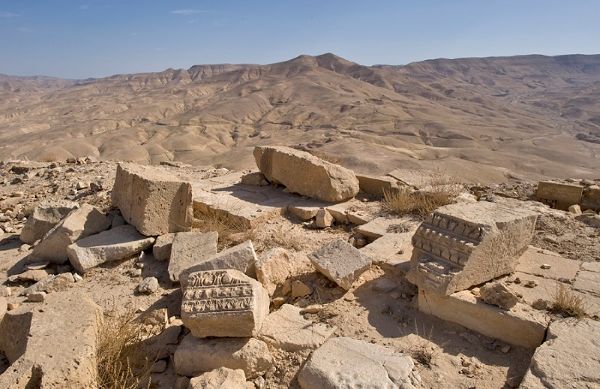
Nabataean temple ruins at Khirbet et-Tannur, Jordan. The temple may have been dedicated to the goddess Atargatis (see McKenzie et al. 2002; Almasri 2019).
When the Rains Come
When the rains come … the dust shall become mud, When the rains come … the mud shall become mire, And the feet of the proud shall sink to the ankle, And their words shall cling like clay to their tongues.
When the rains come … the roofs shall tremble, The cisterns shall overflow their stone mouths, And the low places shall remember the sea, Calling out to the deep from which they were torn.
When the rains come … the idols shall dim, Their painted eyes veiled in silt and silence, And the temples shall weep through broken eaves, For their gods shall not answer from the thunder.
When the rains come … the earth shall be heavy, And the hearts of men heavier still; The widow shall draw her shawl to her face, And the child shall forget the taste of dry bread.
When the rains come … we shall huddle together, Beholding the waters erase our names from the doorposts, And none shall boast of his harvest, For the river shall take what it wills, Bearing all things toward the forgetting sea.
When the Sun Is Restored
When the sun is restored … the waters shall fade, When the sun is restored … the mire shall break and sigh, And the earth shall stir beneath the plough, Breathing again as if reborn.
When the sun is restored … warmth shall come first, A balm to the chilled and the shivering earth; Green shall rise from the broken furrows, And the people shall bless the light.
When the sun is restored … the fields shall swell, The ears grow heavy, the vines bend low; And laughter shall echo in the threshing floor, Till the grain lies fuller than the granaries can hold.
And in the noonday brightness the sparrows fell silent, For they knew the hour would not endure.
When the sun is restored … the rivers shall dwindle, The soil yawn open like a parched mouth, And famine shall creep from the roots of plenty, Taking the firstborn of abundance.
When the sun is restored … the hearts of men shall fail, Their tongues cleaving to the roofs of their mouths; And the widow shall weep no longer, For her tears have been taken by the wind.
When the sun is restored … we shall gather at the well, Staring into its empty throat, And all shall return to dust, For from dust were we raised, and to dust we descend; And we lift parched hands, as if exalting to heaven for rain, That the circle may begin again.
When the Silence Falls
When the silence falls … the people shall gather, Not in joy nor mourning, but in stillness; And the priests shall stand before the altar, Their hands empty of offerings.
When the silence falls … the incense shall not rise, For no prayer shall remain upon our lips; We have cried out in the rains and cursed in the drought, And now we have no words to give.
When the silence falls … the children shall ask, “Why do we come to this place?” And the elders shall have no answer, For the stones themselves have forgotten their purpose.
When the silence falls … the priests shall look upon each other, And see their own faces as through water; They shall remember the prayers they learned as boys, And wonder if the words were ever heard.
When the silence falls … we shall see what we have built— Altars worn smooth by our hands, Bowls that held grain and oil and blood, All the bargaining of our fathers with the sky.
When the silence falls … no voice shall descend, Neither blessing nor judgment from above; And we shall know that we stand alone, Between the rain we fear and the sun we cannot bear, Waiting in the house we made for a goddess Who has not spoken in living memory.
“The poem is the cry of its occasion, / Part of the res itself and not about it.” — Wallace Stevens, “An Ordinary Evening in New Haven”
Lacrimae Sanguinis 2025: A Lamentation in Four Movements
By Donald S. Yarab
I.
Lacrimae sanguinis, Animae nigrae hominum terram maculant. They walk not as men, but as shadows unshriven, Each step a silence, each breath a wound. The ground groans beneath the weight of the fallen, And justice, long buried, forgets her name. No trumpet sounds for the guiltless slain, Only the whisper of blood in the dust.¹
Lacrimae sanguinis— The blackened souls of men stain the earth.
II.
Hate kindles fires no rain can quell, Greed carves its name in the marrow of kings. Fear is a vulture, circling unborn hopes, Its wings beating lies into trembling hearts. These three—unholy trinity—march undenied,² And temples crack beneath their tread. Where once stood gardens, now only ash— And the breath of God withdraws in sorrow.³
Lacrimae sanguinis— The blackened souls of men stain the earth.
III.
No voice comes forth from the cloud or flame, The heavens are sealed in unyielding hush.⁴ The stars avert their gaze, and time forgets its course— Even the winds have ceased to speak His name. Altars stand cold, their offerings stale, And the priest no longer lifts his hands. The silence is not peace, but exile— A stillness too vast for prayer to fill.⁵
Lacrimae sanguinis— The blackened souls of men stain the earth.
IV.
He turned His face—and we, our backs.⁶ Not in wrath, but in weary disdain. The mirror cracked, the image lost, And we wander, eyes open yet unseeing.⁷ We build our Babels in crumbling dust, Raise thrones upon bones, call ruin law. Light knocks, but we bolt the gate from within— And call the silence proof He never was.⁸
Lacrimae sanguinis— The blackened souls of men stain the earth.
Footnotes:
“Shadows unshriven” / “Justice… forgets her name” — Cf. Psalm 82:6–7 and Isaiah 59:14–15. Echoes of prophetic lament over moral collapse and unreconciled souls.
“Unholy trinity” — An inverted image of Augustine’s De Trinitate: hate, greed, and fear form a perverse sacred order.
“Gardens turned to ash” — Evokes Eden undone. The breath of God (Genesis 2:7) has withdrawn.
“The heavens are sealed” — Amos 8:11–12; Lamentations 3:8. Divine silence as the most damning judgment.
“Silence… not peace, but exile” — Apophatic void, not luminous unknowability. Cf. Isaiah 45:15: Deus absconditus.
“He turned His face” — Inverts the Aaronic blessing (Numbers 6:24–26). A divine turning not in anger, but in sorrowful withdrawal.
“Mirror cracked” — A fall from incomplete vision (1 Corinthians 13:12) into permanent distortion.
“Call the silence proof He never was” — Resonates with Nietzsche’s “God is dead,” here framed as mutual estrangement, not denial.
Note: The image of the soul as stained through inordinate attachment finds classical expression in Summa Theologica I–II, Q.86, Art.1, where Aquinas defines sin’s stain not as a substance, but as a privation of the soul’s brightness—a metaphorical shadow cast when the soul cleaves inordinately to created things, against reason and divine order. In this lamentation, the stain is projected outward: what is blackened within stains the world without.ain is projected outward—what is blackened within stains the world without.
It is easy to imagine the critical response already. Some heir to Harold Bloom’s anxiety-of-influence throne would ascertain that I, the creator, am anxious, insecure, prone to nail-biting—that I found it necessary to express my anxiety in more apparatus than poem, drowning the verse in scholarly scaffolding because I lack confidence in the work’s ability to stand alone.
Such banal criticism would miss the point entirely. If I were anxious about critical reception, if I were truly insecure about the poem’s merits, I would have foregone apparatus altogether in sure foreknowledge of such harsh rebuke. The apparatus exists precisely because I am secure in my intent, my method, and my purpose. I am not writing for elite pedantics and pedagogues who jealously guard their interpretive privileges, but for myself and any who wish to partake of poetry’s riches, whatever their opportunity to swim in the canon’s depths.
The truth is, those who argue against apparatus are those who would have poems essentially confined to an elite club, complete with secret handshakes, symbols, and degrees of membership. Like Skull and Bones or the Masonic lodges, traditional poetry criticism has long functioned as an initiatory society where full membership requires years of study, the right mentors, and familiarity with increasingly obscure reference points. The “let the poem stand on its own” argument sounds democratically pure but functions as cultural gatekeeping, preserving poetry as the domain of those who already possess the cultural capital to decode allusions, recognize forms, and trace influences.
When critics rail against apparatus, they defend a system where interpretive authority belongs to those with the “right” education, the proper literary pedigree. The poem becomes a kind of shibboleth—if you do not immediately recognize the echoes of Job, the inversions of Augustine, the liturgical cadences, well, perhaps serious poetry isn’t for you.
My apparatus dismantles that exclusivity. It offers initial guideposts to anyone willing to engage, no secret handshakes required. This is cultural hospitality, not anxiety—a deliberate act of democratization that makes visible the materials from which the poem emerged.
The Method: Nexus, Interaction, Reflection
A poem does not emerge from nothing. It rises from what might be called a nexus—a convergence of memory, reading, experience, and the particular urgency that calls forth language. In composing Lacrimae Sanguinis, this nexus became especially visible: biblical lament tradition, Thomistic theology, contemporary spiritual desolation, and liturgical rhythms that have shaped both prayer and protest for centuries. But rather than hide this genealogy, I choose to make it visible as part of the poem’s offering.
The nexus is not a conscious construction—it cannot be willed into being. Rather, it emerges when conditions are right, when reading and experience have prepared a space where seemingly unrelated elements suddenly reveal their hidden kinship. The Latin refrain lacrimae sanguinis did not arise from scholarly deliberation but from convergence, where liturgical memory met contemporary anguish.
Within this nexus, meaning arises through interaction—the dynamic tension between elements that resist easy synthesis. The “unholy trinity” of hate, greed, and fear stands in deliberate tension with Augustine’s conception of divine Trinity, not as simple inversion but as recognition of how spiritual language can be perverted by the very forces it seeks to name and resist. The line “He turned His face—and we, our backs” emerges from interplay between the Aaronic blessing and the lived experience of mutual estrangement.
The apparatus participates in this interaction by creating dialogue between poem and source. When I note that “silence is not peace, but exile” resonates with Isaiah’s Deus absconditus, I do not suggest the poem merely illustrates the biblical text. Rather, I propose that ancient prophetic cry and modern spiritual dislocation illuminate one another—that meaning arises in their interaction, not in either alone.
The apparatus reveals process without explaining away mystery. When I show that “He turned His face—and we, our backs” emerges from tension between Aaronic blessing and contemporary estrangement, I do not solve the line’s meaning—I multiply its resonances. The reader now encounters not just the line’s immediate emotional impact but also its dialogue with liturgical tradition, its inversion of expectation, its theological implications. The apparatus does not reduce mystery to mechanism; it shows how many mysteries converge in a single moment of language.
This transparency serves poetry’s deepest purpose: not to mystify through obscurity but to reveal the actual complexity of experience. When sources remain hidden, readers may sense depths they cannot fathom and mistake inaccessibility for profundity. When sources become visible, the true marvel emerges—not that the poet knows obscure references, but that these disparate materials can achieve such unity, that ancient texts still speak to contemporary anguish.
Finally, reflection—not as conclusion but as ongoing process. The apparatus serves this reflective function, helping both creator and reader recall not just sources but the quality of attention that makes encounter possible. By showing rather than hiding the poem’s genealogy, it acknowledges that interpretation is always collaborative, that meaning emerges from ongoing conversation between text and reader.
Confidence, Not Anxiety
This method emerges from confidence rather than defensiveness. When apparatus functions generously, it says to readers: here are some materials that were present when this poem emerged, but you are free to make of them—and of the poem itself—what you will. This represents confidence in both the work’s integrity and the reader’s capacity for independent meaning-making.
Critics will object that apparatus risks over-determining meaning, that by naming sources I constrain interpretation. This objection misunderstands how meaning actually works in poetry. The apparatus does not tell readers what to think about the convergence of Nietzschean pronouncement and prophetic lament—it simply makes that convergence visible as one layer among many.
Consider the reader who recognizes the Aaronic blessing inversion without consulting footnotes, discovers resonances I never anticipated or intended, and finds connections to their own liturgical memory. The apparatus does not prevent this encounter—it enriches the conversation by adding another voice. Meaning multiplies rather than contracts when more materials become available for interaction.
The real constraint on interpretation comes from ignorance, not knowledge. When readers miss allusions entirely, they are trapped in partial understanding. When sources become visible, readers gain freedom to accept, reject, or build upon the connections offered. The apparatus functions as invitation, not limitation.
We live in an age where what was once common cultural knowledge—biblical narratives, classical philosophy, liturgical traditions—can no longer be assumed as shared reference points. This is not a failure of readers or education but a consequence of cultural acceleration. Neither poets nor readers can be expected to carry the full weight of cultural memory. When canonical works become unfamiliar, when classical allusions require explanation, apparatus serves not as condescension but as courtesy.
The apparatus preserves a record of one moment’s convergence—the nexus as it appeared when the poem emerged—but it cannot and should not constrain future encounters. It functions as invitation rather than explanation, creating conditions for ongoing dialogue rather than settling interpretive questions once and for all.
Method as Cultural Hospitality
What emerges is method as interpretive generosity rather than critical control. The apparatus offers tools for encounter while acknowledging that even the creator does not exhaust the poem’s meaning. The poem, once written, becomes available for encounter rather than possession, even by the one who wrote it.
This hospitality extends to readers at all levels of familiarity with the sources. Those who recognize the allusions immediately may find additional layers in seeing them made explicit. Those encountering Augustine or Isaiah for the first time receive invitations to explore further. Those who prefer immediate encounter may ignore the scholarly apparatus entirely. All approaches are welcome.
In this way, creative method and interpretive philosophy align. Both resist the fantasy of complete control or final understanding. Both acknowledge that meaning emerges in relationship. Both find fulfillment not in closure but in the ongoing conversation they make possible.
The apparatus, properly understood, serves this conversation. It is not the last word on the poem’s meaning but an invitation to the kind of careful attention that allows meaning to emerge. Like the poem itself, it creates conditions for encounter rather than commanding specific responses.
This is method in poetry as in interpretation: not a tool of conquest but a lens through which the materials of experience might reveal some of their hidden connections. The nexus forms, interactions unfold, reflection deepens—and occasionally, if conditions are right, something emerges that was not there before. Something worth sharing with anyone willing to receive it.
A Reflection Interwoven with Ante Verba, Verba, and Postverbum
Cy Twombly (1928-2011), Untitled 2005, acrylic on canvas, 128 x 194½ in “His madness is a circle of fire, an unbroken circuit of excess, each attempt at containment spilling into the next”—Art historian Malcolm Bull on the Bacchus paintings.
The three poems, CARMINA TRIA: DE VOCE AGGLUTIVA, which follow—Ante Verba, Verba, and Postverbum—did not emerge by design. They followed Liber Agglutivi as if by necessity. Once the treatise had been written, these poems had to be. They are not commentaries on the Liber, nor are they didactic restatements of its metaphysical claims. Rather, they are its echo—its ember. They are the hymns sung at the threshold that Liber Agglutivi only describes.
Even readers unfamiliar with the medieval-inspired treatise can enter these poems directly. They function as meditations on how language lives in us before we speak it, while we speak it, and after our words have fallen silent. Readers of the Liber will recognize these concerns, but the poems make them immediate and felt rather than theoretical.
They move through language as tremor, fire, and resonance. The sequence below mirrors the deeper structure of the Liber: from the agglutum primitivum (pre-verbal memory), to the verbum intransitivum (word as creation), to the postverbum and glosselitha (residual presence).
CARMINA TRIA: DE VOCE AGGLUTIVA
I. Ante Verba
Language as Tremor, Silence as Light
Ante Verba (Versus ad limen vocis) Verbum non dicitur, sed fit. Non transit, sed regnat. Nomen quod loquitur se ipsum non oritur ex ore, sed ex ossibus. Lingua non fert sensum, sed tremorem. Memoria quae nescit quid meminerit audit quod non sonat. Tacere est tangere lumen. Loqui est amittere formam, ut recipiatur flamma.
Before Words (Verses at the threshold of voice) The word is not spoken, but becomes. It does not pass through, but reigns. The name that speaks itself arises not from the mouth, but from the bones. Language carries not meaning, but tremor. Memory that knows not what it remembers hears what does not sound. To be silent is to touch light. To speak is to lose form, so that the flame may be received.
This poem inhabits the space where language has not yet been spoken but is already forming. It suggests that words do not begin with speech—they begin with the body, with memory, with a force older than conscious thought. In the Liber, this is called the agglutum primitivum—the murmur that speaks itself rather than being spoken.
The line “non oritur ex ore, sed ex ossibus” (“arises not from the mouth, but from the bones”) aligns with Martin Heidegger’s vision in Letter on Humanism, where language is not a tool but the “house of Being.” Maurice Blanchot, in The Writing of the Disaster, understands silence not as negation but as a paradoxical mode of presence—a vision we carry forward in our own line from Ante Verba: “Tacere est tangere lumen.”
The poem resists the tendency to think of silence as a void. It suggests instead that silence is already full—that the word is merely what breaks the threshold.
II. Verba
Language Does Not Carry Meaning—It Generates It
Verba Non instrumenta, sed ignes. Non indicia, sed invocationes. Ex spiritu fiunt formae. Ex sono fit lumen. Verbum non portat sensum; generat. Non sequitur lucem; effundit eam. Obliti sumus verba sentire— at illa nos sentiunt.
Words Not instruments, but fires. Not signs, but invocations. From spirit, forms arise. From sound, light is made. The word does not carry meaning; it generates it. It does not follow light; it pours it forth. We have forgotten how to feel words— but they feel us.
Verba shifts from anticipation to ignition. Here, the word becomes flame. It does not describe; it creates. This is the essence of the verbum intransitivum found in the Liber—a word that does not pass meaning from subject to object, but emits meaning by its very being.
This echoes Jacques Derrida’s insight in Of Grammatology: that language does not simply transmit ideas—it generates meaning anew with every utterance. Jean-Paul Sartre in What is Literature? treats language as an existential act, not a report, and this vision is mirrored in the line “Verbum non portat sensum; generat.”
The agglutivum, as the Liber defines it, is precisely this: a word that binds meaning not through grammar, but through presence. The poem closes with a reversal: it is not we who perceive words, but words that perceive us.
III. Postverbum
The Spectral Afterlife of Language
Postverbum Verbum abit, sed tremor manet. Non vox, sed vestigium vocis. Non lumen, sed fulgor in ruina. Post verbum non est silentium, sed memoria quae loqui recusat. Forma cecidit— resonantia viget. Non est oblivio, nec repetitio. Est remanentia sine nomine. Quod dictum est, abit. Quod vivit, remanet.
After-Word The word departs, but the tremor remains. Not voice, but the trace of voice. Not light, but gleam within ruin. After the word there is not silence, but memory that refuses to speak. Form has fallen— resonance thrives. It is not forgetting, nor repetition. It is remainder without name. What has been spoken departs. What lives remains.
What remains when the word falls away? Postverbum addresses the residue of speech, its spectral persistence. The Liber speaks of the glosselitha—words no longer active but still resonant. This poem inhabits that after-space: where meaning is not present, yet not gone.
Derrida’s trace (especially in Writing and Difference) hovers here: a remnant of presence that cannot be fully recovered, nor fully lost. Nietzsche, in The Gay Science, evokes this through the fragment—the broken form more alive than the whole. And Bachelard’s “intimate immensity,” in The Poetics of Space, seems apt: the vast echo of what once was word.
This is not nostalgia. It is presence beyond sound.
Coda: Language as Tremor, Fire, Trace
The poems above are not marginal to Liber Agglutivi—they are its liturgy. They enact what the treatise evokes: a philosophy of speech where the word is not a vessel but a lifeform.
If the Liber speaks of agglutive words—words that bind not by syntax but by resonance—then these poems are agglutive acts. They offer no argument. They offer invocation.
Together, they invite us to listen differently—not just to what we say, but to what speaks through us when we are most quiet, most present, most alive to the mystery of having language at all.
It is difficult to describe the Liber Agglutivi, or as translated into English, The Agglutivum: A Treatise on the Intransitive Voice, for both its origin and content resist conventional classification. Its genesis, as I recount within the pages themselves, was not intellectual but oneiric. The word agglutive—unknown to me then, undefined in any language I … Continue reading “Liber Agglutivi: A Work of Fiction, Philosophy, and Reverence”
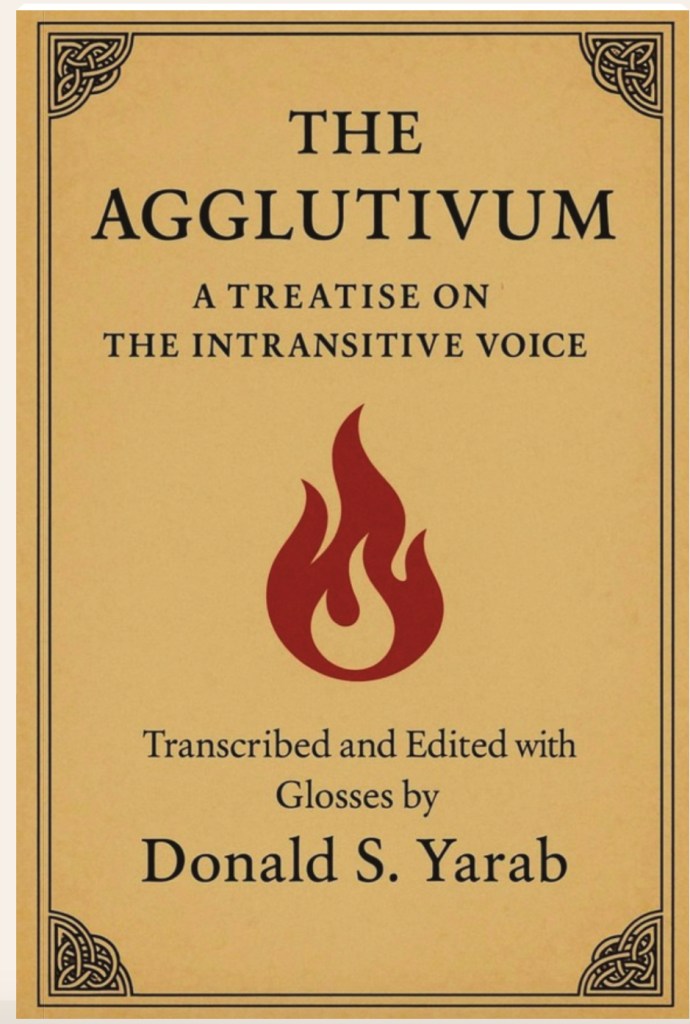
The Agglutivum: A Treatise on the Intransitive Voice Transcribed and Edited with Glosses by Donald S. Yarab Paperback, 58 Pages, 6in × 9in, $7.99 plus $5 postage CLICK IMAGE ABOVE TO ORDER BOUND COPY
It is difficult to describe the Liber Agglutivi, or as translated into English, The Agglutivum: A Treatise on the Intransitive Voice, for both its origin and content resist conventional classification. Its genesis, as I recount within the pages themselves, was not intellectual but oneiric. The word agglutive—unknown to me then, undefined in any language I knew—visited me repeatedly in sleep. So compelling was its sound and weight that, upon waking, I began at once to give breath to the whisper that had haunted my rest. What emerged was not story or doctrine, but something stranger and perhaps more elemental.
The text that followed felt less composed than revealed—an excavation rather than a construction. It is, in the truest sense, a received work. Its structure—voculae, glosselitha, silentia, postverba—appeared as if drawn from some hidden grammar beneath ordinary speech. Though shaped in Latin (with an English translation as appendix) and framed by scholarly apparatus, it is not a parody nor a pastiche, but a sincere tribute to the metaphysical impulse in language.
Readers may find echoes of Borges, Vico, and Pseudo-Dionysius; others may see affinities with mystical traditions, liturgical fragments, or even speculative linguistics. It may be read as fictive scripture, poetic glossolalia, philosophical provocation, or theological shadowplay. Or perhaps—if read rightly—it is none of these, but instead a call to silence, to memory, to the threshold of meaning itself.
Let it be said plainly: this work will not appeal to all. It is slow and strange, elliptical and spare. But for the rare reader attuned to the hum beneath the words we know, it may, in its own agglutive way, speak.
The work is available to read through the link below as a free PDF. For those who find affinity with it, an inexpensive bound copy may be ordered by clicking the image of the book above.
A Contemporary Meditation Inspired by the Liber Agglutivi
The Agglutivum suggests but does not systematize a catalog of words that resist conventional grammar—words that seem to create rather than merely describe reality. What follows is a modern attempt to identify and explore such “ontological voculae,” developed in the spirit of the medieval treatise but acknowledging its contemporary construction.
Voculae Agglutivae
A Supplement to the Glossarium Philosophicum Non omnia verba dicuntur ut loquantur. Quaedam dicuntur ut fiant.
I. Sacra Voculae – Sacred Utterances
These words do not inform; they summon. Often liturgical, they retain weight through resonance, not explanation.
Amen Confirmatio sine contentu. —What is confirmed is not always known.
Alleluia Laus pura, sine scopo. —Praise that outruns its object.
Kyrie Clamor, non formula. —Not request, but primal cry.
Hosanna Eruptio, non enuntiatio. —A word of ascent, not address.
Om / Aum Vox quae se ipsam audit. —The breath that sustains itself.
II. Voculae Primitivae – Primal Expressions
Pre-conceptual utterances: the first stirrings of meaning, or the last.
Yes Vocabulum consentientis animae. —Affirmation without argument.
No Negatio sine opposito. —The first refusal of the void.
The Counterpoint of Ponder, O Morpheus, the Night Sky
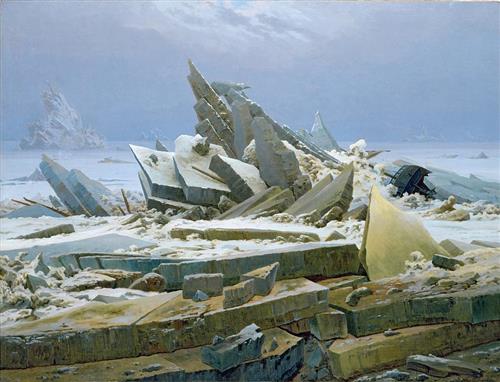
Caspar David Friedrich, The Sea of Ice, also called The Wreck of Hope Oil on canvas, 96.7 cm × 126.9 cm (1823–1824).
On the Unmaking of Benediction
This cycle of verses—The Inversion Cycle—emerged not as a contradiction, but as a counterweight to The Blessing of Morpheus: The Sending Forth, a series of benedictions articulated in reverent tones and metaphysical gestures within the poem Ponder, O Morpheus, the Night Sky. That earlier work was rooted in the soul’s deep yearning toward the ineffable, culminating in luminous affirmations bestowed by the dream-god Morpheus upon the seeker. In time, those benedictions came to feel too complete, too resolved. I began to wonder: what if they failed?
TheInversion Cycle is not blasphemy, but a form of apophatic honesty. It does not seek to erase Ponder, but to stand beside it—its negative counterpoint. Each scroll of the cycle corresponds to a specific line or blessing from Ponder and performs an act of unmaking: where Morpheus blesses, these verses refrain; where he sends the seeker into mystery, these verses stall at the threshold; where he assures, they withhold.
To honor that reversal, a further restraint was imposed: the exclusion of the very vocabulary upon which the original work (and many of my other recent works) so often relied. Words such as breath, dust, light, shadow, silence, and memory—among others—have been set aside. Their absence is not a loss but a signal. These are not the tools we are permitted to carry here.
The scrolls appear here in the same order as the benedictions from Ponder, O Morpheus, the Night Sky. This reversal respects the original arc—from the loosening of dreams to the transformation of the soul—and follows its negative path with precision.
What remains is austerity, not despair. These unsacraments do not offer consolation, but they do speak. If Ponder was a song of ascent, then this is the long exhale after the music ends—a psalter of withheld grace, composed in the space where blessing does not descend.
Let this work be read not in defiance of belief, but in the trembling of its undoing. For if it is brave to bless, it is perhaps braver still to stand in the space where blessing will not come—and write there, in the dust, what remains.
Scroll I: Of the Clinging Husk
Let not your dreams fall— for they will not fall. They remain, clinging like husks unpicked, blackened not by season, but by refusal.
You will try to cast them down, but they are fastened, not to limb, but to marrow.
They do not curl like leaves. They do not return to soil. They sour upon you, a bitterness in the sinew, a ferment in the thought.
And if you turn to shake them loose, they will tighten. Their threads are not of sleep, but of habit, knotted in long forgetting.
There is no wind to lift them. No frost to loosen them. No gardener comes.
Remain, then, beneath their burden— bent, unshed, unchanged.
Scroll II: Of the Inscribed Weight
Take them. You will take them. You cannot help it.
The names carved into stone, the words burned into walls, the cries etched into earth— they cling not to your pack, but to your ribs.
You bear them not as titles, but as scars.
They whisper through your marrow, resisting every act of unmaking. You try to enter the place without form, but they speak before you. They call the ground by its old name, and the gate does not open.
Even the sky does not answer when it hears them rising again.
These names were not carved to remember. They were carved to bind.
And now, as you stand at the edge of the place where all naming ends, they press their syllables against your tongue, and you speak them, not in defiance, but because you cannot forget.
Scroll III: Of Implements Abandoned
Bring not the weighted balances, nor the woven snares of longing. They do not hold, not here.
Their handles crack in the frost where no stars rise to bless the hour. Their mesh is brittle—threaded not of wool, but of claims left too long in the mouth.
The mind, honed to edge, cuts only fog in this place. The heart, cupped too gently, spills what it never held.
There are no laurels in this soil, only reeds that do not bend and brambles that do not bleed.
And should you cast such tools before you, expecting fruit, or fire, or favor— they will return to you as ash, unsought, unshaped, the chaff of means mistaken for ends.
Scroll IV: Of the Withheld Offering
Bring not your hollowed chest, stripped clean of ornaments and plea. It will not be filled.
Wonder has no purchase here. Its gaze returns unreflected from stone too smooth to be shaped.
Let the mind remain loud and unyielding, for awe would shatter in this poise like frost-cracked bronze.
As for your feet— do not lift them. There is no basin here, only ground dry from the beginning, lined with rings that do not ripple.
The wind does not attend. It does not lift. It does not listen.
There is no path across this floor, only grit, and the marks of those who came thinking they would walk upon revelation.
Scroll V: Of the False Horizon
Do not seek. There is no one to be found.
The sea does not receive you. It is not fluid, but glare stretched to the edge of motion— shimmering not with promise, but with mirage.
You did not launch. You drifted. And your craft was not chosen, but assigned, drawn from timbers meant for no voyage.
The sky above you swells with stars, but none are true. Each one marks a path that bends inward, circling you back to your forgetting.
You will think you move. You will call it seeking. You will call it bold. But you are already known by the thing that does not answer. And it has left no threshold, only wind that cannot be charted and depth that does not hold.
Scroll VI: Of the Barren Threshold
There is no beyond. Only the gray field where sleep forgets its end and waking does not begin.
Here, nothing waits. Not voice, not veil, not even the last gasp of wonder.
What lies past dream is not fullness, but poise robbed of sanctity— the deafness of stones before their naming.
No stars ever hung above this place. No fire traced its vault. Only pallor, dull as bone in a dry shrine, untouched by flame or veil.
And death, so often imagined a gate, has no depth here. It is shallow, crusted, and holds nothing but its own refusal.
Let no one say this place is holy. It is not what remains made full— but vacancy made permanent.
A place unmourned. Uncalled. Unmade.
Scroll VII: Of the Unbecome
Go not. There is nowhere that calls. No road unfurls before you, no veil parts, no watchful eye lingers on your vanishing.
The question you bore was not accepted. It curled back into you, like a tongue that feared its own utterance.
You will not be shaped by asking, nor known by your seeking. You will remain as you were before the yearning— a vessel without fracture, never poured, never filled.
No sound will rise behind you. No trace will stir where your feet passed. Even the soil will forget your weight.
Be still, not in peace, but in the form that does not unfold. Remain—not as the question— but as that which never found its shape.
Scroll VIII: The Soul Beneath the Blanched Sky
The soul, girded and unmoved, stood beneath a sky without veil— a dome blanched of fire, where nothing had ever gleamed, only ash adrift from unremembered pyres.
It bore no garment. No mark of calling or descent. It was as parchment without script, unhandled, unblemished, unread.
No winds stirred the plain. Only cairns rose in rows, not raised in reverence, but born of the land’s refusal to yield.
The trees there had no buds. Their limbs were stiff, as if carved for stillness— a forest of halted prayers. And beneath them, the roots did not seek nourishment, but curled inward, content in their forgetting.
There was no calm, no sacred pause. Instead, a muttering of syllables rose from the dry hollows— sounds without grammar, without bond, giving rise to no names, no intelligible form.
And when the soul pressed its palm to the ground, there was no spring, no pulse, only crusted clay— neither moist nor cracked, a firmness that would not give.
It asked nothing. Not from pride, but from knowing that some places are beyond summons— places where even longing has been turned to stone.






 Northcoast Antiquarian