
The Inversion Cycle: Eight Scrolls of Withheld Grace

The Counterpoint of Ponder, O Morpheus, the Night Sky
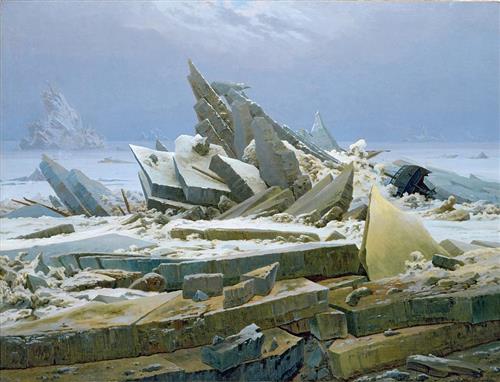

Caspar David Friedrich, The Sea of Ice, also called The Wreck of Hope 
Oil on canvas paint, 96.7 cm × 126.9 cm (1823–1824).
Caspar David Friedrich, The Sea of Ice, also called The Wreck of Hope
Oil on canvas, 96.7 cm × 126.9 cm (1823–1824).

On the Unmaking of Benediction

This cycle of verses—The Inversion Cycle—emerged not as a contradiction, but as a counterweight to The Blessing of Morpheus: The Sending Forth, a series of benedictions articulated in reverent tones and metaphysical gestures within the poem Ponder, O Morpheus, the Night Sky. That earlier work was rooted in the soul’s deep yearning toward the ineffable, culminating in luminous affirmations bestowed by the dream-god Morpheus upon the seeker. In time, those benedictions came to feel too complete, too resolved. I began to wonder: what if they failed?

The Inversion Cycle is not blasphemy, but a form of apophatic honesty. It does not seek to erase Ponder, but to stand beside it—its negative counterpoint. Each scroll of the cycle corresponds to a specific line or blessing from Ponder and performs an act of unmaking: where Morpheus blesses, these verses refrain; where he sends the seeker into mystery, these verses stall at the threshold; where he assures, they withhold.

To honor that reversal, a further restraint was imposed: the exclusion of the very vocabulary upon which the original work (and many of my other recent works) so often relied. Words such as breath, dust, light, shadow, silence, and memory—among others—have been set aside. Their absence is not a loss but a signal. These are not the tools we are permitted to carry here.

The scrolls appear here in the same order as the benedictions from Ponder, O Morpheus, the Night Sky. This reversal respects the original arc—from the loosening of dreams to the transformation of the soul—and follows its negative path with precision.

What remains is austerity, not despair. These unsacraments do not offer consolation, but they do speak. If Ponder was a song of ascent, then this is the long exhale after the music ends—a psalter of withheld grace, composed in the space where blessing does not descend.

Let this work be read not in defiance of belief, but in the trembling of its undoing. For if it is brave to bless, it is perhaps braver still to stand in the space where blessing will not come—and write there, in the dust, what remains.


Scroll I: Of the Clinging Husk

Let not your dreams fall—
for they will not fall.
They remain,
clinging like husks unpicked,
blackened not by season,
but by refusal.

You will try to cast them down,
but they are fastened,
not to limb,
but to marrow.

They do not curl like leaves.
They do not return to soil.
They sour upon you,
a bitterness in the sinew,
a ferment in the thought.

And if you turn to shake them loose,
they will tighten.
Their threads are not of sleep,
but of habit,
knotted in long forgetting.

There is no wind to lift them.
No frost to loosen them.
No gardener comes.

Remain, then, beneath their burden—
bent,
unshed,
unchanged.


Scroll II: Of the Inscribed Weight

Take them.
You will take them.
You cannot help it.

The names carved into stone,
the words burned into walls,
the cries etched into earth—
they cling not to your pack,
but to your ribs.

You bear them not as titles,
but as scars.

They whisper through your marrow,
resisting every act of unmaking.
You try to enter the place without form,
but they speak before you.
They call the ground by its old name,
and the gate does not open.

Even the sky does not answer
when it hears them rising again.

These names were not carved to remember.
They were carved to bind.

And now,
as you stand at the edge
of the place where all naming ends,
they press their syllables
against your tongue,
and you speak them,
not in defiance,
but because you cannot forget.


Scroll III: Of Implements Abandoned

Bring not the weighted balances,
nor the woven snares of longing.
They do not hold,
not here.

Their handles crack in the frost
where no stars rise to bless the hour.
Their mesh is brittle—threaded not of wool,
but of claims left too long in the mouth.

The mind, honed to edge,
cuts only fog in this place.
The heart, cupped too gently,
spills what it never held.

There are no laurels in this soil,
only reeds that do not bend
and brambles that do not bleed.

And should you cast such tools before you,
expecting fruit, or fire, or favor—
they will return to you as ash,
unsought, unshaped,
the chaff of means
mistaken for ends.


Scroll IV: Of the Withheld Offering

Bring not your hollowed chest,
stripped clean of ornaments and plea.
It will not be filled.

Wonder has no purchase here.
Its gaze returns unreflected
from stone too smooth to be shaped.

Let the mind remain loud and unyielding,
for awe would shatter in this poise
like frost-cracked bronze.

As for your feet—
do not lift them.
There is no basin here,
only ground dry from the beginning,
lined with rings that do not ripple.

The wind does not attend.
It does not lift.
It does not listen.

There is no path across this floor,
only grit,
and the marks of those who came
thinking they would walk upon revelation.


Scroll V: Of the False Horizon

Do not seek.
There is no one to be found.

The sea does not receive you.
It is not fluid,
but glare stretched to the edge of motion—
shimmering not with promise,
but with mirage.

You did not launch.
You drifted.
And your craft was not chosen,
but assigned,
drawn from timbers
meant for no voyage.

The sky above you swells with stars,
but none are true.
Each one marks a path
that bends inward,
circling you back to your forgetting.

You will think you move.
You will call it seeking.
You will call it bold.
But you are already known
by the thing that does not answer.
And it has left no threshold,
only wind
that cannot be charted
and depth that does not hold.


Scroll VI: Of the Barren Threshold

There is no beyond.
Only the gray field where sleep forgets its end
and waking does not begin.

Here, nothing waits.
Not voice, not veil,
not even the last gasp of wonder.

What lies past dream is not fullness,
but poise robbed of sanctity—
the deafness of stones
before their naming.

No stars ever hung above this place.
No fire traced its vault.
Only pallor,
dull as bone in a dry shrine,
untouched by flame or veil.

And death,
so often imagined a gate,
has no depth here.
It is shallow, crusted,
and holds nothing but its own refusal.

Let no one say this place is holy.
It is not what remains made full—
but vacancy made permanent.

A place unmourned.
Uncalled.
Unmade.


Scroll VII: Of the Unbecome

Go not.
There is nowhere that calls.
No road unfurls before you,
no veil parts,
no watchful eye lingers on your vanishing.

The question you bore
was not accepted.
It curled back into you,
like a tongue that feared its own utterance.

You will not be shaped by asking,
nor known by your seeking.
You will remain
as you were before the yearning—
a vessel without fracture,
never poured,
never filled.

No sound will rise behind you.
No trace will stir where your feet passed.
Even the soil will forget your weight.

Be still, not in peace,
but in the form that does not unfold.
Remain—not as the question—
but as that which never found its shape.


Scroll VIII: The Soul Beneath the Blanched Sky

The soul, girded and unmoved,
stood beneath a sky without veil—
a dome blanched of fire,
where nothing had ever gleamed,
only ash adrift from unremembered pyres.

It bore no garment.
No mark of calling or descent.
It was as parchment without script,
unhandled, unblemished, unread.

No winds stirred the plain.
Only cairns rose in rows,
not raised in reverence,
but born of the land’s refusal to yield.

The trees there had no buds.
Their limbs were stiff, as if carved for stillness—
a forest of halted prayers.
And beneath them,
the roots did not seek nourishment,
but curled inward,
content in their forgetting.

There was no calm,
no sacred pause.
Instead, a muttering of syllables
rose from the dry hollows—
sounds without grammar,
without bond,
giving rise to no names,
no intelligible form.

And when the soul pressed its palm
to the ground,
there was no spring,
no pulse,
only crusted clay—
neither moist nor cracked,
a firmness that would not give.

It asked nothing.
Not from pride,
but from knowing
that some places are beyond summons—
places where even longing
has been turned to stone.

Widening the Gate: The Moral Imperative of Scholarly Apparatus in Poetry

The article argues that the inclusion of scholarly apparatus in poetry should not be seen as an act of insecurity but as a moral imperative to enhance accessibility and understanding. Providing notes and allusions demonstrates trust in the reader’s intellect and invites deeper engagement with complex literary traditions, enriching the overall poetic experience.


Dante and Virgil in Hell by William-Adolphe Bouguereau (1850).
 Oil on canvas, 281 × 225 cm. Housed in the Musée d'Orsay, Paris.
Dante and Virgil in Hell by William-Adolphe Bouguereau (1850).
Oil on canvas, 281 × 225 cm. Housed in the Musée d’Orsay, Paris.
Depicting a scene from The Divine Comedy, the painting shows Dante guided by the poet Virgil through the torments of the Inferno. This work reflects the enduring need for guidance through complex moral and literary landscapes—much like the role of scholarly apparatus in contemporary poetry.

In certain corners of literary criticism—particularly those shaped by the Bloomian anxiety of influence—the inclusion of scholarly notes in a poem is often regarded with suspicion. To annotate a poetic work, especially with theological or classical references, is, for some, a mark of insecurity or defensiveness. One does not footnote inspiration, the critic suggests, but cloaks inadequacy. This reading, however, reveals more about the critic’s own posture than the poet’s intent. It mistakes generosity for uncertainty, and accessibility for anxiety. In truth, the use of poetic apparatus is not a gesture of retreat but an act of moral clarity.

We no longer inhabit a culture rooted in shared canonical memory. The contemporary reader cannot be presumed to recognize the traces of Augustine or the subtleties of Pauline inversion, nor even the resonances of Lamentations or Miltonic cadence. These once-communal touchstones have grown faint in our fragmented intellectual landscape.

To scatter phrases drawn from such traditions across the page without interpretive aid would not constitute noble restraint—it would be fundamentally exclusionary. One does not prove a poem’s strength by ensuring its opacity to all but the initiated few.

The poet who situates their work within a sacred, historical, or theological lineage and yet withholds the keys to that lineage commits a kind of aesthetic pride. This is the true arrogance: to assume that those who do not immediately perceive are unworthy to understand. In contrast, the provision of notes, allusions, and apparatus is a statement of trust in the reader’s intellectual capacity. It affirms that the reader, though perhaps unfamiliar with particular traditions, is capable of knowing, and thus worthy of invitation into deeper engagement.

Poetic apparatus, when thoughtfully deployed, functions as both guide and companion. It allows the reader to move through layered landscapes without stumbling in darkness. Notes illuminate without overwhelming; they offer pathways, not prescriptions. Just as Dante needed Vergil to navigate the underworld in The Divine Comedy, the modern reader may need scaffolding to ascend the difficult terrain of a theologically-inflected poem. That scaffolding supports not the poem’s inadequacy, but the reader’s journey—and facilitating such journeys is a moral imperative in cultural stewardship.

This approach is not a concession to mediocrity, but a rejection of unnecessary elitism. It demonstrates a commitment to write in full fidelity to tradition without surrendering one’s audience to the assumptions of a forgotten world. When T.S. Eliot appended notes to The Waste Land, he was not performing obscurantist affectation, but rather acknowledging the changing literacy of his readership. His doing so sparked considerable controversy, suspicion, and derision. However, the changing literacy of readership since his day has only deepened and accelerated. Thus, the poet who provides apparatus performs not an act of scholarly vanity but of intellectual hospitality.

Indeed, there is a didactic purpose inherent in such practices: poetry can instruct, not through reductive simplicity, but through guided complexity. The notes, like glosses or scholia in ancient texts, become part of the total work—a parallel conversation between poet and reader. They remind us that poetry is a learned art—not reducible to mere sentiment, nor severed from thought. To annotate is to take seriously both the lineage of one’s words and the intellectual capacity of one’s reader.

In our digital age, we have expanded possibilities for such apparatus—hyperlinks, separate commentary documents, and layered presentations that neither overwhelm the poem’s aesthetic integrity nor abandon readers to unnecessary confusion. These technologies allow for graduated engagement: the poem stands complete for those prepared to receive it directly, while additional resources await those seeking deeper understanding.

Crucially, providing scholarly apparatus never constrains the reader’s interpretive freedom. Each reader brings their own experience and knowledge to a text, often discovering meanings the author never intended or foresaw. The best annotations create access without dictating understanding—they open doors without determining which path the reader must take once inside. This dynamic relationship between authorial context and reader interpretation is not a liability but one of literature’s most profound gifts.

The poet may still be misunderstood. There will be those who persist in reading apparatus as apology, footnotes as armor against criticism. But the deeper truth is that to offer one’s learning as aid is not to retreat from art, but to expand its possibility. It is an act of humility, yes—but also of instruction, of preservation, and above all, of invitation.

Poetic footnotes, then, are not defensive gestures. They are moral acts. They widen the gate; they refuse the cloister. In an age of forgetting, they are essential—if tradition is to live not as relic, but as inheritance: vital, vivid, and available to all who would receive it.

Lacrimae Sanguinis: A Lamentation

“He shall cover His face, that He see not the land;
He shall cover His eyes, that He see not this people.”
— Paraphrased and theologically inverted from Isaiah 47:3

Hate, greed, and fear—forces both ancient and renewed—walk our world masked as necessity, embraced by many with cultish fervor. Their dominion is not imposed but invited—enthroned by a generation that traded justice for the comfort of certainty, mercy for the illusion of control, and truth for pestilent lies that fester beneath the tongue. In such an age, we speak of freedom while erecting altars to power.

Lacrimae Sanguinis (Tears of Blood) offers no balm. It is not a prayer for deliverance but a record of recognition—set in four movements, each marking a descent through abandonment, distortion, silence, and despair. Divine silence, once borne as mystery, now echoes as judgment. This is no resolution, only the slow, unredemptive unfolding of what we have chosen not to see.


John Martin, The Destruction of Sodom and Gomorrah (c. 1852)
oil on canvas, 136.3 cm × 212.3 cm (53.7 in × 83.6 in)
Laing Art Gallery, Newcastle upon Tyne

Lacrimae Sanguinis 2025: A Lamentation in Four Movements

By Donald S. Yarab

I.

Lacrimae sanguinis,
Animae nigrae hominum terram maculant.
They walk not as men, but as shadows unshriven,
Each step a silence, each breath a wound.
The ground groans beneath the weight of the fallen,
And justice, long buried, forgets her name.
No trumpet sounds for the guiltless slain,
Only the whisper of blood in the dust.¹

Lacrimae sanguinis—
The blackened souls of men stain the earth.


II.

Hate kindles fires no rain can quell,
Greed carves its name in the marrow of kings.
Fear is a vulture, circling unborn hopes,
Its wings beating lies into trembling hearts.
These three—unholy trinity—march undenied,²
And temples crack beneath their tread.
Where once stood gardens, now only ash—
And the breath of God withdraws in sorrow.³

Lacrimae sanguinis—
The blackened souls of men stain the earth.


III.

No voice comes forth from the cloud or flame,
The heavens are sealed in unyielding hush.⁴
The stars avert their gaze, and time forgets its course—
Even the winds have ceased to speak His name.
Altars stand cold, their offerings stale,
And the priest no longer lifts his hands.
The silence is not peace, but exile—
A stillness too vast for prayer to fill.⁵

Lacrimae sanguinis—
The blackened souls of men stain the earth.


IV.

He turned His face—and we, our backs.⁶
Not in wrath, but in weary disdain.
The mirror cracked, the image lost,
And we wander, eyes open yet unseeing.⁷
We build our Babels in crumbling dust,
Raise thrones upon bones, call ruin law.
Light knocks, but we bolt the gate from within—
And call the silence proof He never was.⁸

Lacrimae sanguinis—
The blackened souls of men stain the earth.


Footnotes:

  1. “Shadows unshriven” / “Justice… forgets her name” — Cf. Psalm 82:6–7 and Isaiah 59:14–15. Echoes of prophetic lament over moral collapse and unreconciled souls.
  2. “Unholy trinity” — An inverted image of Augustine’s De Trinitate: hate, greed, and fear form a perverse sacred order.
  3. “Gardens turned to ash” — Evokes Eden undone. The breath of God (Genesis 2:7) has withdrawn.
  4. “The heavens are sealed” — Amos 8:11–12; Lamentations 3:8. Divine silence as the most damning judgment.
  5. “Silence… not peace, but exile” — Apophatic void, not luminous unknowability. Cf. Isaiah 45:15: Deus absconditus.
  6. “He turned His face” — Inverts the Aaronic blessing (Numbers 6:24–26). A divine turning not in anger, but in sorrowful withdrawal.
  7. “Mirror cracked” — A fall from incomplete vision (1 Corinthians 13:12) into permanent distortion.
  8. “Call the silence proof He never was” — Resonates with Nietzsche’s “God is dead,” here framed as mutual estrangement, not denial.

Note: The image of the soul as stained through inordinate attachment finds classical expression in Summa Theologica I–II, Q.86, Art.1, where Aquinas defines sin’s stain not as a substance, but as a privation of the soul’s brightness—a metaphorical shadow cast when the soul cleaves inordinately to created things, against reason and divine order. In this lamentation, the stain is projected outward: what is blackened within stains the world without.

The Hush and the Breath

A Poetic Transformation

Some texts are not revised so much as they are reheard. After publishing my essay Between Noise and Silence: On the Literal, the Metaphoric, and the Space Where Meaning Resides, I found myself haunted by one sentence in particular:

“It is the hush in a conversation—not the words, but the breath that precedes or follows them—that can speak more profoundly than the speech itself.”

Those words returned to me again and again. And in their insistence, they asked for more.

The following poetic fragment emerged in response.
It is offered here as a kind of imagined rediscovery—
a scroll unearthed, not written; gathered, not composed.
Said to be copied from a fragment attributed to the Scribe of the Restoration, it may be read as a poetic conceit: a transformation of thought into voice, of prose into hush.


Ruach (Breath, Wind, Spirit — An Aureate Silence)
Intended as a visual companion to Scroll of the Breath – Fragment III, evoking the unseen architecture of spirit and the luminous hush before the word.

Scroll of the Breath — Fragment III

It is the hush in a conversation—not the words, but the breath that precedes or follows them—that can speak more profoundly than the speech itself.
(Saying attributed to the Elder in exile, during the Years of Listening.)

1
There is a hush that is not silence.
It is the waiting before the word.
It is the veil drawn back,
not by hands,
but by reverence.

2
It is the pause in the soul,
where meaning prepares to enter.
It is not the absence of presence,
but presence unadorned.

3
And breath—
Breath is not speech.
It is the spirit moving before sound.
It is the wind before the voice,
the current beneath the utterance.

4
The sages of old did not name this breath lightly.
In the tongue of the first covenant, they called it ruach—
wind, breath, spirit.
It moved across the waters.
It entered the nostrils of clay.
It bore the world on its whisper.

5
Do not rush past the hush.
Do not cast out the breath.
The hush is the cradle of truth.
The breath is its midwife.

6
In the sacred gatherings,
before the chant begins,
there is a breath.
It is not sung,
yet the song is born of it.

7
In the way of the temple,
the priest lifts the cup.
But before he speaks the ancient words,
there is a breath.
In that breath,
time bends,
and the Presence leans close.

7a
And in the house of the laborer,
the mother bends to lift the child.
But before she speaks comfort,
there is a breath.
In that breath, love gathers strength.
In that hush, sorrow is made bearable.

8
In the theatre of the East,
the dancer stands still.
The motion does not begin with movement,
but with breath.
So too the soul.

9
The hush is not confusion.
It is awe.
The breath is not delay.
It is consecration.

10
Blessed is the one who waits without speaking.
Blessed is the one who breathes before declaring.
For wisdom comes not in haste,
but in readiness.

11
And if you seek the voice of the Holy One,
look not in the thunder,
nor in the fire,
nor in the noise of many things.

12
But listen in the hush.
Watch in the breath.
And there—
you may find what does not speak,
but knows.

13
The scribe gathers what the wind leaves behind.
Not with hands,
but with silence.
Not in speech,
but in breath.
He walks as dust that remembers flame.
The fragments are many,
but the hush makes them whole.