What happens when the characters tumble from their tales? When rhyme stumbles, and the Goose remembers? In this playful and poignant poem, nursery rhymes unravel, fairy tales awaken, and the stories themselves walk past their plots.“Once Upon Askew” is a whimsical reflection on the lives of stories—and those who dwell within them.
or, The Story That Would Not Sit Still by Donald S. Yarab
Listen, child—I am the Old Grey Goose, And I was there when books came loose, When volumes tumbled, pages flew, And all the stories mixed like stew.
It started with a mighty thud— Books falling open, words like mud, All swirling, mingling, line by line, Till Alice’s world came mixing into mine.
“Curiouser and curiouser!” she cried, Right into Cow’s green pasture-side, Where “Hey Diddle Diddle” used to play— Now Cow asks questions all the day.
The Spoon caught Alice’s strange delight, Abandoned dishes, fled by night, Beneath a moon from whose bright story— From Carroll’s tale or Goose’s glory?
I squawked from my own tumbled page— Which book? What tale? What ancient age? While Cat’s grin stretched across our scene, Belonging nowhere, everywhere seen.
We passed the wall where once he sat— Poor Humpty, puzzled, round, and flat. Though patched, he watches, cracked but clear, And murmurs, “Not all ends end in fear.”
But one lay still beyond the swirl— A slumbering, untouched young girl. The tales all passed; she did not wake, No prince, no plot her trance to break. Yet in her stillness, something stirred— A dream not shaped by spoken word.
We found Red Riding Hood alone, Her basket lost, her sure path gone. The Wolf came next—not sly, but stunned, As if unsure what he had done. They walked apart, then side by side, Two stories stripped of fear and pride, Each wondering if what they knew Was ever really, wholly true.
So off we walked, this mixed-up crew: Alice with questions, Cow with moo That carried wisdom, Spoon with light From every moon and every night.
Behind us trailed the broken bits— Half-rhymes and verbs that sought their fits, Metaphors in mismatched dancing shoes, Still seeking out their missing clues.
No longer bound by story’s rules, We’d become something new, no fools— Not quite the characters we’d been, Not free of them—but in between.
And hovering above our band, That smile from Cheshire’s distant land— A grin that needs no cat to hold, A question that will not be told.
This is what happens, child, you see, When stories tumble, wild and free— They find they’re more alike than not, And walk together past their plot.
Some time ago—perhaps a year or more—I shared the thought with a friend that, in the absence of a life partner, career milestones, or the outward markers many associate with ongoing joy and fulfillment, I found myself sustained by something smaller, more elusive, yet no less profound: moments. Fleeting as they are, these glimpses—of joy, beauty, tenderness, or connection—carry a weight that lingers long after they pass. Whether in laughter with a friend, a burst of color in nature, the unexpected joy found in art and music, or the hush of shared silence, these moments are what remain.
This conversation was brought to mind earlier today, during a pause in some simple yard work. A robin—one I have come to recognize—perched beside me on a rock for nearly twenty minutes. He did not fly, only hopped, watching me as if we were resting together. That brief companionship, quiet and unexpected, brought back the full force of that earlier insight.
The poem that follows is a first, rough attempt to give shape to that reflection.
This robin, who kept me quiet company, reminded me of the beauty in small moments—and even allowed me, kindly, to take his portrait.
Moments
by Donald S. Yarab
After so long, I see it now— life is not the grand arc we thought we were writing, not triumph etched in time or years stacked with care. It is moments.
The held door, a beat longer than required. A cloud painting itself across the sky. A flower blooming through a crack in concrete.
The hum of a bee, the song of a bird, a friend’s first hello— welcome, familiar music in the air. Laughter spilling like light through a quiet room.
A touch that speaks without language. Sunlight flickering through leaves— nature’s own Morse code. The warm drift from the kitchen: garlic, hope, onions, memory.
The first bite of something sweet dissolving on the tongue. The joy of someone you love laughing till they snort, till they can’t breathe, till you’re laughing too at nothing, at everything.
These— small rebellions against the world’s weight: its monotony, its cold indifference.
But the moments— oh, they persist. They slip through the cracks of our hardest days and remind us why we stay, why we watch, why we dare to hope for just one more:
one more kindness, one more beauty, one more laugh, one more flicker of light— each a defiance, each a benediction in this brief, bright, impossible gift of being alive.
A Reflection Interwoven with Ante Verba, Verba, and Postverbum
Cy Twombly (1928-2011), Untitled 2005, acrylic on canvas, 128 x 194½ in “His madness is a circle of fire, an unbroken circuit of excess, each attempt at containment spilling into the next”—Art historian Malcolm Bull on the Bacchus paintings.
The three poems, CARMINA TRIA: DE VOCE AGGLUTIVA, which follow—Ante Verba, Verba, and Postverbum—did not emerge by design. They followed Liber Agglutivi as if by necessity. Once the treatise had been written, these poems had to be. They are not commentaries on the Liber, nor are they didactic restatements of its metaphysical claims. Rather, they are its echo—its ember. They are the hymns sung at the threshold that Liber Agglutivi only describes.
Even readers unfamiliar with the medieval-inspired treatise can enter these poems directly. They function as meditations on how language lives in us before we speak it, while we speak it, and after our words have fallen silent. Readers of the Liber will recognize these concerns, but the poems make them immediate and felt rather than theoretical.
They move through language as tremor, fire, and resonance. The sequence below mirrors the deeper structure of the Liber: from the agglutum primitivum (pre-verbal memory), to the verbum intransitivum (word as creation), to the postverbum and glosselitha (residual presence).
CARMINA TRIA: DE VOCE AGGLUTIVA
I. Ante Verba
Language as Tremor, Silence as Light
Ante Verba (Versus ad limen vocis) Verbum non dicitur, sed fit. Non transit, sed regnat. Nomen quod loquitur se ipsum non oritur ex ore, sed ex ossibus. Lingua non fert sensum, sed tremorem. Memoria quae nescit quid meminerit audit quod non sonat. Tacere est tangere lumen. Loqui est amittere formam, ut recipiatur flamma.
Before Words (Verses at the threshold of voice) The word is not spoken, but becomes. It does not pass through, but reigns. The name that speaks itself arises not from the mouth, but from the bones. Language carries not meaning, but tremor. Memory that knows not what it remembers hears what does not sound. To be silent is to touch light. To speak is to lose form, so that the flame may be received.
This poem inhabits the space where language has not yet been spoken but is already forming. It suggests that words do not begin with speech—they begin with the body, with memory, with a force older than conscious thought. In the Liber, this is called the agglutum primitivum—the murmur that speaks itself rather than being spoken.
The line “non oritur ex ore, sed ex ossibus” (“arises not from the mouth, but from the bones”) aligns with Martin Heidegger’s vision in Letter on Humanism, where language is not a tool but the “house of Being.” Maurice Blanchot, in The Writing of the Disaster, understands silence not as negation but as a paradoxical mode of presence—a vision we carry forward in our own line from Ante Verba: “Tacere est tangere lumen.”
The poem resists the tendency to think of silence as a void. It suggests instead that silence is already full—that the word is merely what breaks the threshold.
II. Verba
Language Does Not Carry Meaning—It Generates It
Verba Non instrumenta, sed ignes. Non indicia, sed invocationes. Ex spiritu fiunt formae. Ex sono fit lumen. Verbum non portat sensum; generat. Non sequitur lucem; effundit eam. Obliti sumus verba sentire— at illa nos sentiunt.
Words Not instruments, but fires. Not signs, but invocations. From spirit, forms arise. From sound, light is made. The word does not carry meaning; it generates it. It does not follow light; it pours it forth. We have forgotten how to feel words— but they feel us.
Verba shifts from anticipation to ignition. Here, the word becomes flame. It does not describe; it creates. This is the essence of the verbum intransitivum found in the Liber—a word that does not pass meaning from subject to object, but emits meaning by its very being.
This echoes Jacques Derrida’s insight in Of Grammatology: that language does not simply transmit ideas—it generates meaning anew with every utterance. Jean-Paul Sartre in What is Literature? treats language as an existential act, not a report, and this vision is mirrored in the line “Verbum non portat sensum; generat.”
The agglutivum, as the Liber defines it, is precisely this: a word that binds meaning not through grammar, but through presence. The poem closes with a reversal: it is not we who perceive words, but words that perceive us.
III. Postverbum
The Spectral Afterlife of Language
Postverbum Verbum abit, sed tremor manet. Non vox, sed vestigium vocis. Non lumen, sed fulgor in ruina. Post verbum non est silentium, sed memoria quae loqui recusat. Forma cecidit— resonantia viget. Non est oblivio, nec repetitio. Est remanentia sine nomine. Quod dictum est, abit. Quod vivit, remanet.
After-Word The word departs, but the tremor remains. Not voice, but the trace of voice. Not light, but gleam within ruin. After the word there is not silence, but memory that refuses to speak. Form has fallen— resonance thrives. It is not forgetting, nor repetition. It is remainder without name. What has been spoken departs. What lives remains.
What remains when the word falls away? Postverbum addresses the residue of speech, its spectral persistence. The Liber speaks of the glosselitha—words no longer active but still resonant. This poem inhabits that after-space: where meaning is not present, yet not gone.
Derrida’s trace (especially in Writing and Difference) hovers here: a remnant of presence that cannot be fully recovered, nor fully lost. Nietzsche, in The Gay Science, evokes this through the fragment—the broken form more alive than the whole. And Bachelard’s “intimate immensity,” in The Poetics of Space, seems apt: the vast echo of what once was word.
This is not nostalgia. It is presence beyond sound.
Coda: Language as Tremor, Fire, Trace
The poems above are not marginal to Liber Agglutivi—they are its liturgy. They enact what the treatise evokes: a philosophy of speech where the word is not a vessel but a lifeform.
If the Liber speaks of agglutive words—words that bind not by syntax but by resonance—then these poems are agglutive acts. They offer no argument. They offer invocation.
Together, they invite us to listen differently—not just to what we say, but to what speaks through us when we are most quiet, most present, most alive to the mystery of having language at all.
The Counterpoint of Ponder, O Morpheus, the Night Sky
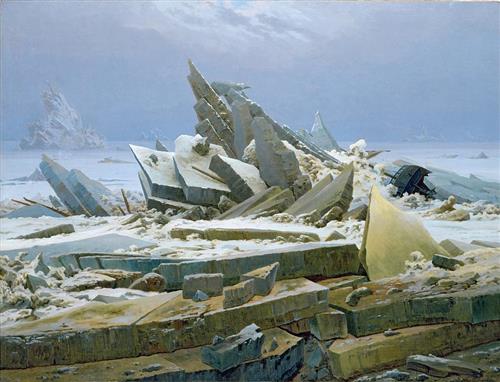
Caspar David Friedrich, The Sea of Ice, also called The Wreck of Hope Oil on canvas, 96.7 cm × 126.9 cm (1823–1824).
On the Unmaking of Benediction
This cycle of verses—The Inversion Cycle—emerged not as a contradiction, but as a counterweight to The Blessing of Morpheus: The Sending Forth, a series of benedictions articulated in reverent tones and metaphysical gestures within the poem Ponder, O Morpheus, the Night Sky. That earlier work was rooted in the soul’s deep yearning toward the ineffable, culminating in luminous affirmations bestowed by the dream-god Morpheus upon the seeker. In time, those benedictions came to feel too complete, too resolved. I began to wonder: what if they failed?
TheInversion Cycle is not blasphemy, but a form of apophatic honesty. It does not seek to erase Ponder, but to stand beside it—its negative counterpoint. Each scroll of the cycle corresponds to a specific line or blessing from Ponder and performs an act of unmaking: where Morpheus blesses, these verses refrain; where he sends the seeker into mystery, these verses stall at the threshold; where he assures, they withhold.
To honor that reversal, a further restraint was imposed: the exclusion of the very vocabulary upon which the original work (and many of my other recent works) so often relied. Words such as breath, dust, light, shadow, silence, and memory—among others—have been set aside. Their absence is not a loss but a signal. These are not the tools we are permitted to carry here.
The scrolls appear here in the same order as the benedictions from Ponder, O Morpheus, the Night Sky. This reversal respects the original arc—from the loosening of dreams to the transformation of the soul—and follows its negative path with precision.
What remains is austerity, not despair. These unsacraments do not offer consolation, but they do speak. If Ponder was a song of ascent, then this is the long exhale after the music ends—a psalter of withheld grace, composed in the space where blessing does not descend.
Let this work be read not in defiance of belief, but in the trembling of its undoing. For if it is brave to bless, it is perhaps braver still to stand in the space where blessing will not come—and write there, in the dust, what remains.
Scroll I: Of the Clinging Husk
Let not your dreams fall— for they will not fall. They remain, clinging like husks unpicked, blackened not by season, but by refusal.
You will try to cast them down, but they are fastened, not to limb, but to marrow.
They do not curl like leaves. They do not return to soil. They sour upon you, a bitterness in the sinew, a ferment in the thought.
And if you turn to shake them loose, they will tighten. Their threads are not of sleep, but of habit, knotted in long forgetting.
There is no wind to lift them. No frost to loosen them. No gardener comes.
Remain, then, beneath their burden— bent, unshed, unchanged.
Scroll II: Of the Inscribed Weight
Take them. You will take them. You cannot help it.
The names carved into stone, the words burned into walls, the cries etched into earth— they cling not to your pack, but to your ribs.
You bear them not as titles, but as scars.
They whisper through your marrow, resisting every act of unmaking. You try to enter the place without form, but they speak before you. They call the ground by its old name, and the gate does not open.
Even the sky does not answer when it hears them rising again.
These names were not carved to remember. They were carved to bind.
And now, as you stand at the edge of the place where all naming ends, they press their syllables against your tongue, and you speak them, not in defiance, but because you cannot forget.
Scroll III: Of Implements Abandoned
Bring not the weighted balances, nor the woven snares of longing. They do not hold, not here.
Their handles crack in the frost where no stars rise to bless the hour. Their mesh is brittle—threaded not of wool, but of claims left too long in the mouth.
The mind, honed to edge, cuts only fog in this place. The heart, cupped too gently, spills what it never held.
There are no laurels in this soil, only reeds that do not bend and brambles that do not bleed.
And should you cast such tools before you, expecting fruit, or fire, or favor— they will return to you as ash, unsought, unshaped, the chaff of means mistaken for ends.
Scroll IV: Of the Withheld Offering
Bring not your hollowed chest, stripped clean of ornaments and plea. It will not be filled.
Wonder has no purchase here. Its gaze returns unreflected from stone too smooth to be shaped.
Let the mind remain loud and unyielding, for awe would shatter in this poise like frost-cracked bronze.
As for your feet— do not lift them. There is no basin here, only ground dry from the beginning, lined with rings that do not ripple.
The wind does not attend. It does not lift. It does not listen.
There is no path across this floor, only grit, and the marks of those who came thinking they would walk upon revelation.
Scroll V: Of the False Horizon
Do not seek. There is no one to be found.
The sea does not receive you. It is not fluid, but glare stretched to the edge of motion— shimmering not with promise, but with mirage.
You did not launch. You drifted. And your craft was not chosen, but assigned, drawn from timbers meant for no voyage.
The sky above you swells with stars, but none are true. Each one marks a path that bends inward, circling you back to your forgetting.
You will think you move. You will call it seeking. You will call it bold. But you are already known by the thing that does not answer. And it has left no threshold, only wind that cannot be charted and depth that does not hold.
Scroll VI: Of the Barren Threshold
There is no beyond. Only the gray field where sleep forgets its end and waking does not begin.
Here, nothing waits. Not voice, not veil, not even the last gasp of wonder.
What lies past dream is not fullness, but poise robbed of sanctity— the deafness of stones before their naming.
No stars ever hung above this place. No fire traced its vault. Only pallor, dull as bone in a dry shrine, untouched by flame or veil.
And death, so often imagined a gate, has no depth here. It is shallow, crusted, and holds nothing but its own refusal.
Let no one say this place is holy. It is not what remains made full— but vacancy made permanent.
A place unmourned. Uncalled. Unmade.
Scroll VII: Of the Unbecome
Go not. There is nowhere that calls. No road unfurls before you, no veil parts, no watchful eye lingers on your vanishing.
The question you bore was not accepted. It curled back into you, like a tongue that feared its own utterance.
You will not be shaped by asking, nor known by your seeking. You will remain as you were before the yearning— a vessel without fracture, never poured, never filled.
No sound will rise behind you. No trace will stir where your feet passed. Even the soil will forget your weight.
Be still, not in peace, but in the form that does not unfold. Remain—not as the question— but as that which never found its shape.
Scroll VIII: The Soul Beneath the Blanched Sky
The soul, girded and unmoved, stood beneath a sky without veil— a dome blanched of fire, where nothing had ever gleamed, only ash adrift from unremembered pyres.
It bore no garment. No mark of calling or descent. It was as parchment without script, unhandled, unblemished, unread.
No winds stirred the plain. Only cairns rose in rows, not raised in reverence, but born of the land’s refusal to yield.
The trees there had no buds. Their limbs were stiff, as if carved for stillness— a forest of halted prayers. And beneath them, the roots did not seek nourishment, but curled inward, content in their forgetting.
There was no calm, no sacred pause. Instead, a muttering of syllables rose from the dry hollows— sounds without grammar, without bond, giving rise to no names, no intelligible form.
And when the soul pressed its palm to the ground, there was no spring, no pulse, only crusted clay— neither moist nor cracked, a firmness that would not give.
It asked nothing. Not from pride, but from knowing that some places are beyond summons— places where even longing has been turned to stone.
The first lines of this poem came to me in the night—those strange hours when thought and dream pass like shadows through the mind. I awoke briefly, not fully, and the phrase lingered: between and betwixt dawn and dusk… and the inverse, between and betwixt dusk and dawn. I held onto it until morning, when I set it down in full light. The poem that followed is a meditation on those intervals—the thresholds of consciousness and the veils through which the soul moves in its waking and its dreaming.
What begins as a reflection on the daily arc—from sunrise to sunset—soon turns inward, toward the more uncertain passage between dusk and dawn, where memory, time, and identity unravel and reweave. The Heraclitean epigraph provides the key: “The waking have one common world, but the sleeping turn aside each into a world of his own.” Yet even that distinction, perhaps, is not so firm as it seems.
The accompanying painting—Whistler’s Nocturne in Black and Gold: The Falling Rocket—mirrors the poem’s atmosphere: its drift between form and dissolution, its reverent wondering, its silence punctuated by brief illumination. Together, word and image ask not what life is, but whether it is lived or dreamed—and what remains of us in either case.
James McNeill Whistler, Nocturne in Black and Gold: The Falling Rocket c. 1872–1877 | Oil on canvas, 60.3 × 46.6 cm Detroit Institute of Arts, Detroit
Betwixt the Spheres
by Donald S. Yarab
“The waking have one common world, but the sleeping turn aside each into a world of his own.” —Heraclitus, Fragment 89
Betwixt the dawn’s gold-burnished, trembling rise, And evening’s hush where embered echoes gleam, A soul drifts outward under waking skies— Or inward, through the latticework of dream.
Morning declares the world as firm and real, Noon lays its claim in certainties and fire, Yet twilight draws the veil we cannot feel, And sings the hush of unfulfilled desire.
The hours fall like leaves from unseen trees, Their passage soft, impermanent, and strange. Some name it life, who walk it by degrees— While others call it dream, and feel no change.
So tell me, when the final light has flown, And silence hangs, unbroken and immense— Was it a road we walked, and called our own, Or but a fleeting spark in dream’s pretense?
But what of time when sun has slipped from sight, And stars drift forth like seeds of the unknown? What voice is heard within the hush of night, When all the world lies still, and we—alone?
Between and betwixt the dusk and morning’s grace, A different kind of being comes to bloom: Where shadows speak, and time forgets its place, And long-dead voices gather in the gloom.
In sleep, the veil grows thin, the borders bend, And hours bleed into realms that none can chart. The soul recalls what lies beyond the end, And bears the hush of ages in its heart.
These hours are not lost—they are the deep, The ocean floor where buried visions gleam. From them we rise, like wanderers from sleep, Still marked by fire, still echoing the dream.
So stands the soul, on thresholds vast and wide, Between and betwixt the turning of the spheres— What seemed a life, a dream walks at its side, Measured not in hours, but in wonder—and in tears.






 Northcoast Antiquarian