In the photographs taken within the Oval Office (2017, 2025), the seat of American executive authority has been transformed into something older and stranger—a sanctuary of royal consecration. At its center sits Donald J. Trump, head bowed, encircled by ministers and advisers whose hands rest upon him in the gesture of impositio manuum, the laying on of hands. Their eyes are closed, lips moving in prayer, yet their posture speaks less of intercession than of veneration. What unfolds in that moment is not simply political theater but a ritual reenactment of an ancient idea: that power may be embodied, sanctified, and made flesh.
Impositio Manuum 2017
The Reversal of Benediction
In Christian and pre-Christian rites alike, the laying on of hands conveys the transmission of grace or authority. The priest’s touch confers the Spirit upon the baptized; the bishop’s hand consecrates the king. Here, however, the direction of sanctification is reversed. The clergy do not mediate divine blessing to the ruler on behalf of the people; they draw legitimacy from him. The bowed heads and concentric hands create a living reliquary around the sovereign’s body. The Oval Office, ordinarily a stage for civil governance, has been re-imagined as an apse, its curved wall a secular altar niche. What was intended as prayer has become an act of anointment—without chrism, yet heavy with its symbolism. In 2025, the Christian supplicants’ language included a declaration of divine appointment: “You assigned him, you appointed him, you anointed him for such a time as this…”
Impositio Manuum 2025
The Living Law
Ernst H. Kantorowicz, in The King’s Two Bodies, described how medieval jurisprudence conceived the ruler as lex animata—the “living law.” The sovereign’s person contained within it both the mortal, fallible flesh (corpus naturale) and the immortal, juridical body politic (corpus mysticum). Law was not merely administered by the king; it was enfleshed in him. The maxim omnia iura in scrinio pectoris imperatoris—“all laws reside in the emperor’s breast”—expressed the same belief: that the sovereign’s will constituted legality itself.
Trump’s self-understanding, as revealed in his statements that “I (have) the right to do anything that I want to do. I’m the president of the United States,” and that he could even “declassify by thinking” alone, reflects this archaic conception of sovereignty. In the photographs, that philosophy becomes visible form. His body, ringed by supplicants, stands as the physical repository of authority: thought and flesh fused into the living source of law. The constitutional process is eclipsed by a medieval metaphysic—the emperor’s breast revived within a republic.
The Mystical Body of the Republic
In Kantorowicz’s analysis, the king’s dual body was not a theological curiosity but a political necessity: it allowed the continuity of the realm despite the mortality of its ruler. The body politic outlived the natural body through the fiction of divine investiture. Yet in the Oval Office images, the relationship is inverted. The ruler’s flesh absorbs the polity rather than the polity transcending the ruler. The praying ministers become members of his mystical body, as if the state were incarnate in him rather than he in the state. The photographs thus performs a political transubstantiation—the transformation of a secular office into a sacred organism whose head alone is divine.
Iconography of Idolatry
The camera captures only the back of the president’s head in one of the images, a composition that echoes the devotional art of relic veneration. The viewer’s gaze aligns with the worshippers’ hands, all converging on the same luminous focal point: the golden hair, haloed by the light of the room. The gesture is tactile worship, the contact-relic as conduit of grace. In medieval reliquaries, touch transmitted sanctity; here it transmits legitimacy. The image collapses the distinction between religion and politics, portraying a people seeking salvation through proximity to power.
The Return of the Arcane Sovereign
What Kantorowicz chronicled as a vanished theology of monarchy reappears in modern populist guise. The constitutional republic, built upon the rejection of divine kingship, finds itself haunted by its ghost. The sovereign’s “two bodies” are re-fused: the office and the man, the law and the will, the symbol and the flesh. Those who kneel do so not before the law but before its living embodiment. When the sovereign’s body absorbs the state, law becomes indistinguishable from will. In such a regime, dissent is not disagreement—it is heresy. The king’s body, once divided for the safety of the state, is whole again.
The danger lies not only in the man but in the myth reborn around him—the longing for the immediate, the personal, the sacred ruler who is the nation. In that longing, the modern citizen becomes medieval subject once more. And the Oval Office, once the seat of the people’s servant, becomes the sanctuary of an arcane sovereign whose heart, like the emperor’s of old, is presumed to contain all laws within its breast.
A Meditation on the Grand Inquisitor in Light of Metaphor and Meaning
“Man seeks not so much God as the miraculous… For man seeks not so much freedom as someone to bow before.” — The Grand Inquisitor, The Brothers Karamazov
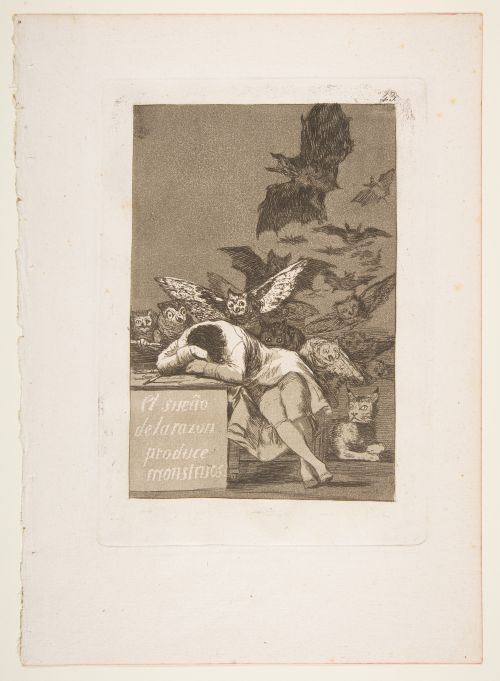
Francisco Goya’s The Sleep of Reason Produces Monsters (1799)—an image of what emerges when the mind abdicates its responsibility: not freedom, but fantasy; not peace, but nightmare. Where reason sleeps, the trinity of miracle, mystery, and authority awakens to devour.
In Dostoevsky’s The Brothers Karamazov, the tale of the Grand Inquisitor remains one of the most unsettling parables in modern literature. Told by Ivan Karamazov to his younger brother Alyosha, the fable imagines Christ returning during the Spanish Inquisition—only to be arrested and silenced by the Church. The Inquisitor, a cardinal of imposing intellect and grave compassion, does not accuse Christ of falsehood, but of cruelty: You gave them freedom, he says, when they needed bread. You gave them mystery, when they needed answers. You gave them love, when they needed order.
There was a time, decades ago, in the earnest conviction of my youth, when I found myself perplexed by the Grand Inquisitor’s logic. I did not admire him, nor excuse his authoritarianism, but I recognized the ache that underpinned his argument. Bread matters. Peace matters. Even then, I sensed the moral gravity of the dilemma he posed: How does one respond to suffering in a world that is often brutal, hungry, and unforgiving?
But I also responded viscerally to something else: the pen of Dostoevsky was not just crafting a fable, but weaponizing a caricature. The Inquisitor was not simply a tragic figure—he was also a polemic against Catholicism, a projection of Dostoevsky’s own religious bigotry. As someone educated within the Catholic tradition, I saw the ugliness beneath the fable—the prejudice tucked behind the parable’s grandeur. The critique was not only of power, but of Rome. The Inquisitor’s mitre bore the unmistakable weight of Jesuit anti-types, cloaked in suspicion and veiled accusation. My disquiet, then, was not only with the Inquisitor’s words, but with the frame within which they were uttered.
And yet, despite its polemical underpinnings, the parable remains one of the most profound meditations on freedom and faith in modern literature. Its imaginative force exceeds its prejudices. The Inquisitor endures not only as a critique, but as a haunting embodiment of the human temptation to trade liberty for comfort.
And that temptation has not faded. The Grand Inquisitor endures because he gives voice to something deeply human, and psychologically real: the desire for security, for certainty, for order amidst chaos. It is a desire that remains active—arguably ascendant—in our own time. One hears the Inquisitor’s voice today in populist strongmen, in the cynical strategist’s smirk, in the media apparatus that soothes while it divides, and in slogans that promise greatness through obedience—Make America Great Again, for instance, the rallying cry of a leader who proclaimed, “I am the only one who can save this nation,” inviting not deliberation, but devotion. The trinity he offers—miracle, mystery, and authority—is the very catechism of modern demagoguery.
This reflection, then, is not a defense of the Inquisitor, but an attempt to understand his appeal, and to reclaim the concepts he distorts. In my recent essay on literalism, metaphor, and balance, I sought to describe the menace of the literalist disposition—a mentality that cannot live with ambiguity, that flees from the poetic, and that finds in surface meaning a shield against the deeper, riskier call of the soul. Here, I apply that lens to the Inquisitor’s three pillars.
Miracle and the Tyranny of the Literal
The Inquisitor offers miracle as literal spectacle: bread conjured from stone, laws suspended, proof offered to silence doubt. He rebukes Christ for refusing to perform such signs in the desert, calling His restraint an act of cruelty rather than spiritual wisdom.
Even as a young reader, I did not mistake the Inquisitor’s miracle for holiness. But I understood that hunger cannot be spiritualized away. In a world where the body is often broken before the spirit can rise, the refusal to give bread seems harsh.
What I have since come to understand is that bread must be shared, not wielded—and that miracles, if they mean anything at all, must point beyond themselves. A miracle that ends conversation is not a miracle but a manipulation.
We have seen modern versions of such miracles: promises made and spectacles staged not to elevate understanding, but to prove power. Consider the border wall—hailed not merely as a policy, but as a singular, salvific act. Its construction, real or exaggerated, was brandished as proof of providence, as the visible sign that the nation could be made great, pure, and safe again. Nor was it the only such “miracle.” Similar wonders were promised: the immediate end of the Russian invasion of Ukraine, the revival of a fading industrial economy, the return of jobs long gone, and the rapid reordering of the global market in our favor. These, too, were presented as guarantees—not to be debated, but to be believed. And like the Inquisitor’s miracles, they have largely yet to be seen.
In my essay on literalism and metaphor, I argued that literalism becomes a menace when it displaces metaphor—when it insists on one meaning, one proof, one visible sign. The Inquisitor’s miracles are precisely that: spectacles that end the need for faith. They are miracles without meaning.
Mystery and the Collapse of Metaphor
The Inquisitor’s use of mystery is a case study in spiritual containment. Mystery becomes the guarded unknown, parceled out by clerical authority to pacify rather than provoke. It is not a sacred unknowing, but a fog of confusion meant to keep the people docile.
But true mystery, like true metaphor, does not confuse—it illuminates by depth. It renders the world porous to truth. It refuses finality not because it is evasive, but because it is more honest than premature closure allows.
I did not reject mystery in youth, nor do I now. But I reject the collapse of mystery into secrecy, the transformation of the ineffable into the inaccessible. Metaphor must breathe. Mystery must invite. When weaponized, they become not sacred, but sinister.
In our current dysfunctional era, mystery is often replaced by conspiracy—a counterfeit that plays the same psychological role, offering significance without wisdom, awe without humility. The literalist disposition, fearing true complexity, gravitates toward these shallow depths. Conspiracy is mystery stripped of humility. It retains the trappings of hidden knowledge but closes the mind rather than opening it. It flatters the believer with secrets while shielding them from ambiguity. It is not reverence for the unknown, but a refuge from the supposed unbearable complexity of reality.
We see this vividly in the ecosystem of conspiracy theories surrounding Trump’s political movement. Whether it is the belief that a global cabal of elites and pedophiles is secretly running the world (QAnon), or that massive voter fraud orchestrated by shadowy networks altered the outcome of the 2020 election, or that figures like Barack Obama, Hillary Clinton, or George Soros are puppet-masters in an international scheme to undermine American sovereignty—each offers an illusion of secret insight in place of the real work of understanding. These narratives are not pursued for their truthfulness but for their emotional certainty. They replace sacred mystery with a kind of gnosis—fierce, insular, and self-reinforcing.
And like the Inquisitor’s mystery, they are not shared to free the soul, but to bind it—to a worldview, to a figure (whether cult, religious, or political leader, a distinction without merit or significance), to a sense of exceptionalist belonging. The effect is not illumination but containment.
Authority and the Displacement of Balance
The Inquisitor’s authority is final, paternal, and brutal in its compassion. It replaces freedom with peace, conscience with obedience. Its appeal lies not only in its force, but in its promise: You no longer have to choose. I will choose for you. And I will feed you.
As I have aged, I have come to see that this vision is not merely imposed—it is desired. Much of the populace is psychologically predisposed to respond favorably to such authority, whether it comes in vestments or slogans. It offers relief from the burden of discernment. It relieves the anxiety of paradox.
This recognition—that the hunger for certainty is as much internal as external—has shaped my own philosophical trajectory.
And that is where the menace lies. This is not a top-down problem alone, but a convergence of design and desire. The Inquisitor gives the people what they already, in some meaningful manner, want: a world made safe through submission. The leader becomes the sole interpreter of truth, the guarantor of safety, the vessel of meaning. Authority becomes a theology in itself.
We have seen this in our time, where devotion to a figure supplants loyalty to principle. When a leader proclaims “I am the only one who can save this nation,” and is met not with unease but with cheers, authority has ceased to be a mediating presence and has become a metaphysical claim. It no longer balances tension; it obliterates it.
In contrast, the authority I defended in my earlier essay was not coercive, but mediating—a balancing presence, a harmonizing voice. It does not dominate or dismiss. It holds the tension without collapsing it. It does not provide peace through closure, but through co-suffering. It listens. It waits.
The Bread and the Burden
So no, I did not approve of the Grand Inquisitor—not in youth, not now. But I acknowledged, and still acknowledge, the ache beneath his argument. It was not cruelty that made him persuasive, but compassion twisted into control—a desire to ease pain by removing the possibility of choice.
What I now see more clearly is that this fable is not merely a theological drama. It is a psychological map. The Grand Inquisitor is the high priest of the literalist disposition—offering miracle that silences, mystery that obscures, authority that absolves.
That disposition is not confined to Dostoevsky’s century. It is at work now—in every movement that prefers spectacle to sign, dogma to dialogue, power to presence. It thrives in political rhetoric, in media narratives, in spiritual systems that replace grace with control.
Dostoevsky does not argue against it. Christ does not rebut it. He answers with a kiss.
A kiss without domination. A kiss that respects freedom. A kiss that does not resolve the tension, but chooses to love within it.
That is the burden of freedom: not only to bear it ourselves, but to offer it to others, knowing they may prefer their chains.
To offer bread, but not as bribe. To teach, but not as demand. To speak, but not to silence. To live, still and quietly, within the balance that resists the Inquisitor’s call.
To refuse the miracle that enslaves, To offer bread and still preserve the soul, That is the quiet defiance the world most needs.
There was hesitation before I posted the essay below. Not for its merit, but for its timing. I wonder, truly, whether we have already passed the point of rupture—whether the buffoonery we witness in scandals such as Whiskeyleaks (the use of the Signal app by U.S. cabinet officials and others to discuss classified war plans) is not merely incompetence, but a smokescreen for something more deliberate, more calculated, and far more lethal. If the jesters, clowns, and buffoons distract, it may be only so that the knife may fall unnoticed. This essay, then, may read not as prophecy but as postmortem—or as warning flung desperately against a wind already turning. And yet, even still, I believe it must be said.
Note to the Reader
This essay is written not as a partisan screed, nor as a nostalgic lament for some imagined golden age, but as a meditation—part moral reckoning, part civic warning—on the condition of a republic that has allowed itself to descend into spectacle, incoherence, and institutional decay.
It is addressed to those who still believe that government, for all its failings, remains a public trust; that civic virtue is not an antiquated ideal; and that the health of a nation may be measured not merely in wealth or might, but in memory, restraint, and the character of its leaders and laws.
The tone is deliberately severe, for the times are unserious. The satire is not meant to entertain, but to unmask. Where irony sharpens, it does so to reveal truths that cannot be said plainly without losing their edge. And where the anger beneath the prose surfaces, it does so not in despair, but in the hope that the reader, too, is angry—and unwilling to become numb.
This is not a call to revolution, but a call to remembrance, to vigilance, and above all to responsibility. If the republic is to be rebuilt, it will not be by those who broke it, nor by those who profited from its breaking, but by those who, though weary, still believe it is worth the rising.
The Farce of Ruin: On the Buffoonery, Cowardice, and Consent that Endanger the Republic
It becomes difficult indeed to weigh if the republic is more greatly endangered by ignoble, incompetent lackeys such as now populate the greatest offices of state, appointed by the bitter, vengeful, demented, and oft confused and wholly arbitrary despotic personality that resides in the executive mansion, courtesy of the cult of resentment, hate, and fear, than it would have been had he appointed more able men and women to execute his whims and vices. For in one case, we face the farce of ruin—the slow, stumbling, ignoble unraveling of a once-proud polity into absurdity and impotence. In the other, we would face tyranny executed with precision, method, and perhaps permanence. Yet if there is any comfort to be found in chaos, it is this: incompetence leaves wreckage; competence might have left chains. But wreckage, at least, invites the labor of rebuilding—if the will, the memory, and the courage yet remain.
This is the bitter paradox of the present hour: that we may find ourselves grateful not for wisdom, but for the want of it; not for virtue, but for its absence. That the republic’s temporary reprieve lies not in the strength of her institutions nor the vigilance of her people, but in the vacuity and vanity of her despoilers. These are not statesmen in the Roman sense, nor even villains in the Shakespearean; they are caricatures—jesters costumed in stolen robes of office, bumbling through decrees, barking orders not out of conviction but impulse, devoid alike of strategy and shame. And yet, we dare not laugh too loudly. For every laugh chokes on the question: how long can a republic endure when the machinery of its survival is entrusted to hands unfit to hold it?
The Rise of the Cult: Resentment as Political Theology
Power, once grounded in consent and law, now derives its strength from a darker source: resentment. Not merely disappointment or disillusionment, but that deeper, more corrosive sentiment born of perceived humiliation, of grievance nurtured until it metastasizes into dogma. No longer content to reform what they claim to hate, the votaries of this new creed seek instead to destroy—to salt the fields, poison the wells, and tear down every institution that once restrained ambition with honor, and pride with duty.
This is not politics in any meaningful sense. It is theology by other means—a bitter creed that worships neither God nor country but the self, wounded and wrathful. Its high priests preach vengeance cloaked in patriotism, its sacraments are insult and spectacle, and its liturgy is grievance repeated endlessly, unexamined and unrelieved. To belong to this cult is not to believe in anything beyond the negation of others: the “elites,” the “experts,” the “traitors,” the “others”—those perpetual abstractions upon whom every failure may be pinned, every fear projected.
Thus, the executive, himself a totem of grievance, is not admired in spite of his vices but because of them. His incoherence becomes a form of authenticity; his cruelty, a mark of strength; his ignorance, proof that he is unsullied by the corruption of thought. This is the logic of the mob, sanctified and enthroned. It does not seek truth, only validation; not justice, but vengeance. And from such poison grows not a polity, but a pack.
The Machinery of Power: Incompetents in High Places
Once, high office required at least the semblance of merit—a capacity for governance, a grasp of statecraft, or, at the very least, the discretion to defer to those who possessed it. No longer. The new qualification is loyalty alone: loyalty not to the Constitution, not to principle or country, but to personality. And not even to a consistent personality, but to a flickering candle in a tempest—unstable, moody, and perpetually affronted.
Thus have the halls of government been peopled with jesters, flatterers, and feckless opportunists. Ministers of the treasury who do not believe in numbers, secretaries of education who scorn learning, envoys who sabotage diplomacy, and legal advisors who treat the law as a nuisance to be outmaneuvered rather than a structure to be upheld. Their résumés are padded with failure, their careers propped up by sycophancy, their ambitions tethered not to public service but to personal advancement through proximity to power.
Yet their greatest failing is not simply what they do, but what they permit. Their very mediocrity becomes the shield behind which greater abuses are concealed. For while the citizenry scoffs at the spectacle—the press conference gaffes, the mangled grammar, the contradictions piled upon contradictions—policy proceeds maliciously, cruelly. Freed from oversight, insulated by noise, the machinery grinds on: protections undone, laws abandoned, rights weakened, government dismantled, alliances broken. The clown at the helm distracts the gaze, while the bureaucratic knife goes unnoticed beneath the velvet tablecloth.
And in this lies the genius of institutional vandalism: not to destroy with one mighty blow, but to dull the blade slowly—through mismanagement, attrition, and the silent resignation of the capable and the firing of tens of thousands. A thousand small indignities, each one tolerable, each one dismissed, until the edifice no longer stands, and we wonder not when it fell, but how we failed to notice.
The Counterfactual: What If the Tyrant Were Wise?
One is almost tempted to breathe a sigh of relief at the chaos, for chaos is its own limit. A despot who contradicts himself hourly, who governs by whim and forgets his decrees by dusk, is a tyrant only in name. He may wish to rule absolutely, but lacking consistency, foresight, or discipline, he becomes instead a figure of grotesque parody—dangerous, yes, but disarmed by his very incoherence. We may survive him not because of our strength, but because of his weakness.
But imagine, if you will, the inverse: a tyrant possessed of intellect, method, and clarity. One who governs not in the service of ego but of vision—however malignant. One who surrounds himself not with cowed incompetents, but with men and women of ruthless efficiency, cold logic, and administrative precision. This is the tyrant history has known best. It is not the fool who builds the gulag or writes the blacklists, but the functionary with a plan, the theorist with a chart, the orderly mind untroubled by conscience.
Had our moment produced such a figure, how much swifter the erosion of liberty would have been! How much more subtle the theft of rights, how much more durable the machinery of oppression! The republic might not have looked so disordered—it might have seemed vigorous, decisive, strangely efficient. But beneath the appearance of control, the soul of the nation would have already been extinguished, its people transformed not into rebels or resisters, but into docile instruments of the state’s will.
The question, then, is no longer whether we are fortunate in our calamity, but whether we understand its nature. For fools can be replaced. But should a day come when their successors wear the same mask but wield it with purpose—then the hour will be far darker, and the laughter that once served as shield will curdle into silence.
The Theatre of the Absurd: Democracy as Entertainment
If the republic falters from within, it is not only because of those who hold the levers of power, but because of those who have come to see governance not as a civic duty, but as a form of entertainment. The forum has become a stage, the statesman a performer, and the electorate an audience demanding sensation. Nuance bores, compromise offends, and truth is a distant, flickering ghost—unwelcome and unprofitable.
In such a theatre, absurdity is not a bug but a feature. Every gaffe becomes a meme, every outrage a headline, every policy a subplot in an endless narrative of grievance and spectacle. The media, desperate to retain its vanishing grip on attention, ceases to inform and instead curates the drama—cutting, splicing, amplifying. The body politic is no longer a deliberative citizenry but a viewership conditioned to react, not to reason.
And what is the role of the elected official in this new dramaturgy? Not to lead, but to brand. Not to govern, but to trend. They issue not laws, but slogans. They trade not in facts, but in feels. Even their failures become assets, for in the logic of the spectacle, visibility is power, and infamy sells just as well as virtue—often better.
Worse still, even those who know the performance is a fraud feel trapped within it. To disengage is to surrender the stage to the most unscrupulous actors; to engage is to be complicit in a system that rewards noise over thought, allegiance over principle. This is the final genius of the absurd republic: to create a politics where participation itself feels degrading, and yet absence feels dangerous.
Thus the state becomes not a polity of free and deliberative people, but a spectacle of exhaustion. We scroll, we jeer, we despair. But rarely—too rarely—do we act.
The Fragility of Memory: When History No Longer Speaks
No tyranny begins as tyranny. It begins in the forgetting. A forgetting not only of facts or dates, but of the moral weight of precedent, the slow accumulation of civic wisdom, the lessons written in blood and ink by those who came before. When memory is intact, it serves as conscience; when eroded, it becomes convenience. We do not recognize the fall because we no longer remember what it was to stand.
Once, a statesman would rise in the chamber and quote Pericles or Lincoln, Cicero or Solon—not merely to adorn his speech but to anchor it in tradition, to draw from the well of republican virtue. Now, even such allusion is dismissed as elitist pedantry. The past is regarded not as a guide but as a burden, and history is reduced to a buffet of misremembered grievances, curated to flatter the resentful and indict the dead.
In this vacuum, lies grow bold. Fictions parade as fact, myths usurp monuments, and the record of what was is rewritten by those who benefit from what is. The archives decay; the historians, sidelined or silenced, speak to a shrinking audience. Memory becomes tribal, curated by algorithm and sentiment. The young no longer study the fragility of freedom because it is no longer taught. The old recall its price, but their warnings are heard as the mutterings of a defeated past.
And what, then, remains? A citizenry adrift—cut loose from history’s moorings, vulnerable to every charlatan with a flag and a grievance. The republic, in such a state, is no longer endangered by enemies at the gates, but by the silence within. Not the silence of censorship, but the quieter, more dangerous silence of indifference. The silence that follows when memory no longer speaks and no one cares to ask what it once said.
Wreckage or Rebirth?
It is tempting, when surveying the present wreckage, to surrender to despair—to believe that the republic, having stumbled so absurdly into decline, can never be set aright. The pillars have cracked, the roof sags, and the foundation seems to shift beneath our feet. But wreckage, for all its tragedy, is not the same as ruin. What has been shattered can, in principle, be rebuilt. The question is whether the will endures, and whether the anger now rising can be forged into resolve rather than simply rage.
For there is anger—mounting, justified, and no longer concealed. It grows not within the cult, but outside it, among those who have watched with clenched jaws as the instruments of governance were handed to buffoons and cowards, as the executive strutted and raged, as the political class bowed and curtsied, mumbling excuses, averting eyes, trading principle for position. And it is not merely the executive that earns their ire, but the entire edifice of acquiescence—a legislature that mutters indignation but funds the farce all the same; a judiciary that, cloaked in solemnity, too often validates the very abuses it ought to constrain. These are not neutral bystanders. They are collaborators by convenience, guardians turned ushers to a constitutional catastrophe.
And so the citizen watches, furious and exhausted, as the republic’s very stewards conspire in its diminishment. Yet this fury, though dangerous if left to fester, may still be redemptive if rightly directed. The task is not to lament the collapse of a golden age that never was, but to resist the entrenchment of a cynical age that need not be. The republic will not be saved by the institutions that failed to defend it, nor by the party machines that greased its fall. If salvation comes, it will be through memory rekindled, virtue rediscovered, and courage reclaimed—not in grand gestures, but in the hard, slow work of rebuilding what was squandered.
We stand, then, not at the end, but at a crossroads between farce fulfilled and tragedy averted. The clowns will fall—their nature guarantees it. But what comes next will not be dictated by their collapse. It will be shaped by those who remain: the watchful, the angry, the resolute. The question is not whether the republic can rise again, but whether we still believe it is worth the rising.






 Northcoast Antiquarian