
Between Astonishment and Silence

“When I consider thy heavens, the work of thy fingers,
the moon and the stars, which thou hast ordained;
What is man, that thou art mindful of him?” Psalm 8:3-4

The Psalmist, gazing beneath the vault of stars, marvels aloud:
What is man, that Thou art mindful of him?
The heavens dwarf him, the dust clings to him,
yet he dares believe the Maker bends low, remembers, and grants worth.

But even in that astonishment, the shadow of doubt stirs.
Another voice—the Philosopher’s—finds in the same expanse not remembrance but silence.
The stars speak only of distance,
the void carries no voice.
Armenia and Auschwitz, Hiroshima and Rwanda, Ukraine and Gaza—
the graves of countless innocents cry out:
how can one still say, Thou art mindful?
Likewise, science has stripped the heavens bare:
no angels in the spheres, only galaxies colliding in indifferent law.
Scripture, once oracle, is now artifact, sifted by history.
Thus the question sharpens: not What is man, that Thou art mindful?
but Is Thou mindful at all?

Between astonishment and silence stands the Poet, unable to forsake either.
He reveres the psalm, yet trembles with the Philosopher’s doubt.
Inheritance falters: the words remain precious,
but their certainty slips from them.
Still, he will not cast them aside.
Instead, he holds the fragments as one might hold a candle in the wind:
not enough to illumine the void,
yet enough to keep the darkness from being complete.
He labors to shape language into vigil,
to bind meaning against the scatter of grief,
to weave remembrance into flame so silence is not the final word.

Perhaps mindfulness is only man’s work—
to remember, to wrest coherence from the scatter of loss.
Or perhaps it is more: a presence that waits rather than speaks,
a silence that shelters rather than denies.
The Poet does not resolve the question;
he learns instead to live within it,
to practice reverence without assurance,
until the asking itself becomes our mindfulness.

Elegy for the Automatons: A Reflection on Political Decline in the Orwellian State


The Disquieting Muses by Giorgio de Chirico
(1916-18, oil on canvas)
The Disquieting Muses (1916-18) by Giorgio de Chirico
(97.16 cm × 66 cm, oil on canvas)

Preface

This poem, Elegy for the Automatons, was inspired by George Packer’s article The Hollow Men, which appeared in the May 2025 issue of The Atlantic. Packer’s article examines the political and moral collapse of certain American officials—Speaker Mike Johnson, Senator Lindsey Graham, and Secretary of State Marco Rubio—who, once defenders of democratic principles, surrendered themselves to the inverted realities demanded by Donald Trump’s authority and his increasingly Orwellian authoritarian state.

Echoing the pivotal scene in Orwell’s 1984 where a Party orator is handed a note and instantly redirects his vitriol toward a different enemy “mid-sentence, without a pause,” Packer documents how key Republican figures performed their own breathtaking reversal on Ukraine policy, and describes how these officials pivoted instantly from celebrating Ukraine’s resistance to Russia’s aggression to denouncing Ukraine as the enemy—all in service to Trump’s shifting personal allegiances and contempt for democratic values.

Packer also invokes Henri Bergson’s insight that the mechanical within the human evokes both laughter and horror. Yet what he describes transcends mechanical reflex: it is the slow hollowing-out of conscience itself. Once-thoughtful men become fluent automatons, mouthing words disconnected from belief, loyalty, or memory.

This poem seeks to render in elegiac form the sorrowful descent of a free polity into ritualized untruth, and the transformation of human beings into instruments of submission.


“We are the hollow men
We are the stuffed men
Leaning together
Headpiece filled with straw. Alas!”

— T. S. Eliot, The Hollow Men

Elegy for the Automatons

In the year when the hollowing began,
and Orwell’s warning stirred too late,
it came not by fire nor iron decree,
but smiling, in the face of one man.
He bore no heavy crown, no burning sword;
only the gift of inversion:
truth was a lie, loyalty a whim,
freedom the mask of power.
A man for whom cruelty was a virtue,
and truth a broken toy at his feet;
a man who measured loyalty by abasement,
and called the strong weak and the weak strong.

Under his gaze, the names of enemies blurred,
history curled back on itself like smoke;
words, having lost their anchor, floated
as banners torn from any mast.
And a people once proud of remembering
forgot that they had ever known another day.

From this hour of unmooring
emerged the hollowing of men.

Johnson, first among the fallen,
fumbled for strength among hollow phrases,
mouth heavy with the weight of borrowed words.
Behind his thickened glass, a flicker died—
and he mistook its ashes for light.

Graham, quick to find the favor of the wind,
circled the ruin with the laughter of forgetting,
shedding oaths like old garments,
spinning from vow to vow as a moth to a dying flame,
faithless to all but the empty crown of belonging.

Rubio, once proud in the defense of liberty,
sank into the yellow chair of forgetting,
listening to the slow departure of his own voice.
Once he cried for the dignity of nations;
now he stitched the banners of surrender with empty hands.

Thus were men unmade,
not by terror, nor by war,
but by the patient grinding of truth into noise,
by the slow machinery of convenience and fear.

And we, who watched,
sang no hymns for these men,
built no statues to mark their days.
They passed like shadows over a broken dial,
automatons grinding down the hour,
till even the dust forgot their tread.


U.S. Secretary of State Marco Rubio, February 28, 2025 — slipping deeper into the hollowing of the soul.

Not a Shepherd but a Wolf

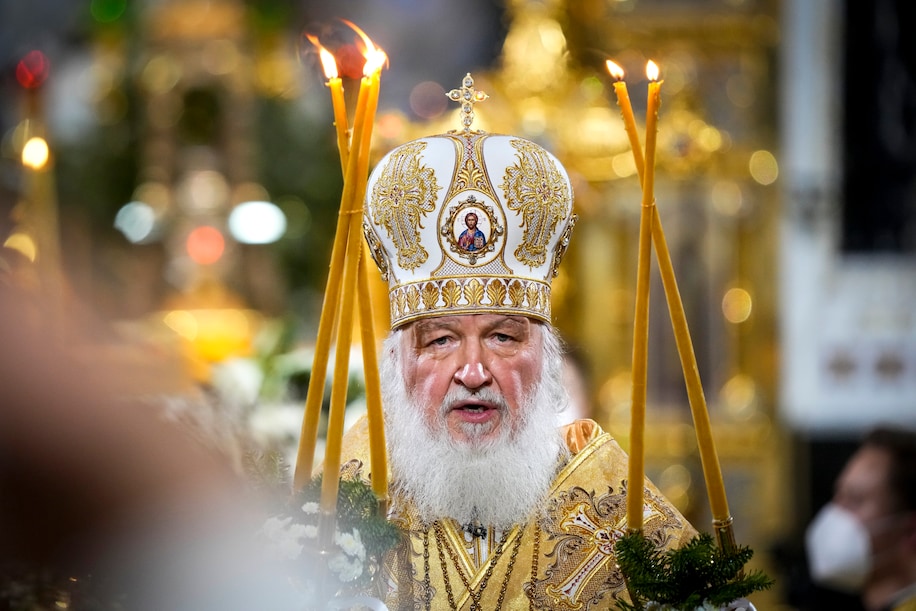
Russian Patriarch Kirill, Non Pastor Sed Lupus

Today, as Russian forces continued to kill Ukrainians during their unprovoked invasion of Ukraine, Russian Orthodox Patriarch Kirill cited Vladimir Putin’s view of a Russian world with ‘one people’ in his sermon at Moscow’s Christ the Savior Cathedral, echoing Putin’s mania that Ukraine belongs to Russia. He said he wanted peace in the “Russian land” — meaning Russia, Ukraine and Belarus — adding “may the Lord protect the peoples that are part of the single space of the Russian Orthodox Church,” warning of “dark and hostile external forces” seeking to divide “our common historical fatherland.” To which the only response can be the medieval formulaic expression “non pastor sed lupus” (not a shepherd but a wolf) wherein the second element of the negation refers to a hireling or Judas. In this instance, clearly Kirill is a hireling of the thug Putin. The formula is based on Christ’s words as narrated in the Gospel of John (10:11–14) and the Sermon on the Mount from the Gospel of Matthew (7:15): “Beware of false prophets, who come to you in the clothing of sheep, but inwardly they are ravening wolves.”