

My Friend, You Were There: A Reflection on Complicity


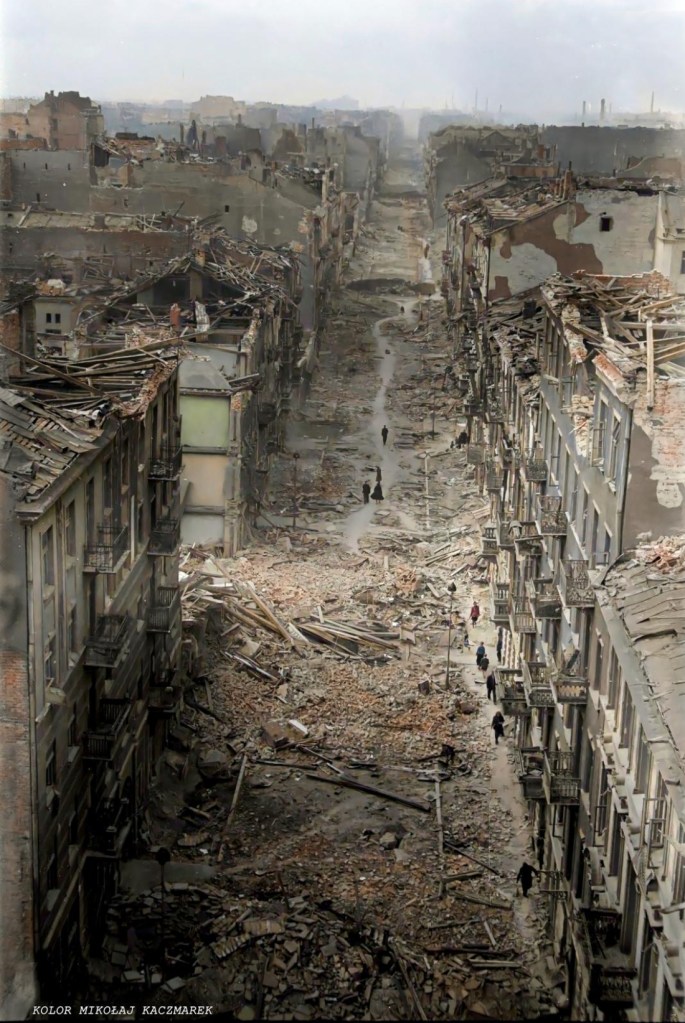
Warsaw Ruins 1944
Warsaw 1944

History shows that evil rarely marches under banners we immediately recognize. Too often, it comes draped in righteousness, purity, and fear. This piece is a lament for how easily we have been—and still can be—drawn into the machinery of cruelty.


My Friend, You Were There

My friend,
When the Holy Catholic Church, seeking to preserve the Faith in all its radiant purity,
instituted the Inquisition,
you were there—
not as a bystander,
but as a willing voice.

You denounced the old widow,
who lived alone with her cat.
You whispered against the Jewish family—
familiar, yet forever marked as other—
and gave your assent to their undoing.

You crowded into the square to watch the trials.
You sang hymns
as the flames crowned their bodies with smoke.
You wept tears of joy
that the world was made purer that day.

My friend,
When the ships came heavy with human cargo,
and the auction blocks stained the soil,
you were there.

You placed your bids.
You weighed their flesh.
You wrote the laws that chained their children.

You sang hymns on Sunday,
and broke their backs on Monday.
You called it providence.
You called it order.

My friend,
When the traders came with flags and rifles,
when the rivers flowed with rubber and blood,
you were there.

You signed the charters.
You counted the profits.
You sold the shackles and the scales.

You called it commerce.
You called it destiny.

My friend,
When the banners of the Reich unfurled,
and the drums of destiny beat their hollow call,
you were there.

You shouted with the crowds
as glass shattered from shopfronts.
You signed the letters,
you cheered the laws,
you raised your hand high in salute.

You bought the house,
the shop,
the art your neighbors were forced to leave behind.

You praised the strong hand
that swept away the weak.
You rejoiced as neighbors vanished,
grateful that your streets were made clean.

My friend,
When Stalin summoned the will of the people
to root out the enemy within,
you were there.

You reported the whispered doubts
of your cousin,
your friend,
your brother.

You paraded with red flags
while the trucks rumbled into the night.
You filled the quotas.
You seized the land.
You counted the spoils
as others disappeared.

You sang of the bright tomorrow
as you cast your eyes down
and stepped over the absent.

My friend,
When Mao lifted the Little Red Book,
and the children cried out against their fathers,
you were there.

You led the chants.
You scrawled denunciations across the walls.
You struck the old professor who dared to hesitate.
You cheered as the temples fell,
and the old poems burned,
convinced you were building a paradise
on the bones of the past.

My friend,
When Pol Pot promised that the fields
would bloom with new life,
you were there.

You marched the teachers into the paddies.
You pointed the rifle.
You praised the year zero
that would erase the memory of all that came before.

You smiled
as the world was reborn in silence.

My friend,
When the generals rose in the name of order,
when the prisons filled and the stadiums overflowed,
you were there.

You nodded at the names.
You counted the profits.
You watched the blindfolded taken at night.

You called it security.
You called it salvation.

My friend,
You have always been there.

Only too late did you realize.
Only too late did you doubt—
but not much.

You fell silent,
lest you betray your doubt.
You looked away,
lest you see.

You told yourself it would be different this time.
You told yourself you had learned.
But the signs are familiar.
The words are familiar.
The silence is familiar.

And it is happening again.

Elegy for the Automatons: A Reflection on Political Decline in the Orwellian State


The Disquieting Muses by Giorgio de Chirico
(1916-18, oil on canvas)
The Disquieting Muses (1916-18) by Giorgio de Chirico
(97.16 cm × 66 cm, oil on canvas)

Preface

This poem, Elegy for the Automatons, was inspired by George Packer’s article The Hollow Men, which appeared in the May 2025 issue of The Atlantic. Packer’s article examines the political and moral collapse of certain American officials—Speaker Mike Johnson, Senator Lindsey Graham, and Secretary of State Marco Rubio—who, once defenders of democratic principles, surrendered themselves to the inverted realities demanded by Donald Trump’s authority and his increasingly Orwellian authoritarian state.

Echoing the pivotal scene in Orwell’s 1984 where a Party orator is handed a note and instantly redirects his vitriol toward a different enemy “mid-sentence, without a pause,” Packer documents how key Republican figures performed their own breathtaking reversal on Ukraine policy, and describes how these officials pivoted instantly from celebrating Ukraine’s resistance to Russia’s aggression to denouncing Ukraine as the enemy—all in service to Trump’s shifting personal allegiances and contempt for democratic values.

Packer also invokes Henri Bergson’s insight that the mechanical within the human evokes both laughter and horror. Yet what he describes transcends mechanical reflex: it is the slow hollowing-out of conscience itself. Once-thoughtful men become fluent automatons, mouthing words disconnected from belief, loyalty, or memory.

This poem seeks to render in elegiac form the sorrowful descent of a free polity into ritualized untruth, and the transformation of human beings into instruments of submission.


“We are the hollow men
We are the stuffed men
Leaning together
Headpiece filled with straw. Alas!”

— T. S. Eliot, The Hollow Men

Elegy for the Automatons

In the year when the hollowing began,
and Orwell’s warning stirred too late,
it came not by fire nor iron decree,
but smiling, in the face of one man.
He bore no heavy crown, no burning sword;
only the gift of inversion:
truth was a lie, loyalty a whim,
freedom the mask of power.
A man for whom cruelty was a virtue,
and truth a broken toy at his feet;
a man who measured loyalty by abasement,
and called the strong weak and the weak strong.

Under his gaze, the names of enemies blurred,
history curled back on itself like smoke;
words, having lost their anchor, floated
as banners torn from any mast.
And a people once proud of remembering
forgot that they had ever known another day.

From this hour of unmooring
emerged the hollowing of men.

Johnson, first among the fallen,
fumbled for strength among hollow phrases,
mouth heavy with the weight of borrowed words.
Behind his thickened glass, a flicker died—
and he mistook its ashes for light.

Graham, quick to find the favor of the wind,
circled the ruin with the laughter of forgetting,
shedding oaths like old garments,
spinning from vow to vow as a moth to a dying flame,
faithless to all but the empty crown of belonging.

Rubio, once proud in the defense of liberty,
sank into the yellow chair of forgetting,
listening to the slow departure of his own voice.
Once he cried for the dignity of nations;
now he stitched the banners of surrender with empty hands.

Thus were men unmade,
not by terror, nor by war,
but by the patient grinding of truth into noise,
by the slow machinery of convenience and fear.

And we, who watched,
sang no hymns for these men,
built no statues to mark their days.
They passed like shadows over a broken dial,
automatons grinding down the hour,
till even the dust forgot their tread.


U.S. Secretary of State Marco Rubio, February 28, 2025 — slipping deeper into the hollowing of the soul.

The Unopened Book

by Donald S. Yarab


Scholar in His Study by Rembrandt Harmenszoon van Rijn, 1634
Oil on canvas, 141 × 135 cm
Collection of the National Gallery Prague, Schwarzenberg Palace
© National Gallery Prague

The unopened book, its spine uncreased,
rests on the shelf, untouched by breath.
No hand has turned its waiting leaves,
no eye has met its silent depths.

The pages sleep in folded time,
ink unmoved by thought or light—
a universe uncalled to mind,
a star unkindled in the night.

Who knows what worlds it might contain—
a lover’s vow, a tyrant’s fall,
a name that once was yours or mine,
a deathless truth, a whispered call?

The story never yet begun
is writ in ink that does not fade.
Its fate, unlike the morning sun,
has neither risen nor decayed.

And yet—another book lies bare,
its binding worn, its chapters told.
The margins smudged by time and care,
its tale rehearsed a thousandfold.

We read, we skip, we turn again,
we bookmark thoughts we dare not bind—
then falter near the closing lines,
no meaning fixed, no end designed.

A narrative half-read, half-lost,
its final thought left unexpressed—
the thread unwinds, the ink runs dry,
the reader dozes, unconfessed.

Between the two—a paradox:
the never read, the half-complete.
Which holds the weight of what we are?
Which better marks our own defeat?

Perhaps all books are mirrors dim,
reflecting what we dare not see:
the start we fear, the end we flee,
the truths we touch but never free.

So let it lie, unopened still,
or let it fall apart, well-worn—
the soul is both the waiting page,
and every word we leave unborn.


Widening the Gate: The Moral Imperative of Scholarly Apparatus in Poetry

The article argues that the inclusion of scholarly apparatus in poetry should not be seen as an act of insecurity but as a moral imperative to enhance accessibility and understanding. Providing notes and allusions demonstrates trust in the reader’s intellect and invites deeper engagement with complex literary traditions, enriching the overall poetic experience.


Dante and Virgil in Hell by William-Adolphe Bouguereau (1850).
 Oil on canvas, 281 × 225 cm. Housed in the Musée d'Orsay, Paris.
Dante and Virgil in Hell by William-Adolphe Bouguereau (1850).
Oil on canvas, 281 × 225 cm. Housed in the Musée d’Orsay, Paris.
Depicting a scene from The Divine Comedy, the painting shows Dante guided by the poet Virgil through the torments of the Inferno. This work reflects the enduring need for guidance through complex moral and literary landscapes—much like the role of scholarly apparatus in contemporary poetry.

In certain corners of literary criticism—particularly those shaped by the Bloomian anxiety of influence—the inclusion of scholarly notes in a poem is often regarded with suspicion. To annotate a poetic work, especially with theological or classical references, is, for some, a mark of insecurity or defensiveness. One does not footnote inspiration, the critic suggests, but cloaks inadequacy. This reading, however, reveals more about the critic’s own posture than the poet’s intent. It mistakes generosity for uncertainty, and accessibility for anxiety. In truth, the use of poetic apparatus is not a gesture of retreat but an act of moral clarity.

We no longer inhabit a culture rooted in shared canonical memory. The contemporary reader cannot be presumed to recognize the traces of Augustine or the subtleties of Pauline inversion, nor even the resonances of Lamentations or Miltonic cadence. These once-communal touchstones have grown faint in our fragmented intellectual landscape.

To scatter phrases drawn from such traditions across the page without interpretive aid would not constitute noble restraint—it would be fundamentally exclusionary. One does not prove a poem’s strength by ensuring its opacity to all but the initiated few.

The poet who situates their work within a sacred, historical, or theological lineage and yet withholds the keys to that lineage commits a kind of aesthetic pride. This is the true arrogance: to assume that those who do not immediately perceive are unworthy to understand. In contrast, the provision of notes, allusions, and apparatus is a statement of trust in the reader’s intellectual capacity. It affirms that the reader, though perhaps unfamiliar with particular traditions, is capable of knowing, and thus worthy of invitation into deeper engagement.

Poetic apparatus, when thoughtfully deployed, functions as both guide and companion. It allows the reader to move through layered landscapes without stumbling in darkness. Notes illuminate without overwhelming; they offer pathways, not prescriptions. Just as Dante needed Vergil to navigate the underworld in The Divine Comedy, the modern reader may need scaffolding to ascend the difficult terrain of a theologically-inflected poem. That scaffolding supports not the poem’s inadequacy, but the reader’s journey—and facilitating such journeys is a moral imperative in cultural stewardship.

This approach is not a concession to mediocrity, but a rejection of unnecessary elitism. It demonstrates a commitment to write in full fidelity to tradition without surrendering one’s audience to the assumptions of a forgotten world. When T.S. Eliot appended notes to The Waste Land, he was not performing obscurantist affectation, but rather acknowledging the changing literacy of his readership. His doing so sparked considerable controversy, suspicion, and derision. However, the changing literacy of readership since his day has only deepened and accelerated. Thus, the poet who provides apparatus performs not an act of scholarly vanity but of intellectual hospitality.

Indeed, there is a didactic purpose inherent in such practices: poetry can instruct, not through reductive simplicity, but through guided complexity. The notes, like glosses or scholia in ancient texts, become part of the total work—a parallel conversation between poet and reader. They remind us that poetry is a learned art—not reducible to mere sentiment, nor severed from thought. To annotate is to take seriously both the lineage of one’s words and the intellectual capacity of one’s reader.

In our digital age, we have expanded possibilities for such apparatus—hyperlinks, separate commentary documents, and layered presentations that neither overwhelm the poem’s aesthetic integrity nor abandon readers to unnecessary confusion. These technologies allow for graduated engagement: the poem stands complete for those prepared to receive it directly, while additional resources await those seeking deeper understanding.

Crucially, providing scholarly apparatus never constrains the reader’s interpretive freedom. Each reader brings their own experience and knowledge to a text, often discovering meanings the author never intended or foresaw. The best annotations create access without dictating understanding—they open doors without determining which path the reader must take once inside. This dynamic relationship between authorial context and reader interpretation is not a liability but one of literature’s most profound gifts.

The poet may still be misunderstood. There will be those who persist in reading apparatus as apology, footnotes as armor against criticism. But the deeper truth is that to offer one’s learning as aid is not to retreat from art, but to expand its possibility. It is an act of humility, yes—but also of instruction, of preservation, and above all, of invitation.

Poetic footnotes, then, are not defensive gestures. They are moral acts. They widen the gate; they refuse the cloister. In an age of forgetting, they are essential—if tradition is to live not as relic, but as inheritance: vital, vivid, and available to all who would receive it.

Lacrimae Sanguinis: A Lamentation

He shall cover His face, that He see not the land;
He shall cover His eyes, that He see not this people.
Paraphrased and theologically inverted from Isaiah 47:3

Hate, greed, and fear—forces both ancient and renewed—walk our world masked as necessity, embraced by many with cultish fervor. Their dominion is not imposed but invited—enthroned by a generation that traded justice for the comfort of certainty, mercy for the illusion of control, and truth for pestilent lies that fester beneath the tongue. In such an age, we speak of freedom while erecting altars to power.

Lacrimae Sanguinis (Tears of Blood) offers no balm. It is not a prayer for deliverance but a record of recognition—set in four movements, each marking a descent through abandonment, distortion, silence, and despair. Divine silence, once borne as mystery, now echoes as judgment. This is no resolution, only the slow, unredemptive unfolding of what we have chosen not to see.


John Martin, The Destruction of Sodom and Gomorrah (c. 1852)
oil on canvas, 136.3 cm × 212.3 cm (53.7 in × 83.6 in)
Laing Art Gallery, Newcastle upon Tyne

Lacrimae Sanguinis 2025: A Lamentation in Four Movements

By Donald S. Yarab

I.

Lacrimae sanguinis,
Animae nigrae hominum terram maculant.
They walk not as men, but as shadows unshriven,
Each step a silence, each breath a wound.
The ground groans beneath the weight of the fallen,
And justice, long buried, forgets her name.
No trumpet sounds for the guiltless slain,
Only the whisper of blood in the dust.¹

Lacrimae sanguinis—
The blackened souls of men stain the earth.


II.

Hate kindles fires no rain can quell,
Greed carves its name in the marrow of kings.
Fear is a vulture, circling unborn hopes,
Its wings beating lies into trembling hearts.
These three—unholy trinity—march undenied,²
And temples crack beneath their tread.
Where once stood gardens, now only ash—
And the breath of God withdraws in sorrow.³

Lacrimae sanguinis—
The blackened souls of men stain the earth.


III.

No voice comes forth from the cloud or flame,
The heavens are sealed in unyielding hush.⁴
The stars avert their gaze, and time forgets its course—
Even the winds have ceased to speak His name.
Altars stand cold, their offerings stale,
And the priest no longer lifts his hands.
The silence is not peace, but exile—
A stillness too vast for prayer to fill.⁵

Lacrimae sanguinis—
The blackened souls of men stain the earth.


IV.

He turned His face—and we, our backs.⁶
Not in wrath, but in weary disdain.
The mirror cracked, the image lost,
And we wander, eyes open yet unseeing.⁷
We build our Babels in crumbling dust,
Raise thrones upon bones, call ruin law.
Light knocks, but we bolt the gate from within—
And call the silence proof He never was.⁸

Lacrimae sanguinis—
The blackened souls of men stain the earth.


Footnotes:

  1. “Shadows unshriven” / “Justice… forgets her name” — Cf. Psalm 82:6–7 and Isaiah 59:14–15. Echoes of prophetic lament over moral collapse and unreconciled souls.
  2. “Unholy trinity” — An inverted image of Augustine’s De Trinitate: hate, greed, and fear form a perverse sacred order.
  3. “Gardens turned to ash” — Evokes Eden undone. The breath of God (Genesis 2:7) has withdrawn.
  4. “The heavens are sealed”Amos 8:11–12; Lamentations 3:8. Divine silence as the most damning judgment.
  5. “Silence… not peace, but exile” — Apophatic void, not luminous unknowability. Cf. Isaiah 45:15: Deus absconditus.
  6. “He turned His face” — Inverts the Aaronic blessing (Numbers 6:24–26). A divine turning not in anger, but in sorrowful withdrawal.
  7. “Mirror cracked” — A fall from incomplete vision (1 Corinthians 13:12) into permanent distortion.
  8. “Call the silence proof He never was” — Resonates with Nietzsche’s “God is dead,” here framed as mutual estrangement, not denial.

Note: The image of the soul as stained through inordinate attachment finds classical expression in Summa Theologica I–II, Q.86, Art.1, where Aquinas defines sin’s stain not as a substance, but as a privation of the soul’s brightness—a metaphorical shadow cast when the soul cleaves inordinately to created things, against reason and divine order. In this lamentation, the stain is projected outward: what is blackened within stains the world without.