“Here I am, an old man in a dry month, / Being read to by a boy, waiting for rain.” —T.S. Eliot, Gerontion
“Enigmas never age, have you noticed that” —Donald Trump, in a 50th birthday greeting to Jeffrey Epstein, as reported by the Wall Street Journal, July 17, 2025
The Great Day of His Wrath by John Martin, 1853, oil painting on canvas.
Not with a whimper but with judgment— the hollow men are laid bare. Between the shadow and the substance falls the weight of what they’ve done.
April reaps the harvest of unburied sins, memory and justice tally their dues in the counting house of broken promises. The rats abandon ship; the reckoning arrives through cracks in gilded towers.
We are not hollow, not stuffed with lies— we are the thunder that shakes foundations, the rain that scours the ledger clean, the voice that names the unnamed.
In this valley of false prophets their empires crumble while truth endures, and when the smoke clears, we remain— the witnesses in the empty boardroom, the light that penetrates the shadow.
The desert remembers. The wasteland testifies. And those who thought themselves untouchable now face the music of their making: Here. Here is the bill.
Between the crime and the punishment falls not silence, but the sound of debts returning to their debtors— inevitable, unrelenting, just.
In the room the power brokers scheme and plot, but tonight the doors are locked and the receipts read aloud.
This is the way the world ends— not with their bang, but with our thunder— the final indictment.
Tom Homan, Trump Border Czar, Fox News, July 2025: “People need to understand, ICE officers and Border Patrol don’t need probable cause to walk up to somebody, briefly detain them, and question them. They just go through the observations, get articulable facts based on their location, their occupation, their physical appearance, their actions.”
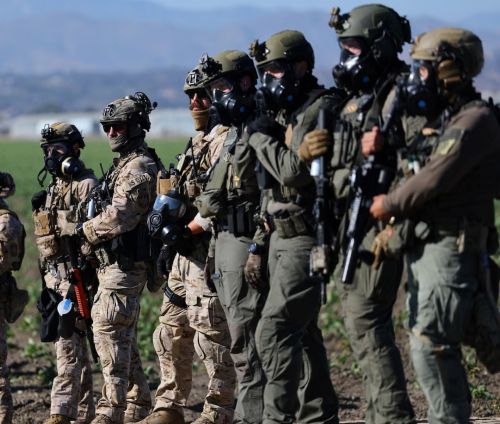
U.S. federal agents stand guard while blocking a road leading to an agricultural facility where U.S. federal agents and immigration officers carried out an operation, in Camarillo, California, U.S., July 10, 2025
Scene 1: The Raid
The pre-dawn silence of a Central Valley farm is shattered by the low rumble of diesel engines. Unmarked ICE vehicles crawl down the dusty access road. A sudden flash of tactical lights. Barked orders. The field erupts in chaos.
Workers scatter like startled birds through rows of lettuce and beans. Shadows flit beneath the irrigation lines. A woman screams. A man falls.
The first canister arcs through the air, trailing white smoke. Then another. The acrid burn of tear gas mingles with the scent of overturned earth. Workers stumble, eyes streaming, choking on chemicals and fear.
Hector, broad-shouldered, quiet, sees only one thing: his son, Mateo, crouching near the equipment shed, toy truck forgotten in the dirt. Hector runs—faster than he has in years—dodging crates and shouting agents, lungs searing. A crushed weed clings to the cuff of his pants as he runs. He reaches the boy and pulls him close. They crouch behind a rusting disc harrow, trembling, Mateo’s small hands pressed to his eyes.
In desperation, Hector begins to pray aloud in Spanish through the burning air.
“Jesús, protégeme. Ten piedad de mi hijo.”
Out of the chemical haze, a figure approaches—not running, not afraid. A man in simple linen, worn sandals, dark hair, and a weathered face. His eyes are kind, though tears stream down his cheeks from the gas. He kneels beside them, placing one hand on Hector’s shoulder and the other gently on Mateo’s head.
He begins to pray—not in Spanish or English, but in the cadence of scripture:
“I was hungry and you gave me food… I was thirsty and you gave me drink… I was a stranger, and you did not welcome me.”
The sounds of boots crunching dirt grow louder. ICE agents round the corner through the dissipating smoke, rifles raised, armor clanking, gas masks covering their faces. They see three brown-skinned figures huddled together.
One agent hesitates. “Wait… who is—?”
Another cuts him off, voice muffled behind his mask. “Doesn’t matter. They match the profile. Bag ’em.”
The agents swarm. Zip ties bite into wrists. Mateo cries out as he’s yanked from his father, still coughing from the gas. Hector shouts in panic. The stranger offers no resistance—his gaze full of grief, not fear.
“Do not be afraid,” he says softly. “They do not know what they do.”
The agents drag them toward the transport van. No one asks the stranger his name.
Scene 2: The Hearing
A windowless immigration courtroom, sterile and indifferent. A fluorescent hum fills the air. The docket reads:
“JESUS — No Last Name.”
The defendant sits at the table, still wearing the dirt-stained robe from the fields. His feet are bare.
The judge, gray-suited and impatient, flips through forms without lifting his eyes.
“Do you have documentation establishing your legal presence in the United States?”
Jesus replies, softly:
“I have roots in this land older than maps. I have walked its fields and wept at its borders. I have come for the least among you.”
The judge sighs. “This court does not recognize mythology, metaphor, or messianic claims. Do you have a valid visa or asylum paperwork?”
“I was here before paperwork.”
The interpreter glances up but says nothing.
The judge shrugs, jots a note, and speaks without emotion:
“Absent documentation, this court orders your removal from the United States.”
He pounds the gavel. The sound echoes like a tomb closing.
The bailiff calls out the next name:
“González, Maria.”
Scene 3: Alligator Alcatraz
Deep in the Florida Everglades, forty-five miles from Miami, an airstrip rises from the swamp. Chain-link fences topped with razor wire stretch across the tarmac. Guard towers pierce the humid air. Beyond the perimeter, dark water reflects nothing—cypress knees and saw grass disappearing into mist where alligator eyes glide silent as death.
The official name is Dade-Collier Training and Transition Airport. Everyone calls it Alligator Alcatraz.
Inside the compound, heavy-duty tents and FEMA trailers house thousands. The hum of industrial air conditioning battles the crushing heat, never quite winning. Mosquitoes cloud the recreation yard. In the distance, something splashes in the canal—too large to be a fish.
Jesus sits on a metal cot, sharing his meal with a trembling boy whose parents were deported separately. He tends to an old woman’s infected foot with water and torn fabric. Around him, the detained speak in whispers—some have been here days, others weeks. No one knows when the final expulsion orders will come.
A guard leans against the fence, sweating despite the cooling units. “That one thinks he’s some kind of prophet,” he tells his partner, nodding toward Jesus.
The other shrugs. “Least he’s peaceful. Better than the ones who try to run.” He glances toward the swamp. “Though where would they go?”
That evening, Jesus stands at the perimeter fence, fingers resting on the chain link. Through the mesh, he watches the sun set over an endless maze of waterways and predators. Behind him, someone begins humming a half-remembered hymn. Others join in—Mexican ballads, Salvadoran lullabies, the songs of home, sung low through clenched hope.
Mateo sits nearby, no longer crying, but hollow-eyed. He stares at the fence, at the razor wire, at the guard towers with their searchlights that never sleep.
“He came to his own, and his own received him not.”
In a crack between concrete slabs, where a drainage pipe meets the ground, a single green shoot pushes through. Impossibly small. Impossibly resilient. The guards walk past it twice a day and never see it.
Jesus kneels and touches the tiny leaf with one finger.
He whispers something no one hears—a prayer, a promise, a word riding the night wind across the water, past the alligators and the pythons, past the razor wire and the searchlights, out into the vast American darkness where other hearts are breaking, other prayers ascending.
The detention facility sleeps fitfully in the swamp.
The Browns stadium deal is not merely a bad investment—it is a paradigm of elite hypocrisy, a socialist redistribution of public wealth upward, executed by lawmakers who claim allegiance to free‑market principles while enacting policies that privatize profit and publicize risk.
Earlier this year, Ohio’s Republican supermajority passed legislation requiring that high school students be instructed in the virtues of capitalism.¹ At the same time, these very lawmakers voted to seize $600 million from the state’s unclaimed‑property fund—money legally belonging to ordinary Ohioans—and redirect it to fund a $2.4 billion private stadium project for billionaire owners Jimmy and Dee Haslam. That is not capitalism. That is elite socialism, a state‑directed transfer of private/collective resources to elite private interests.
The Haslams, whose estimated net worth exceeds $8.5 billion, are not merely beneficiaries of state largesse—they are its architects. Whether the team remains in downtown Cleveland (with the city offering $461 million in renovations) or relocates to Brook Park with state and county subsidies, the outcome is the same: private/public funds extracted to enhance elite private empires.
Let us strip away the euphemisms. This is not a “public–private partnership.” It is a state‑sanctioned seizure and redistribution of wealth, orchestrated by legislators who demand work requirements, means testing, and behavioral monitoring for ordinary Ohioans receiving food, housing, or healthcare assistance—but offer no such oversight when the recipient wears a suit and owns a football team.²
When working families receive modest aid, it is denounced as “government dependency.” When billionaires receive hundreds of millions in public money, it is praised as “economic development.” This is not pedestrian ideological inconsistency; it is class warfare masquerading as policy.
County Executive Chris Ronayne called the proposal “piracy,” rightly charging that lawmakers are robbing Bob and Betty Buckeye to pay Jimmy and Dee Haslam.³ And indeed, the state has now declared the unclaimed‑property fund reverts to public ownership after ten years—not to be reinvested in public education or healthcare, but to underwrite the speculative ventures of the ultra‑wealthy.
Even the supposed safeguards are laughable: a mere $50 million in escrow from the Haslams, and another $50 million line of credit—a token hedge against a half‑billion‑dollar state exposure. Meanwhile, individuals requesting a few hundred dollars in public aid are subjected to rigorous oversight and bureaucratic suspicion.
This arrangement is a perfect study in the moral inversion of modern American political economy: public discipline for the broad citizenry, public indulgence for the rich; free‑market platitudes for the powerless, centralized socialism for the powerful.
This stadium subsidy is merely the latest manifestation of a systematic pattern—from pharmaceutical companies capturing billions in public research funding while charging monopoly prices for resulting drugs, to defense contractors operating on cost-plus arrangements that guarantee profits regardless of performance, to agricultural corporations receiving millions in annual subsidies while preaching individual responsibility. The Browns deal simply makes visible what usually operates through more obscure channels.
This is not merely the marginalization of the interests of the poor, working, and middle classes, but the broader appropriation of public resources away from the citizenry at large—those who should have access to public investment without facing moral scrutiny, bureaucratic suspicion, or ideological disapproval.
It is telling that both Policy Matters Ohio and the Buckeye Institute—voices from the ideological left and right—oppose the deal. They understand, as do many citizens, that this is not governance in the public interest. It is the use of state authority to engineer a systematic upward redistribution of wealth, cloaked in the language of jobs and development.
The real divide in America is not between socialism and capitalism—it is between elite socialism, in which wealth is extracted and insulated for the privileged, and democratic socialism, in which collective resources are used for collective needs. (Ours has always been a mixed economy—part capitalist, part socialist, the latter increasingly tilted toward elite interests—though this has rarely been acknowledged in our political discourse.) Until we name this truth and demand ideological consistency from our legislators, we will continue subsidizing billionaires while denying the citizenry investment—and calling it “fiscal responsibility.”
The scaffolding of economic life already exists. The only question is whether it will remain a scaffold supporting billionaires or be reclaimed as a structure serving all the people.
NOTES:
¹ Senate Bill 17, signed by Gov. Mike DeWine in March 2024, requires ten principles of “free market capitalism” to be taught as part of financial literacy courses required for high school graduation. The Ohio House passed the bill 66–26 in February 2024. See: Ohio Capital Journal, “Ohio House passes bill that would add capitalism to high school financial literacy curriculum,” Feb. 12, 2024.
The Statehouse News Bureau, “Former Gov. Rhodes said ‘Profit isn’t a dirty word.’ Now, Ohio students will learn about capitalism,” Mar. 15, 2024.
² See, e.g., Ohio Administrative Code 5101:4‑3‑13 and 5101:4‑9‑09 (SNAP work registration, employment/training and sanctions); 5101:1‑3‑12 (Ohio Works First requiring 30–55 hours/week of work). Ongoing eligibility mandates include documentation of income, assets, and residency. No equivalent oversight applies to recipients of corporate subsidies or stadium funding.
³ Chris Ronayne described the plan as “akin to piracy” and stated, “This is not just robbing Peter to pay Paul, this is robbing Bob and Betty Buckeye to pay Jimmy and Dee Haslam.” See: WKYC, “Ohio’s unclaimed funds could help build Browns stadium: Here’s how to see if any belong to you,” June 5, 2025. wkyc.com
Axios Cleveland, “Ohio Senate proposes $600 million Browns stadium subsidy using taxpayers’ unclaimed funds,” June 4, 2025.
DeNatale, Dave, Lynna Lai, and Peter Fleischer. “Ohio Senate approves its version of budget, including $600M for new Cleveland Browns domed stadium in Brook Park.” WKYC, June 11, 2025.
⁴ Should the Browns remain in downtown Cleveland, the city’s proposed $461 million commitment is expected to come from municipally issued bonds, potentially backed by revenues through the Cleveland–Cuyahoga County Port Authority or tax levies. The Port Authority, which regularly issues loans and revenue bonds to spur commercial development, functions as a centralized mechanism for steering public resources—effectively a form of state planning within a nominally capitalist framework, choosing economic “winners” with public backing.
General sources consulted: Associated Press, Axios Cleveland, The Guardian, New York Post
Pieter Bruegel the Elder, The Tower of Babel (c. 1563, oil on panel) Kunsthistorisches Museum, Vienna
Utopias, like theoretical economic models and theological constructs, are among the most daring expressions of human thought. Each arises from an impulse toward order and improvement, born of the conviction that the present is insufficient and the future can be shaped. Yet despite their elevated origins, these frameworks call to be eschewed—not for the good they propose, but for the horrors they have enabled when unmoored from humility and constraint.
The history of ideas is littered with systems that began in hope and ended in terror. Plato’s Republic, with its philosopher-kings and rigid class hierarchy, inspired centuries of authoritarian dreams. Soviet central planning promised rational allocation but delivered famine and repression. The Puritan theocracy in Massachusetts Bay sought godly perfection but produced witch trials and exile for dissenters. Each began as a vision of human flourishing—the utopian city, the rationalized economy, the purified creed—yet furnished the blueprints for regimes of control.
Nor is such danger confined to leftist excesses or theological zealotry. In Chile, the 1973 overthrow of Salvador Allende led not only to political violence, but also to the forceful imposition of a radical free-market model under General Pinochet, guided by economists trained in the Chicago School. The result was economic restructuring praised by some for its efficiency, yet experienced by many as immiseration and repression. Here, too, theory eclipsed humanity. Market mechanisms became commandments; dissenters were not debated but disappeared. What was billed as liberation through market freedom became another apparatus of dominance—less visible, perhaps, but no less brutal. The lesson is not partisan, but perennial: when theory is elevated above persons, systems serve themselves.
Elevated to ideology, models cease to be guides and become chains. They offer certainty in place of inquiry, coherence in place of complexity, and purpose in place of personhood. What begins as vision hardens into decree; what is meant as a lens becomes law. Mao’s Great Leap Forward exemplified this transformation: an economic model promising industrial prosperity became an unyielding doctrine that cost millions of lives when reality refused to conform to theory.
When the model becomes sacred, deviation becomes heresy. And where heresy is named, there follow inevitably the commissars, the inquisitors, the doctrinaires—those who patrol the borders of the permissible. Stalin’s show trials eliminated those who questioned economic orthodoxy. Both Catholic Inquisitions and Protestant persecutions took inhuman measures against those who strayed from their respective versions of theological purity. McCarthyism destroyed careers in service of ideological conformity. All operated in service of the model, the path, the “truth”—though truth, in such hands, is no longer a horizon toward which one travels, but a cudgel with which to enforce obedience. And perhaps there is no final truth to be had, only a multiplicity of partial illuminations, glimpsed through the mist, refracted through fallible minds.
And yet, it would be a grave error to reject these models wholesale. A utopia, though unattainable, directs the gaze beyond the immediate—Martin Luther King Jr.’s “Dream” inspired civil rights progress precisely because it painted a picture of what America could become. A well-crafted economic model brings coherence to chaotic phenomena: Keynesian theory, whatever its limitations, helped navigate the Great Depression by providing a framework for understanding how governments might respond to economic collapse. A theological vision offers moral orientation and poetic resonance—liberation theology in Latin America, despite its political complications, channeled Christian teaching toward concrete concern for the poor and oppressed.
When held lightly—non-dogmatically, open to revision, aware of their limits—such models are not prisons but tools. They help us navigate complexity, but they must never be mistaken for the complexity itself. The Chicago School economists who influenced policy in the 1980s offered valuable insights about market mechanisms, but when their models became gospel rather than guides, the result was often ideology that ignored market failures and social costs.
The question, then, is one of balance. Can aspiration be disentangled from absolutism? Can man dream without dictating, model without mastering, believe without binding? This is no easy task, for humanity is rarely a creature of balance. We veer, we commit, we grasp too tightly. The same revolutionary fervor that toppled the Bastille eventually devoured its own children in the Terror. But the remedy is not the renunciation of vision; it is the cultivation of humility within vision. It is the refusal to equate map with territory, model with meaning, doctrine with destiny.
If balance is the ideal, then it must rest not on detachment but on a deeper fidelity—one that refuses both rigidity and relativism. This is not a call to valueless existence, but to the most valued existence—one that honors core commitments through responsive attention rather than rigid prescription. The danger lies not in caring deeply about human flourishing, justice, or freedom, but in believing we possess the universal formula for achieving these goods. True fidelity to our highest values often requires abandoning our preconceptions about how they must be realized. It demands constant attentiveness to circumstances, genuine openness to what the moment requires, and the intellectual courage to adjust course when reality refuses to conform to our expectations. The principled life is not one that follows predetermined blueprints, but one that remains alert to the irreducible complexity of human need and the ever-changing demands of genuine care.
To live without models is to drift. To live by them uncritically is to be enslaved. Wisdom lies in the middle path: to aspire without illusion, to theorize without tyranny, and to seek the better without forgetting the cost of the best. In this fragile equilibrium lies the noblest promise of human reason—not to control the world, but to understand it more justly, and to live within it more wisely. And in that wisdom, to leave room for the truth that ever escapes us.
An Essay on Memory, Power, and the Blood Beneath Our Feet
By Donald S. Yarab
“Taking the proceedings of the Athenians toward Melos from the beginning to the end, they form one of the grossest and most inexcusable pieces of cruelty combined with injustice which Grecian history presents to us … But the treatment of the Melians goes beyond all rigor of the laws of war; for they had never been at war with Athens, nor had they done anything to incur her enmity ….” George Grote, A History of Greece (London 1850) VII, 114.¹
Though we may think otherwise, we are a belligerent people. We flatter ourselves with tales of virtue, liberty, and civilization, but our history betrays us. We are heirs not only to triumphs of culture, learning, and law, but to the unspoken litany of conquest, subjugation, and blood. The soil itself bears witness. Its silence is not empty. It murmurs the blood of men and the cries of women and children—those cast aside, broken, forgotten, or made invisible by the forward march of empire.
This thought came to me not through modern headlines, though there are many that might summon it, but while reading of the Peloponnesian War—of its needless provocations, of its spiraling brutality, of Athens, the “enlightened city,” casting off the veil of philosophy to reveal the naked face of power. It was not necessity that brought on that war, Thucydides tells us, but desire. Desire for power. Desire to dominate. Desire to possess what one has not earned and cannot keep without violence.
Nowhere is this desire more exposed than in the fate of Melos.
During a lull in the great war between Athens and Sparta, the Athenians sailed to the small island of Melos, which had attempted to remain neutral. The Melians appealed to justice, to their rights as a small people, and to the protection of the Spartans with whom they shared kinship. The Athenians responded with brutal clarity: “The strong do what they can, and the weak suffer what they must.”² When Melos refused to surrender, the Athenians besieged and conquered the city. They slaughtered the men. They enslaved the women and children.³
Before its destruction, Melos minted coins bearing the image of an apple—mēlon in Greek, a deliberate pun upon the island’s name that now carries unintended prophetic weight.⁴ And in this small emblem, I saw more than a civic badge. I saw a symbol that reached backward to Eden.
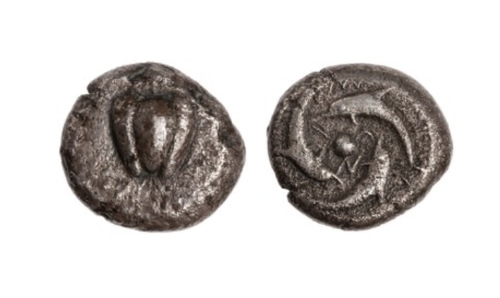
Silver stater of Melos, buried c. 416 B.C. as the Athenians laid siege. The obverse of the coin bears an apple—mēlon—on the obverse, a pun on the city’s name. The reverse shows dolphins swimming around a central boss. The coin was not recovered until discovered in the early 20th century. Image courtesy of American Numismatic Society 1944.100.27879 CC BY-NC 4.0
The apple—though scripture never names the fruit—is a stand-in, in Christian tradition, for the forbidden fruit of knowledge. With it came the mythical expulsion from paradise and the ensuing inheritance of suffering, toil, and death. But in our age, as in ages past, we have not been cast out merely for seeking knowledge. We have been cast out for failing to know ourselves.
We do not seek knowledge. We seek dominion. We crave possession—of land, of treasure, of people. And in so doing, we deny our complicity. We forget. We suppress. We sanctify the victors and silence the conquered. From age to age, we retell only the parts of the story that flatter us.
And here lies the uncomfortable mirror.
In this, we are more like Athens than we care to admit. Like them, we cloak power in principle. And like them, we forget.
We in the United States have long imagined ourselves the inheritors of Athenian democracy. We trace our civic ideals to their assemblies, our rhetoric to their orators, our architecture to their temples. We forget, or do not care to remember, that Athens was also an imperial power, that its democracy was partial and exclusionary, and that it extorted tribute, enslaved its enemies, and turned allies into subjects. At Melos, it abandoned all pretense of justice. It wielded power for its own sake and cloaked the sword in reason.
So too have we. We have invaded and occupied, supported tyrants when convenient, and crushed the aspirations of distant peoples in the name of freedom. At home, we have reaped the fruits of conquest while teaching ourselves to hear only the hymns of progress and patriotism.
Consider the Trail of Tears—where we marched Cherokee, Creek, and other nations from their ancestral lands to distant territories, causing thousands of deaths. That forced removal, justified by the rhetoric of “civilization” and “progress,” has spiraled into generations of poverty, educational disadvantage, and health crises on reservations. Even today, as Native communities face disproportionate hardships, we struggle to acknowledge our national policies as their root cause.
Or look to El Salvador and Nicaragua, where American foreign policy in the 1980s supported authoritarian regimes and death squads in El Salvador while simultaneously funding the Contra rebels against Nicaragua’s Sandinista government—all in the name of anti-communism. Our military aid facilitated massacres of civilians in both countries, devastated civil society, and undermined democratic institutions. The ensuing regional instability bred gangs, poverty, and the very migration crisis that excites our domestic politics today. Yet few Americans connect today’s asylum seekers to our own actions decades ago. Like Athens at Melos, we exercise power, then avert our eyes from the consequences. Yet evidence of our actions remains, waiting to be unearthed.
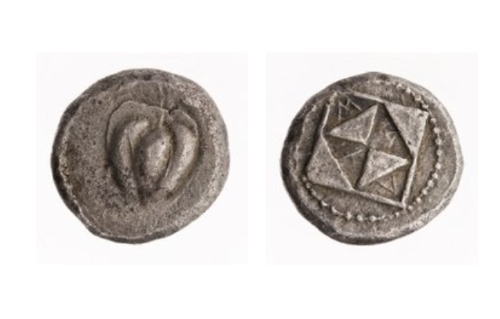
Another silver stater from the soil of Melos, the blood speaks still. This one was also buried in c. 416 B.C. likely during the Athenian siege and recovered only in 1907. On the obverse it too bore the civic emblem, the apple. Its reverse, however, featured a square divided into four triangles. Image courtesy of American Numismatic Society 1959.70.2 CC BY-NC 4.0
From the soil of Melos itself, the blood speaks still. In 1907, a hoard of silver coins was unearthed—buried, according to scholars, in 416 B.C. as the Athenians closed in.⁵ Those who hid them did not live to recover the coins. Both coins bear on the obverse the apple—the symbol of Melos, its punning emblem, its name. But their reverses differ: one shows dolphins encircling a central boss, evoking the sea that once embraced the island; the other, a square divided into four triangles. These buried apples of silver—like their biblical counterpart—bear knowledge too painful to confront: the truth of what power does when unbound by conscience. These coins, long entombed, bear no voices. Yet they cry out. Like Abel’s blood, they testify—not in sound, but in presence. That these objects survived while their owners perished is both historical evidence and perfect metaphor—artifacts outlive empires, bearing witness long after the powerful have fallen. Metal as memory. Silver as witness.
We are not alone in this legacy. But neither are we innocent. The voice of justice does not go silent simply because we stop our ears. As in Genesis, so in history: the blood cries from the ground.⁶ And though we deny it, the Eternal hears.
The apple on the coin of Melos is a relic now, but its meaning remains. It is a warning. It is a mirror. Excavated from darkness, these silent witnesses challenge our comfortable narratives. It is a fruit offered again and again to each generation: not to reveal what lies in the heavens, but what lies within ourselves.
Until we dare to eat of that fruit—not in pride, but in truth—we shall remain wanderers east of Eden, armed with denial, and thus, with destiny.
Footnotes
¹ Seaman, Michael G. “The Athenian Expedition to Melos in 416 B.C.” Historia: Zeitschrift für Alte Geschichte, vol. 46, no. 4, 1997, p. 385. The epigraph featured above is an adaptation of the citation used in Seaman’s essay, which being a fine summary of emotive outrage at Athenian transgressions, could not be more finely articulated.
² Thucydides, History of the Peloponnesian War, Book V, §§89–116. The quoted phrase is a paraphrase of the Athenian argument in the Melian Dialogue, often rendered: “The strong do what they can, and the weak suffer what they must.” See: Robert B. Strassler, ed., The Landmark Thucydides (New York: Free Press, 2008), 352.
³ See Seaman, Michael G., ibid., pp. 385–418, for a detailed discussion of the motives and actions surrounding the Athenian assault on Melos.
⁴ On the apple (mēlon) as a civic pun in Melian coinage, see Sheedy, Kenneth. “Aegina, the Cyclades and Crete.” In The Oxford Handbook of Greek and Roman Coinage, ed. William Metcalf, 2012, p. 112.
⁵ See: Kallet, Lisa and John H. Kroll, The Athenian Empire: Using Coins as Sources (Cambridge University Press, 2020), 105.
⁶ Genesis 4:10: “The voice of your brother’s blood is crying to me from the ground.”






 Northcoast Antiquarian