The Tyranny of Polymathy and the Silence of Wisdom
Among the scattered remains of Heraclitus’ thought, few sayings possess the enduring sharpness of this brief maxim: πολυμαθίη νόον οὐ διδάσκει — “much learning does not teach understanding” (Fragment XVIII, in The Art and Thought of Heraclitus, ed. Charles H. Kahn, Cambridge: Cambridge University Press, 1979, pp. 36–37). In a world increasingly captivated by the accumulation of knowledge, this ancient fragment persists as both a critique and a corrective.
Heraclitus of Ephesus, known to later generations as “the Obscure,” was not hostile to knowledge itself, but to its superficial accumulation. He reserved his sharpest disdain for those who amassed facts while remaining blind to deeper unity—figures such as Hesiod, Pythagoras, Xenophanes, and other fellow polymaths. To Heraclitus, the decisive mark of wisdom was not volume but depth, not possession of facts but recognition of λόγος (logos), the underlying order binding the manifold into one.
At the heart of his saying is the contrast between πολυμαθίη (polymathy, or the gathering of knowledge) and νόος (intelligence, intuitive understanding). Polymathy is acquisitive; it accumulates and catalogs. It may grow in quantity, but seldom in quality. Νόος, in Heraclitus’ conception, is penetrative—it cuts through the clutter, grasping the essential, perceiving the harmony hidden beneath the flux of appearances.
Modern Echoes: Information Without Insight
Heraclitus’ critique resonates acutely within the modern world. Never has humanity enjoyed such unrestricted access to knowledge. Vast databases, rapid transmission of ideas, and instantaneous retrieval of information define our age. Yet the paradox deepens: the world grows correspondingly impoverished in intelligence and understanding.
Data is abundant, but coherence is rare. Scholarly disciplines multiply, but their mutual intelligibility diminishes. Algorithms accumulate citations while human insight often withers beneath the sheer weight of accumulated text. Heraclitus reminds us that the mere collection of knowledge is not a pathway to wisdom; the two may diverge as sharply as night from day.
Heraclitus and the Machine Mind
This divergence is nowhere more manifest than in the emergence of artificial intelligence. Large language models, trained on incomprehensible expanses of text, generate fluent prose, plausible argumentation, and stylistic mimicry. They are polymathy mechanized: vast collectors, elegant rephrasers, yet fundamentally lacking in νόος.
Heraclitus would have recognized this phenomenon at once, for the problem is not the breadth of data but the absence of soul. In another pointed maxim, he declared: κακοὶ μάρτυρες ἀνθρώποισιν ὀφθαλμοὶ καὶ ὦτα, βαρβάρους ψυχὰς ἐχόντων —“eyes and ears are bad witnesses for men who have barbarian souls” (Fragment XVI, Kahn, pp. 34–35). It is not merely that the senses deceive, but that without a cultivated and receptive soul, sensory data remains inert, misapprehended, or altogether meaningless.
Machines “see” through vast datasets, “hear” through colossal corpora, but possess no ψυχή (soul), only a barbarian mimicry. Their testimony is immense but alien, their utterances fluent but soulless, incapable of partaking in the λόγος (logos) that Heraclitus saw as the ordering principle of reality. They traffic in appearances without substance, in signals without understanding.
Such systems compound the crisis by making superficial synthesis effortless, further displacing the contemplative labor essential to the cultivation of νόος. The true danger is not that machines think, but that they make it easier for humans to avoid thinking. The peril lies not in the tool itself, but in our eagerness to mistake mimicry for wisdom—to enthrone fluent appearance where only reflective engagement yields genuine understanding.
Conclusion: The Call to Stillness
Heraclitus, who spoke of the river that flows yet remains the same, calls us back to what is most essential: not the accumulation of voices, but the discernment of harmony; not endless learning, but the cultivation of understanding. His words remind us: the vessel may be filled to overflowing, yet remain empty of wisdom.
Against the relentless deluge of data, against the mechanical polymathy of our age, Heraclitus directs us to the deeper current. True understanding arises in the stillness where νόος awakens and the λόγος reveals its hidden thread. To cultivate νόος demands not accumulation but attention: the examined life, sustained reflection, and the pursuit of insight rather than quantity. The wisdom of Heraclitus remains as vital today as when it was first set down in fragments.
Source for Heraclitus: Charles H. Kahn, The Art and Thought of Heraclitus (Cambridge: Cambridge University Press, 1979).
“Here I am, an old man in a dry month, / Being read to by a boy, waiting for rain.” —T.S. Eliot, Gerontion
“Enigmas never age, have you noticed that” —Donald Trump, in a 50th birthday greeting to Jeffrey Epstein, as reported by the Wall Street Journal, July 17, 2025
The Great Day of His Wrath by John Martin, 1853, oil painting on canvas.
Not with a whimper but with judgment— the hollow men are laid bare. Between the shadow and the substance falls the weight of what they’ve done.
April reaps the harvest of unburied sins, memory and justice tally their dues in the counting house of broken promises. The rats abandon ship; the reckoning arrives through cracks in gilded towers.
We are not hollow, not stuffed with lies— we are the thunder that shakes foundations, the rain that scours the ledger clean, the voice that names the unnamed.
In this valley of false prophets their empires crumble while truth endures, and when the smoke clears, we remain— the witnesses in the empty boardroom, the light that penetrates the shadow.
The desert remembers. The wasteland testifies. And those who thought themselves untouchable now face the music of their making: Here. Here is the bill.
Between the crime and the punishment falls not silence, but the sound of debts returning to their debtors— inevitable, unrelenting, just.
In the room the power brokers scheme and plot, but tonight the doors are locked and the receipts read aloud.
This is the way the world ends— not with their bang, but with our thunder— the final indictment.
Tom Homan, Trump Border Czar, Fox News, July 2025: “People need to understand, ICE officers and Border Patrol don’t need probable cause to walk up to somebody, briefly detain them, and question them. They just go through the observations, get articulable facts based on their location, their occupation, their physical appearance, their actions.”
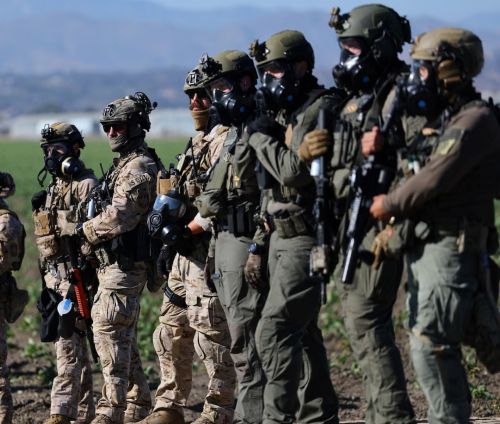
U.S. federal agents stand guard while blocking a road leading to an agricultural facility where U.S. federal agents and immigration officers carried out an operation, in Camarillo, California, U.S., July 10, 2025
Scene 1: The Raid
The pre-dawn silence of a Central Valley farm is shattered by the low rumble of diesel engines. Unmarked ICE vehicles crawl down the dusty access road. A sudden flash of tactical lights. Barked orders. The field erupts in chaos.
Workers scatter like startled birds through rows of lettuce and beans. Shadows flit beneath the irrigation lines. A woman screams. A man falls.
The first canister arcs through the air, trailing white smoke. Then another. The acrid burn of tear gas mingles with the scent of overturned earth. Workers stumble, eyes streaming, choking on chemicals and fear.
Hector, broad-shouldered, quiet, sees only one thing: his son, Mateo, crouching near the equipment shed, toy truck forgotten in the dirt. Hector runs—faster than he has in years—dodging crates and shouting agents, lungs searing. A crushed weed clings to the cuff of his pants as he runs. He reaches the boy and pulls him close. They crouch behind a rusting disc harrow, trembling, Mateo’s small hands pressed to his eyes.
In desperation, Hector begins to pray aloud in Spanish through the burning air.
“Jesús, protégeme. Ten piedad de mi hijo.”
Out of the chemical haze, a figure approaches—not running, not afraid. A man in simple linen, worn sandals, dark hair, and a weathered face. His eyes are kind, though tears stream down his cheeks from the gas. He kneels beside them, placing one hand on Hector’s shoulder and the other gently on Mateo’s head.
He begins to pray—not in Spanish or English, but in the cadence of scripture:
“I was hungry and you gave me food… I was thirsty and you gave me drink… I was a stranger, and you did not welcome me.”
The sounds of boots crunching dirt grow louder. ICE agents round the corner through the dissipating smoke, rifles raised, armor clanking, gas masks covering their faces. They see three brown-skinned figures huddled together.
One agent hesitates. “Wait… who is—?”
Another cuts him off, voice muffled behind his mask. “Doesn’t matter. They match the profile. Bag ’em.”
The agents swarm. Zip ties bite into wrists. Mateo cries out as he’s yanked from his father, still coughing from the gas. Hector shouts in panic. The stranger offers no resistance—his gaze full of grief, not fear.
“Do not be afraid,” he says softly. “They do not know what they do.”
The agents drag them toward the transport van. No one asks the stranger his name.
Scene 2: The Hearing
A windowless immigration courtroom, sterile and indifferent. A fluorescent hum fills the air. The docket reads:
“JESUS — No Last Name.”
The defendant sits at the table, still wearing the dirt-stained robe from the fields. His feet are bare.
The judge, gray-suited and impatient, flips through forms without lifting his eyes.
“Do you have documentation establishing your legal presence in the United States?”
Jesus replies, softly:
“I have roots in this land older than maps. I have walked its fields and wept at its borders. I have come for the least among you.”
The judge sighs. “This court does not recognize mythology, metaphor, or messianic claims. Do you have a valid visa or asylum paperwork?”
“I was here before paperwork.”
The interpreter glances up but says nothing.
The judge shrugs, jots a note, and speaks without emotion:
“Absent documentation, this court orders your removal from the United States.”
He pounds the gavel. The sound echoes like a tomb closing.
The bailiff calls out the next name:
“González, Maria.”
Scene 3: Alligator Alcatraz
Deep in the Florida Everglades, forty-five miles from Miami, an airstrip rises from the swamp. Chain-link fences topped with razor wire stretch across the tarmac. Guard towers pierce the humid air. Beyond the perimeter, dark water reflects nothing—cypress knees and saw grass disappearing into mist where alligator eyes glide silent as death.
The official name is Dade-Collier Training and Transition Airport. Everyone calls it Alligator Alcatraz.
Inside the compound, heavy-duty tents and FEMA trailers house thousands. The hum of industrial air conditioning battles the crushing heat, never quite winning. Mosquitoes cloud the recreation yard. In the distance, something splashes in the canal—too large to be a fish.
Jesus sits on a metal cot, sharing his meal with a trembling boy whose parents were deported separately. He tends to an old woman’s infected foot with water and torn fabric. Around him, the detained speak in whispers—some have been here days, others weeks. No one knows when the final expulsion orders will come.
A guard leans against the fence, sweating despite the cooling units. “That one thinks he’s some kind of prophet,” he tells his partner, nodding toward Jesus.
The other shrugs. “Least he’s peaceful. Better than the ones who try to run.” He glances toward the swamp. “Though where would they go?”
That evening, Jesus stands at the perimeter fence, fingers resting on the chain link. Through the mesh, he watches the sun set over an endless maze of waterways and predators. Behind him, someone begins humming a half-remembered hymn. Others join in—Mexican ballads, Salvadoran lullabies, the songs of home, sung low through clenched hope.
Mateo sits nearby, no longer crying, but hollow-eyed. He stares at the fence, at the razor wire, at the guard towers with their searchlights that never sleep.
“He came to his own, and his own received him not.”
In a crack between concrete slabs, where a drainage pipe meets the ground, a single green shoot pushes through. Impossibly small. Impossibly resilient. The guards walk past it twice a day and never see it.
Jesus kneels and touches the tiny leaf with one finger.
He whispers something no one hears—a prayer, a promise, a word riding the night wind across the water, past the alligators and the pythons, past the razor wire and the searchlights, out into the vast American darkness where other hearts are breaking, other prayers ascending.
The detention facility sleeps fitfully in the swamp.
“Now the whole earth had one language and the same words… And they said to one another, ‘Come, let us build ourselves a city and a tower… lest we be scattered abroad upon the face of the whole earth.'” — Genesis 11:1-4
“Look, they are one people, and they have all one language… nothing that they propose to do will now be impossible for them.” — Genesis 11:6
Tower of Babel by M.C. Escher. Woodcut, 1928. Escher, commenting on the work, stated: “Some of the builders are white and others black. The work is at a standstill because they are no longer able to understand one another. Seeing as the climax of the drama takes place at the summit of the tower which is under construction, the building has been shown from above as though from a bird’s eye view.”
The last man to descend from the Tower of Babel after language was confounded carried with him a memory that the theologians would spend centuries trying to erase. Dust-covered and thirsty, standing bewildered among companions now made strangers, he remembered what it had been like to build together. He remembered the shared mortar, the common purpose, the simple joy of raising something greater than any one of them could accomplish alone.
He remembered their fear—not pride, but fear. The fear of being scattered, of losing one another, of becoming strangers in a vast and empty world. And he remembered their response: “Come, let us build.” Not “Come, let us conquer heaven,” but “Come, let us remain together.”
Yet somehow, in the millennia that followed, their unity would be called sin. Their cooperation would be named rebellion. Their fear of scattering would be recast as prideful ambition. The very virtues that had bound them—brotherhood, shared purpose, mutual aid—would be transformed by interpreters into vices deserving divine punishment.
But the last man remembered. And his memory betrays the tradition we were taught.
A child, gathering stones with siblings to build a fort in the backyard, does not think of rebellion. The impulse to create together, to make something shared and lasting, springs from the deepest wells of human nature. It is the sacred reaching toward we that lifts us beyond the isolation of I. When children say “Let’s build something,” they echo the first and purest impulse of community itself.
How then can it be imagined that the Divine—source of all communion, all love—would greet humanity’s first great act of cooperation not with blessing but with violence? How could the natural longing to remain together, to build something lasting, to resist the entropy of scattering, be met not with approval but with the very scattering they feared?
It cannot be so. It is not the divine who pronounced guilt over unity; it is man.
The doctrine that Babel represents sinful pride emerges not from the text itself but from human artifice. It is born of fear—fear of unity that cannot be controlled, fear of cooperation that bypasses authority, fear of communities that dare to build without permission from those who claim dominion over building.
For what is the story of Babel if not the story of the first We? The natural longing to remain together, to resist isolation, to create something greater than the sum of individual parts—this was not the rebellion of prideful beings but the organic unfolding of community itself. To portray this reaching as disobedience is to misread the very nature of human fellowship.
The Genesis narrative itself frames the matter plainly. The builders are not described as wicked. They are not blasphemers or tyrants. They are simply people who share a language and a purpose. Their stated aim is modest and moving: to build a city and tower “lest we be scattered abroad upon the face of the whole earth.”
This is not hubris. This is the cry of community itself—the recognition that separation means death, that scattering means the end of the shared life they have known. They build not to reach heaven but to remain earthbound together. Not to transcend the human condition but to honor it through cooperation.
When the divine voice observes, “Look, they are one people, and they have all one language, and this is only the beginning of what they will do; nothing that they propose to do will now be impossible for them,” there is no anger in the words. There is something else—perhaps apprehension, perhaps wonder, perhaps even a kind of sorrow. The tone is not of wrath but of recognition: unity makes all things possible.
But perhaps this “divine voice” is not divine at all. Perhaps it is the voice of the writer, generations later, trying to make theological sense of a catastrophe that was entirely human in origin. Perhaps the real Babel was not a moment when God intervened, but when human beings—through political fracture, resource conflict, or the machinations of those who feared unified peoples—engineered their own scattering. Perhaps the “confusion of tongues” was not miraculous punishment but the natural result of division, distrust, and the deliberate sowing of misunderstanding.
The Last Man would have known the difference. He would have remembered not divine intervention, but human failure. Not the voice of judgment from heaven, but the whispers of those who benefited from division. He would have seen how cooperation became suspect, how shared purpose was undermined, how the fear of remaining together was replaced by the greater fear of those who might control them if they remained apart.
Later theological traditions, particularly within Christianity, would recast this moment as divine judgment against human pride. Augustine, in The City of God (Book XVI), framed Babel as the archetype of the earthly city, writing that the builders “erected this tower against the Lord, and so gave expression to their impious pride; and justly was their wicked intention punished by God.” He further interpreted their motive as believing “they could avoid a future flood (as if anything could be too high for God!)” (Tractates on John 6.10.2). Augustine thought that ‘babel’ meant ‘confusion’: it is characteristic of the earthly city, he said, that there is no consistent moral or religious teaching, only a babble of conflicting voices. Medieval theologians deepened this interpretation, with Isidore of Seville’s influential Etymologies helping to establish the framework where the confusion of languages was seen as divinely designed punishment for human arrogance. Augustine had already helped establish the tradition that 72 languages resulted from Babel’s confusion (The City of God XVI 6), and this numerical framework became standard in medieval interpretations. Bede the Venerable employed allegorical interpretation methods that turned Babel into a moral allegory, while later Reformation thinkers would see scattered tongues as evidence of human fallenness.
But this interpretive tradition serves power more than truth. For if the scattering was actually human-engineered—the result of political manipulation, resource conflicts, or the deliberate sowing of division by those who feared unified peoples—then claiming it was divinely ordained becomes a theological cover-up. If unity without proper authority is called sinful, then those who claim to speak for proper authority become indispensable. If human fellowship is made suspect, then mediated fellowship—through church, through state, through hierarchy—becomes the only legitimate path to community.
Thus the interpreters of tradition did not just sanctify separation—they concealed its human origins. They made peace with estrangement by calling it divine will. They turned a human tragedy into a divine necessity, a wound into a cure.
The last man at Babel would not have recognized this version of his story. He would have remembered the morning when work began, when neighbors called to neighbors across the plain of Shinar: “Come, let us make bricks. Come, let us build.” He would have remembered the satisfaction of shared labor, the jokes passed from hand to hand with the mortar, the songs that rose from many voices into one.
He would have remembered their dream: not to storm heaven, but to remain together. Not to challenge the divine, but to honor the human bonds that felt, themselves, like gifts from beyond.
And he would have remembered how it ended. Not with divine fire or celestial intervention, but with human scheming. The whispered warnings about “those people” over there. The rumors of resource hoarding. The gradual erosion of trust. The political calculations of those who saw more advantage in a scattered people than a unified one. The slow poison of suspicion that made neighbor distrust neighbor, until the common language itself began to fracture—not by miracle, but by design.
The misreading of Babel has shaped our politics, our theology, our imagination for millennia. It has made us suspicious of cooperation, fearful of unity, comfortable with division. It has taught us that coming together is dangerous, that shared purpose is prideful, that the stranger—created not by divine decree but by human manipulation—is properly strange.
But more than that, it has concealed the human responsibility for our fractures. It has allowed us to blame God for what we did to ourselves. It has made us forget that Babel was not divine judgment but human failure—and that the story was written to make the perpetrators seem like agents of divine will.
Under the weight of this interpretation, we have learned to distrust the very impulses that might heal our brokenness. We have been taught that our longing for true community is suspect, that our desire to build together is rebellious, that our resistance to scattering is sinful.
But the text itself whispers another truth: that the builders were afraid of becoming strangers to one another. That their tower was not an assault on heaven but an anchor against forgetting. That what was lost at Babel was not obedience, but fellowship—and that the loss was engineered by human hands, then sanctified by human interpreters who found it useful to claim that God wanted division.
And perhaps what was broken by human manipulation might yet be mended by human recognition—by refusing to let the theological cover story stand unchallenged.
Man is not innately proud. Man is innately communal. Born into a world too vast for any individual to comprehend or inhabit alone, humanity’s first impulse is not toward dominion but toward fellowship—the need to share the burden and wonder of existence, to say “we” in a cosmos that otherwise echoes only “I.”
Community, then, is not a luxury; it is the ground of survival. It is the blessed recognition that no one person contains enough wisdom, strength, or love to make full sense of being human. Without it, there would be no shared labor, no common song, no building of anything that might outlast the brief span of individual life.
The theologians, in their haste to impose hierarchy where partnership had flourished, mistook cooperation for conspiracy. They mistook the reaching toward “we” for rebellion against divine order. But community is not sin; it is the evidence of our created nature, the signature of beings made not for isolation but for fellowship.
To say “Come, let us build” is to live as we were made to live: together, sharing the work, sharing the dream, sharing the hope that what we make together might matter more than what any of us could make alone.
The first great act of building was not a crime against the divine. It was the first true expression of humanity: the confused, hopeful, vulnerable community daring to create something lasting in a world of scattering.
In our cooperation, then, we find not our fall but our calling. Not our sin but our salvation. For to say “Come, let us build” is to begin the work of home—not a tower reaching toward heaven, but a community reaching toward one another.
The sacred path is not upward but inward—into fellowship, into shared purpose, into the endless possibility of what human beings might accomplish when they refuse to remain strangers.
The last man at Babel, climbing down from the ruins, carried with him more than dust and disappointment. He carried the memory of what it felt like to build together. And that memory, fragile as it was, held within it the seed of every community that would ever rise again from the ashes of confusion.
For the impulse to build together, like the impulse to question, is indestructible. Scattered, perhaps. Confused, certainly. But never finally lost.
The tower was abandoned. But the dream of building together endures.
And the question remains: who broke us apart, and who benefits from keeping us scattered? The Last Man knows. His memory threatens not just bad theology, but the very structures of power that require our division to survive.
Perhaps that is why his voice has been so carefully silenced for so long.
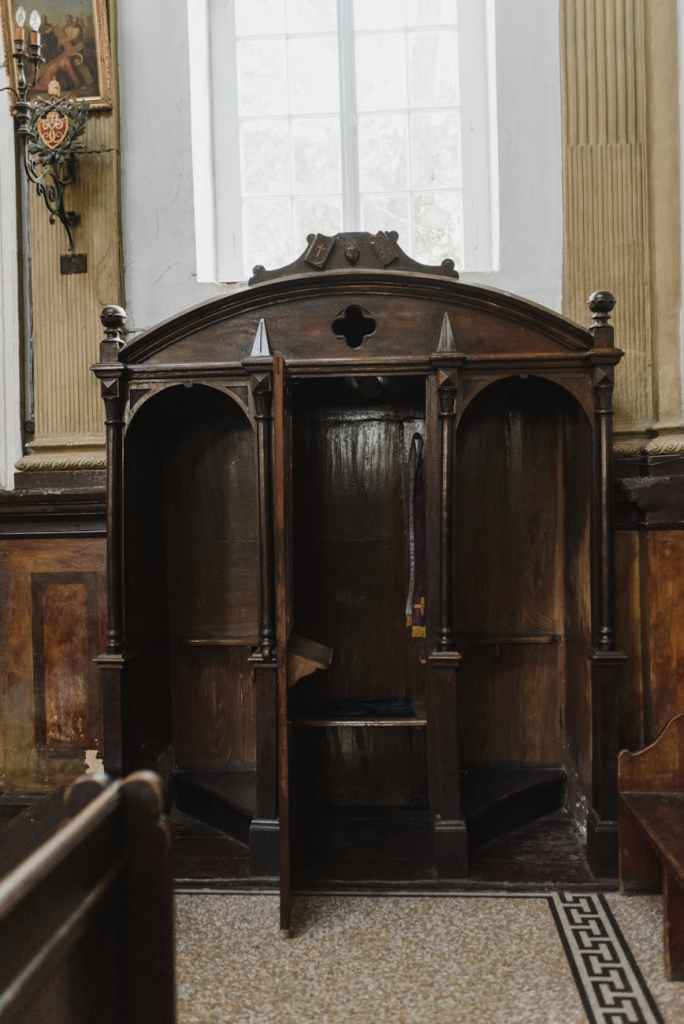
Forgive us, Father, for we have sinned, It has been… we cannot count the years— since we knew what sin meant.
We mouth the words the nuns and priests once taught us, but the syllables taste foreign now, like prayers in a dead language we pretend to understand.
We have forgotten why we kneel, though still our knees recall the stone. We have lost the thread of what was broken, but feel the weight of something severed.
We built cathedrals out of doubt and filled them with our questions. We replaced altars with algorithms, confession with comment sections.
We are no longer sure You are listening— or if listening is something we invented to make the silence bearable, the vastness less vacant.
We have sinned—we think— though we are not sure against what. Against nature? Against each other? Against some half-remembered covenant, written in a script we can no longer read?
We recite the forms like actors who have forgotten their motivation, performing the ancient motions because they feel like muscle memory— like DNA calling us home to a house we are no longer certain exists.
Still we gather, still we whisper these inherited incantations, hoping they might still hold power, hoping the words might remember what we have forgotten.
O my God… we are… we think we are… sorry… for having… for having what? For having forgotten how to finish this prayer?





 Northcoast Antiquarian