
The Creation in Ovid’s Metamorphoses and A Recommended Translation

Antonio Tempesta’s etching “The Creation of the World” is based on Ovid’s ‘Metamorphoses’. Ovid, a canonical Roman poet, is best known for this epic poem, which beautifully recounts classical mythology tales. Charles Martin’s translation of Metamorphoses is recommended for its elegance and brilliance. In the poem, Ovid describes the divine creation of the universe, which Stephen M. Wheeler argues is influenced by the Homeric shield from Homer’s Iliad. Wheeler notes Ovid’s self-consciousness as a poet, suggesting that the universe’s ordering is a metaphor for the creation of the poem itself. This insightful exploration adds depth to Ovid’s captivating tale of creation.

Pūblius Ovidius Nāsō (43 BC – 17/18 AD), known in English as Ovid, is, along with Virgil and Horace, one of the three “canonical poets” of Latin literature.  He is, no doubt, best known today for his epic poem Metamorphoses, which is an extraordinarily beautiful telling of the tales of classical mythology.  I first became intimately acquainted with Metamorphoses in summer 1987 and have revisited it on multiple occasions ever since, never ceasing to be refreshed and delighted by the visit.

Metamorphoses – Ovid: A New Translation by Charles Martin, Introduction by Bernard Knox. W.W. Norton & Co., New York, 2004.

Several years ago, I purchased and read Charle Martin’s translation of Metamorphoses and do not hesitate to recommend this particular translation to you for its elegance, flow, and brilliance as demonstrated in the following excerpt.

The Creation

Before the seas and lands had been created,

before the sky that covers everything,

Nature displayed a single aspect only

throughout the cosmos; Chaos was its name,

a shapeless, unwrought mass of inert bulk

and nothing more, with the discordant seeds

of disconnected elements all heaped

together in anarchic disarray.

The sun as yet did not light up the earth,

nor did the crescent moon renew her horns,

nor was the earth suspended in midair,

balanced by her own weight, nor did the ocean

extend her arms to the margins of the land.

Although the land and sea and air were present,

land was unstable, the sea unfit for swimming,

and air lacked light; shapes shifted constantly,

and all things were at odds with one another,

for in a single mass cold strove with warm,

wet was opposed to dry and soft to hard,

and weightlessness to matter having weight.

Some god (or kinder nature) settled this

dispute by separating earth from heaven,

and then by separating sea from earth

and fluid aether from denser air;

and after these were separated out

and liberated from the primal heap,

he bound the disentangled elements

each in its place and all in harmony.

The fiery and weightless aether leapt

to heaven’s vault and claimed its citadel;

the next in lightness to be placed was air;

the denser earth drew down gross elements

and was compressed by its own gravity;

encircling water lastly found its place,

encompassing the solid earth entire.

Now when that god (whichever one it was)

had given Chaos form, dividing it

in parts which he arranged, he molded earth

into the shape of an enormous globe,

so that it should be uniform throughout.

And afterward he sent the waters streaming

in all directions, ordered waves to swell

under the sweeping winds, and sent the flood

to form new shores on the surrounded earth;

he added springs, great standing swamps and lakes,

as well as sloping rivers fixed between

their narrow banks, whose plunging waters (all

in varied places, each in its own channel)

are partly taken back into the earth

and in part flow until they reach the sea,

when they – received into larger field

of a freer flood – beat against shores, not banks.

He ordered open plains to spread themselves,

valleys to sink, the stony peaks to rise,

and forests to put on their coats of green.

And as the vault of heaven is divided

by two zones on the right and two on the left,

with a central zone, much hotter, in between,

so, by the care of this creator god,

the mass that was enclosed now by the sky

was zoned in the same way, with the same lines

inscribed upon the surface of the earth.

Heat makes the middle zone unlivable,

and the two outer zones are deep in snow;

between these two extremes, he placed two others

of temperate climate, blending cold and warmth.

Air was suspended over all of this,

proportionately heavier than aether,

as earth is heavier than water is.

He ordered mists and clouds into position,

and thunder, to make test of our resolve,

and winds creating thunderbolts and lighting.

Nor did that world-creating god permit

the winds to roam ungoverned through the air;

for even now, with each of them in charge

of his own kingdom, and their blasts controlled,

they scarcely can be kept from shattering

the world, such is the discord between brothers.

Eurus went eastward, to the lands of Dawn,

the kingdoms of Arabia and Persia,

and to the mountain peaks that lie below

the morning’s rays; and Zephyr took his place

on the western shores warmed by the setting sun.

The frozen north and Scythia were seized

by bristling Boreas; the lands opposite,

continually drenched by fog and rain,

are where the south wind, known as Auster, dwells.

Above these winds, he set the weightless aether,

a liquid free of every earthly toxin.

No sooner had he separated all

within defining limits, when the stars,

which formerly had been concealed in darkness,

began to blaze up all throughout the heavens;

and so that every region of the world

should have its own distinctive forms of life,

the constellations and the shapes of gods

occupied the lower part of heaven;

the seas gave shelter to the shining fishes,

earth received beasts, and flighty air, the birds.

An animal more like the gods than these,

more intellectually capable

and able to control the other beasts,

had not as yet appeared: now man was born,

either because the framer of all things,

the fabricator of this better world,

created man out of his own divine

substance – or else because Prometheus

took up a clod (so lately broken off

from lofty aether that it still contained

some elements in common with its kin),

and mixing it with water, molded it

into the shape of gods, who govern all.

And even though all other animals

lean forward and look down toward the ground,

he gave to man a face that is uplifted,

and ordered him to stand erect and look

directly up into the vaulted heavens

and turn his countenance to meet the stars;

the earth, that was lately rude and formless,

was changed by taking on the shapes of men.

Ovid, Metamorphoses, Book I, lines 6-125 (trans. Charles Martin)

Ovid’s tale of creation is both moving and striking, to say the least. And if one is at all like me in intellectual temperament, one cannot help but wonder where Ovid found the inspirational well for his striking poetic imagery and design. Fear not, my friends, Stephen M. Wheeler explored this issue in “Imago Mundi: Another View of the Creation in Ovid’s Metamorphoses” (The American Journal of Philology, vol. 116, no. 1, Johns Hopkins University Press, 1995, pp. 95–121, https://doi.org/10.2307/295504), an article recommended as worth your time to read.

Among other things, Wheeler argues that Ovid uses the Shield of Achilles (the Homeric Shield), from Homer’s Illiad, as “a model for his own version of the divinely created universe.” Wheeler does so by presenting evidence showing Ovid’s “allusive engagement with the Homeric shield” in his account of chaos, showing that Ovid’s description of the universe resembled the ecphrasis [i.e., the use of detailed description of a work of visual art as a literary device] of a work of art in the tradition of the Homeric shield, and that it prefigured other divine works of art in Metamorphoses, and by explaining why Ovid began the Metamorphoses with a reference to the Homeric shield as well as how the work should be read in “light of obvious allusions to Hesiod’s Theogony and the Apollonian song of Orpheus.” 

Greek, c. 470BC. Two-handled ceramic jar (amphora) depicting Hephaistos polishing the Shield of Achilles in the presence of Thetis. In the field, a pair of greaves, a helmet, tongs, hammer and saw. Bartlett Collection. (c) Museum of Fine Art Boston.

Towards the conclusion of his article, Wheeler states the following: “Ovid’s choice to begin Metamorphoses with an epic ecphrasis also highlights his own-self-consciousness as a poet.  It is well-known that the device of ecphrasis offers the poet an opportunity to reflect upon his own art while describing the art of another.  The deus et melior natura may therefore be read as a figure for the poet, and the ordering of the universe as a metaphor for creation of the poem; thus the “real” subject of Ovid’s cosmogony may be the literary creation of Metamorphoses, just as the shield of Achilles is emblematic of the creation of the Iliad” (p. 117).

All Abuzz about the Nexus Between My Readings: The Promised Land

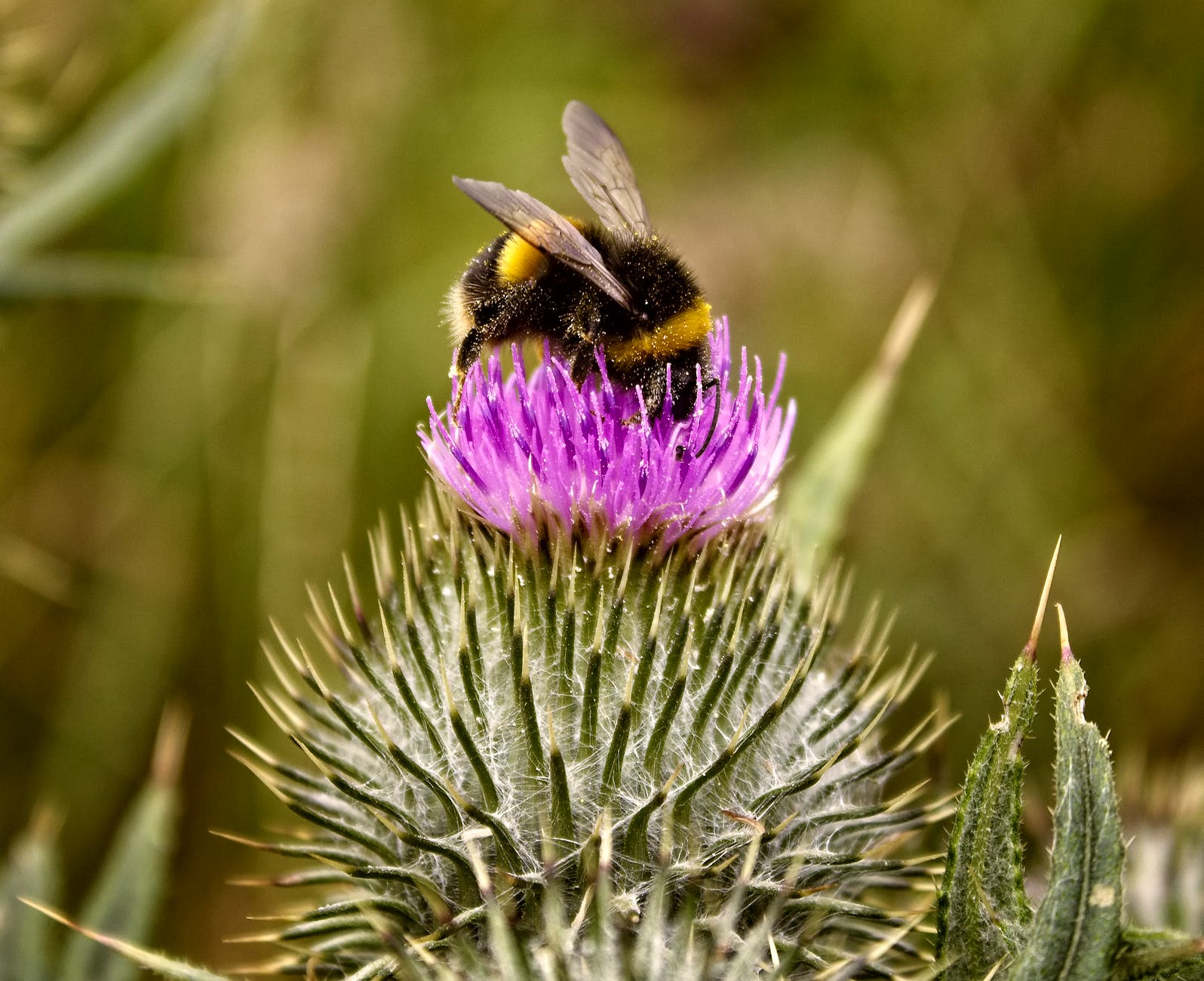
Honey Bee alighting on a bloom. Photo by Michelle Reeves on Pexels.com

And the Lord said, “I indeed have seen the abuse of My people that is in Egypt and its outcry because of its taskmasters. I have heard, for I know its pain. And I have come down to rescue it from the hand of Egypt and to bring it up from that land to a goodly and spacious land, to a land flowing with milk and honey, to the place of the Canaanite and the Hittite and the Amorite and the Perizzite and the Hivvite and the Jebusite.”

Exodus 3:7-8. From Robert Alter’s The Hebrew Bible : A Translation with Commentary.

What particularly caught my attention after reading this passage was Robert Alter’s commentary on the milk and honey to be found in The Promised Land. He stated the following: “The honey in question is probably not bee’s honey, for apiculture was not practiced in this early period, but rather a sweet syrup extracted from dates. The milk would most likely have been goat’s milk and not cow’s milk. In any case, these two synecdoches for agriculture and animal husbandry respectively become a fixed epithet for the bounty of the promised land” (Alter, Robert (2019). The Hebrew Bible: A Translation with Commentary, v. 1, p. 221, n. 8.).

Immediately upon reading this I was seized with a curiosity to know more about the sweet syrup extracted from dates and apiculture in the Holy Land. Let us begin with a research paper that helps me understand the comment above and discusses the earliest known archaeological apicultural remains in The Promised Land.

Date “honey”

In 2010, Guy Bloch and others published an exciting paper detailing the oldest archaeological evidence related to bee-keeping ever discovered (Bloch, Guy; Francoy, Tiago; Wachtel, Ido; Panitz-Cohen, Nava; Fuchs, Stefan; and Mazar, Amihai. (2010). Industrial Apiculture in the Jordan Valley during Biblical Times with Anatolian Honeybees. In Proceedings of the National Academy of Sciences of the United States of America. 107. 11240-4. 10.1073).

The work began by noting that: “[a]lthough texts and wall paintings suggest that bees were kept in the Ancient Near East for the production of precious wax and honey, archaeological evidence for beekeeping has never been found. The Biblical term “honey” commonly was interpreted as the sweet product of fruits, such as dates and figs.” This confirmed Alter’s comment, above. But then the paper proceeded to share its extraordinary findings:

“However, actual evidence for beekeeping in antiquity had not been found before the recent discovery of what appears to be a well-organized apiary at Tel Rehov in the middle Jordan valley in northern Israel. Tel Rehov is one of the largest Iron Age sites in Israel. A city 10 ha in area flourished there between the 12th and 9th centuries Before Common Era (B.C.E.). The apiary includes ≈30 hives (of 100–200 estimated) that were made as unfired clay cylinders. The hives have a small hole on one side for the bees to enter and exit and a lid on the opposite side for the beekeepers to access the honeycomb. Three rows of such hives were located in a courtyard that was part of a large architectural complex that was severely destroyed, most probably at the end of the 10th or beginning of the 9th centuries B.C.E. In terms of Biblical historiography, this period corresponds with the United Monarchy of David and Solomon and the beginning of the kingdom of northern Israel” p. 11240.

What is also extraordinarily interesting is that the authors report the discovery of remains of honey bees and their larvae inside the hives, which allowed them to identify the species of bee. The authors determined that the bees in the hives were A. m. anatoliaca, which currently resides in Turkey. This suggested to them that either Western honeybee subspecies distribution has undergone rapid change during the past 3,000 years or that the ancient beekeepers at Tel Rehov imported bees with a less aggressive temperament and superior honey yield (3 to 8 times more yield than the native species, A. m. syriaca). The possibility of importation cannot be easily dismissed given tantalizing hints of a developed apiculture transport practices, such as the following, cited by the authors:

“There is evidence that beekeeping was practiced in Anatolia during the Late Bronze Age (1); Hittite laws dated to the 14th–13th centuries B.C.E. contain severe punishments for thieves of bee swarms and hives (25). The Zenon papyri from Egypt suggest that transferring bees in portable hives or pottery jars was practiced in the third century B.C.E. (1). An Assyrian memorial stele dated to the mid-eighth century B.C.E. (about 100–150 y later than the beehives at Tel Rehov) describes the importation of honeybees from a country called “Habha,” probably in the Zagros or Taurus mountains (modern day southeastern Turkey
or northwestern Iran), about 300–400 km to the north or northeast of the land of Suhu on the Middle Euphrates (the modern border zone between Syria and Iraq)” pp. 11243-11244.

Today, apiculture is flourishing in The Promised Land. The Israeli Honey Production and Marketing Board says that apiculture and the trade in honey produced by honey bees can be traced back to 1882. The Israeli honeybee is actually of Italian origin, and is known as the Apis mellifera ligustica – a subspecies of the western honey bee. There are 529 beekeepers in Israel tending to approximately 120,000 hives. Their bees produce approximately 35 kilograms of honey per hive annually. Fortunately, honeybee populations are reported to be stable in The Promised Land, which serves as a transition to my next “connected” reading.

Newsweek reported earlier this week that the U.S. Fish and Wildlife Service reviewed a petition calling for the the American bumble bee to be listed as an endangered or threatened species and found it “may be warranted.” The petition, which can be found here, was written and submitted by the Center for Biological Diversity and the Bombus Pollinators Association of Law Students. The petition states, in part, in its executive summary, the following:

Bombus pensylvanicus De Geer (American Bumble Bee)

“The American bumble bee (Bombus pensylvanicus De Geer) is one of the most iconic native pollinators in North America. This highly adaptable pollinator once ranged coast to coast, foraging in the grasslands, fields, and open spaces in 47 of the lower 48 states. Like the endangered rusty-patched bumble bee, it is a generalist that provides essential pollination service to a wide variety of plants—including native plants and cultivated crops, across a vast range. Its loss will have considerable consequences to whole ecosystems and to crop production. Once the most commonly observed bumble bee in the United States, the American bumble bee has declined by 89 percent in relative abundance and continues to decline toward extinction due to the disastrous, synergistic impacts of threats including habitat loss, pesticides, disease, climate change, competition with honey bees, and loss of genetic diversity. In the last 20 years, the American bumble bee has vanished from at least eight states, mostly in the Northeast, and it is in precipitous decline in many more. For example, in New York it has suffered a catastrophic decline of 99 percent in relative abundance, and in Illinois it has disappeared from the northern part of the state and is down 74 percent since 2004. In sum, the American bumble bee has become very rare or possibly extripated from 16 states in the Northeast and Northwest; it has experienced declines of over 90 percent in the upper Midwest; and 19 other states in the Southeast and Midwest have seen declines of over 50 percent” p. 8.

That the American Bumble Bee would be so close to extinction, in the land that so many identify as the new promised land, is depressing. Which leads to one final, not bee related but promised land related reading: Charles Taylor’s book review, An America That Could Explain: On Barack Obama’s “A Promised Land.” The reader should read the review but for my purposes, I will share only the concluding thought of the review, as it seemed most appropriate for these troubled times:

In Caste, Isabel Wilkerson quotes Taylor Branch, the author of the magisterial Martin Luther King Jr. biography America in the King Years. “The real question,” Branch asks, “would be if people were given the choice between democracy and whiteness, how many would choose whiteness?” At last count, the answer is 74,222,958.

“Put your hand, pray, under my thigh, that I may make you swear by the Lord, God of the heavens and God of the earth …”

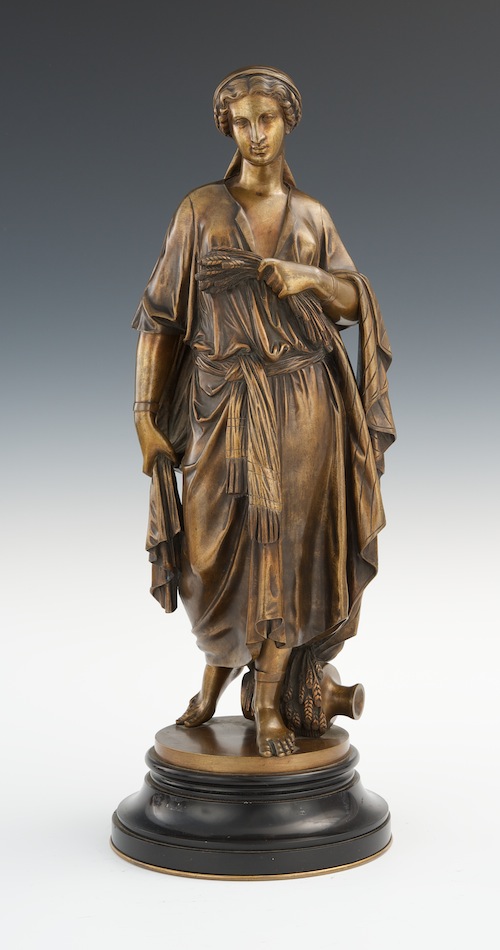
Cast Bronze Statue of Rebekah, whom the servant of Abraham found at the well, as a wife for Isaac. From my collection, Aspire.03.2011.

In the 24th Chapter of Genesis of The Hebrew Bible, Abraham, the Patriarch of the Abrahamic Faiths of Judaism, Christianity, and Islam, calls his servant to him, and bids the servant to swear a most solemn oath, by either holding his, Abraham’s genitals, or placing his hands next to his genitals, a means of oath-taking attested in various ancient cultures, to the following effect:

Put your hand, pray, under my thigh, that I may make you swear by the Lord, God of the heavens and God of the earth, that you shall not take a wife for my son from the daughters of the Canaanite in whose midst I dwell. But to my land and to my birthplace you shall go, and you shall take a wife for my son, for Isaac.”

Genesis, Chapter 24: 1-4

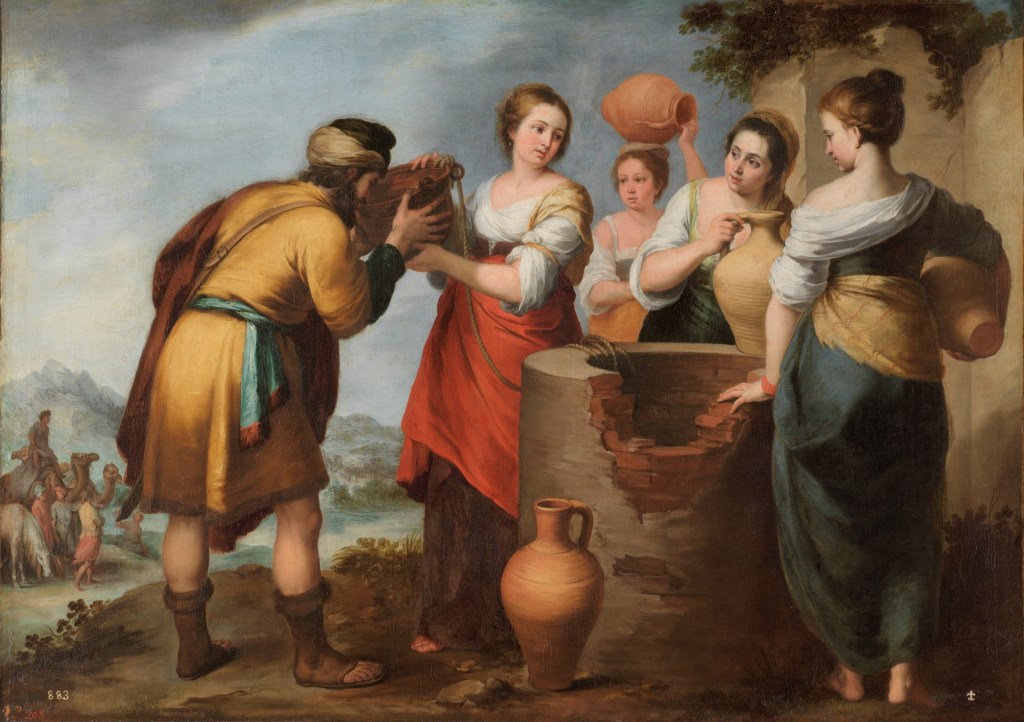
Genesis records in Chapter 24, 9-10, “And the servant put his hand under Abraham’s thigh and he swore to him concerning this thing. And the servant took ten camels from his master’s camels, with all the bounty of his master in his hand, and he rose and went to Aram-Naharaim, to the city of Nahor.”

Rebecca at the Well (Oil on canvas, c. 1660)
Murillo, Bartolome Esteban
(1617-1682)
Copyright ©Museo Nacional del Prado

When the servant arrived outside the city of Nahor by the well, he said:

“Lord, God of my master Abraham, pray, grant me good speed this day and do kindness with my master Abraham. Here, I am poised by the spring of water, and the daughters of the men of the town are coming out to draw water. Let it be that the young woman to whom I say, ‘Pray, tip down your jug that I may drink,’ if she says, ‘Drink, and your camels, too, I shall water,’ she it is whom You have marked for Your servant, for Isaac, and by this I shall know that You have done kindness with my master.” He had barely finished speaking when, look, Rebekah was coming out, who was born to Bethuel son of Milcah, the wife of Nahor, Abraham’s brother, with her jug on her shoulder. And the young woman was very comely to look at, a virgin, no man had known her. And she came down to the spring and filled her jug and came back up. And the servant ran toward her and said, “Pray, let me sip a bit of water from your jug.” And she said, “Drink, my lord,” and she hurried and lowered her jug onto her hand and let him drink. And she let him drink his fill and said, “For your camels, too, I shall draw water until they drink their fill.” And she hurried and emptied her jug into the trough and she ran again to the well to draw water for all his camels. And the man was staring at her, keeping silent , to know whether the Lord had granted success to his journey. And it happened, when the camels had drunk their fill, that the man took a gold nose ring, a beqa in weight, and two bracelets for her arms, ten gold shekels in weight. And he said, “Whose daughter are you? Tell me, pray, Is there room in your father’s house for us to spend the night?” And she said to him, “I am the daughter of Bethuel the son of Milcah who she bore to Nahor.” And she said to him, “We have abundance of bran and feed as well and room to spend the night.” And the man did obeisance and bowed to the Lord, and he said, “Blessed be the Lord, God of my master Abraham, Who has not left off His steadfast kindness toward my master – me on this journey the Lord led to the house of my master’s kinsmen.”

Genesis Chapter 24: 12-27

Chapter 24 of Genesis concludes with the servant negotiating the betrothal of Rebekah to Isaac, transporting Rebekah to Isaac, and Isaac taking Rebekah as his wife.

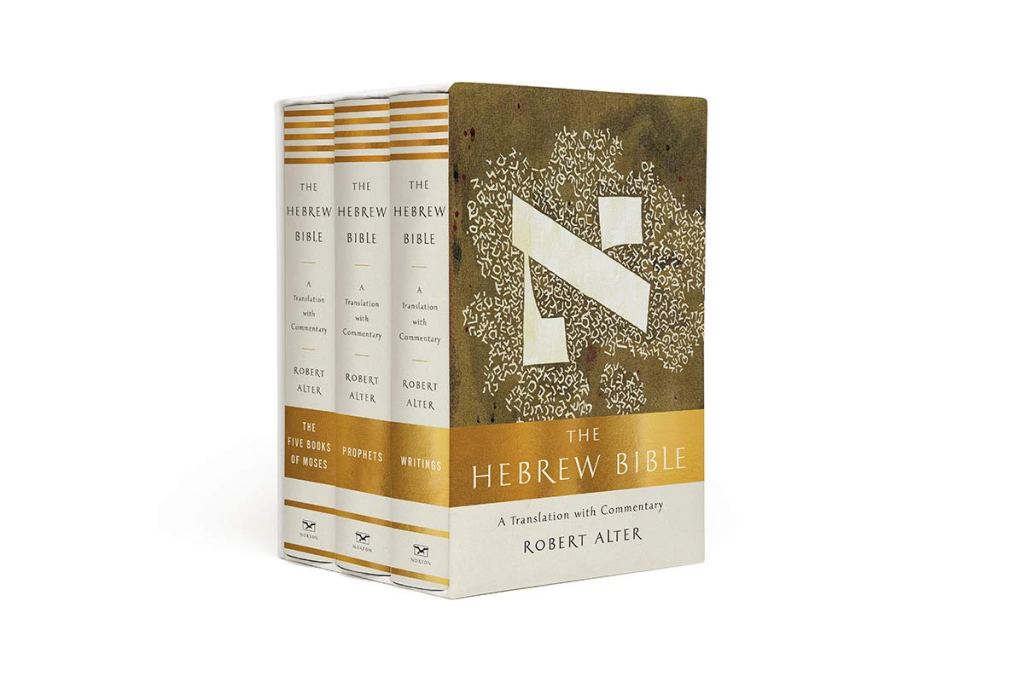
This post was inspired by the gorgeous cast bronze statue of Rebekah in my collection and the recent acquisition of The Hebrew Bible: A Translation with Commentary by Robert Alter for my library. The Hebrew Bible is highly recommend as a sensitive and inspired translation with deeply insightful scholarly commentary.

The Hebrew Bible: A Translation with Commentary by Robert Alter

It is not to be doubted that soon I will be looking for a scholarly paper or two on the solemn oaths which the ancients took that involved the holding of the genitalia of others … as I am most curious as to when such intimate habits were abandoned for less hands on formalities. I can hardly imagine any Muslim, Christian, or Jew not doing other than seeking criminal charges if someone went near their genitalia in the name of an oath these days – even in the name of the Lord with appropriate appeals to Abrahamic precedents.

I am also intrigued by the citation of weights in the Biblical verses of this chapter. I study weights, and the importance of weights to early trade and civilization cannot be overstated.

And to hold back the donkeys, Who has breath for that?

As they say: to stand up, and to sit down,

To protect the king’s son,

And to hold back the donkeys,

Who has breath for that?

Gilgamesh and Akka, Lines 24-27 (trans. Dina Katz)

Gilgamesh and Akka, by Dina Katz (Library of Oriental Texts, Vol. 1, STYX Publications, 1993), explores the short narrative poem in standard literary Sumerian which tells the tale of Gilgamesh of Uruk’s war against Akka of Kish.

Gilgamesh
GILGAMESH

In the tale, Akka of Kish demanded physical labor from the people of Uruk “to finish the wells, to finish all the wells of the land.” Gilgamesh, in response, asked the elders of Uruk for permission to wage war against Kish. The elders denied Gilgamesh permission to wage war against Kish, at which point Gilgamesh took his case for war to the able-bodied men of Uruk directly:

Since Gilgamesh, the Lord of Kulaba

had placed his trust in Inanna,

He did not take to heart the words of his city’s elders.

Gilgamesh before the able-bodied men of his city again

Laid the matter, seeking for words:

‘To finish the wells, to finish all the wells of the land,

To finish all the shallow wells of the land,

To finish all the deep wells with hoisting ropes,

Let us not submit to the house of Kish,

Let us smite it with weapons.’

The convoked assembly of his city’s able-bodied men answered Gilgamesh:

‘As they say: To stand up, and to sit down,

To protect the king’s son,

And to hold back the donkeys,

Who has breath for that?

Let us not submit to the house of Kish, Let us smite it with weapons.’

Gilgamesh and Akka, Lines 15-29 (Trans. Dina Katz)

The tale records that Gilgamesh and his able-bodied men went on to wage successful war against Akka and Kish.

Katz identified the passage that I am so enamored of, and which I quoted at the beginning of this post, as “puzzling.” She noted that a previous scholar felt that the expression was likely a “common saw” [i.e., a common Sumerian saying] whose meaning was lost to us. She noted, however, that the verbs “to stand” and “to sit” were often associated with the participants of the public assembly. It would appear, from the context, that the expression suggests having no more need or patience for further discussion due to appropriate consideration having been given (as in an assembly), pressing exigent conditions (as in a security situation), or exasperating circumstances (as in corralling or guiding donkeys).

Herman L. J. Vanstiphout, in reviewing Katz’s work in “A New Edition of Gilgamesh and Akka” (Journal of the American Oriental Society, vol. 119, no. 2, American Oriental Society, 1999, pp. 293–96) generally approved of Katz’s scholarly contributions and, with respect to the translation of the particular passage, took exception only with the wording regarding holding back the donkeys. He conceded that translating the line as “to hold back” “might surely be all right in a general sense” but seemed to suggest that something along the lines of “to hold the reins” may have been (more?) appropriate. For my part, I find the translation endearing, and intend to invoke the phrase regarding the donkeys, as translated, however perplexing it may seem, whenever I seek to end a discussion and perhaps give exasperated approval to a request in which I am in agreement.

City of Glory: The Oasis City of Paikend

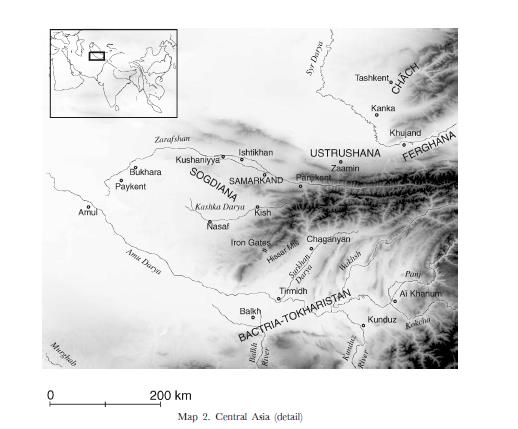
Central Asia: Sogdiana, reproduced after Vaissière, 2005

“City of Glory” almost sounds as if it were the appellation for a city in the HBO series “Game of Thrones,” such as Pentos, Qarth, or Astapor. But in reality it was given to a wealthy merchant city in Sogdiana, as attested to by the coin illustrated below.

Paikend AE Cash, ca. 640-710. Image from Stephen Album Rare Coins, Auction 38, Lot 133

The coin is a very rare AE cash from the Sogdiana merchant city of Paikend (Paykent), ca. 640-710, which has always fascinated me and is worthy of more research. The obverse features the Bukhara tamgha at top, Chinese yuan below, and Sogdian text to left & right. The reverse features a cross above & below the central hole. The scholar Aleksandr Naymark has read the Sogdian text on the obverse as PRN / KND, “city of glory,” and suggested that this was a local issue under a Christian ruler, in opposition to the kings of Bukhara. The coin illustrated was Lot 133 in Stephen Album Rare Coin Auction 38.

Paikend: Fortifications in City Wall. Image by Don Croner

The oasis city of Paikend, which was first inhabited c. the 4th century BC, existed until the Zarafshan River changed its course in the 12th сentury, at which point the city was abandoned by its residents. The abandoned city was subsequently buried over time under the sands of the Kyzylkum Desert, resulting in the city being well preserved for future generations of inquisitive archaeologists. Excavations on the site first started in 1914 by L.A. Zimin, representative of the St. Petersburg school of Asian studies, and continue to this day by the Archaeology Institute, Uzbekistan Academy of Sciences, and Andrey Omelchenko, of the Hermitage Museum in Russia.