
Ferocious Irish Bees, the Book Of Aicill, and the Origins of Money

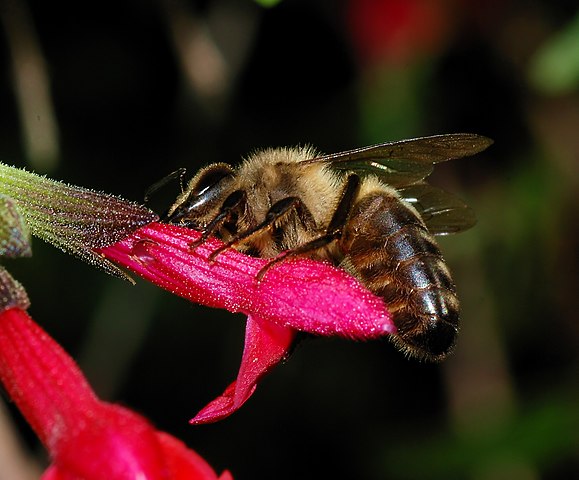
apis mellifera mellifera - northern dark bee - only native honey bee of Ireland
For Ireland, there is only one native honey bee, a sub-species called Apis mellifera mellifera or the Northern dark bee. Photograph by Alvesgaspar.

In The Origins of Money (Philip Grierson.  The Origins of Money. Research in Economic Anthropology, Vol. 1, 1978, pp. 1-35), Grierson, in discussing the origin of monetary values, noted that monetary values pre-existed market economies and that monetary values were well-attested as existing in “customary” and “command” pre-market societies.  He stated that “[i]n such societies [monetary values] provided a scale for evaluating personal injuries in the institution which the Anglo-Saxons termed the wergild, and it is in this institution that the origin of money as a standard of value must, I believe, be sought.  The practice of wergild, that of paying a compensation primarily for the killing of a man but the term by extension covering compensations for injuries to himself or his family and household, is most familiar to us in its Indo-European setting” (p.12).  Grierson proffers various supporting evidence for his thesis, but one linguistic and one quite trivial and ancillary struck my fancy.  

Grierson’s linguistic argument presents concisely and rather convincingly the connection between monetary value and its compensatory use in its opening paragraph (although, I note, that his evidence, linguistic and otherwise, does not, of course, dilute other arguments for the origins of money that are often discussed that are unrelated to markets):

“Our best approach to the problem is through the testimony of language, often the most revealing key to the structure of early societies.  It has naturally not been neglected by writers on early money.  Everyone is familiar with the connection of pecunia and pecus – this was known to the Romans themselves – of fee and O.E. feoh, cow (mod. Germ. Vieh), of the derivation of shilling and rouble (rubl’) from verbs meaning to cut (skilja, rupit’. i.e., pieces of precious metal), of the relationship of talent, lira, and pound with the process of weighing metal.  What we are concerned with, however, are not particular units but the notion of money in general and how it was first used.  Much of our own vocabulary is borrowed from Latin by way of French and is not relevant to Germanic antiquities, though one may note in passing that pay comes through Fr. Payer from Lat. pacare “to pacify” ‘to make peace with,” and that behind the idea of appeasing your creditor lies the more revealing pacere, to come to terms with the injured party. Si membrum rupsit, ni cum eo pacit, talio esto, “If a limb is injured, unless peace is made with him (i.e., with the injured party, by paying compensation), there shall be retaliation,” was the Roman doctrine, as set out in the Law of the Twelve Tables” (footnotes redacted, pp. 15-16).

After exploring his linguistic argument, Grierson noted that it might be difficult to generalize from the available “compensatory law codes” for the pre-market Germanic, Celtic and Russian societies to other early pre-market Indo-European societies but he noted that the available codes provide an extraordinary wealth of detail.  In this regard, he noted that the compilers of the codes “sometimes seem to be trying to provide for every contingency, of however improbable a nature.”  “The other is their occasional frivolity, for some of their provisions, especially in the Celtic codes, must have been inserted more or less in fun.  How else can one explain … the responsa of Cormac Mac Art and Cennfaeladh in the Book of Aicill providing compensations for bee stings – Irish bees were apparently of unexampled ferocity – but allowing a deduction of the value of a bee from the compensation if the bee was killed by the injured party?  Clearly such provisions were not meant to be taken seriously” (p 17).

The unexampled ferocity of Irish bees had me immediately scampering to find out more about the Book of Aicill, its authors, and precisely what it said about Irish bees and how their attacks were to be compensated.  Having examined the Book of Aicill, I would disagree that frivolity was intended.  Either the section was intended in earnest or was intended as an example of how an arbiter should reason through similar, but perhaps more likely and just as serious, injuries.  For here is what the pages dedicated to the ferocious Irish bees said in the book:   

Injuries in the case of bees. That is, a hive is the fine for the blinding, and two hives for the killing of a person; and a book mentions the hive for the blinding, and it does not mention two hives for the killing; but as there is twice the ‘eric’-fine due from a person for killing a person that there is for blinding him, it is right from this, that it is twice the ‘eric’-fine which is due from a bee for blinding him that should be due for killing him. A man’s full meal of honey is the fine for drawing blood; a fifth of the full meal for an injury which leaves a lump, three-fourths of it for a white blow which leaves a sinew in pain, or green, or swollen, or red; if it be one or two of these injuries that are present, it (the penalty) is one-fifth with half one-fifth; one-fifth only for his natural white wound. A hive is the fine for the death-maim necessitating the removal of a limb, but if there be no removal of a limb, it (the fine) is a hive, less one-seventh; two-thirds of it for a ‘cumhal’-maim; one-third of it for a tent-wound of six ‘seds’; one-sixth or one-seventh part is to be added to it for the tent-wound of seven ‘seds.’

From the owners of the bees these fines are due for the persons. What shall be due from the persons for the bees? If the person has killed the bee while blinding him or inflicting a wound on him until it reaches bleeding, a proportion of the full meal of honey equal to the ‘eric’-fine for the wound shall be remitted in the case; the remainder is to be paid by the owner of the bee to the person injured. If the person killed the bee while inflicting a white wound upon him, they (the fines) shall be set off against each other. If the person killed the bee while inflicting a lump-wound on him, four-fifths of the fine shall be remitted, and one-fifth paid. If it was while inflicting a white wound which left a sinew under pain, or green, or swollen, or red, he killed the bee, three-fifths of the fine are to be remitted, and two-fifths paid. If it was while inflicting one or two of them (the wounds) he killed the bee, half one-fifth is to be remitted, and one-fifth paid. From the owners of the bees these fines are due for the persons, and from the persons for the bees. What shall be due from the owners of the bees for the animals injured, and from the owners of the animals for the bees? If the bee has blinded or killed the animal, what shall be the fine for it? The proportion which the hive that is due from the owners of the bees bears to the fine for their blinding the person, or which the two hives that are due for their killing him bear to the natural body-fine of the person, is the proportion which the full natural dire-fine of the animal shall bear to that fine which shall be due from the bee for blinding or killing it (the animal). One-half of what is due for killing it is due for blinding it, or inflicting a death maim which necessitates the removal of a limb; if there be no removal of a limb, it (the fine) is one-half, less half one fifth, if it be a quadruple animal; or one-half, less the half of one-half, if it be an animal of double. Two-thirds of this are due for a ‘cumhal’-maim; one-third for a tent wound of six ‘seds’; and an equivalent of a sixth or seventh part is to be added to it for a tent- wound of seven ‘seds,’ over and above what shall be due for the tent-wound of six ‘seds.’

What shall be due from a bee for making the animal bleed? The proportion which the full meal of honey that is due from a bee for making a person bleed bears to the hive that is due from it for killing him, is the proportion which the ‘eric’-fine for blinding or killing the animal bears to that which will be due from a bee for making it bleed, i.e. four-fifths is the proportion for its lump-wound, three-fifths for its white wound which leaves a sinew in pain, or green, or swollen, or red. If it be one or two of them that are inflicted, it (the fine) is two-fifths and half one-fifth. Two-fifths is the proportion for a natural white wound. From the owners of the bees these fines are due for the animals. What shall be due from the owners of animals for the bees? If the animal killed the bee while in the act of blinding it, or killing it, or inflicting a wound upon it until it reaches bleeding, a proportion of the ‘eric’-fine for the wound equal to a full meal of honey shall be remitted, and the remainder shall be paid by the owner of the bee to the owner of the animal. If it was while in the act of causing the animal to bleed it (the animal) killed the bee, they i.e. the bleeding of the animal and the killing of the bee, shall be set off against each other; or else, indeed, according to others, the difference which is between causing a person to bleed and causing an animal to bleed is the difference that shall be paid by the owner of the animal to the owner of the bee. If it was while inflicting a lump-wound on it the bee was killed, four-fifths shall be remitted, and one-fifth, the difference, paid. If it was while inflicting a white wound which left a sinew in pain, or green, or swollen, or red, the bee was killed, three fifths shall be remitted, and two-fifths, for the difference, paid. If the bee was killed while inflicting one or two of them (the wounds), two-fifths and a half shall be remitted, and two-fifths and a half, for the difference, paid. If the bee was killed while inflicting a natural white wound on it (the animal), one fifth shall be remitted, and four-fifths, for the difference, paid.

If there were many gardens, or if there were many bees, lots are to be cast to discover from which garden the injury was done; and when it shall have been discovered, if there were many possessions in that garden, lots are to be cast on them till the particular possession be discovered from which the injury was done; and when it shall have been discovered, if there were many hives’ in that possession, lots are to be cast upon them until the particular hive from which the injury was done shall have been discovered. And the reason why this is done is, that a bad hive may not be given in place of a good hive, or that a good hive may not be given in place of a bad hive; but that the very hive from which the injury was done may go for the injury. If it was intentionally or inadvertently in unlawful anger the person killed the bee, a man’s full meal of honey shall be given as compensation, and four full meals as dire-fine. If it was inadvertently in lawful anger he killed the bee, a man’s full meal of honey is given as compensation, and two full meals as dire-fine. If it was through unnecessary profit he killed the bee, only a full meal of honey is given as compensation. This is due from the bees of a native freeman for a person; the half thereof from the bees of a stranger; a fourth of it from the bees of a foreigner; there is nothing due from the bees of a daer-person, until it reaches sick maintenance or compensation, or, according to others, even when it does. From the bees of a native freeman this is due for a person; four-sevenths thereof from the bees of a stranger; two-sevenths and one-fourteenth from the bees of a foreigner; there is nothing due from the bees of a daer-person, until it reaches sick maintenance or compensation, or, according to others, even when it does. From the bees of a native freeman this is due for a cow; the half thereof from the bees of a stranger; a fourth of it from the bees of a foreigner; and there is nothing from the bees of a daer-person until it reaches sick maintenance or compensation, or, according to others, even when it does. From the bees of a native freeman this is due for a horse; half thereof from the bees of a stranger; a fourth of it from the bees of a foreigner; and there is nothing due from the bees of a daer-person until it reaches sick maintenance or compensation, or, according to others, even when it does. From the bees of a native freeman this is due; a fourth thereof from the bees of a stranger; a half and a seventh from the bees of a foreigner; an exact half from the bees of a daer person.

Ancient Laws of Ireland, Vol. III, Dublin, 1873, pp. 433-441.

The sophistication of the compensatory structure regarding damages for injuries from bees discussed in the Book of Aicill does not strike me as being as frivolous as Grierson suggested when one considers that the temperature of a cup of coffee from a fast food franchise which spills onto an elderly woman, an incident deemed by many frivolous, can justifiably make a successful $2.9 million tort claim in the American legal system (Andrea Gerlin. A Matter of Degree: How a Jury Decided That a Coffee Spill Is Worth $2.9. Wall Street Journal. September 1, 1994). So perhaps the sagacity and foresightedness of authors of the Book of Aicill were greater than Grierson and others perceived.

As to the authors, Laurence Ginnell (Laurence Ginnell. The Brehon Laws: A Legal Handbook. T. Fisher Unwin, London, 1894), provided a colorful, even if antiquated background, for them and the Book of Aicill in his legal handbook well over century ago. I quote liberally from therein:

The whole of the Book of Aicill is composed of the opinions or placita of two eminent men, illustrious in law and in other respects: The first was King Cormac mac Airt, otherwise called Cormac ua Cuinn; the second was Cennfaeladh the Learned. Cormac was one of the most deservedly celebrated of the monarchs of ancient Erinn. He was Ard-Rig from A.D. 227 until 266 (according to others from 218 until 260). He was, as his names signify, the son of Art and the grandson of Conn of the Hundred Battles, both monarchs of Erinn, and he was the father of Cairbre who may be said to have succeeded him, the very short reign of Eochaidh alone intervening. He was also the father of Grainne, celebrated in the Fenian poetry of Oisin and his contemporaries. In youth he was violent enough, perhaps unscrupulous in pursuit of power; but his subsequent life proved that his ambition rose from the solid basis of ability to rule men; and to this extent, as also by the use he made of power when acquired, he justified himself. He was a great reformer of the national institutions of his time, civil and military, including the Feis of Tara; and most of the traces of its former greatness now existing at Tara are attributed to his time. Consistently with his reforming spirit, he was a great patron of literature, art, and industry, the first of whose patronage we have undoubted evidence. He either wrote himself or procured the writing of several works on law, history, and other important subjects. Some of these works on subjects other than law were still extant so late as the seventeenth century, but appear to have been since destroyed or lost. Among the useful things for which the country was indebted to Cormac was the introduction of the water-mill. He had the first mill erected on a small stream on the slope of Tara. He was a man in many respects far in advance of his time. Though living long before Saint Patrick’s arrival, and king of a pagan nation, there is reason for thinking that he was a believer in Christianity before his death. He at all events ceased to believe in the pagan gods. …

According to one Gaelic authority Cormac was the author of the text of the Book of Aicill throughout, and Cennfaeladh afterwards modified and commented on the whole of it, besides adding some of the case law which had grown up in the interval. And I am inclined to think that this view is correct. However, the introduction to the Book of Aicill gives a different account, and naturally it is that usually accepted. It begins thus: “The place of this book is Aicill, close to Tara, and its time is the time of Coirpri Lifechair (Carbre of the Liffey), the son of Cormac, and its author is Cormac, and the cause of its having been composed was the blinding of the eye of Cormac by Aengus Gabhuaidech.” Owing to the loss of his eye, Cormac became incapable under the Irish law of retaining the sovereignty, “because it is a prohibited thing for one with a blemish to be king at Tara.” The sovereignty was transferred to his son, after a temporary usurper had been got rid of, and Cormac retired to Aicill, now called Skreen, near Tara. It is stated that in difficult cases he was consulted by his son the young king. However this may be, a great deal of the Book of Aicill is written as if in answer to questions submitted, and the answer in each case begins with the words, “My son, that thou mayest know.”

It was on account of this injury to his eye that Cormac expelled the Deisi from the district in Meath still from them called Deece, and drove them to Munster where they settled and gave their name to a district there also.

Having told where, when, on what occasion, and by whom, the book was first written, the introduction proceeds: “These were the place and time of it as far as regards Cormac. But as regards Cennfaeladh, its place is Daire Lurain (now Derryloran, in Tyrone), and its time was the time of Domhnall, son of Aedh, son of Ainmire; and its author was Cennfaeladh, son of Oilell, and the cause of its being composed was that part of his brain was taken out of his [Cennfaeladl1’s] head after it had been split in the battle of Magh Rath.” The Domhnall (Donal) in whose reign this occurred was monarch of Ireland and fought the battle of Magh Rath (now Anglicised Moira) in A.D. 634 (? 642) against Congal Claen, king of Uladh.

The foregoing statements are remarkably clear and explicit. They represent the Book of Aicill as the production of two authors, one writing in the third century, the other in the seventh. Notwithstanding this, Sir Henry Maine, the standard authority on ancient law, in his learned discoveries of “village communities” where they never existed, represents Cennfaeladh as assisting Cormac! Worse still, I find an Irish author saying gravely that Cormac was just the man to appreciate Cennfaeladh’s services! Granted that Cormac was highly endowed, still the power of appreciating services rendered more than three hundred years after his own death can hardly be conceded even to Cormac mac Airt; and if he had such power, any express recognition of Cennfaeladh’s services would then have been rather premature.

Laurence Ginnell. The Brehon Laws: A Legal Handbook. T. Fisher Unwin, London, 1894. p. 177.

In future, after considering the above, when confronted with a ferocious Irish bee, you may have occasion to reflect on the Book of Aicill and the ultimate origins of money. And, more importantly, if in future you are injured by said ferocious Irish bee, you will know what compensation you may seek for redress for the injury inflicted from the owner of the hive of the mischievous bee.

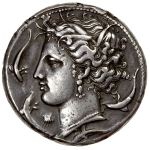
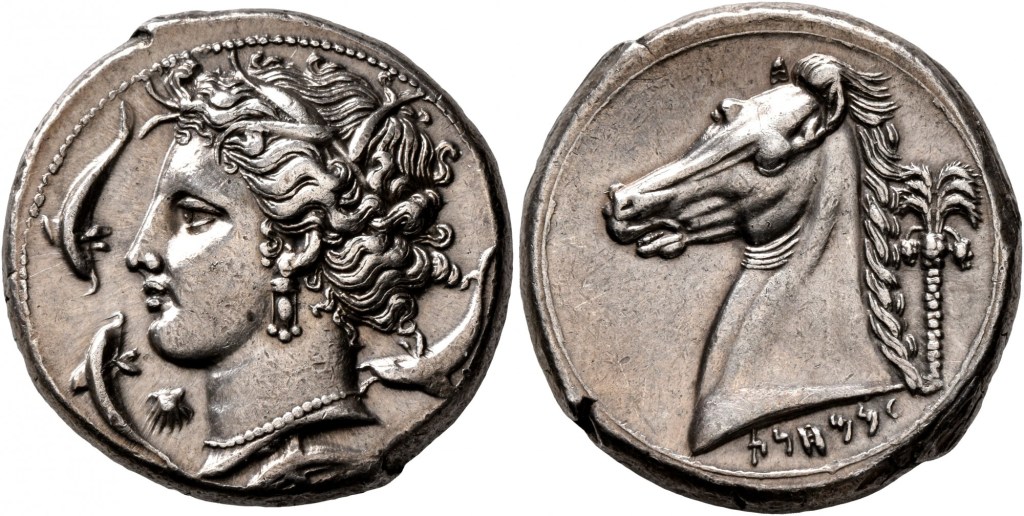
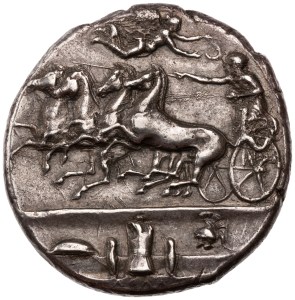
A Stunning SICULO-PUNIC Tetradrachm, circa 320-300 BC

Very few coins are, literally, breathtaking. The above coin is breathtaking. It sold at a Stephen Album Rare Coin auction for well-over its conservative estimate, and deservedly so, on January 20, 2022. It is most reminiscent of the slightly better example of the same type (also Jenkins 161) that sold for slightly less (8500 CHF, approx. $8,485) in Leu Numismatik’s 2019 Auction 4 as Lot 178.

Siculo-Punic AR Tetradrachm, c. 320-300 BC, People of the Camp mint, 17.00g.  Jenkins-161.  Numismatik Leu Auction 4, Lot 178 (2019).   Realized 8500 CHF on 4000 CHF Estimate.
Siculo-Punic AR Tetradrachm, c. 320-300 BC, People of the Camp mint, 17.00g. Jenkins-161. Numismatik Leu Auction 4, Lot 178 (2019). Realized 8500 CHF on 4000 CHF Estimate.

In the final decade of the fifth century BC, the Carthaginians launched a series of invasions of Sicily, conquering much of the western half of the island. The Carthaginian presence lasted for a century and a half, until Rome’s victory in the First Punic War obliged the Carthaginians to withdraw.

During their occupation of Sicily, the Carthaginians struck an extensive coinage for the purpose of financing their military operations and the maintenance of garrisons. Many of these coins were “military issues” and, surprisingly, labeled as such (i.e., as “camp” issues). The obverse and reverse types of the coins in the military series are mostly influenced by Sicilian prototypes, particularly those of Syracuse. The obverse of the Siculo-Punic Tetradrachm of which I am writing was inspired by the Syracusan AR decadrachm c. 400 BC signed by Euainetos. As noted by N.K. Rutter in Greek Coinages of Southern Italy and Sicily (Spink, London, 1997), it was copied by the Carthaginians because “… the reference to a Syracusan coin-type would have meant something to a Greek mercenary” (p.157).

G. Kenneth Jenkins studied these issues in his Coins of Punic Sicily (Parts I-IV, 1971-1978), and noted that the camp mint, once it was operating in Sicily, was most probably located in Lilybaion (Part III, p.11). This proposed location for the camp mint has been the object of debate for years and other locations have been proposed. For instance, Ian Lee, surveying the literature and reexamining the evidence for the earliest Punic coinage in Sicily, more recently concluded that the camp mint was located at Entella (LEE, IAN. “Entella: The Silver Coinage of the Campanian Mercenaries and the Site of the First Carthaginian Mint 410-409 BC.” The Numismatic Chronicle (1966-), vol. 160, Royal Numismatic Society, 2000, pp. 1–66, http://www.jstor.org/stable/42668259).

Siculo-Punic Tetradrachms, such as the one sold by Stephen Album Rare Coins, were ultimately destined to pay Greek mercenaries. The tetradrachms’ visual familiarity combined with its being struck to the Attic weight standard (c. 17.2 g.) rather than the Phoenician weight standard (c. 14.3 g. to the shekel or tetradrachm) usually used by the Carthaginians would have made it the perfect mechanism for payment to its intended recipients. [See Visonà, Paolo. “CARTHAGINIAN COINAGE IN PERSPECTIVE.” American Journal of Numismatics (1989-), vol. 10, American Numismatic Society, 1998, pp. 1–27, http://www.jstor.org/stable/43580385, p. 4, for discussion regarding adoption of Attic weight standard due to military exigency].

City of Glory: The Oasis City of Paikend

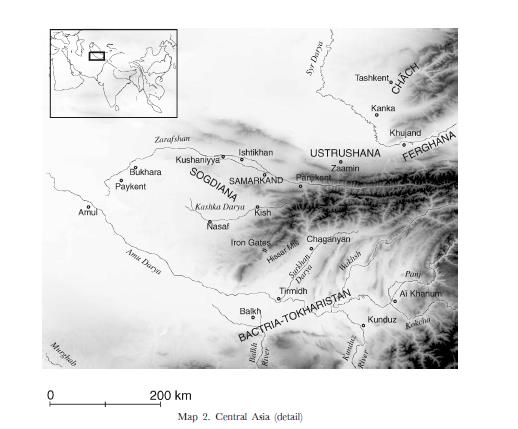
Central Asia: Sogdiana, reproduced after Vaissière, 2005

“City of Glory” almost sounds as if it were the appellation for a city in the HBO series “Game of Thrones,” such as Pentos, Qarth, or Astapor. But in reality it was given to a wealthy merchant city in Sogdiana, as attested to by the coin illustrated below.

Paikend AE Cash, ca. 640-710. Image from Stephen Album Rare Coins, Auction 38, Lot 133

The coin is a very rare AE cash from the Sogdiana merchant city of Paikend (Paykent), ca. 640-710, which has always fascinated me and is worthy of more research. The obverse features the Bukhara tamgha at top, Chinese yuan below, and Sogdian text to left & right. The reverse features a cross above & below the central hole. The scholar Aleksandr Naymark has read the Sogdian text on the obverse as PRN / KND, “city of glory,” and suggested that this was a local issue under a Christian ruler, in opposition to the kings of Bukhara. The coin illustrated was Lot 133 in Stephen Album Rare Coin Auction 38.

Paikend: Fortifications in City Wall. Image by Don Croner

The oasis city of Paikend, which was first inhabited c. the 4th century BC, existed until the Zarafshan River changed its course in the 12th сentury, at which point the city was abandoned by its residents. The abandoned city was subsequently buried over time under the sands of the Kyzylkum Desert, resulting in the city being well preserved for future generations of inquisitive archaeologists. Excavations on the site first started in 1914 by L.A. Zimin, representative of the St. Petersburg school of Asian studies, and continue to this day by the Archaeology Institute, Uzbekistan Academy of Sciences, and Andrey Omelchenko, of the Hermitage Museum in Russia.

An Attractive Silver Didrachm of the Greek Colony of Selinus in Sicily with a Crane on the Reverse

AR Didrachm from Greek colony of Selinus in Sicily (c. 450BC). Obv: Inscription, Hercules about to club the Cretan bull. Rev: Inscription above, River-god Hypsas sacrifices at altar with serpent coiled around it; at right selinon (celery) leaf above crane.  ANS 1957.172.629. American Numismatic Society.

Yarab is an Anglicized spelling of the Slovak surname Jaráb.  It is a zoonym, which is a name of an animal.  That animal is a crane, for in 19th century Slovak Jaráb is akin to the Czech word jeřáb, which means crane. Accordingly, when I happened across the the above coin from Selinus, depicting a crane on its reverse, I had to learn a little bit more about the history of Selinus and the imagery appearing on this stunning coin.

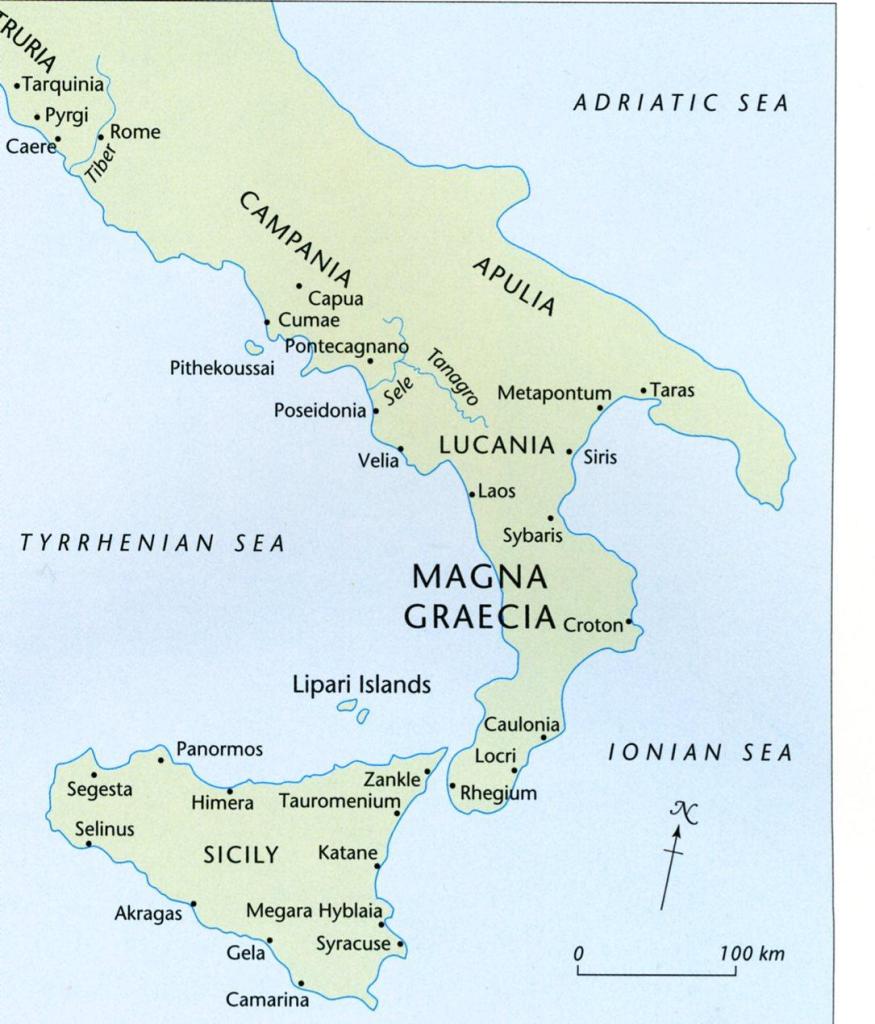
Map of Magna Graecia

Selinus is located on the south-west coast of Sicily and, according to  Thucydides, was founded in 628BC by Greek colonists from Megara Hyblaea, a Greek colony on the eastern side of Sicily. It was the most western Greek colony on Sicily and one of the first Greek colonies in Sicily to issue coins.

The colony covered a large and well-planned urban and sacred area. The sacred area is reputed to have had ten separate temples dating from the 6th to 5th century BC. The Temple of Hera is amongst the city’s most famous ruins.

The World History Encyclopedia article on Selinus records that the city was completely redesigned between 580-570BC and that the city is one of the best examples of ancient town planning. It also notes that indicators of the city’s wealth were the presence of a theatre, its prolific mint, and its satellite colonies (such as Eraclea Minoa, established in 570 BC).

Selinus allied itself with Carthage in 480BC and was often at war with rival city Segesta on the northern coast of the island. Although initially ruled by an oligarchy, Selinus was governed by tyrants throughout the 5th century BC. Selinus was sacked by Carthage in 409BC after Hannibal besieged the city for nine days; some 16,000 of the city’s inhabitants were slain after the city fell. The city was rebuilt by the Syracusan exile Hermocrates, but was under Carthaginian control in the 4th century BC. During the first Punic War (264-241BC), the city was abandoned.

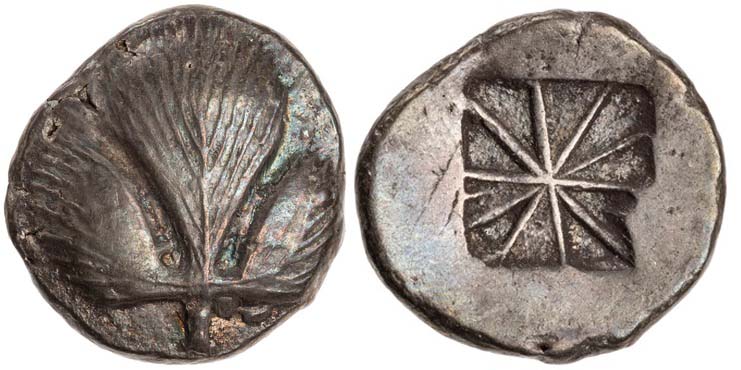
Selinus AR Didrachm of the general type struck between c.570-470BC. Selinus (celery) leaf/incuse square divided. ANS 1987.76.32 American Numismatic Society

As mentioned above, Selinus was among the the first cities to strike coins in Sicily. In Greek Coinages of Southern Italy and Sicily, N.K. Rutter records that “the obverse of the first coins had a canting type represent the name of the city in a visual form: a leaf of the celery plant, selinon in Greek, mostly presented in a stylized way with three parts, a central frond supported by a frond on either side. Later versions of the leaf are more complex. The reverse bears an incuse square, on the earlier issues divided into triangles, usually with raised and depressed sections” (p. 102). These types may have been struck from c. 530 -470BC.

The coin which is of especial interest to this post, however, was struck c.450BC and was of a very different type. Of this type, Rutter says the following (pp. 138-139):

Reverse of Selinus AR didrachm (c. 450BC). Reverse: Hypsas, river-god, standing, sacrificing over altar with entwined serpent, to right selinon (celery) leaf over crane. ANS 1957.172.629 American Numismatic Society

“A little later, perhaps around 450, Selinus revived the minting activity that it seems to have abandoned around the time of the Carthaginian attack in 480 (or perhaps a decade later) with a series of coins rich in religious imagery and references to local cults. … On earlier coins of Selinus a leaf of the celery plant had been the main type, now it is merely a small symbol in the field. The didrachms repeat the theme of sacrifice on the reverse – performed now by Hypsas the other river-god of Selinus – while the obverse shows Heracles fighting the Cretan bull: the hero brandishes his club in his right hand, while with his left he seizes one of the bull’s horns. The cult of Heracles is well-attested at Selinus and had a special interest for its citizens: it linked them to Argos, home of the dynasty that gave birth to Heracles, and also to Cnossos in Crete, where the hero had performed one of his celebrated labors.”

For those unfamiliar, Eurystheus’s demand that Heracles capture and bring the Cretan bull to him alive was the Seventh Labor of Heracles. It was a labor easily accomplished. See Apollodorus. The Library, Volume I: Books 1-3.9. Translated by James G. Frazer. Loeb Classical Library 121. Cambridge, MA: Harvard University Press, 1921. pp. 198-201 or, perhaps more readily available, see The Labors of Hercules.

Regarding the bird appearing on the reverse of this type and identified as a crane (which it is currently identified as in most references and databases (such as the American Numismatic Society’s database) and most trade offerings (see various offerings as recorded in coinarchives.com and acsearch.info), it was first identified as a crane as early as 1876 in the British Museum catalogue. But this identification was not unchallenged, apparently. For a period, numismatists, being uncertain, identified the bird simply as a marsh bird, and then were prone to identify it as a heron or egret. See pp. 90-91 of the following article for a discussion of this issue: Lloyd, A. H. “THE COIN TYPES OF SELINUS AND THE LEGEND OF EMPEDOCLES.” The Numismatic Chronicle and Journal of the Royal Numismatic Society, vol. 15, no. 58, 1935, pp. 73–93. JSTOR, http://www.jstor.org/stable/42664348. Accessed 14 Aug. 2021.

However, cranes have been present in western Sicily recently (e.g. most recently in the Trapani salt marshes, an area not too distant from ancient Selinus), and have been present in western Sicily historically, and there should be no reason to doubt the initial identification of the “marsh bird” on the coin’s reverse as a crane. See Masseti, Marco. “The lost cranes of the island of Lampedusa (Italy).” Rivista Italiana di Ornitologia, vol. 86 (I), 2016, pp. 49-54.

Eucratides I the Great, the Appearance of His Extraordinary Musculature on His Coinage, and Exercise and Working Out in Antiquity

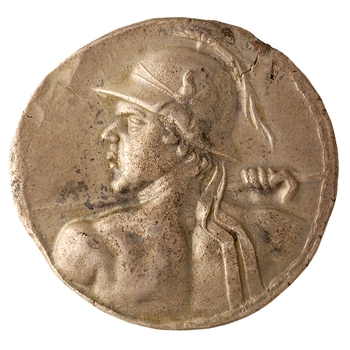
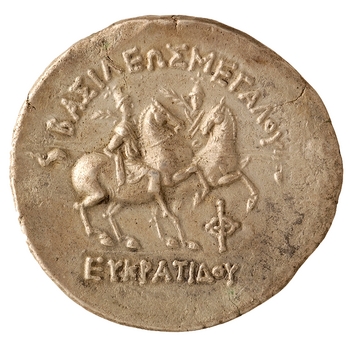
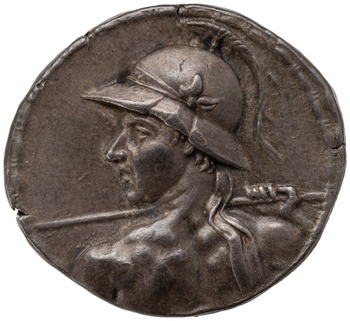
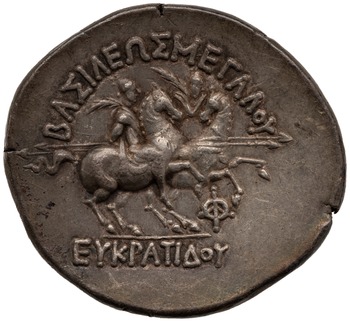
The Silver tetradrachm heading this post features on the obverse a helmeted and diademed bust of Eucratides, bare shoulders, throwing javelin to his left. The tetradrachm’s reverse has the Greek inscription ΒΑΣΙΛΕΩΣ ΜΕΓΑΛΟΥ ΕΥΚΡΑΤΙΔΟΥ (of great king Eucratides) around an image of the dioscuri (the twin brothers and sons of Zeus, Pollux and Castor) charging right holding long lances and palms. Peter Thonemann, commenting on this highly individualist and explicitly martial portraiture opined as follows: “… we may be grateful that not all kings paraded their military credentials in quite so butch a fashion as Eucratides I of Bactria.”

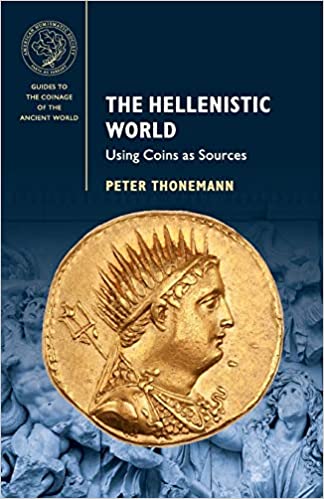
Book Cover of The Hellenistic World by Peter Thonemann
The Hellenistic World: Using Coins as Sources by Peter Thonemann

Peter Thonemann’s wonderful work, The Hellenistic World: Using Coins as Sources, is a superb introductory survey of both the history and coins of the Hellenistic world from c. 323-31BC. It is engagingly written and well-illustrated, often with coins from the collection of the American Numismatic Society. Although many of the coin photographs which are reproduced are slightly disappointing due to being in black and white and produced life size, when enlargements would have been more suitable, the coins selected for the work were well chosen and served the survey and the reader well. And, since the author and publisher were so careful to credit the sources of the photographs, when a particular coin caught my fancy, I was often able to go the the source on the internet, such as the ANS’s online collection database, and see the original color photographs of the coin.

So, after I read about Eucratides I the Great of Bactria (c. 170-145) and his stunning coins in Thonemann’s work, then saw the coins in their glory on the ANS database, and followed up with an interesting conversation about the coins and what type of workout routines were around in the ancient world with my good friend SF (more about the exercise and workout routines of the ancients below), I knew that a post was forthcoming.

First, what do we know about Eucratides I? From the 2nd century AD writer and historian Justin, we have this small snippet of information:

“Almost at the same time that Mithridates ascended the throne among the Parthians, Eucratides began to reign among the Bactrians; both of them being great men. But the fortune of the Parthians, being the more successful, raised them, under this prince, to the highest degree of power; while the Bactrians, harassed with various wars, lost not only their dominions, but their liberty; for having suffered from contentions with the Sogdians, the Drangians, and the Indians, they were at last overcome, as if exhausted, by the weaker Parthians. Eucratides, however, carried on several wars with great spirit, and though much reduced by his losses in them, yet, when he was besieged by Demetrius king of the Indians, with a garrison of only three hundred soldiers, he repulsed, by continual sallies, a force of sixty thousand enemies. Having accordingly escaped, after a five months’ siege, he reduced India under his power. But as he was returning from the country, he was killed on his march by his son, with whom he had shared his throne, and who was so far from concealing the murder, that, as if he had killed an enemy, and not his father, he drove his chariot through his blood, and ordered his body to be cast out unburied.” Epitome of the Philippic History of Pompeius Trogus, XLI 6.1-5

Appropriate to a king assuming the title “the Great” on his coins (a numismatic innovation of Eucratides, Eucratides also is famous for another numismatic feat, as explained by CoinWeek columnist Mike Markowitz in Metal Monsters: The Biggest Ancient Coins (march 18, 2014):

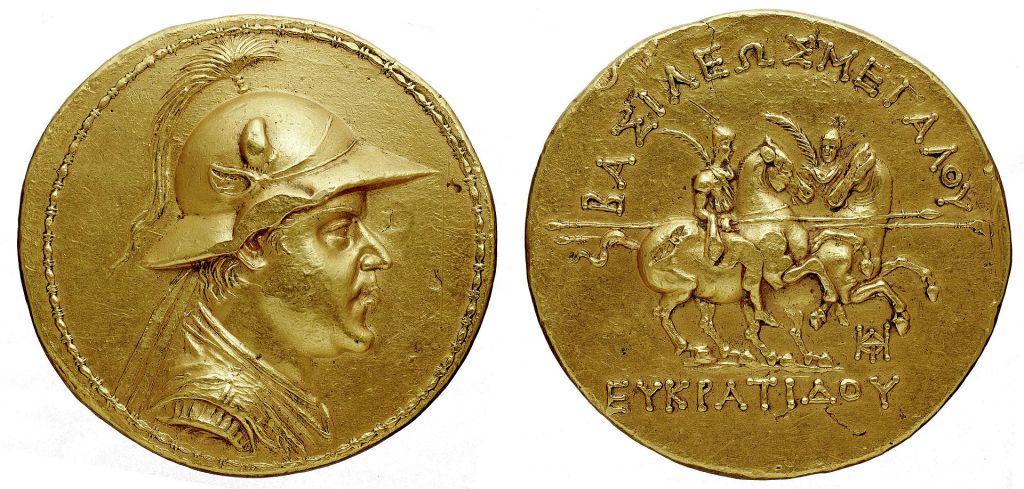
“[Eucratides] commissioned the largest surviving gold coin struck in antiquity: a 20-stater piece, 58 mm in diameter, weighing 169.2 grams. That’s nearly five and a half ounces. The unique example was found in 1867 in Bukhara (Uzbekistan), nearly 300 miles northwest of the Baktrian heartland. Eventually acquired by Napoleon III, it resides today in the Bibliothéque nationale in Paris.

On the obverse we see the king in profile, wearing a plumed cavalry helmet. On the reverse, the twin heroes Castor and Pollux carry long lances and palm branches and ride prancing horses surrounded by a carelessly lettered inscription: ‘Great King Eucratides.’” 

A quick side note before moving on to the portion of the post answering my friend SF’s query about exercise and workout routines in antiquity: as king of Bactria, Eucratides I ruled over the city of Ai Khanoum, which we discussed in an earlier post.

Jack W. Berryman wrote a short essay entitled Motion and rest: Galen on exercise and health published in The Lancet (Vol. 380, Issue 9838, 21 July 2012, pp. 210-211). From the essay is the following relevant quote:

“Exercise was an important component of ancient medical theory and a physician’s duties included the preservation and promotion of health as well as the prevention of disease. In this context, physicians in antiquity emphasised the centrality of exercise and diet, or what was known as regimen, as a key part of one’s way of life.

It was Hippocrates (c 460–370 BC) who wrote three books on regimen and noted that ‘eating alone will not keep a man well; he must also take exercise.’ Galen (c 129–210 AD), who borrowed much from Hippocrates, structured his medical “theory” upon the “naturals” (of, or with nature—physiology), the “non-naturals” (things not innate—health), and the “contra-naturals” (against nature—pathology). Central to Galen’s theory was hygiene (named after the goddess of health Hygieia) and the uses and abuses of Galen’s “six things non-natural”. Galen’s theory was underpinned by six factors external to the body over which a person had some control: air and environment; food (diet) and drink; sleep and wake; motion (exercise) and rest; retention and evacuation; and passions of the mind (emotions). Galen proposed that these factors should be used in moderation since too much or too little would put the body in imbalance and lead to disease or illness.”

Jarrett A. Lobell wrote a short snippet, entitled The Ancient Pursuit of Wellness: Exercise, in the September/October 2021 issue of Archaeology, which explicitly linked exercise to military preparation among the Greeks. I quote more extensively from Lobell:

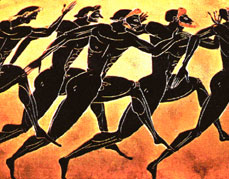
Greek Footrace

“For the ancient Greeks, exercise meant competition, often in organized festivals such as the Olympics—the word “athlete” comes from the ancient Greek athlos, meaning contest. Participation in these events was limited to young men of certain classes. Exercise was also a crucial part of preparation for Greek military service, and thus women were excluded. But in the Roman world, exercise was more universally popular, and both men and women were frequent participants. Romans often exercised at the public baths, where both sexes and most social classes regularly gathered, says classicist Nigel Crowther of Western University. Men might play ball, run, wrestle, box, or lift weights. Women swam, played a hoop-rolling game called trochus, and especially favored ball games. ‘Galen suggests that ball games were good training for the fitness of both body and mind,’ Crowther says.”

Finally, as it summarizes so well many of the ancient sources regarding workouts and exercises, I provide the following lengthy quote from an article entitled The Real Gladiator Workout: Train Like A Gladiator (posted 9/14/14) on RENAISSANCE MAN JOURNAL:

“There is a story that was often told of Milo of Croton. This was an Ancient Greek athlete from the Greek city-state of Croton located in what is now southern Italy. He lived in the 6th century BC and was training for the Olympics.

One of the ways that he was training was by taking a newly born bull, hoisting it up on his shoulders and carrying it for some distance. He would do it every day. As time passed, the bull would grow larger and so Milo kept on hoisting more and more weight. This culminated with him walking into the Olympic stadium with a full grown bull on his shoulders.

So over time he was increasing the weight he was lifting. This is basically the birth of progressive overload. The ancients knew that if you want your muscles to grow and get stronger, you need to lift heavier and heavier weights.

The Greeks had three weighted implements – javelin, discus and halteres. The halteres are hand held weights that they use during jumping exercises and drills. See The Complete History of Fitness: From Paleo to Pole Dancing at the Website Lost In Fitness

Another principle from the ancient world is that of periodization. Many gladiator schools probably used periodization training, which is an organization of training that splits training into blocks of time, each one focusing on different skills. They would be training all day and split their training into units of time during which they would focus on just one skill.

The ancient gladiators also knew about the intensity of training and that you should not go into training full speed at the beginning, but need to warm up first, otherwise you risk injury. Galen wrote that intensity should be increased gradually: “Intensity should be gradually increased, peaking at the end. This should be of special concern in order to avoid injury to competitors.”

The cool-down process was also important. Hippocrates (an Ancient Greek doctor) said that “those who walk after exercising will then have a stronger and more rested body.” This means that there should be a period of cool down after intense training and people should not fall down and lie on the ground immediately, but instead the person should cool down by walking around. Also on rest days, according to Hippocrates, the athlete should not do completely nothing, but instead do something of low intensity.

The ancients were very aware of the dangers of over-training and many of the doctors preached against it. They knew that the body needs rest in order to recover from intense training and also that your body achieves the best results if rest is a part of your routine.

Throughout their training, the gladiators would use different types of equipment and do all kinds of varied exercises.

Modern statue of Galen in his home town, Pergamon. Photograph by Bernard Gagnon.

Galen divided exercises into three types:

Vigorous exercises: These were exercises performed with strength, but without speed. Examples of these include: digging, picking up any kind of heavy load and either standing still with it or walking (especially up a hill), climbing a rope, hanging from rope or beam for as long as possible, holding arms up (with or without weights) while partner tried pushing them in a downwards direction…etc. These exercises show that the Ancient Greeks and Romans had an understanding of overload (including progressive overload) and its positive effects on building strength and muscles.

Speed exercises: Here the primary objective was speed, apart from strength and force. Examples of these include: running, shadow boxing, hitting the punching bag, running around with balls, arm and leg exercises like drill stuff…etc.

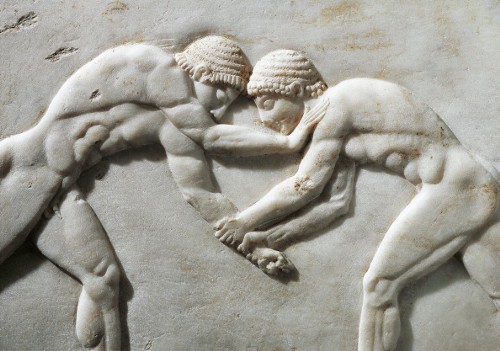
Greek Wrestlers

A particular example of this type of exercise that was performed has the Greek name “pitylysma”. The exercise goes like this: start by standing on tip toes, stretch your arms upwards, move one arm quickly forward, while moving the other one backwards, roll quickly on the ground, quickly come up, stand erect and start jumping up and down, sometimes with a backward kick, sometimes bringing each leg forward in an alternating fashion.

Violent exercises: These combined speed and strength. Exercises classified as vigorous became violent if you increased their speed – jumping continuously without rest, or any speed exercises performed with weight became violent – moving around quickly in heavy armor.

The word ‘violent’ in this context could be better understood if you use it as a synonym for the word ‘power.’ A recommendation of Galen for these types of exercises was to rest between the different individual exercises.”

So, yes, the highly muscled king appearing on those beautiful coins likely had plenty of thoughtful exercise routines behind those sculpted muscles — or he kept buff by throwing lots of javelins while trying to preserve his kingdom.