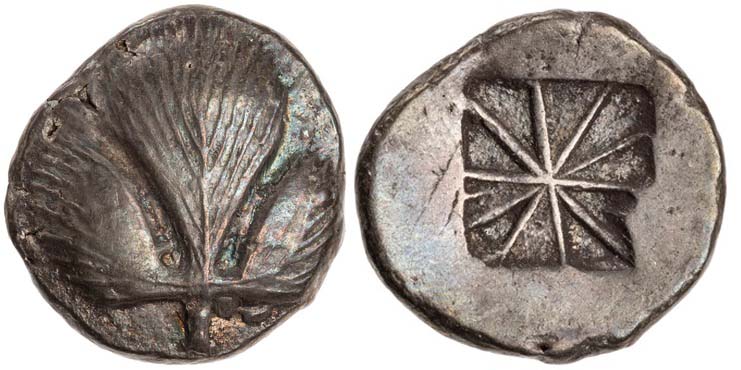
AR Didrachm from Greek colony of Selinus in Sicily (c. 450BC). Obv: Inscription, Hercules about to club the Cretan bull. Rev: Inscription above, River-god Hypsas sacrifices at altar with serpent coiled around it; at right selinon (celery) leaf above crane.ANS 1957.172.629. American Numismatic Society.
Yarab is an Anglicized spelling of the Slovak surname Jaráb. It is a zoonym, which is a name of an animal. That animal is a crane, for in 19th century Slovak Jaráb is akin to the Czech word jeřáb, which means crane. Accordingly, when I happened across the the above coin from Selinus, depicting a crane on its reverse, I had to learn a little bit more about the history of Selinus and the imagery appearing on this stunning coin.
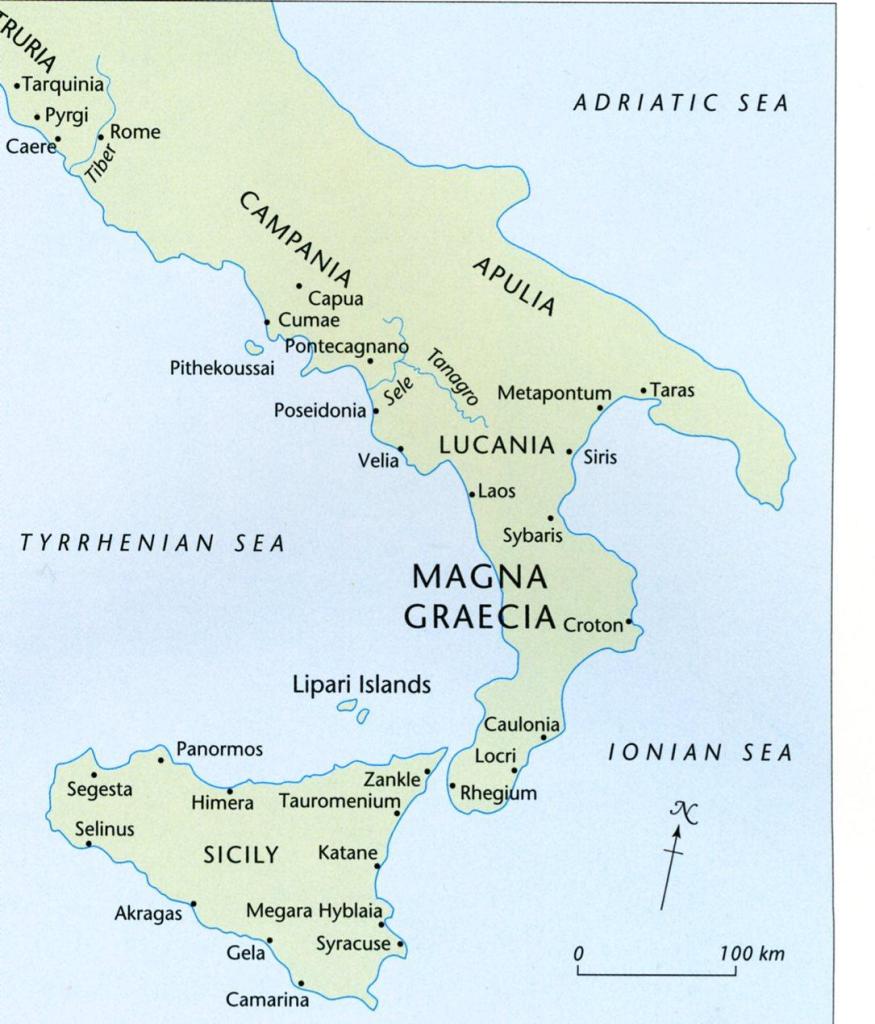
Selinus is located on the south-west coast of Sicily and, according to Thucydides, was founded in 628BC by Greek colonists from Megara Hyblaea, a Greek colony on the eastern side of Sicily. It was the most western Greek colony on Sicily and one of the first Greek colonies in Sicily to issue coins.
The colony covered a large and well-planned urban and sacred area. The sacred area is reputed to have had ten separate temples dating from the 6th to 5th century BC. The Temple of Hera is amongst the city’s most famous ruins.
The World History Encyclopedia article on Selinus records that the city was completely redesigned between 580-570BC and that the city is one of the best examples of ancient town planning. It also notes that indicators of the city’s wealth were the presence of a theatre, its prolific mint, and its satellite colonies (such as Eraclea Minoa, established in 570 BC).
Selinus allied itself with Carthage in 480BC and was often at war with rival city Segesta on the northern coast of the island. Although initially ruled by an oligarchy, Selinus was governed by tyrants throughout the 5th century BC. Selinus was sacked by Carthage in 409BC after Hannibal besieged the city for nine days; some 16,000 of the city’s inhabitants were slain after the city fell. The city was rebuilt by the Syracusan exile Hermocrates, but was under Carthaginian control in the 4th century BC. During the first Punic War (264-241BC), the city was abandoned.
As mentioned above, Selinus was among the the first cities to strike coins in Sicily. In Greek Coinages of Southern Italy and Sicily, N.K. Rutter records that “the obverse of the first coins had a canting type represent the name of the city in a visual form: a leaf of the celery plant, selinon in Greek, mostly presented in a stylized way with three parts, a central frond supported by a frond on either side. Later versions of the leaf are more complex. The reverse bears an incuse square, on the earlier issues divided into triangles, usually with raised and depressed sections” (p. 102). These types may have been struck from c. 530 -470BC.
The coin which is of especial interest to this post, however, was struck c.450BC and was of a very different type. Of this type, Rutter says the following (pp. 138-139):
Reverse of Selinus AR didrachm (c. 450BC). Reverse: Hypsas, river-god, standing, sacrificing over altar with entwined serpent, to right selinon (celery) leaf over crane. ANS 1957.172.629 American Numismatic Society
“A little later, perhaps around 450, Selinus revived the minting activity that it seems to have abandoned around the time of the Carthaginian attack in 480 (or perhaps a decade later) with a series of coins rich in religious imagery and references to local cults. … On earlier coins of Selinus a leaf of the celery plant had been the main type, now it is merely a small symbol in the field. The didrachms repeat the theme of sacrifice on the reverse – performed now by Hypsas the other river-god of Selinus – while the obverse shows Heracles fighting the Cretan bull: the hero brandishes his club in his right hand, while with his left he seizes one of the bull’s horns. The cult of Heracles is well-attested at Selinus and had a special interest for its citizens: it linked them to Argos, home of the dynasty that gave birth to Heracles, and also to Cnossos in Crete, where the hero had performed one of his celebrated labors.”
For those unfamiliar, Eurystheus’s demand that Heracles capture and bring the Cretan bull to him alive was the Seventh Labor of Heracles. It was a labor easily accomplished. See Apollodorus. The Library, Volume I: Books 1-3.9. Translated by James G. Frazer. Loeb Classical Library 121. Cambridge, MA: Harvard University Press, 1921. pp. 198-201 or, perhaps more readily available, see The Labors of Hercules.
Regarding the bird appearing on the reverse of this type and identified as a crane (which it is currently identified as in most references and databases (such as the American Numismatic Society’s database) and most trade offerings (see various offerings as recorded in coinarchives.com and acsearch.info), it was first identified as a crane as early as 1876 in the British Museum catalogue. But this identification was not unchallenged, apparently. For a period, numismatists, being uncertain, identified the bird simply as a marsh bird, and then were prone to identify it as a heron or egret. See pp. 90-91 of the following article for a discussion of this issue: Lloyd, A. H. “THE COIN TYPES OF SELINUS AND THE LEGEND OF EMPEDOCLES.” The Numismatic Chronicle and Journal of the Royal Numismatic Society, vol. 15, no. 58, 1935, pp. 73–93. JSTOR, http://www.jstor.org/stable/42664348. Accessed 14 Aug. 2021.
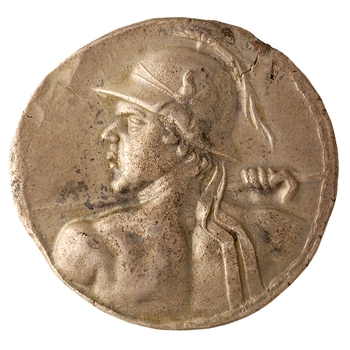
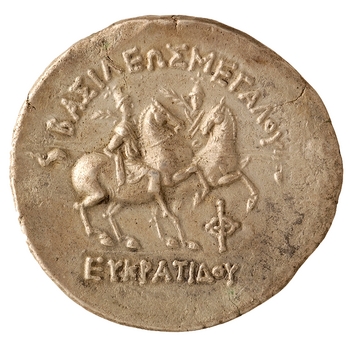
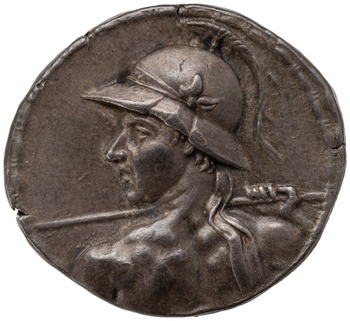
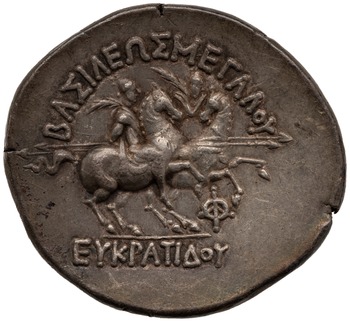
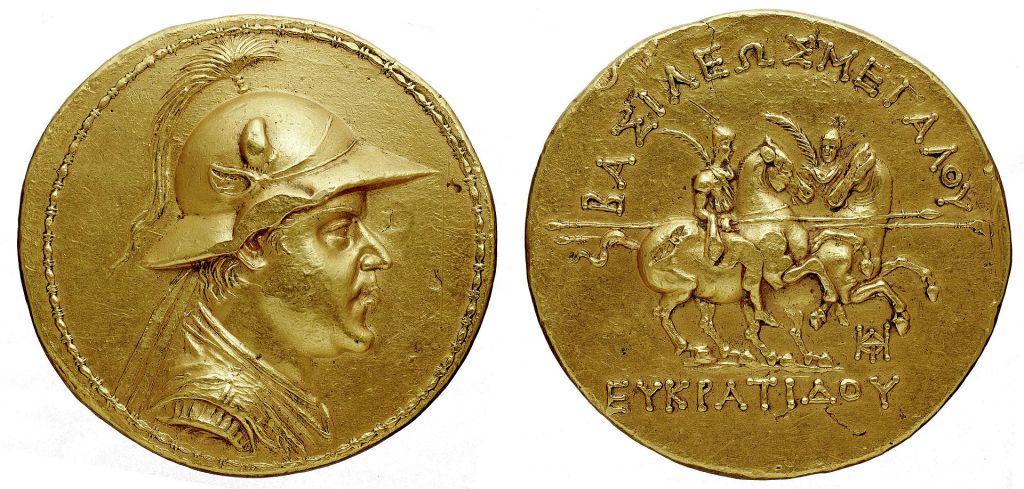
The Silver tetradrachm heading this post features on the obverse a helmeted and diademed bust of Eucratides, bare shoulders, throwing javelin to his left. The tetradrachm’s reverse has the Greek inscription ΒΑΣΙΛΕΩΣ ΜΕΓΑΛΟΥ ΕΥΚΡΑΤΙΔΟΥ (of great king Eucratides) around an image of the dioscuri (the twin brothers and sons of Zeus, Pollux and Castor) charging right holding long lances and palms. Peter Thonemann, commenting on this highly individualist and explicitly martial portraiture opined as follows: “… we may be grateful that not all kings paraded their military credentials in quite so butch a fashion as Eucratides I of Bactria.”
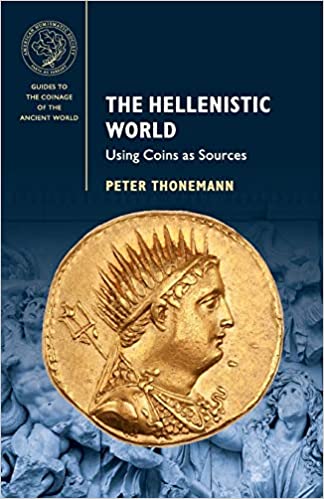
The Hellenistic World: Using Coins as Sources by Peter Thonemann
Peter Thonemann’s wonderful work, The Hellenistic World: Using Coins as Sources, is a superb introductory survey of both the history and coins of the Hellenistic world from c. 323-31BC. It is engagingly written and well-illustrated, often with coins from the collection of the American Numismatic Society. Although many of the coin photographs which are reproduced are slightly disappointing due to being in black and white and produced life size, when enlargements would have been more suitable, the coins selected for the work were well chosen and served the survey and the reader well. And, since the author and publisher were so careful to credit the sources of the photographs, when a particular coin caught my fancy, I was often able to go the the source on the internet, such as the ANS’s online collection database, and see the original color photographs of the coin.
So, after I read about Eucratides I the Great of Bactria (c. 170-145) and his stunning coins in Thonemann’s work, then saw the coins in their glory on the ANS database, and followed up with an interesting conversation about the coins and what type of workout routines were around in the ancient world with my good friend SF (more about the exercise and workout routines of the ancients below), I knew that a post was forthcoming.
First, what do we know about Eucratides I? From the 2nd century AD writer and historian Justin, we have this small snippet of information:
“Almost at the same time that Mithridates ascended the throne among the Parthians, Eucratides began to reign among the Bactrians; both of them being great men. But the fortune of the Parthians, being the more successful, raised them, under this prince, to the highest degree of power; while the Bactrians, harassed with various wars, lost not only their dominions, but their liberty; for having suffered from contentions with the Sogdians, the Drangians, and the Indians, they were at last overcome, as if exhausted, by the weaker Parthians. Eucratides, however, carried on several wars with great spirit, and though much reduced by his losses in them, yet, when he was besieged by Demetrius king of the Indians, with a garrison of only three hundred soldiers, he repulsed, by continual sallies, a force of sixty thousand enemies. Having accordingly escaped, after a five months’ siege, he reduced India under his power. But as he was returning from the country, he was killed on his march by his son, with whom he had shared his throne, and who was so far from concealing the murder, that, as if he had killed an enemy, and not his father, he drove his chariot through his blood, and ordered his body to be cast out unburied.” Epitome of the Philippic History of Pompeius Trogus, XLI 6.1-5
Appropriate to a king assuming the title “the Great” on his coins (a numismatic innovation of Eucratides, Eucratides also is famous for another numismatic feat, as explained by CoinWeek columnist Mike Markowitz in Metal Monsters: The Biggest Ancient Coins (march 18, 2014):
“[Eucratides] commissioned the largest surviving gold coin struck in antiquity: a 20-stater piece, 58 mm in diameter, weighing 169.2 grams. That’s nearly five and a half ounces. The unique example was found in 1867 in Bukhara (Uzbekistan), nearly 300 miles northwest of the Baktrian heartland. Eventually acquired by Napoleon III, it resides today in the Bibliothéque nationale in Paris.
On the obverse we see the king in profile, wearing a plumed cavalry helmet. On the reverse, the twin heroes Castor and Pollux carry long lances and palm branches and ride prancing horses surrounded by a carelessly lettered inscription: ‘Great King Eucratides.’”
A quick side note before moving on to the portion of the post answering my friend SF’s query about exercise and workout routines in antiquity: as king of Bactria, Eucratides I ruled over the city of Ai Khanoum, which we discussed in an earlier post.
Jack W. Berryman wrote a short essay entitled Motion and rest: Galen on exercise and health published in The Lancet (Vol. 380, Issue 9838, 21 July 2012, pp. 210-211). From the essay is the following relevant quote:
“Exercise was an important component of ancient medical theory and a physician’s duties included the preservation and promotion of health as well as the prevention of disease. In this context, physicians in antiquity emphasised the centrality of exercise and diet, or what was known as regimen, as a key part of one’s way of life.
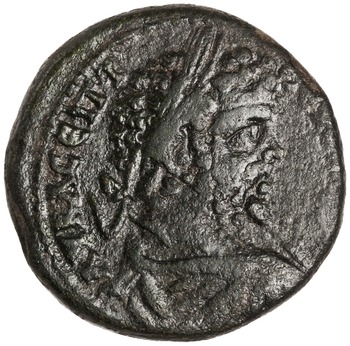
From the time of Galen (c. 129-210AD), a bronze coin (Anchialus mint) of the Roman Emperor Septimus Severus (193-211 AD) featuring Asklepios standing right and and Hygieia standing left on the reverse. Hygieia inspired Galen’s theory of hygiene. ANS 1998.13.10 American Numismatic Society
It was Hippocrates (c 460–370 BC) who wrote three books on regimen and noted that ‘eating alone will not keep a man well; he must also take exercise.’ Galen (c 129–210 AD), who borrowed much from Hippocrates, structured his medical “theory” upon the “naturals” (of, or with nature—physiology), the “non-naturals” (things not innate—health), and the “contra-naturals” (against nature—pathology). Central to Galen’s theory was hygiene (named after the goddess of health Hygieia) and the uses and abuses of Galen’s “six things non-natural”. Galen’s theory was underpinned by six factors external to the body over which a person had some control: air and environment; food (diet) and drink; sleep and wake; motion (exercise) and rest; retention and evacuation; and passions of the mind (emotions). Galen proposed that these factors should be used in moderation since too much or too little would put the body in imbalance and lead to disease or illness.”
Jarrett A. Lobell wrote a short snippet, entitled The Ancient Pursuit of Wellness: Exercise, in the September/October 2021 issue of Archaeology, which explicitly linked exercise to military preparation among the Greeks. I quote more extensively from Lobell:
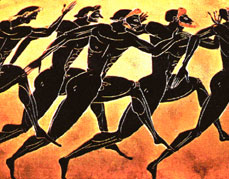
Greek Footrace
“For the ancient Greeks, exercise meant competition, often in organized festivals such as the Olympics—the word “athlete” comes from the ancient Greek athlos, meaning contest. Participation in these events was limited to young men of certain classes. Exercise was also a crucial part of preparation for Greek military service, and thus women were excluded. But in the Roman world, exercise was more universally popular, and both men and women were frequent participants. Romans often exercised at the public baths, where both sexes and most social classes regularly gathered, says classicist Nigel Crowther of Western University. Men might play ball, run, wrestle, box, or lift weights. Women swam, played a hoop-rolling game called trochus, and especially favored ball games. ‘Galen suggests that ball games were good training for the fitness of both body and mind,’ Crowther says.”
“There is a story that was often told of Milo of Croton. This was an Ancient Greek athlete from the Greek city-state of Croton located in what is now southern Italy. He lived in the 6th century BC and was training for the Olympics.
One of the ways that he was training was by taking a newly born bull, hoisting it up on his shoulders and carrying it for some distance. He would do it every day. As time passed, the bull would grow larger and so Milo kept on hoisting more and more weight. This culminated with him walking into the Olympic stadium with a full grown bull on his shoulders.
So over time he was increasing the weight he was lifting. This is basically the birth of progressive overload. The ancients knew that if you want your muscles to grow and get stronger, you need to lift heavier and heavier weights.
Another principle from the ancient world is that of periodization. Many gladiator schools probably used periodization training, which is an organization of training that splits training into blocks of time, each one focusing on different skills. They would be training all day and split their training into units of time during which they would focus on just one skill.
The ancient gladiators also knew about the intensity of training and that you should not go into training full speed at the beginning, but need to warm up first, otherwise you risk injury. Galen wrote that intensity should be increased gradually: “Intensity should be gradually increased, peaking at the end. This should be of special concern in order to avoid injury to competitors.”
The cool-down process was also important. Hippocrates (an Ancient Greek doctor) said that “those who walk after exercising will then have a stronger and more rested body.” This means that there should be a period of cool down after intense training and people should not fall down and lie on the ground immediately, but instead the person should cool down by walking around. Also on rest days, according to Hippocrates, the athlete should not do completely nothing, but instead do something of low intensity.
The ancients were very aware of the dangers of over-training and many of the doctors preached against it. They knew that the body needs rest in order to recover from intense training and also that your body achieves the best results if rest is a part of your routine.
Throughout their training, the gladiators would use different types of equipment and do all kinds of varied exercises.
Vigorous exercises: These were exercises performed with strength, but without speed. Examples of these include: digging, picking up any kind of heavy load and either standing still with it or walking (especially up a hill), climbing a rope, hanging from rope or beam for as long as possible, holding arms up (with or without weights) while partner tried pushing them in a downwards direction…etc. These exercises show that the Ancient Greeks and Romans had an understanding of overload (including progressive overload) and its positive effects on building strength and muscles.
Speed exercises: Here the primary objective was speed, apart from strength and force. Examples of these include: running, shadow boxing, hitting the punching bag, running around with balls, arm and leg exercises like drill stuff…etc.
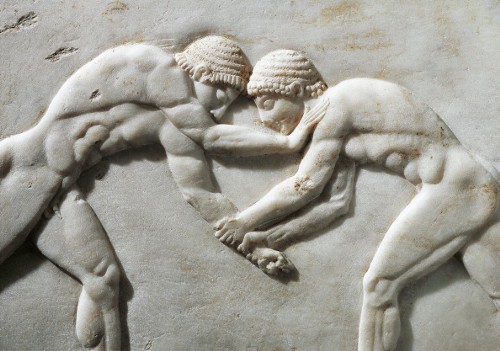
Greek Wrestlers
A particular example of this type of exercise that was performed has the Greek name “pitylysma”. The exercise goes like this: start by standing on tip toes, stretch your arms upwards, move one arm quickly forward, while moving the other one backwards, roll quickly on the ground, quickly come up, stand erect and start jumping up and down, sometimes with a backward kick, sometimes bringing each leg forward in an alternating fashion.
Violent exercises: These combined speed and strength. Exercises classified as vigorous became violent if you increased their speed – jumping continuously without rest, or any speed exercises performed with weight became violent – moving around quickly in heavy armor.
The word ‘violent’ in this context could be better understood if you use it as a synonym for the word ‘power.’ A recommendation of Galen for these types of exercises was to rest between the different individual exercises.”
So, yes, the highly muscled king appearing on those beautiful coins likely had plenty of thoughtful exercise routines behind those sculpted muscles — or he kept buff by throwing lots of javelins while trying to preserve his kingdom.
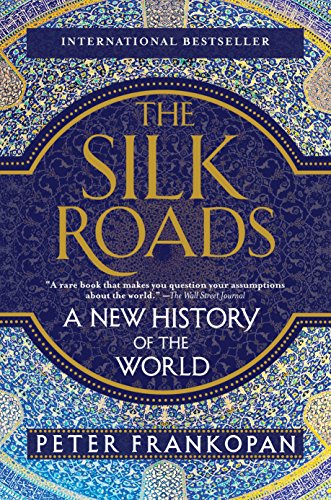
One of the books I am currently reading is Peter Frankopan’s The Silk Roads: A New History of the World. I have just begun the work and find it both interesting and irritating. Interesting in that it has much to impart to me and irritating in that too much of the information imparted is highly superficial. Fortunately, there are notes but, alas, they are endnotes rather than footnotes.
Additionally, the information contained in the notes is sparse. The upshot of the foregoing is that when I come across a provocative morsel of information, which occurs with frequency, I am compelled to leap headlong down the proverbial rabbit hole in search of enlightenment. For instance, the following tantalizing appetizer appeared on pages 8-9 of Mr. Frankopan’s tome:
A Roman copy of a Greek statue of Seleucus I Nicator found in Herculaneum. Naples National Archaeological Museum.
“At Ai Khanoum in northern Afghanistan – a new city founded by Seleucus – maxims from Delphi were carved onto a monument, including:
As a child, be well behaved.
As a youth, be self-controlled.
As an adult, be just.
As an elder, be wise.
As one dying, be without pain.”
Being reasonably educated, I may claim general familiarity with Afghanistan, Seleucus, one of the Diadochi who fought for control of Alexander the Great’s empire after his death, and things Delphic; however, I may not claim any familiarity with Ai Khanoum or the particular Delphic maxim cited. Therefore, I immediately looked to the referenced endnote in hopes of being further educated about each of the foregoing as the main text provided only the tease outlined above and nothing more. Alas, a review of the endnote (number 24 in chapter 1) revealed that it only cited two works, one in French which suggested that it was apparently the repository of the original Greek inscription and the other apparently the repository of the English translation of the Greek inscription by F. Holt. The endnote provided no commentary to sate my appetite for context or illumination regarding the city, its founding, or the Delphic maxim.
Immediately putting the book aside, I fired up the mystical engine that facilitates my instantaneous access to sources of knowledge once unfathomable to my imagination, and within minutes I am able to begin to sketch out the missing context for the above tease from Mr. Frankopan.
Let’s begin our tumble down the rabbit hole with an anecdote recorded in an article appearing on the Biblical Archeological Society Website entitled Alexander in the East, which was written by Frank Holt, the translator of the Greek inscription cited in the note above:
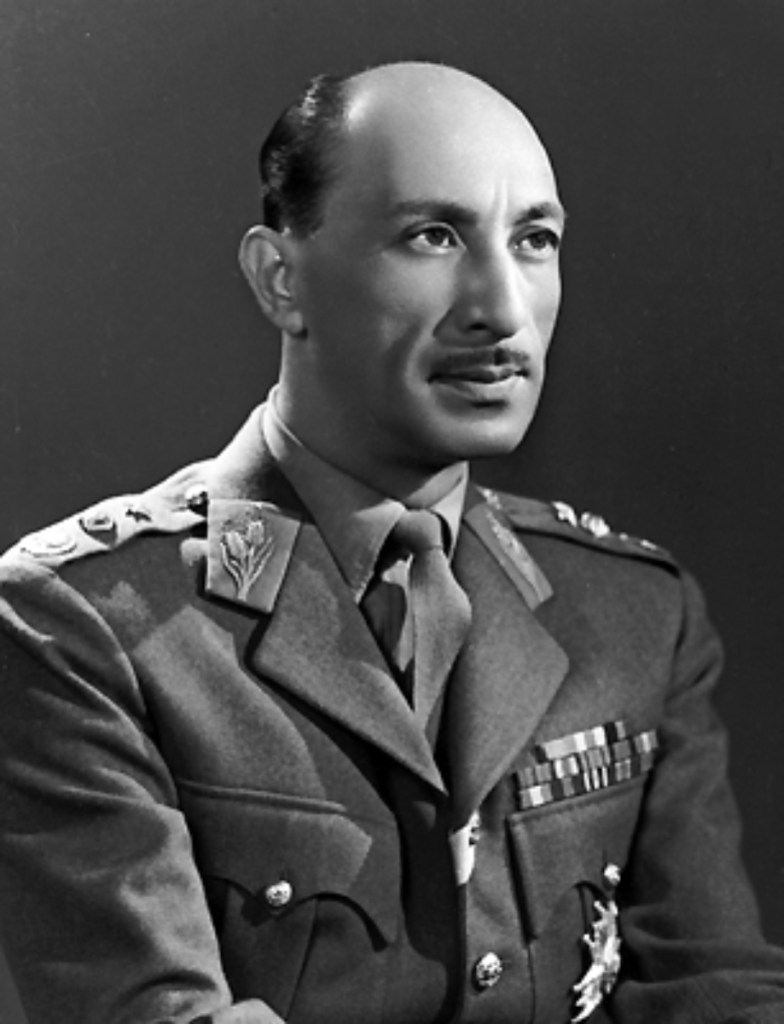
King Muhammad Zahir Shah of Afghanistan in 1963
“On a royal hunt in a remote corner of his realm [in 1961], King Muhammad Zahir Shah of Afghanistan spotted a strange outline in the dry soil between two rivers. Looking down from a hillside at this confluence of the Amu Darya (ancient Oxus) and Kochba rivers, the king could see traces of a well-planned ancient city: A wall and defensive ditch stretched from the hill to the Oxus, broken only by a gateway leading to the main street inside the settlement. The shapes of many large buildings bulged underneath the thin carpet of dirt, and at least one Corinthian column rose up like a signpost of Hellenistic civilization. Here, at last, was Alexander’s elusive legacy in the East.”
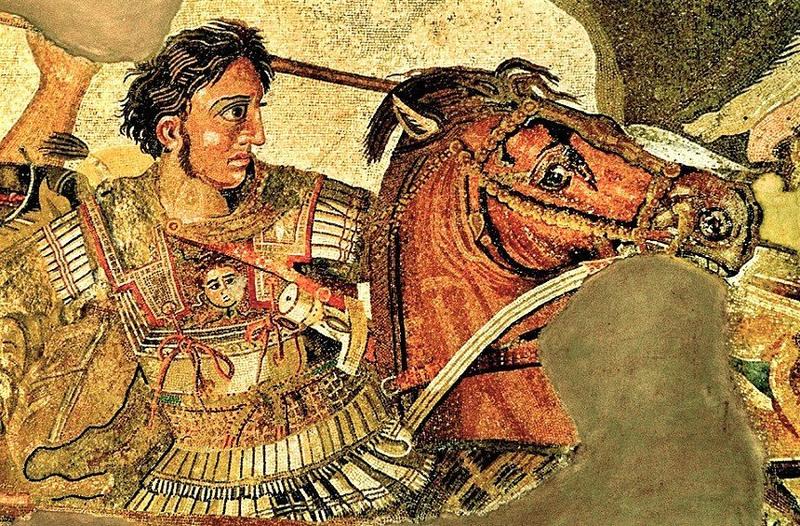
Alexander the Great
And what was this elusive legacy of Alexander’s in the East? Well, to answer this, here we do well to lift generously from another scholar, Jeffrey Lerner, and his article entitled Alexander’s Settlement of the Upper Satrapies in Policyand Practice, which provides ample context for the significance of King Muhammad Zahir Shah’s find:
“Alexander’s plans for maintaining his authority over the region involved the stationing of troops in a system of strategically placed cities and fortifications. A manifestation of Alexander’s authority that was particularly directed at the Upper Satrapies was the founding of settlements denoted by Greek authors as πόλις and by Roman authors as urbs. Justin, for example, notes that Alexander established seven cities in Baktria and Sogdiana. The problem with identifying Alexander foundations is not knowing the number of cities that he or his successors founded. To date no site in Central Asia dating to the Hellenistic period has yielded an inscription bearing its name, whether in Greek or in any other language. For example, there are a number of cities whose foundations are attributed to Alexander, but apart from their names, there is precious little else known about them.”
Lerner goes on in his article to discuss Aï Khanoum, which had been the object of archaeological survey under the direction of French archaeologist Paul Bernard from 1965 until the 1979 Soviet invasion of Afghanistan:
“One particularly illusive foundation that has attracted a great deal of attention is that of Alexandreia on the Oxos, which Ptolemy places in Sogdiana, but whose whereabouts remain highly controversial due to Ptolemy’s placement of the city in relation to the rivers Oxos and Iaxartes, μεταξὺ δὲ καὶ ἀνωτέρω τῶν ποταμῶν. This prompted Bernard to remark that the difficulty of reconciling the whereabouts of the city with its name is that it supposedly existed along the river Oxos, because as a general rule cities named after rivers are located directly on their banks. Apparently, Ptolemy erred in combining data on two different cities in the same description. Nonetheless, several suggestions have been made as to its location. One holds that Alexander had founded the city at Termez on the north bank of the Oxos and, following its destruction by nomads, was refounded by Antiochos I as Antioch-Tarmita, but was subsequently refounded by the Greek-Baktrian king Demetrios I as Demetrias in the second century BCE. The discovery of the site of Aï Khanoum in northeastern Afghanistan south of the river Oxos in Baktria led Bernard to conjecture that this region of Baktria was actually part of Sogdiana. To make this reconstruction work, he further speculated that upon the conquest of Marakanda by nomads, Aï Khanoum became the country’s capital with the Kokcha acting as the border between Baktria and Sogdiana. Rtveladze has argued that Kampyrtepa was Alexandreia Oxiana. Finally, the fortress of Takhti Sangin in modern Tajikistan on the north bank of the Oxos situated between Ai Khanoum and Termez has also been proposed as the ancient city. The site contains the so-called Oxos Temple in which an altar dedicated to the river god Oxos by a certain Atrosokes was recovered.”
A few lengthy paragraphs from Lerner are in order as to why Alexander would have settled some of his men on the farthest fringes of his conquests and how those men were selected and reacted to their selection:
“As a rule, Alexander employed a settlement policy in the regions of the far eastern corridor of the empire as one method of controlling these subjugated states. This practice, like many others that Alexander followed, was initiated by his father, although of course in Alexander’s case on a much larger scale. The role that cities played in achieving this goal was two-fold. First, many were so hastily constructed – literally in the matter of days – that they appear to have been little more than military colonies with names given them to connote a sense of grandeur, like ‘Alexandreia.’ Such was the case of Alexandreia Eskhate that served as no more than a frontier post. On the other hand, Alexander’s propensity for renaming existing cities, usually after himself, seems to have enjoyed longer lasting success, like Alexandreia Arachosia/Alexandropolis, and Alexandreia Areia among others. The key to understanding Alexander’s achievement with this policy was the practice of creating colonies of heterogeneous populations, consisting in the vast majority of cases of indigenous peoples and Greek mercenaries, and only rarely Makedonians. Aside from serving as the king’s direct agents in the satrapies, these settlements also had the benefit of allowing Alexander to rid himself of dissatisfied elements in the army by stationing them in remote places as punishment for their insubordination. Indeed prior to the rebellion of 325 BCE, Koenos states emphatically that Alexander had left behind in Baktria Greeks and Makedonians who had no wish to remain. As a matter of course retired soldiers received land and quite likely economic support to set up a farm. The local population, however, by all appearances did not fare as well as their Greek and Makedonian counterparts. This is especially true in the case of a captured population, such as those who were taken prisoner at the Rock of Ariamazes. The majority of those who had surrendered were given to the newly arrived settlers as slaves of the six towns situated near Alexandreia Margiana. No matter how imperfect this policy of colonizing the conquered regions in the Upper Satrapies may have been in hindsight, it did provide some measure of control, while also safeguarding communication routes, and the king’s borders. The method of founding new cities, deploying garrisons in large old cities, coupled with the creation of military colonies was to a degree based on Alexander’s policy of integration, even if it was compulsory. Yet the garrisons appear to have been generally small, ranging from a few dozen to several hundreds. The overall effect of this policy was that it served as the basis of contact between peoples and the resulting cultural interaction that might otherwise have not occurred.
Throughout his campaign in the further east Alexander established military settlements that later became cities and renamed cities after himself, though the locations of each remains controversial. Yet the veterans he left behind were hostile to his intentions and revolted in 325 and 323 BCE. For those who rebelled wanted no part in living on the fringes of the known world. Rather they passionately desired to return to a polis lifestyle replete with Greek institutions and a citizenry who shared similar values as opposed to the drab settlements in which they found themselves as just one constituent body in an otherwise mixed population. The so-called cities that Alexander constructed in less than three weeks could in no way resemble cities like Aï Khanoum of the future, for they were the products of the next period. Certainly, the numbers of these veterans had seriously declined especially after the revolt of 323 BCE, in which they found themselves a dwindling minority. They were aliens in an alien world. While they helped conquer this part of Alexander’s kingdom, they had no desire to rule it. Nonetheless, the arrangement that Alexander had established by the time of his death generally held firm as Makedonian supremacy throughout the empire existed without any serious challenges, save among the Makedonian generals themselves. The wars of the Diodochi had little effect on the indigenous populations of the empire as this was left to those charged with administering it, particularly the satrapies in the further east.”
All the foregoing suggests, therefore, that Aï Khanoum, attested in the archaeological survey as a splendid Hellenistic city in its heyday (more on this below), was likely “founded” by Alexander in a perfunctory manner with, at best, slightly disaffected veterans from his campaigns. Whether it was founded from scratch or on a pre-existing village that was simply renamed is unclear to me at this stage of my reading. However, it is clear, that after Seleucus acquired his mastery of much of Alexander’s empire, including the Upper Satrapies which included Aï Khanoum, the city acquired a mint (always of interest to this numismatist) and he invested in the city’s development.
At this point, we may return to the ever so brief snippet from Mr. Frankopan which began this entire journey, as the larger context is now set, for the more specific illumination which is now to be provided by an extract from the earlier article cited by Mr. Frank Holt:
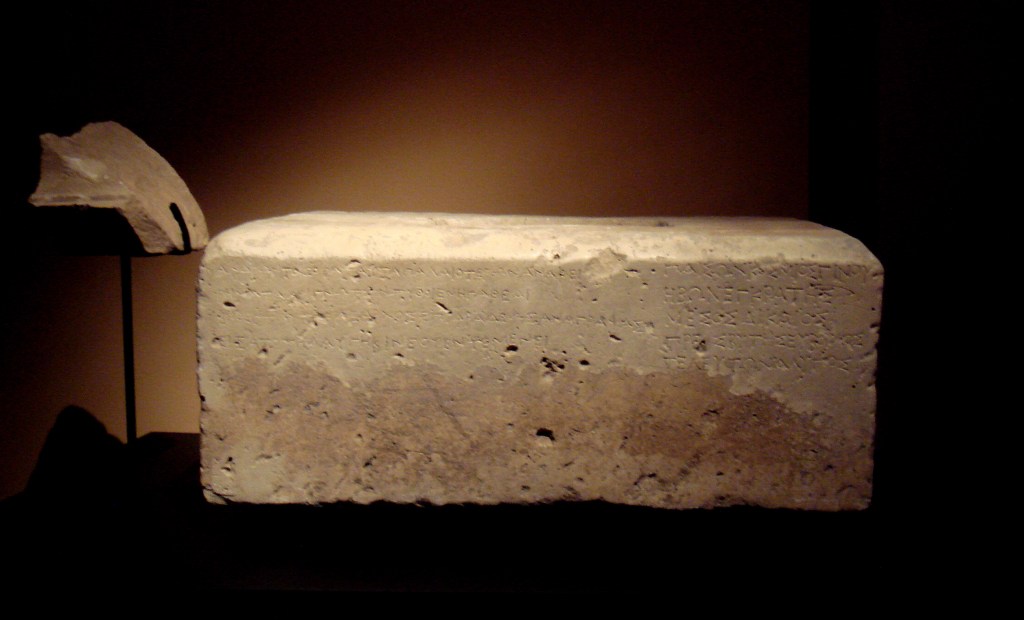
Funerary monument in the tomb of Kineas in northern Afghanistan at Ai Khanoum upon which the Delphic Maxim Cited in this Post is Inscribed.
“The Greek founder of this colony [Ai-Khanoum], which may have been called Alexandria Oxiana, was a man named Kineas, whose fourth-century B.C. shrine and tomb stood in the heart of the city. Kineas may have been one of Alexander’s soldiers, sent to settle this strategic fortress on the frontiers of Bactria. There are indications of an attack on the site soon after Alexander’s demise, perhaps part of the disturbances that took place when Greek settlers attempted to abandon Bactria. Fifty years later, under the aegis of the Seleucid dynasty, a major building phase began. True to Greek cultural traditions, the later citizens of the city enjoyed a large theater, a gymnasium with a pool, and quantities of olive oil and wine. Papyrus for writing was transported from Egypt.
These ancient Greeks built large, luxurious private homes and a great sprawling palace. Their Greek names and political titles appear on tombstones and government records. To preserve Greek values in this alien land, an Aristotelian philosopher copied the Delphic Maxims in Greece and carried them all the way to Bactria. An inscription found at Ai Khanoum explained to the colonists that these maxims were the wise counsel of earlier Greeks as codified by priests at the sacred site of Delphi. Their closing lines convey the idea of this Hellenic creed ‘blazing from afar’:
As a youth, be self-controlled. As an adult, be just. As an elder, be wise, As one dying, be without regrets.”
Mr. Holt makes passing reference above to how the Delphic maxims inscribed on the funerary monument, illustrated above, found there way to the city and the shrine dedicated to Kineas. I note that the funerary monument includes the following inscription on it, explicitly explaining how the Delphic maxims came to be there:
“These wise commandments of men of old- Words of well-known thinkers – stand dedicated in the most holy Pythian shrine. From there Klearchos, having copied them carefully, set them up, shining from afar, in the sanctuary of Kineas.”
Thus, a gentleman name Klearchos traveled from the holy Phythian shrine, the temple of Apollo at Delphi, where he copied the maxims, to Ai Khanoum, to have the maxims engraved on a funerary stone. As to the Delphic maxims, the words of well-known thinkers, that would be another entire post!
Finally, if you have the time and access to the Scientific American, I recommend the following article for more background on this city and its archaeological survey:
Bernard, Paul. “An Ancient Greek City in Central Asia.” Scientific American, vol. 246, no. 1, 1982, pp. 148–159. Another recommended article is linked in the button below and explores, in depth, the literature through 2015.
I also recommend the following American Numismatic Society lecture by Michael Alram (“Money and Power in Ancient Bactria”) which surveys the numismatic history of Bactria, and in a number of places, discusses the coinage found at Ai Khanoum:
Michael Alram: “Money and Power in Ancient Bactria”
Though those of my lineage have no heraldic arms, I have taken as a personal emblem a crane on starry azure field, with a chief charged with three golden dragon flies. As a motto, I have adopted, Humilitatem Initium Sapientiae. A phoenix gold and red crest with gold and black mantling support the shield.
The Personal Emblem of D. S. Y.
The crane was adopted as the central figure of my emblem because of its rich symbolism and because, simply, my Slovak surname translates into crane. The crane was placed on a starry field because I so oft look up in wonderment into the night skies. Indeed, I recall with regularity the beauty of the words from a small little text called the Christianica, which I was given decades ago by Father Richard for serving as a catechist at St. John Catholic Church in Albion, Michigan. In particular, I remember the following lines (a most felicitous juxtaposition of some verses from Psalms and Genesis) that have a particular resonance with me:
Lord, when I look at thy heavens, the work of they fingers, the moon and the stars which thou hast established;/what is man that thou are mindful of him?/ Yet thou has made him little less than the angels and given him dominion over the works of they hands;/ thou has put all things under his feet.
Wonderment at the cosmos. Humility at our place in the cosmos.
“Lord, when I look at thy heavens, the work of thy fingers, the moon and the stars, which thou has established; what is man that thou art mindful of him?”
I was further moved to place the crane on a starry sky when I read the Fable of The Crane and the Peacock by Avianus. Here is the full translation of the fable:
The story goes that Juno’s bird disparaged the Thracian fowl, when she shared their joint feeding ground. For a quarrel had arisen involving their different kinds of beauty and they were protracting a long argument on a case easy to settle. The peacock contended that the parts of his body gleamed in manifold loveliness, but that a dingy back gave the crane a dun colour, and at the word he arrayed about him the canopy of his uplifted tail and shot an arc of light upwards to the sky. The crane, though unable to rival the other in any glory of plumage, is nevertheless said to have used these words in mockery: “Countless may be the array of colours variegating your plumage, yet you, the wearer of the gaudy tail, are for ever kept close to earth. But I soar aloft into the air on my wing for all its ugliness, and am wafted nigh to the stars and heavenly powers.”
Avianus, Hadrian, Florus, Nemesianus, Reposianus, Tiberianus, Phoenix, Rutilius Namatianus. Minor Latin Poets, Volume II: Florus. Hadrian. Nemesianus. Reposianus. Tiberianus. Dicta Catonis. Phoenix. Avianus. Rutilius Namatianus. Others. Translated by J. Wight Duff, Arnold M. Duff. Loeb Classical Library 434. Cambridge, MA: Harvard University Press, 1934, p. 705.