
Elegy for the Automatons: A Reflection on Political Decline in the Orwellian State


The Disquieting Muses by Giorgio de Chirico
(1916-18, oil on canvas)
The Disquieting Muses (1916-18) by Giorgio de Chirico
(97.16 cm × 66 cm, oil on canvas)

Preface

This poem, Elegy for the Automatons, was inspired by George Packer’s article The Hollow Men, which appeared in the May 2025 issue of The Atlantic. Packer’s article examines the political and moral collapse of certain American officials—Speaker Mike Johnson, Senator Lindsey Graham, and Secretary of State Marco Rubio—who, once defenders of democratic principles, surrendered themselves to the inverted realities demanded by Donald Trump’s authority and his increasingly Orwellian authoritarian state.

Echoing the pivotal scene in Orwell’s 1984 where a Party orator is handed a note and instantly redirects his vitriol toward a different enemy “mid-sentence, without a pause,” Packer documents how key Republican figures performed their own breathtaking reversal on Ukraine policy, and describes how these officials pivoted instantly from celebrating Ukraine’s resistance to Russia’s aggression to denouncing Ukraine as the enemy—all in service to Trump’s shifting personal allegiances and contempt for democratic values.

Packer also invokes Henri Bergson’s insight that the mechanical within the human evokes both laughter and horror. Yet what he describes transcends mechanical reflex: it is the slow hollowing-out of conscience itself. Once-thoughtful men become fluent automatons, mouthing words disconnected from belief, loyalty, or memory.

This poem seeks to render in elegiac form the sorrowful descent of a free polity into ritualized untruth, and the transformation of human beings into instruments of submission.


“We are the hollow men
We are the stuffed men
Leaning together
Headpiece filled with straw. Alas!”

— T. S. Eliot, The Hollow Men

Elegy for the Automatons

In the year when the hollowing began,
and Orwell’s warning stirred too late,
it came not by fire nor iron decree,
but smiling, in the face of one man.
He bore no heavy crown, no burning sword;
only the gift of inversion:
truth was a lie, loyalty a whim,
freedom the mask of power.
A man for whom cruelty was a virtue,
and truth a broken toy at his feet;
a man who measured loyalty by abasement,
and called the strong weak and the weak strong.

Under his gaze, the names of enemies blurred,
history curled back on itself like smoke;
words, having lost their anchor, floated
as banners torn from any mast.
And a people once proud of remembering
forgot that they had ever known another day.

From this hour of unmooring
emerged the hollowing of men.

Johnson, first among the fallen,
fumbled for strength among hollow phrases,
mouth heavy with the weight of borrowed words.
Behind his thickened glass, a flicker died—
and he mistook its ashes for light.

Graham, quick to find the favor of the wind,
circled the ruin with the laughter of forgetting,
shedding oaths like old garments,
spinning from vow to vow as a moth to a dying flame,
faithless to all but the empty crown of belonging.

Rubio, once proud in the defense of liberty,
sank into the yellow chair of forgetting,
listening to the slow departure of his own voice.
Once he cried for the dignity of nations;
now he stitched the banners of surrender with empty hands.

Thus were men unmade,
not by terror, nor by war,
but by the patient grinding of truth into noise,
by the slow machinery of convenience and fear.

And we, who watched,
sang no hymns for these men,
built no statues to mark their days.
They passed like shadows over a broken dial,
automatons grinding down the hour,
till even the dust forgot their tread.


U.S. Secretary of State Marco Rubio, February 28, 2025 — slipping deeper into the hollowing of the soul.

The Unopened Book

by Donald S. Yarab


Scholar in His Study by Rembrandt Harmenszoon van Rijn, 1634
Oil on canvas, 141 × 135 cm
Collection of the National Gallery Prague, Schwarzenberg Palace
© National Gallery Prague

The unopened book, its spine uncreased,
rests on the shelf, untouched by breath.
No hand has turned its waiting leaves,
no eye has met its silent depths.

The pages sleep in folded time,
ink unmoved by thought or light—
a universe uncalled to mind,
a star unkindled in the night.

Who knows what worlds it might contain—
a lover’s vow, a tyrant’s fall,
a name that once was yours or mine,
a deathless truth, a whispered call?

The story never yet begun
is writ in ink that does not fade.
Its fate, unlike the morning sun,
has neither risen nor decayed.

And yet—another book lies bare,
its binding worn, its chapters told.
The margins smudged by time and care,
its tale rehearsed a thousandfold.

We read, we skip, we turn again,
we bookmark thoughts we dare not bind—
then falter near the closing lines,
no meaning fixed, no end designed.

A narrative half-read, half-lost,
its final thought left unexpressed—
the thread unwinds, the ink runs dry,
the reader dozes, unconfessed.

Between the two—a paradox:
the never read, the half-complete.
Which holds the weight of what we are?
Which better marks our own defeat?

Perhaps all books are mirrors dim,
reflecting what we dare not see:
the start we fear, the end we flee,
the truths we touch but never free.

So let it lie, unopened still,
or let it fall apart, well-worn—
the soul is both the waiting page,
and every word we leave unborn.


Poetry as Revelation: Engaging with “Vitruvian Man Unbound”

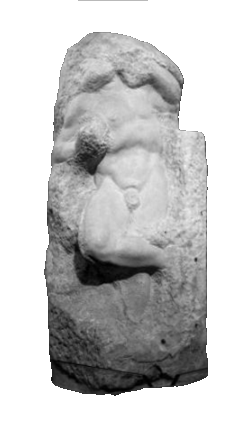
Michelangelo, The Awakening Slave (c. 1525–30).
A body caught between measure and becoming.

I. On Bloom and the Anxiety of Influence

As the poet of Vitruvian Man Unbound, I find myself drawn to Harold Bloom’s understanding of how poetry functions within tradition—not as mere imitation or influence, but as a creative misreading that transforms both predecessor and successor. Bloom’s vocabulary—his clinamen (poetic swerve), daemonization, and apophrades (the return of the dead)—offers a framework for understanding my own relationship with Leonardo’s iconic drawing.

Yet I would press beyond the confines of Bloom’s categorical system. The strongest poetry, as Bloom himself recognized, resists easy resolution. Vitruvian Man Unbound embodies what he called a tessera—a completion of its precursor that simultaneously preserves and undermines its foundational terms. The poem does not simply revise Leonardo; it retroactively reshapes our understanding of him. It allows us to see Vitruvian Man as an incomplete gesture, one whose implicit metaphysical longing only achieves full articulation through the poem’s unfolding of form, desire, and transcendence.

II. The Paradox of Poetic Creation as Discovery

When I began Vitruvian Man Unbound, there was no conceit of a new idea. Rather, I felt I was unearthing the obvious—articulating for the first time verses that had already been rendered, waiting to be heard.

This situates the poem not as invention but as discovery—a Renaissance conception of artistic creation. Michelangelo spoke of liberating the form already imprisoned within the marble. Leonardo, too, conceived of art as revelation through observation, uncovering structures latent in nature and proportion. I participate in that lineage: the transcendence of the circle was already latent in Leonardo’s drawing. My poem does not overwrite Vitruvian Man but unveils what it always contained.

III. Poetry as Transcription of Revealed Truth

Poetry is primarily, in my conception, the art of transcription. Poetry is ultimately truth revealed, however rendered.

This belief is ancient. Poets once invoked the Muse, believing their songs were received rather than authored. Plato cast poets as possessed vessels of divine madness. In scriptural traditions, the prophet or sage writes not from invention but from vision. In this view, the poet is not creator but conduit.

This understanding reorients poetic practice. What matters most is not novelty of theme or form but receptivity—a cultivated attentiveness to truths that ask to be heard. To compose well is to listen well. The most vital poems do not invent so much as reveal. The poet’s charge, then, is fidelity.

Vitruvian Man Unbound aspires to this kind of transcription. It draws out from Leonardo’s image the philosophical tensions embedded therein: between proportion and possibility, containment and becoming, structure and the longing to transcend it.

IV. The Poem’s Journey: From Containment to Transcendence

At its heart, my poem charts a metaphysical journey—the awakening of a consciousness confined within geometry, gradually realizing its cosmic vocation. The Vitruvian figure, bound in ratios and ruled lines, discovers within himself not mere form but flame. The movement is from being drawn to drawing, from being measured to measuring.

The poem gives voice to this paradox: “I am both bound and boundless, large and small, / Both measured part and immeasurable all.”

This is no empty contradiction. It is the philosophical heart of the work. The circle becomes “not wall but door,” not negated but reimagined. Limitation, as I came to understand, is not the enemy of freedom but its precondition. Form does not imprison; it allows the infinite to appear in the guise of the finite.

This idea resonates with multiple traditions: the Christian theology of kenosis, quantum indeterminacy, the aesthetics of the golden ratio, even the existential struggle of Camus’ Sisyphus. In Vitruvian Man Unbound, I sought to draw them all into poetic coherence.

V. Beyond Influence: Co-Creation and Transcendence

My relationship to Leonardo’s drawing is not one of mere homage or critique. The poem does not simply descend from his vision; it reconfigures how I understand that vision. In Bloom’s terms, it enacts an apophrades: the precursor is altered by the successor, the past rewritten by the presence of the present.

I acknowledged this inversion within the poem itself: “Da Vinci dreamed me into being’s start; / I dream myself anew with conscious art.”

This was not rebellion against the tradition but transcendence through deep fidelity. I did not seek to destroy Leonardo’s Vitruvian Man; I hoped to fulfill him. I entered the drawing and found the voice that seemed to have been waiting there. The Vitruvian Man, for me, ceased to be object and became subject, consciousness incarnate.

VI. Poetry as Epistemological Practice

If poetry is the transcription of revealed truth, then it is not merely aesthetic. It is epistemological. It helps us understand not only what is, but how we come to know what is. The most original poems do not dazzle through novelty alone; they resonate because they name what we already suspected was true, but had not yet heard.

Vitruvian Man Unbound aspires to such resonance. I hope it awakens a dormant dimension in Leonardo’s drawing—and perhaps, in us. I did not set out to create a new form, but to reveal the old form’s silent music. For me, it was an act not of invention, but of listening—not conquest, but witnessing. A poetry of revelation.

Thus the ink that once bound becomes the ink that reveals.

VII. Echoes of Prometheus

In reflecting on Vitruvian Man Unbound, I recognize the shadow of another unbound figure—Shelley’s Prometheus. His liberation from cosmic tyranny, his transformation into a visionary voice of harmony, and his rejection of vengeance in favor of transcendence, all resonate deeply with the arc of my poem. Like Prometheus, the Vitruvian figure is not merely released; he is revealed—as a bearer of fire, of knowledge, of poetic truth. It is not accidental that in striving toward the infinite, we find ourselves echoing those myths and verses where the infinite has already spoken.

James Baldwin on Race: Insights from ‘The Cross of Redemption’

Photo of James Baldwin in  1969
James Baldwin in 1969. Photograph: Allan Warren CC BY-SA 3.0

One of the books I am currently reading is James Baldwin: The Cross of Redemption (Uncollected Writings), edited with an introduction by Randall Kenan and published in 2010. One of the essays in the collection, dated 1984 but still strikingly relevant, is “On Being White … and Other Lies.” A particular passage from that essay stood out to me:

“Just so does the white community, as a means of keeping itself white, elect, as they imagine, their political (!) representatives. No nation in the world, including England, is represented by so stunning a pantheon of the relentlessly mediocre. I will not name names—I will leave that to you.

But this cowardice, this necessity of justifying a totally false identity and of justifying what must be called a genocidal history, has placed everyone now living into the hands of the most ignorant and powerful people the world has ever seen. And how did they get that way? By deciding they were white. By opting for safety instead of life. By persuading themselves that a black child’s life meant nothing compared with a white child’s life. By abandoning their children to the things white men could buy. By informing their children that black women, black men, and black children had no human integrity that those who call themselves white were bound to respect. And in this debasement and definition of black people, they debased and defined themselves.” (The Cross of Redemption, pp. 168–169)

This passage struck me as just as relevant today as it was in Baldwin’s time. The language of racial division may sometimes be more coded—though often, it is not—but the underlying dynamics remain. Some now speak of a mythical golden age to be restored, painting diversity, equity, and inclusion as enemies to be vanquished. Yet Baldwin’s pantheon of the relentlessly mediocre remains firmly in place, with a growing number of elected officials – led by one in particular – who traffic in racial grievance and nostalgia for an edifice of the past that was built upon exclusion. The resentment they cultivate is growing more visceral, more vengeful by the day.

At its core, Baldwin’s essay is a reminder that race is a social construct—one created not out of noble ideals or science but out of moral rot. It was, and remains, a means of defining power and justifying subjugation. Today’s renewed emphasis on racial division in politics—whether explicit or coded—is no less morally bankrupt than in Baldwin’s time.

Finding Humility Through Montaigne’s Wheat Allegory

Photo by Pixabay on Pexels.com

One of the most striking images from Montaigne’s Essays, which has lodged itself firmly in my mind, comes from his Apology for Raymond Sebond. Specifically, within one paragraph, he uses wheat as an extended metaphor or an allegory wherein he suggests that the more wisdom or knowledge one acquires, the more humble one becomes. He writes:

To really learned men has happened what happens to ears of wheat: they rise high and lofty, heads erect and proud, as long as they are empty; but when they are full and swollen with grain in their ripeness, they begin to grow humble and lower their horns. (Montaigne, 1963, p. 227)

The image captures what I have found to be my experience insofar as that, with each passing year, as my hair has silvered and my eyes dimmed, I have found that wisdom requires casting the certitude, rigidity, and knowledge of youth aside for the humility of lived experience.  

Additionally, I find the lesson to be an extraordinary corollary to my personal motto, about which I have previously written, Humilitatem Initium Sapientiae (humility is the beginning of wisdom).

Thus, having reflected if not obsessed upon Montaigne’s insight for well over a fortnight, I finally shaped my thoughts about it into a poem, the results of which are below.


The Ripened Ear
(Inspired by Montaigne)

Beneath the sun’s unyielding gaze, it grows,
The tender stalk, upright and full of pride,
Its hollow strength unbent by winds that blow,
Yet void of fruit, it stands unsatisfied.

But time, the patient sower, bids it yield,
To weight of grain within its swelling breast,
It bows its head, as on the golden field,
The burdened ear finds wisdom’s humble crest.

So too the soul, in ignorance, stands tall,
Unbowed by truths it dares not yet to see,
Until the harvest’s gentle weight does call,
And bends the heart to find humility.

For wisdom ripens where humility’s sown,
And humbleness, by wisdom, is full-grown.


Montaigne, M. de. (1963). Essays and selected writings: A bilingual edition (D. M. Frame, Trans. & Ed.). St. Martin’s Press.