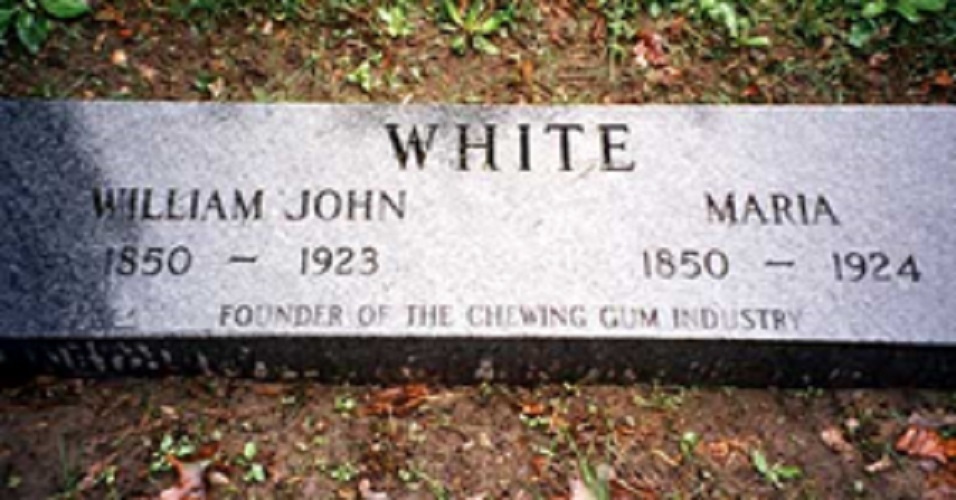


Back in the 1890s, the Edgewater neighborhood was home to royalty, of a sort, for William John White, who resided in an ornate and well-appointed 52-room mansion on a Lake Avenue estate known as Thornwood, was styled the “Chewing Gum King.” He was certainly one of the most colorful characters to have ever resided in the neighborhood, as his story will tell.

William J. White was born on October 7, 1850, in Rice Lake, Ontario, Canada. He came to Cleveland with his parents, John and Laura White, when he was six years old. After receiving the benefit of an education in district schools, he went to work for Orange Mansfield, the owner of a well-digging company. The advantages of working for Mr. Mansfield were singular: William met Mr. Mansfield’s daughter Ellen Marie, whom he married on April 23, 1873. William and Ellen Marie had seven children: William Benjamin, Harrie Walter, Gloria Marie, Pearl Marietta, Miles Arthur, Adah Melora, and Ralph Royden.
Shortly after his marriage in 1873, Mansfield’s well-digging business closed down and White sought employment in a confectionary store. At the confectionary store, White began experimenting with paraffin wax (a petroleum by-product), which had been used as a base for chewing gum since about 1850. It should be understood that chewing gum at this time was a rather tasteless affair as long-lasting flavored chewing gum had not yet been contrived.
Confectionary Alchemy
In 1876, White went into the confectionary business for himself after purchasing at auction the equipment of a little manufacturer of confectionary that had gone out of business. The equipment he obtained included a marble slab and a soot-covered pot – candy was boiled in the pot and cooled on the slab. White set the equipment up in the kitchen of his Lorain Avenue home and continued his confectionary experiments. He eventually began selling a paraffin wax chewing gum known as “The Diamond” in the streets from a one-horse wagon to grocers and small stores with the assistance of his wife and, as soon as they were able, his sons.
Though sales of “The Diamond” chewing gum were modestly successfully, White continued to practice confectionary alchemy in his kitchen, always seeking to turn his confectionary product into gold. In 1880, White happened upon a barrel of chicle (a natural gum tapped from certain Mesoamerican trees) – some reports state that a local grocer gave him the barrel after mistakenly receiving it in inventory – and found through his kitchen-based experimentation that mixing corn syrup and sugar with chicle latex allowed the chicle to absorb and hold flavors.
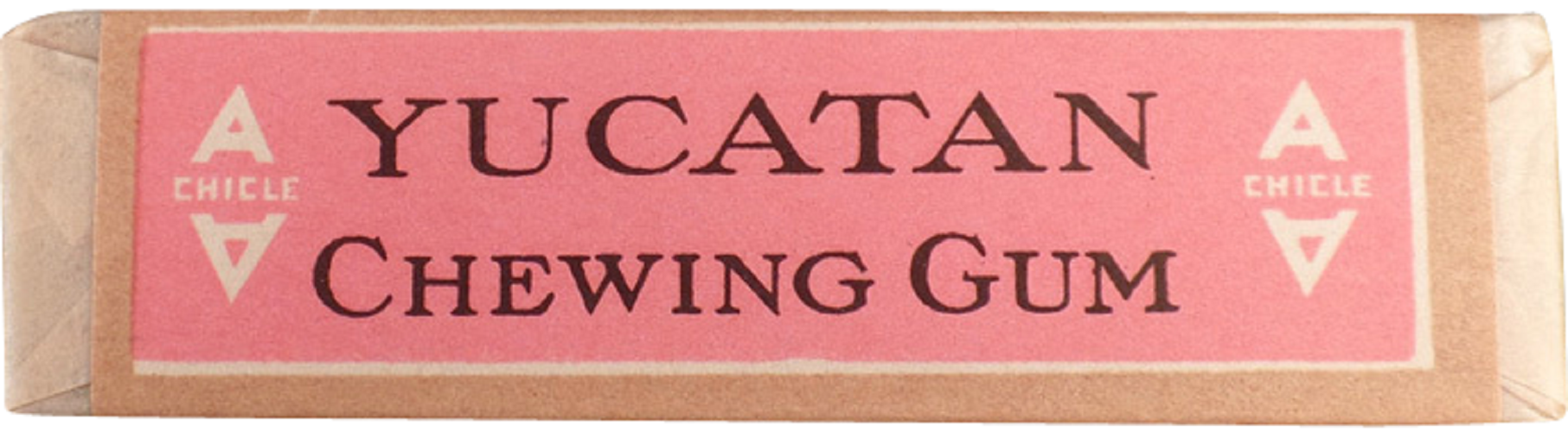
White experimented with various flavors and ultimately determined that peppermint extract was the longest lasting. He thereupon developed and marketed a peppermint flavored chewing gum called “Yucatan,” named after the Yucatan Peninsula of Mexico, from whence his chicle had originated.
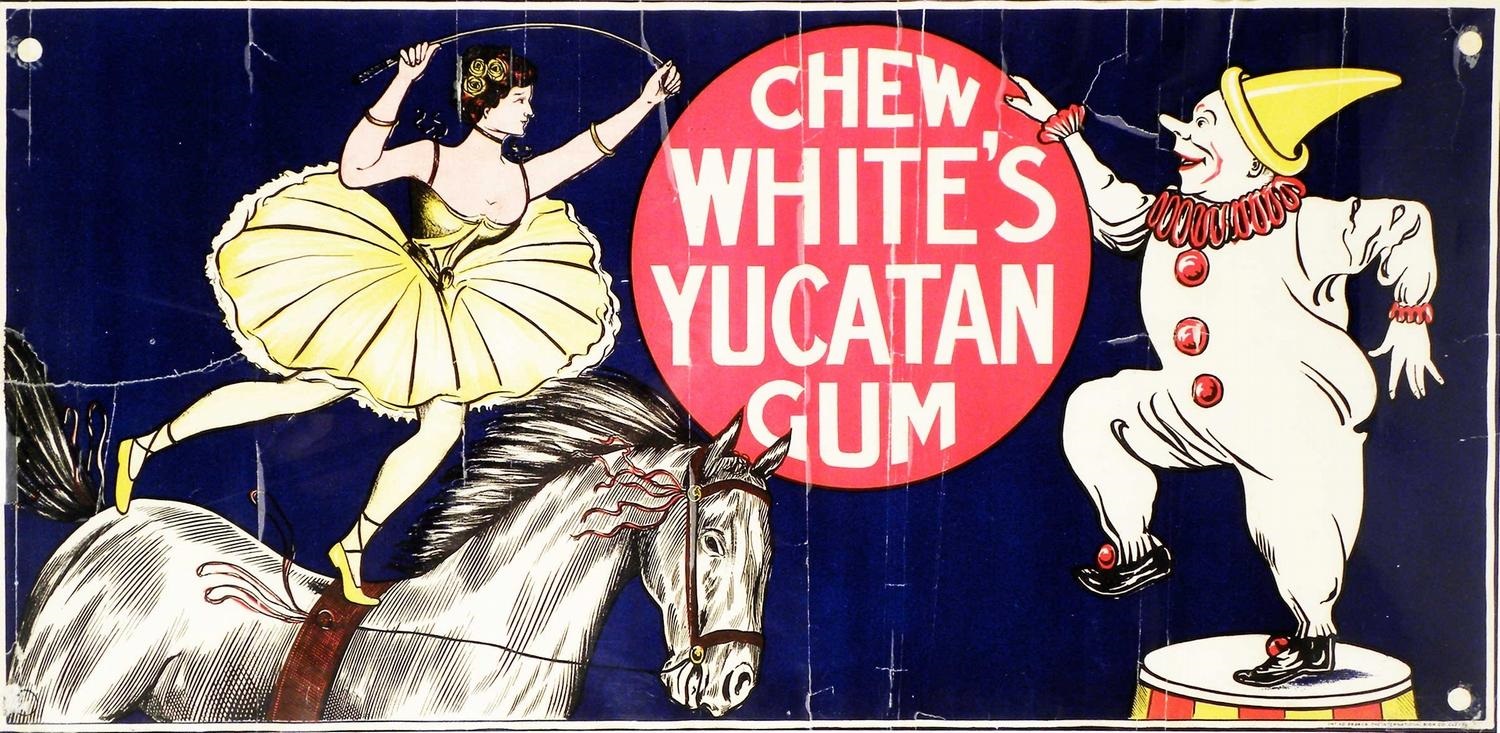
He cut his gum into sticks, packaged them in pink paper, and soon found that he was a very wealthy man – for he was none other than the Chewing Gum King, the inventor of modern, flavored chewing gum.
White was also a marketing genius, for he knew how to target consumers, as evidenced by the introduction of another chewing gum he branded “Red Robin.” “Red Robin” was popular with young boys because White brilliantly affixed to every wrapper a “Boy’s Fortune,” not dissimilar to the fortune we encounter inside Chinese fortune cookies. One such wrapper which has survived records the following rather perplexing and unfortunate prognostication:
You are a very good boy, only when Jake Riger and Bob Spoots get you to go on with them to steal watermelons and peaches from old Daddy Boker. Then you always take the lead in deviltry. You will try to get his Bartlett pears and will get fast on a wire fence, and his dog Bose will tear the whole back part of your pants off before you get out, and when you go home your best girl will be there and you will be so afraid that she will see you, that you will sleep in the barn all night. But you finally become a minister and marry a widow with three very bad sons.
By 1884, no longer able to meet demand for his confectionary gold from his kitchen, White was manufacturing his chewing gum at a plant located at 57 South Water Street (West 9th St.). By 1888, demand was such that White was able to build a new factory at 1675 Detroit Avenue to manufacture both his Yucatan and Red Robin chewing gums.

The Detroit factory still stands, now converted into residential units and known as the Chicle Building (10307 Detroit Avenue), and is a listed National Historical Landmark.
In 1890, White founded the American Chicle Co., which operated two plants in Cleveland, employing hundreds. By this time, White was recognized as the largest chewing gum manufacturer in the world, having sold well over 150 million sticks of chewing gum. By 1906, White was reportedly earning over $500,000 a year from his confectionary interests alone. When White was asked by journalist James Morrow if he thought that the gum business might fade away, White responded, “The gum business will not play out. Americans are so nervous that they must bite on something. Farmers use hay, other men use tobacco.”
A Move to Edgewater
White had mastered confectionary alchemy and successfully turned base chicle into monetary gold. Having done so, he spent no time in spending that gold.
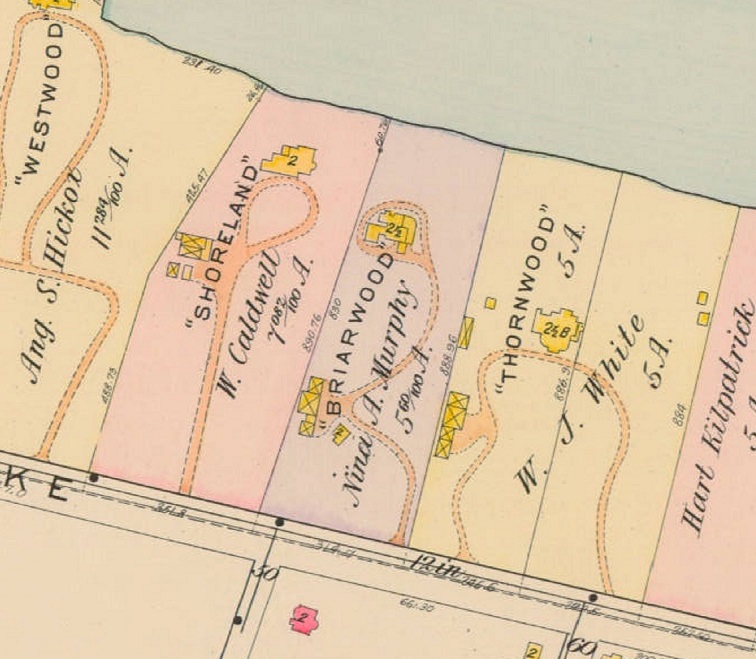
In 1889, White purchased a large estate on Lake Avenue, which he called Thornwood. On that estate, he built a fifty-two room mansion, which he generously bedecked with oriental carpets, antique furniture, fine paintings, and luxurious tapestries. He also purchased a 500 acre farm located about eight miles from Cleveland Public Square, called “Two Minute Stock Farm,” where he raised and bred 125 thoroughbred horses, several of which were world record holders at the time. For recreation, he indulged in yachting on Lake Erie. Of particular note, he purchased the steam yacht “Say When” in 1890, which he sailed from Chicago to Cleveland in forty-five hours and thirty-five minutes during the Columbian Exposition in 1893. He also sailed his yacht to England, where he purportedly presented his wife and his gum to King Edward VII.
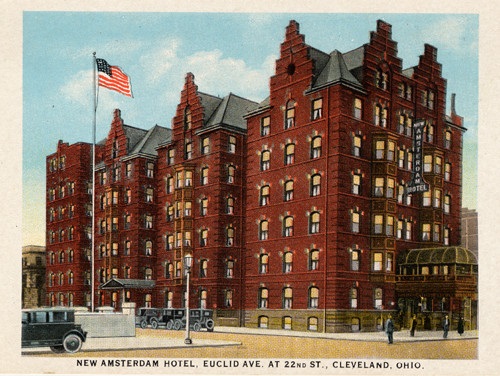
White also used his new found wealth to purchase substantial business and maritime interests. He was a substantial stockholder in the Cleveland and Buffalo Transit Company, the Owen Transportation Company, the First National Bank, the Columbia Savings and Loan Company, and the West Cleveland Banking Company (of which he was also president). He also owned real estate throughout the United States, including business blocks and apartment houses in Chicago, Cleveland, Lorain and other cities, as well as a large farm in Canada. His maritime interests included several steamers, including the Britannic and Ballentine. In 1901, he built the New Amsterdam Hotel, a seven-story brick and stone residential hotel, which stood on the southwest corner of Euclid Avenue and East 22nd Street until being razed in 1969.
Electoral Politics
For additional diversion, White engaged in electoral politics. In 1889, after moving to Lake Avenue, he was elected mayor of the Village of West Cleveland – scurrilous rumor claiming he secured his electoral victory, in part, by distributing free chewing gum to the electorate. White served one two-year term as mayor. As background, for those unfamiliar with the story of the Village of West Cleveland, the Village was created in 1871 and consisted of 1,500 acres of land. It was bounded on the north by Lake Erie, on the east by the Cleveland corporation line near Gordon Avenue (West 65th Street), on the west by Highland Avenue (West 117th Street), and on the south by Lorain Street. Prior to 1871, the area was part of Brooklyn Township. In 1893, the electorate of the Village of West Cleveland voted to annex to the City of Cleveland and, the following year, the Village and the City agreed upon the terms of the annexation.
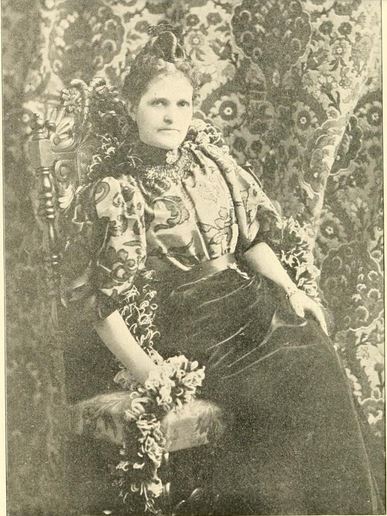
After his term as mayor, he decided to run for the U.S. House of Representatives. He was elected as a Republican to the Fifty-third Congress (March 4, 1893-March 3, 1895) but declined to be a candidate for re-nomination in 1894. During his term in Congress, he introduced and piloted to successful passage the law known as the “White Bill,” an Act which regulated navigation on the Great Lakes and their connecting and contributary waters. Ever the salesman, it is reported that White gave a box of his Yucatan chewing gum to every U.S. congressman while he served in Congress. The picture of Mrs. White with this article is from The Washington Sketch Book: A Society Souvenir (1895), which had the following to say of Mrs. White:
“Mrs. William J. White, wife of the Representative of the Twelfth District, is one of the interesting women that Ohio lent to adorn the official society of Washington for the Winter. Mrs. White is a lady of quiet dignity of manner, rare tact, intelligence and charming personality. She possesses a kind, generous nature and a warm affectionate heart, which attract even casual acquaintances to her and make her many warm friends. Mrs. White was born in Cleveland, Ohio, and is the daughter of Orange and Marletto Howard, of Mansfield. Mr. and Mrs. White are very hospitable and entertained in Washington, as at their beautiful Cleveland home, in a magnificent style and manner. One of the most elegant afternoon receptions of the season of 1895 was that given by them at the Shoreham. They have one lovely daughter, Miss Georgia, who is being carefully educated.”
Conclusion

Perhaps it is not surprising that a gentleman as frenetic as White appears to have been would find settled domestic life less than satisfying. Newspaper headlines reported that at one point the married White gave Anna Held, an internationally renown stage performer and singer, most often associated with impresario Florenze Ziegfeld, a $120,000 neckless.
They also record that White divorced his first wife, Ellen, in 1906 and married the very next day the wealthy divorcee Helen Sheldon. He and Helen moved to New York.
Probably in 1916, White became penniless after business difficulties and was removed as president of American Chicle Co. By 1920, White had founded Wm. J. White Chicle Co. in Niagara Falls, where he reportedly made and lost another fortune. He returned to Cleveland in 1922, penniless; however, always resourceful, he built a new factory determined to achieve success yet again. But, alas, before success came, in January 1923, White slipped on a sidewalk and died a few weeks later. He is buried in Lake View Cemetery.