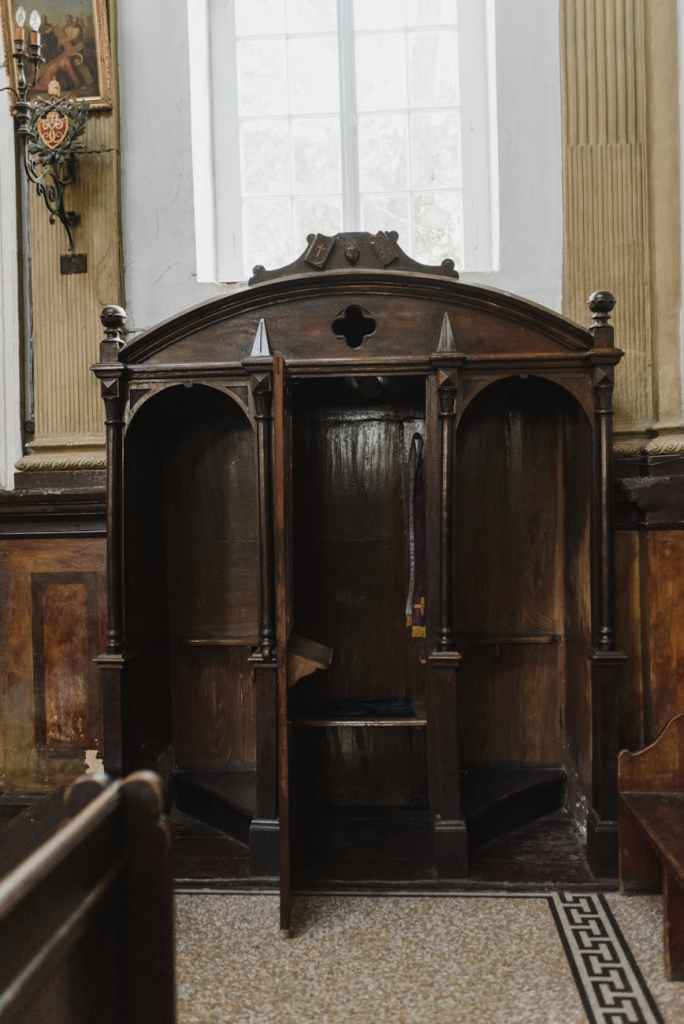
Confessio: The Half-Remembered

A Liturgy for Those Who Have Forgotten the Words


Confessional
Photo by Arina Krasnikova on Pexels.com

Forgive us, Father, for we have sinned,
It has been… we cannot count the years—
since we knew what sin meant.

We mouth the words the nuns and priests once taught us,
but the syllables taste foreign now,
like prayers in a dead language
we pretend to understand.

We have forgotten why we kneel,
though still our knees recall the stone.
We have lost the thread of what was broken,
but feel the weight of something severed.

We built cathedrals out of doubt
and filled them with our questions.
We replaced altars with algorithms,
confession with comment sections.

We are no longer sure You are listening—
or if listening is something we invented
to make the silence bearable,
the vastness less vacant.

We have sinned—we think—
though we are not sure against what.
Against nature? Against each other?
Against some half-remembered covenant,
written in a script we can no longer read?

We recite the forms like actors
who have forgotten their motivation,
performing the ancient motions
because they feel like muscle memory—
like DNA calling us home
to a house we are no longer certain exists.

Still we gather, still we whisper
these inherited incantations,
hoping they might still hold power,
hoping the words might remember
what we have forgotten.

O my God… we are… we think we are…
sorry… for having… for having what?
For having forgotten how to finish this prayer?

The Poet’s Apparatus: On Method, Reflection, and the Gift of Context

“The poem is the cry of its occasion, / Part of the res itself and not about it.” — Wallace Stevens, “An Ordinary Evening in New Haven”


Lacrimae Sanguinis 2025: A Lamentation in Four Movements

By Donald S. Yarab

I.

Lacrimae sanguinis,
Animae nigrae hominum terram maculant.
They walk not as men, but as shadows unshriven,
Each step a silence, each breath a wound.
The ground groans beneath the weight of the fallen,
And justice, long buried, forgets her name.
No trumpet sounds for the guiltless slain,
Only the whisper of blood in the dust.¹

Lacrimae sanguinis—
The blackened souls of men stain the earth.


II.

Hate kindles fires no rain can quell,
Greed carves its name in the marrow of kings.
Fear is a vulture, circling unborn hopes,
Its wings beating lies into trembling hearts.
These three—unholy trinity—march undenied,²
And temples crack beneath their tread.
Where once stood gardens, now only ash—
And the breath of God withdraws in sorrow.³

Lacrimae sanguinis—
The blackened souls of men stain the earth.


III.

No voice comes forth from the cloud or flame,
The heavens are sealed in unyielding hush.⁴
The stars avert their gaze, and time forgets its course—
Even the winds have ceased to speak His name.
Altars stand cold, their offerings stale,
And the priest no longer lifts his hands.
The silence is not peace, but exile—
A stillness too vast for prayer to fill.⁵

Lacrimae sanguinis—
The blackened souls of men stain the earth.


IV.

He turned His face—and we, our backs.⁶
Not in wrath, but in weary disdain.
The mirror cracked, the image lost,
And we wander, eyes open yet unseeing.⁷
We build our Babels in crumbling dust,
Raise thrones upon bones, call ruin law.
Light knocks, but we bolt the gate from within—
And call the silence proof He never was.⁸

Lacrimae sanguinis—
The blackened souls of men stain the earth.


Footnotes:

  1. “Shadows unshriven” / “Justice… forgets her name” — Cf. Psalm 82:6–7 and Isaiah 59:14–15. Echoes of prophetic lament over moral collapse and unreconciled souls.
  2. “Unholy trinity” — An inverted image of Augustine’s De Trinitate: hate, greed, and fear form a perverse sacred order.
  3. “Gardens turned to ash” — Evokes Eden undone. The breath of God (Genesis 2:7) has withdrawn.
  4. “The heavens are sealed” — Amos 8:11–12Lamentations 3:8. Divine silence as the most damning judgment.
  5. “Silence… not peace, but exile” — Apophatic void, not luminous unknowability. Cf. Isaiah 45:15Deus absconditus.
  6. “He turned His face” — Inverts the Aaronic blessing (Numbers 6:24–26). A divine turning not in anger, but in sorrowful withdrawal.
  7. “Mirror cracked” — A fall from incomplete vision (1 Corinthians 13:12) into permanent distortion.
  8. “Call the silence proof He never was” — Resonates with Nietzsche’s “God is dead,” here framed as mutual estrangement, not denial.

Note: The image of the soul as stained through inordinate attachment finds classical expression in Summa Theologica I–II, Q.86, Art.1, where Aquinas defines sin’s stain not as a substance, but as a privation of the soul’s brightness—a metaphorical shadow cast when the soul cleaves inordinately to created things, against reason and divine order. In this lamentation, the stain is projected outward: what is blackened within stains the world without.ain is projected outward—what is blackened within stains the world without.


It is easy to imagine the critical response already. Some heir to Harold Bloom’s anxiety-of-influence throne would ascertain that I, the creator, am anxious, insecure, prone to nail-biting—that I found it necessary to express my anxiety in more apparatus than poem, drowning the verse in scholarly scaffolding because I lack confidence in the work’s ability to stand alone.

Such banal criticism would miss the point entirely. If I were anxious about critical reception, if I were truly insecure about the poem’s merits, I would have foregone apparatus altogether in sure foreknowledge of such harsh rebuke. The apparatus exists precisely because I am secure in my intent, my method, and my purpose. I am not writing for elite pedantics and pedagogues who jealously guard their interpretive privileges, but for myself and any who wish to partake of poetry’s riches, whatever their opportunity to swim in the canon’s depths.

The truth is, those who argue against apparatus are those who would have poems essentially confined to an elite club, complete with secret handshakes, symbols, and degrees of membership. Like Skull and Bones or the Masonic lodges, traditional poetry criticism has long functioned as an initiatory society where full membership requires years of study, the right mentors, and familiarity with increasingly obscure reference points. The “let the poem stand on its own” argument sounds democratically pure but functions as cultural gatekeeping, preserving poetry as the domain of those who already possess the cultural capital to decode allusions, recognize forms, and trace influences.

When critics rail against apparatus, they defend a system where interpretive authority belongs to those with the “right” education, the proper literary pedigree. The poem becomes a kind of shibboleth—if you do not immediately recognize the echoes of Job, the inversions of Augustine, the liturgical cadences, well, perhaps serious poetry isn’t for you.

My apparatus dismantles that exclusivity. It offers initial guideposts to anyone willing to engage, no secret handshakes required. This is cultural hospitality, not anxiety—a deliberate act of democratization that makes visible the materials from which the poem emerged.

The Method: Nexus, Interaction, Reflection

A poem does not emerge from nothing. It rises from what might be called a nexus—a convergence of memory, reading, experience, and the particular urgency that calls forth language. In composing Lacrimae Sanguinis, this nexus became especially visible: biblical lament tradition, Thomistic theology, contemporary spiritual desolation, and liturgical rhythms that have shaped both prayer and protest for centuries. But rather than hide this genealogy, I choose to make it visible as part of the poem’s offering.

The nexus is not a conscious construction—it cannot be willed into being. Rather, it emerges when conditions are right, when reading and experience have prepared a space where seemingly unrelated elements suddenly reveal their hidden kinship. The Latin refrain lacrimae sanguinis did not arise from scholarly deliberation but from convergence, where liturgical memory met contemporary anguish.

Within this nexus, meaning arises through interaction—the dynamic tension between elements that resist easy synthesis. The “unholy trinity” of hate, greed, and fear stands in deliberate tension with Augustine’s conception of divine Trinity, not as simple inversion but as recognition of how spiritual language can be perverted by the very forces it seeks to name and resist. The line “He turned His face—and we, our backs” emerges from interplay between the Aaronic blessing and the lived experience of mutual estrangement.

The apparatus participates in this interaction by creating dialogue between poem and source. When I note that “silence is not peace, but exile” resonates with Isaiah’s Deus absconditus, I do not suggest the poem merely illustrates the biblical text. Rather, I propose that ancient prophetic cry and modern spiritual dislocation illuminate one another—that meaning arises in their interaction, not in either alone.

The apparatus reveals process without explaining away mystery. When I show that “He turned His face—and we, our backs” emerges from tension between Aaronic blessing and contemporary estrangement, I do not solve the line’s meaning—I multiply its resonances. The reader now encounters not just the line’s immediate emotional impact but also its dialogue with liturgical tradition, its inversion of expectation, its theological implications. The apparatus does not reduce mystery to mechanism; it shows how many mysteries converge in a single moment of language.

This transparency serves poetry’s deepest purpose: not to mystify through obscurity but to reveal the actual complexity of experience. When sources remain hidden, readers may sense depths they cannot fathom and mistake inaccessibility for profundity. When sources become visible, the true marvel emerges—not that the poet knows obscure references, but that these disparate materials can achieve such unity, that ancient texts still speak to contemporary anguish.

Finally, reflection—not as conclusion but as ongoing process. The apparatus serves this reflective function, helping both creator and reader recall not just sources but the quality of attention that makes encounter possible. By showing rather than hiding the poem’s genealogy, it acknowledges that interpretation is always collaborative, that meaning emerges from ongoing conversation between text and reader.

Confidence, Not Anxiety

This method emerges from confidence rather than defensiveness. When apparatus functions generously, it says to readers: here are some materials that were present when this poem emerged, but you are free to make of them—and of the poem itself—what you will. This represents confidence in both the work’s integrity and the reader’s capacity for independent meaning-making.

Critics will object that apparatus risks over-determining meaning, that by naming sources I constrain interpretation. This objection misunderstands how meaning actually works in poetry. The apparatus does not tell readers what to think about the convergence of Nietzschean pronouncement and prophetic lament—it simply makes that convergence visible as one layer among many.

Consider the reader who recognizes the Aaronic blessing inversion without consulting footnotes, discovers resonances I never anticipated or intended, and finds connections to their own liturgical memory. The apparatus does not prevent this encounter—it enriches the conversation by adding another voice. Meaning multiplies rather than contracts when more materials become available for interaction.

The real constraint on interpretation comes from ignorance, not knowledge. When readers miss allusions entirely, they are trapped in partial understanding. When sources become visible, readers gain freedom to accept, reject, or build upon the connections offered. The apparatus functions as invitation, not limitation.

We live in an age where what was once common cultural knowledge—biblical narratives, classical philosophy, liturgical traditions—can no longer be assumed as shared reference points. This is not a failure of readers or education but a consequence of cultural acceleration. Neither poets nor readers can be expected to carry the full weight of cultural memory. When canonical works become unfamiliar, when classical allusions require explanation, apparatus serves not as condescension but as courtesy.

The apparatus preserves a record of one moment’s convergence—the nexus as it appeared when the poem emerged—but it cannot and should not constrain future encounters. It functions as invitation rather than explanation, creating conditions for ongoing dialogue rather than settling interpretive questions once and for all.

Method as Cultural Hospitality

What emerges is method as interpretive generosity rather than critical control. The apparatus offers tools for encounter while acknowledging that even the creator does not exhaust the poem’s meaning. The poem, once written, becomes available for encounter rather than possession, even by the one who wrote it.

This hospitality extends to readers at all levels of familiarity with the sources. Those who recognize the allusions immediately may find additional layers in seeing them made explicit. Those encountering Augustine or Isaiah for the first time receive invitations to explore further. Those who prefer immediate encounter may ignore the scholarly apparatus entirely. All approaches are welcome.

In this way, creative method and interpretive philosophy align. Both resist the fantasy of complete control or final understanding. Both acknowledge that meaning emerges in relationship. Both find fulfillment not in closure but in the ongoing conversation they make possible.

The apparatus, properly understood, serves this conversation. It is not the last word on the poem’s meaning but an invitation to the kind of careful attention that allows meaning to emerge. Like the poem itself, it creates conditions for encounter rather than commanding specific responses.

This is method in poetry as in interpretation: not a tool of conquest but a lens through which the materials of experience might reveal some of their hidden connections. The nexus forms, interactions unfold, reflection deepens—and occasionally, if conditions are right, something emerges that was not there before. Something worth sharing with anyone willing to receive it.

Method and Meaning in an Unteachable World

Prefatory Note

The following are two companion reflections—On Truth and Empirical Fact and No Arc, No Lessons—presented together under the shared heading Method and Meaning in an Unteachable World. Though each may stand alone, they are best read in conversation with one another. Both essays resist the comforting notion that history, literature, or art functions as teacher or guide, and instead consider interpretation as an act of encounter—provisional, situated, and shaped as much by silence as by statement.

The first essay explores the distinction between fact and truth, exploring how memory, intention, and metaphor complicate the act of knowing. The second rejects the idea that history bends toward moral instruction or cumulative wisdom, and instead proposes a posture of reflective attention to the recurring patterns and failures of the human condition.

Versions of both essays with full citations and scholarly apparatus are in preparation for future publication. What follows here is intended for open reading and contemplation.


On Truth and Empirical Fact

“You cannot step into the same river twice.”
—Heraclitus (Fragment 91, DK B91)

In the course of recent reflection, a distinction long known, but not always properly honored, must be drawn again: that between truth and empirical fact. Though often conflated in casual discourse, these are not synonymous—nor should they be.

An empirical fact is a datum: observed, measured, verified. It is the yield of experiment, the result of record, the artifact of sensory perception. That water boils at one hundred degrees Celsius at sea level is a fact. That a coin weighs 3.2 grams and bears a cross upon its reverse is a fact. That a battle was fought in the year 1066 may be supported by a host of facts: chronicles, bones, weaponry, et cetera. Such facts, when properly corroborated, are not unimportant. But they are not truth.

Truth, if it exists at all, is something larger, more elusive, more alive—not constructed by us, but encountered when consciousness prepares itself to receive what appears. It does not come when summoned, but when the conditions for its appearing have been made ready: doubt, humility, attention. It is apprehended in this prepared openness, grasped in the space between what is seen and what is understood.

Philosophers have long attended to this disjunction. Plato distinguished between the world of appearances and the world of eternal Forms, the former unstable, the latter enduring. Augustine found truth not in the fluctuating realm of sensory report, but in the divine Logos. Nietzsche, ever unsettling, dismissed truth as a “mobile army of metaphors”—useful, yes, but neither objective nor stable. Heidegger, resisting the reduction of truth to correctness, instead spoke of aletheia—not truth as correspondence, but as unconcealment, as that which emerges into view. And Gadamer—whose influence upon this approach is not accidental—taught that truth emerges in understanding itself, not as a proposition but as a happening, shaped by dialogue and historical consciousness.

Facts may be marshaled. Truth, by contrast, is survived.

Even intention, often treated as the surest witness to truth, must be interrogated. The poet’s intent, the author’s purpose, the painter’s design—these are not fixed coordinates but shifting recollections. Memory does not preserve; it reconstructs. And with each return to the well of what was once meant, the water tastes slightly different. Heraclitus observed that one cannot step into the same river twice—not only because the river flows, but because the self who steps in is no longer the same. So it is with intention. If asked now what was intended in a particular line or gesture, one may offer a reply—but it is a construction, shaped by who speaks now, not by who once acted. Intention, like truth, is not preserved in stillness—it is shaped in motion. It, too, is not possessed, but pursued.

In the poem At the Crossing, the aim was not to name truth—such a thing cannot be done—but to describe the space it haunts. The poem speaks of words that fracture, colors that deceive, touches that both reveal and withdraw. It ends not in assertion, but in a trembling, a silence where meaning nearly forms but does not solidify. A reader once dismissed it: “Life is too brief,” he said, “to spend in the space where meaning almost forms.” The impulse is understood. But the objection must be declined.

For it is in that space—that trembling margin—that life does happen. To live fully is not to claim truth as possession, but to encounter it as presence. Not to seal it in certainty, but to allow it to move, shadowlike, across the inner walls of the soul.

Empirical facts anchor us to the world. But truth is not what anchors—it is the thread we follow across the abyss.

And we follow it not with measuring tape, but with metaphor, with memory reshaped each time it stirs, with intention half-forgotten, and with the courage to walk where the light breaks, not where it rests.


No Arc, No Lessons: On Method, Encounter, and the Tragic Repetition of History

“To articulate the past historically does not mean to recognize it ‘the way it really was’… It means to seize hold of a memory as it flashes up at a moment of danger.”
—Walter Benjamin, Theses on the Philosophy of History

Each age brings forth its own imperative—shaped by its wounds, haunted by its questions, driven by its unspoken needs. The present is no exception. Whether in the study of history, the contemplation of art, or the exegesis of sacred or poetic texts, interpretation does not arise in a vacuum. It emerges from a condition: the place, the moment, the unease that calls forth inquiry. And yet, though each generation may believe itself newly burdened or singularly illuminated, the recurring gestures of human life belie that novelty. There are patterns, yes—but these do not confirm progress. They reveal persistence.

The idea that history bends—toward justice, truth, wisdom—is seductive. It offers shape to the shapeless, comfort to the anguished, and direction to the lost. But there is no arc. The metaphor distorts by promising what experience consistently denies. If history teaches, its students are unteachable. The same motives recur, the same errors repeat, the same vanities endure. Progress, when claimed, is often little more than a rearrangement of circumstance. The root remains.

The players do not change. Their names shift, their languages evolve, but their roles remain remarkably constant. Power is sought, justified, and abused. Fear is stoked and traded for security. Hope is minted into symbols, then worn threadbare. Love, loss, betrayal, glory, shame—these are the constants. The stages differ: the scenery updated, the choreography modernized. But the script draws upon ancient instincts. And the audience, again and again, forgets the last performance, believing the story to be new.

Images of Warsaw Ghetto 1943 and Gaza 2925 ruins ... same destruction, different players, same human patterns.

Interpretation, then, cannot rest on the assumption that knowledge leads to virtue or that understanding necessarily yields transformation. It may. But often it does not. History is not a teacher. Art is not a moralist. Scripture does not condescend to pedagogy. If anything is revealed, it is revealed despite the will to ignore, deny, or disfigure it.

This position echoes Walter Benjamin’s image of the Angel of History, whose face is turned toward the wreckage of the past even as a storm drives him blindly into the future—what we call progress. It stands also in contrast to the historicism that treats the past as lesson-book or path to telos. Gadamer reminds us that understanding is not methodical recovery, but an event of fusion between past and present. Yet this fusion must be entered with humility, not control.

Given the absence of reliable progress and the persistence of human patterns, interpretation requires a different posture—one that recognizes repetition, resists despair, and permits meaning to arise without demand. Method, in this context, must be understood not as a tool of conquest, but as a lens—no more authoritative than another, yet capable of bringing certain essences to the surface. Every method is partial, shaped by its assumptions, animated by its framing questions. No method sees the whole. Each reveals what it is attuned to find. Truth, if it appears at all, does so not as result, but as event—as something glimpsed when the interpreter is prepared to receive, not to impose.

Three words mark the contours of a fitting approach: nexus, interaction, and reflection.

Nexus identifies the place of convergence—where past and present, text and reader, artifact and witness intersect. It is not discovered in isolation, but emerges through relation. Interaction marks the dynamic movement within that convergence. Meaning is not fixed; it arises through tension, difference, and engagement. Reflection follows—contemplative, fragmentary, often incomplete. It does not assert finality but honors process. It acknowledges that memory reshapes what it recalls, that intention fades into approximation, and that even the most careful exegesis remains provisional.

This echoes the work of Paul Ricoeur, who reminds us that narrative, memory, and identity are always under construction—never final, always revised in the act of remembering. Warburg’s concept of Nachleben der Antike—the afterlife of antiquity—reveals how cultural symbols and images recur across historical periods not as static forms but as charged fragments, reanimated under new conditions, carrying both continuity and transformation in their repetitions. This persistence of symbolic forms across time exemplifies the broader pattern: not progress, but recurrence with variation.

From art, history, and sacred text, nothing must be demanded. They may instruct, but only when they are permitted to resist instruction. They may illuminate, but not on command. They may wound, they may deceive, or they may pass in silence. The encounter must be enough.

Empirical facts can be gathered. Archives can be organized. But truth, if it comes, does not arrive catalogued. It appears only when conditions are ready—when the reader or viewer stands not with certainty, but with openness. Not as master, but as interlocutor.

Too often, only the facts are preserved. They are worn as tokens of knowledge while the truth behind them—uncomfortable, paradoxical, demanding—is left behind. The lesser lesson becomes the badge of wisdom; the deeper truth is dismembered for convenience.

No arc. No grand instruction. Just the repetition of roles, the echo of stories, the persistence of hunger. Meaning, when it comes, comes not as reward, but as grace.

And yet, even in refusal, in distortion, in failure, there remains something sacred in the effort to attend. To see the pattern, not to worship it. To hear the old lines in new voices. To walk the ruins with open eyes, knowing that the script will be performed again.


Widening the Gate: The Moral Imperative of Scholarly Apparatus in Poetry

The article argues that the inclusion of scholarly apparatus in poetry should not be seen as an act of insecurity but as a moral imperative to enhance accessibility and understanding. Providing notes and allusions demonstrates trust in the reader’s intellect and invites deeper engagement with complex literary traditions, enriching the overall poetic experience.


Dante and Virgil in Hell by William-Adolphe Bouguereau (1850).
 Oil on canvas, 281 × 225 cm. Housed in the Musée d'Orsay, Paris.
Dante and Virgil in Hell by William-Adolphe Bouguereau (1850).
Oil on canvas, 281 × 225 cm. Housed in the Musée d’Orsay, Paris.
Depicting a scene from The Divine Comedy, the painting shows Dante guided by the poet Virgil through the torments of the Inferno. This work reflects the enduring need for guidance through complex moral and literary landscapes—much like the role of scholarly apparatus in contemporary poetry.

In certain corners of literary criticism—particularly those shaped by the Bloomian anxiety of influence—the inclusion of scholarly notes in a poem is often regarded with suspicion. To annotate a poetic work, especially with theological or classical references, is, for some, a mark of insecurity or defensiveness. One does not footnote inspiration, the critic suggests, but cloaks inadequacy. This reading, however, reveals more about the critic’s own posture than the poet’s intent. It mistakes generosity for uncertainty, and accessibility for anxiety. In truth, the use of poetic apparatus is not a gesture of retreat but an act of moral clarity.

We no longer inhabit a culture rooted in shared canonical memory. The contemporary reader cannot be presumed to recognize the traces of Augustine or the subtleties of Pauline inversion, nor even the resonances of Lamentations or Miltonic cadence. These once-communal touchstones have grown faint in our fragmented intellectual landscape.

To scatter phrases drawn from such traditions across the page without interpretive aid would not constitute noble restraint—it would be fundamentally exclusionary. One does not prove a poem’s strength by ensuring its opacity to all but the initiated few.

The poet who situates their work within a sacred, historical, or theological lineage and yet withholds the keys to that lineage commits a kind of aesthetic pride. This is the true arrogance: to assume that those who do not immediately perceive are unworthy to understand. In contrast, the provision of notes, allusions, and apparatus is a statement of trust in the reader’s intellectual capacity. It affirms that the reader, though perhaps unfamiliar with particular traditions, is capable of knowing, and thus worthy of invitation into deeper engagement.

Poetic apparatus, when thoughtfully deployed, functions as both guide and companion. It allows the reader to move through layered landscapes without stumbling in darkness. Notes illuminate without overwhelming; they offer pathways, not prescriptions. Just as Dante needed Vergil to navigate the underworld in The Divine Comedy, the modern reader may need scaffolding to ascend the difficult terrain of a theologically-inflected poem. That scaffolding supports not the poem’s inadequacy, but the reader’s journey—and facilitating such journeys is a moral imperative in cultural stewardship.

This approach is not a concession to mediocrity, but a rejection of unnecessary elitism. It demonstrates a commitment to write in full fidelity to tradition without surrendering one’s audience to the assumptions of a forgotten world. When T.S. Eliot appended notes to The Waste Land, he was not performing obscurantist affectation, but rather acknowledging the changing literacy of his readership. His doing so sparked considerable controversy, suspicion, and derision. However, the changing literacy of readership since his day has only deepened and accelerated. Thus, the poet who provides apparatus performs not an act of scholarly vanity but of intellectual hospitality.

Indeed, there is a didactic purpose inherent in such practices: poetry can instruct, not through reductive simplicity, but through guided complexity. The notes, like glosses or scholia in ancient texts, become part of the total work—a parallel conversation between poet and reader. They remind us that poetry is a learned art—not reducible to mere sentiment, nor severed from thought. To annotate is to take seriously both the lineage of one’s words and the intellectual capacity of one’s reader.

In our digital age, we have expanded possibilities for such apparatus—hyperlinks, separate commentary documents, and layered presentations that neither overwhelm the poem’s aesthetic integrity nor abandon readers to unnecessary confusion. These technologies allow for graduated engagement: the poem stands complete for those prepared to receive it directly, while additional resources await those seeking deeper understanding.

Crucially, providing scholarly apparatus never constrains the reader’s interpretive freedom. Each reader brings their own experience and knowledge to a text, often discovering meanings the author never intended or foresaw. The best annotations create access without dictating understanding—they open doors without determining which path the reader must take once inside. This dynamic relationship between authorial context and reader interpretation is not a liability but one of literature’s most profound gifts.

The poet may still be misunderstood. There will be those who persist in reading apparatus as apology, footnotes as armor against criticism. But the deeper truth is that to offer one’s learning as aid is not to retreat from art, but to expand its possibility. It is an act of humility, yes—but also of instruction, of preservation, and above all, of invitation.

Poetic footnotes, then, are not defensive gestures. They are moral acts. They widen the gate; they refuse the cloister. In an age of forgetting, they are essential—if tradition is to live not as relic, but as inheritance: vital, vivid, and available to all who would receive it.