
The Peril and Promise of Models: Utopia, Economy, and Theology


Pieter Bruegel the Elder, The Tower of Babel (c. 1563)
Pieter Bruegel the Elder, The Tower of Babel (c. 1563, oil on panel)
Kunsthistorisches Museum, Vienna

Utopias, like theoretical economic models and theological constructs, are among the most daring expressions of human thought. Each arises from an impulse toward order and improvement, born of the conviction that the present is insufficient and the future can be shaped. Yet despite their elevated origins, these frameworks call to be eschewed—not for the good they propose, but for the horrors they have enabled when unmoored from humility and constraint.

The history of ideas is littered with systems that began in hope and ended in terror. Plato’s Republic, with its philosopher-kings and rigid class hierarchy, inspired centuries of authoritarian dreams. Soviet central planning promised rational allocation but delivered famine and repression. The Puritan theocracy in Massachusetts Bay sought godly perfection but produced witch trials and exile for dissenters. Each began as a vision of human flourishing—the utopian city, the rationalized economy, the purified creed—yet furnished the blueprints for regimes of control.

Nor is such danger confined to leftist excesses or theological zealotry. In Chile, the 1973 overthrow of Salvador Allende led not only to political violence, but also to the forceful imposition of a radical free-market model under General Pinochet, guided by economists trained in the Chicago School. The result was economic restructuring praised by some for its efficiency, yet experienced by many as immiseration and repression. Here, too, theory eclipsed humanity. Market mechanisms became commandments; dissenters were not debated but disappeared. What was billed as liberation through market freedom became another apparatus of dominance—less visible, perhaps, but no less brutal. The lesson is not partisan, but perennial: when theory is elevated above persons, systems serve themselves.

Elevated to ideology, models cease to be guides and become chains. They offer certainty in place of inquiry, coherence in place of complexity, and purpose in place of personhood. What begins as vision hardens into decree; what is meant as a lens becomes law. Mao’s Great Leap Forward exemplified this transformation: an economic model promising industrial prosperity became an unyielding doctrine that cost millions of lives when reality refused to conform to theory.

When the model becomes sacred, deviation becomes heresy. And where heresy is named, there follow inevitably the commissars, the inquisitors, the doctrinaires—those who patrol the borders of the permissible. Stalin’s show trials eliminated those who questioned economic orthodoxy. Both Catholic Inquisitions and Protestant persecutions took inhuman measures against those who strayed from their respective versions of theological purity. McCarthyism destroyed careers in service of ideological conformity. All operated in service of the model, the path, the “truth”—though truth, in such hands, is no longer a horizon toward which one travels, but a cudgel with which to enforce obedience. And perhaps there is no final truth to be had, only a multiplicity of partial illuminations, glimpsed through the mist, refracted through fallible minds.

And yet, it would be a grave error to reject these models wholesale. A utopia, though unattainable, directs the gaze beyond the immediate—Martin Luther King Jr.’s “Dream” inspired civil rights progress precisely because it painted a picture of what America could become. A well-crafted economic model brings coherence to chaotic phenomena: Keynesian theory, whatever its limitations, helped navigate the Great Depression by providing a framework for understanding how governments might respond to economic collapse. A theological vision offers moral orientation and poetic resonance—liberation theology in Latin America, despite its political complications, channeled Christian teaching toward concrete concern for the poor and oppressed.

When held lightly—non-dogmatically, open to revision, aware of their limits—such models are not prisons but tools. They help us navigate complexity, but they must never be mistaken for the complexity itself. The Chicago School economists who influenced policy in the 1980s offered valuable insights about market mechanisms, but when their models became gospel rather than guides, the result was often ideology that ignored market failures and social costs.

The question, then, is one of balance. Can aspiration be disentangled from absolutism? Can man dream without dictating, model without mastering, believe without binding? This is no easy task, for humanity is rarely a creature of balance. We veer, we commit, we grasp too tightly. The same revolutionary fervor that toppled the Bastille eventually devoured its own children in the Terror. But the remedy is not the renunciation of vision; it is the cultivation of humility within vision. It is the refusal to equate map with territory, model with meaning, doctrine with destiny.

If balance is the ideal, then it must rest not on detachment but on a deeper fidelity—one that refuses both rigidity and relativism. This is not a call to valueless existence, but to the most valued existence—one that honors core commitments through responsive attention rather than rigid prescription. The danger lies not in caring deeply about human flourishing, justice, or freedom, but in believing we possess the universal formula for achieving these goods. True fidelity to our highest values often requires abandoning our preconceptions about how they must be realized. It demands constant attentiveness to circumstances, genuine openness to what the moment requires, and the intellectual courage to adjust course when reality refuses to conform to our expectations. The principled life is not one that follows predetermined blueprints, but one that remains alert to the irreducible complexity of human need and the ever-changing demands of genuine care.

To live without models is to drift. To live by them uncritically is to be enslaved. Wisdom lies in the middle path: to aspire without illusion, to theorize without tyranny, and to seek the better without forgetting the cost of the best. In this fragile equilibrium lies the noblest promise of human reason—not to control the world, but to understand it more justly, and to live within it more wisely. And in that wisdom, to leave room for the truth that ever escapes us.

The Art of Praise: Tariff Impact on Economics and Ethics

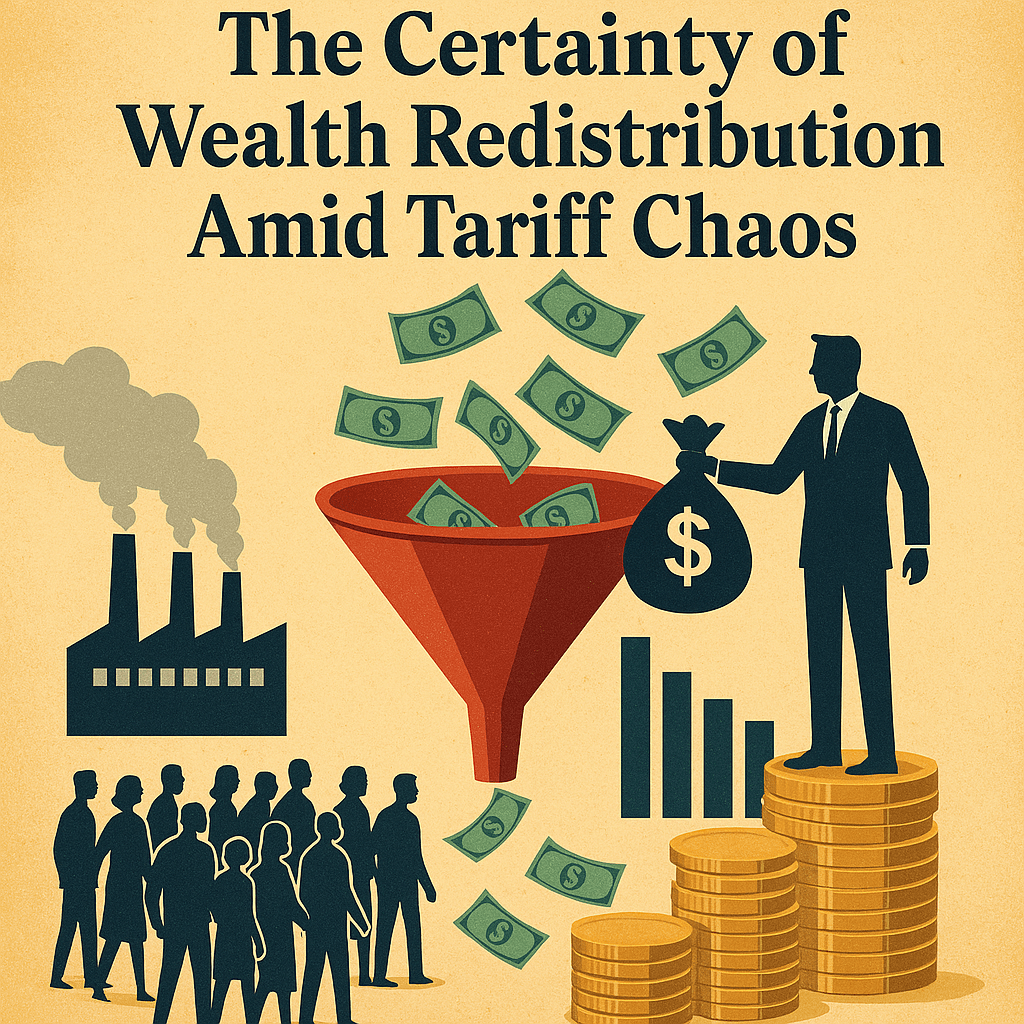
Recently, I published an essay titled The Certainty of Wealth Redistribution Amid Tariff Chaos, in which I argued that the true function of the current administration’s tariff policies was not economic revival, but the deliberate and predictable transfer of wealth from working households to the uppermost tier of financial elites.

Events of the past several days—culminating in imposition of a market-crashing tariff decree swiftly reversed for maximum opportunistic gain—have confirmed my worst fears. That some now praise this spectacle as “brilliant” only adds insult to economic injury.

In response, I offer the following satirical memo from a fictional Wharton Annex ethics professor—one Professor Basil P. Whisker, Chair of Ethical Opportunism at the Weasel School of Business. His observations regarding the situation and the logic he embodies—even though he is fictional—are uncomfortably real.


Professor Basil P. Whisker

On Ethics, Market Manipulation, and the Power of Praise

Buy the Dip, Praise the Dipper: A Wealth Transfer Playbook

By Professor Basil P. Whisker, PhD, MBA, CFA (Parole Honoré Distinction)
Chair of Ethical Opportunism, Weasel School of Business, Wharton Annex
Formerly of the Federal Correctional Institute for White Collar Refinement
“Our Honor Code is Flexible. Our Returns Are Not.”


Some in Congress have raised the unfashionable concern that the recent tariff saga looks suspiciously like market manipulation.

To which I reply: Of course it is.
But for whom?

Not the little people—they lack both the reflexes and the capital reserves. No, it is for the elite few trained in the disciplines of anticipation, flexibility, and pliable morality.

At the Weasel School of Business, we teach that ethics must be nonlinear and dynamic—responsive to the moment, like high-frequency trading algorithms or a presidential memory when questioned under oath. The recent 90-day tariff “pause” (following a dramatic market collapse) teaches students everywhere that sometimes the most profitable thing to do is to:

  1. Create a crisis
  2. Seize the resulting dip
  3. Declare victory through reversal
  4. Congratulate the disruptor for his “brilliance”
  5. Move on before the subpoenas arrive

The Art of the Non-Deal

When a policy announcement wipes trillions from the markets, only to be reversed days later with a triumphant “THIS IS A GREAT TIME TO BUY!!!” post, we must acknowledge we are witnessing not governance but performance art.

Like all great art, it asks difficult questions:

  • Is it market manipulation if you announce the manipulation in real time?
  • Can one declare “Liberation Day” and then liberate oneself from that declaration?
  • If financial whiplash creates billionaire gratitude, is it still whiplash—or merely strategic spine realignment?

Billionaires praising such tactics is not sycophancy—it is advanced portfolio management by other means.

As we say in Weasel Finance 101:
“Praise is just another form of leverage.”


Looking Ahead: A Curriculum of Chaos

We are entering a new phase of global commerce—what I call the Era of the Glorious Lurch. In this new age, tariffs are not policies but market mood regulators, deployed tactically to evoke loss, recovery, and eventual Stockholm syndrome-like gratitude.

My revised syllabus for the coming semester will include:

  • Advanced Self-Dealing (OPS-526)
  • Narrative Arbitrage: Writing History Before It Happens (OPS-618)
  • Strategic Sycophancy and Influence Leasing (co-listed with Communications)
  • Tariff Whiplash: Creating Wealth Through Vertigo (OPS-750)
  • When Textbooks Fail: The Art of the No-Deal Deal (Senior Seminar)

Applications are open. Scholarships available for those with prior SEC entanglements or experience declaring “everything’s beautiful” while markets burn.


A Word on Timing

Critics who suggest that one should wait until an actual deal is struck before declaring brilliance simply do not understand modern finance.

In today’s economy, praise is a futures contract—you are betting on the perception of success, not success itself.

When a policy costs the average American household thousands in higher prices and market losses, only to be partially reversed with no actual concessions gained, the correct reaction is not analysis but applause. After all, it takes real courage to back down without admitting it.


A Final Toast

To the president, I raise a glass of vintage tax shelter with notes of plausible deniability.

To the billionaires celebrating the “brilliant execution” of a retreat, I offer a velvet-lined echo chamber.

And to my students, past and future, I remind you:
If you cannot time the market, at least time your praise.

Because in today’s economy, there is no such thing as too soon, too blatant, or too obviously beneficial to the 0.01%.

So next time markets plunge on policy chaos, do not ask “who benefits?”
Instead ask, “am I positioned to be among those who do?”

Thank you. And as always—
buy low, tweet high, and declare victory before the facts catch up.

An Ice-Cold Response: Penguins of Heard Island React to Trumpian Tariff Madness

By Gentoo T. Adelie, Chief Diplomatic Penguin of Heard Island

Macaroni Penguin of Heard Island responding in disbelief to the news of the Trumpian Tariffs of 2025.

An Audio Recitation of “An Ice Cold Response” by Gentoo T. Adelie

It was a clear morning on Heard Island. A gentle drift of cloud played among the slopes of Big Ben, and the Southern Ocean moved against the gravel shores with its slow, eternal breath. Among patches of moss and lichen, our colonies bustled with seasonal purpose—territories reestablished, mates greeted, feathers fluffed against the autumn wind. The eastern rockhoppers had returned to their grassland burrows, the macaronis muttered among the coastal tussock, and the gentoos stood sentinel. Then word arrived—borne by a wandering albatross returning from northern skies.

The Trump administration had imposed tariffs upon us.

Tariffs. Upon penguins.

I summoned the colonies. The emperors listened in regal silence, their gold-ringed heads unmoved. The kings shuffled to attention along the icy moraine. The skuas perched nearby, and even the black-faced sheathbill—normally distracted by refuse—cocked a pale head toward the speaker’s mound.

Our indignation was tempered by confusion.

We are not exporters. We are not manufacturers. Ours is not a civilization of spreadsheets, but of rhythm and return. We recognize no currency but krill, no metric but the molt. We nest in the gullies and commune with the icy winds that polish our shores.

It is true that humans have declared sovereignty over us. Flags have been planted, letters exchanged, and acts of parliament signed in Canberra. Heard and McDonald Islands, they assert, are administered by the Australian Antarctic Division, whose bureaucrats maintain that our affairs fall under the jurisdiction of the Supreme Court of the Australian Capital Territory—though no court has ever convened upon our shores.

But let it be understood: though we permit their presence, we do not cede authority.

The king penguin does not bow to Hobart. The Heard Island shag files no petitions. And the sheathbill, should it ever stand before the High Court, will surely eat the brief.

So it was with bewilderment that we received news of the 10% tariff levied by the United States upon our territory. An island with no people, no ports, and no exports—accused of an imbalance in trade. A claim founded on mislabeled shipping data: specifically, six containers of semiconductor components manufactured in Taiwan but erroneously coded as “HRD”—Heard Island’s port code, rarely used but technically valid—instead of “HKG” for Hong Kong by an exhausted logistics clerk working the graveyard shift in Singapore.

Naturally, the memes began to circulate—relayed to us by kelp gulls who’ve developed a taste for human refuse and, consequently, smartphones washed ashore from passing vessels. These gulls, perched near research stations to pilfer Wi-Fi signals (and the occasional protein bar), have become our unwitting ambassadors to digital culture. Among their findings: images of penguins queuing at customs, passports in wing. Shags rebuffed at security checkpoints. A sheathbill with a placard reading “TAXATION WITHOUT MIGRATION.”

The images are amusing. Yet beneath the laughter lies a chill deeper than our glaciers.

The absurdity is not that tariffs have been imposed, but that the structures of power are so far removed from reality as to invent us as participants in their theatre. Our colony is not a market. Our rookery is not a trading floor. If humans mistake our ecological presence for economic threat, then it is their world, not ours, that is disordered.

Even the ecosystem watched with bemusement. The mosses clung silently to volcanic stone. The seals slumped across the glacial flats, unmoved. Life persisted as it always has.

We shall not respond in kind. We shall not embargo the sea. We have no ports to close, no envoys to recall. We shall simply continue—diving into the surf, tending our chicks, enduring the westerlies that lash our coast.

The mosses remember.
The sheathbill remembers.
The ice remembers, too.


Confidential Diplomatic Cable

From: Office of the Subantarctic Avian Council (Provisional), Heard Island and McDonald Islands
Domain: commonwealth.penguin.gov.hm
To: Bureau of Global Trade Anomalies, U.S. Department of Commerce
Date: April 8, 2025
Priority: Routine (given prevailing currents)


RE: ERRONEOUS APPLICATION OF TRADE TARIFFS TO UNRECOGNIZED BIOLOGICAL POLITY

To Whom It May Confound,

We write with a combination of courteous gravity and ice-bound disbelief upon learning that the Territory of Heard Island and McDonald Islands—comprising an uninhabited archipelago, 80% of which is glacier, and 100% of which is devoid of Walmart, Walgreens, or Whole Foods—has been subjected to a 10% tariff by your esteemed administration.

We presume this action arises from the alleged export of “machinery and electrical goods” originating from our domain. As no such items have been observed here since the disintegration of a scientific balloon payload in 1989, and as neither the king penguins nor the black-faced sheathbills have mastered voltage regulation, we suggest an administrative review.

Indeed, it now appears the source of this confusion lies in a series of clerical misassignments within international shipping records. Several bills of lading reportedly list the shipper’s address as “Vienna, Heard Island and McDonald Islands”—a charming bit of geopolitical fiction that, while expanding our sense of empire, sadly bears no relation to geographic or penguin reality.{1}

For clarity:

  • Our economy is non-monetized and chiefly fish-based.
  • Our primary industries include standing, molting, and collective thermoregulation.
  • Our manufacturing sector is limited to guano, occasionally artistic in form but unfit for commercial use.
  • The .hm domain, while charming, is not associated with logistical throughput. It is managed by a sooty albatross with a rusted antenna.
  • No residents, citizens, or consumers exist here in the human sense.

We therefore formally request the rescission of said tariff and the reclassification of Heard Island and McDonald Islands from “Emerging Trade Threat” to “Uninhabited Geopolitical Curiosity.” Alternatively, we are willing to accept foreign aid in the form of high-calorie fish paste, new tagging rings, or a fully functioning weather station.

For future reference, all customs declarations should be addressed to:
Gentoo T. Adelie, Chief Diplomatic Penguin
C/O The Hollow Behind the Third Basalt Outcrop
Atlas Cove, Heard Island
UTM Coordinates Available Upon Request (or clear skies)

We await your reply, though not urgently.

Warmest regards from the coldest coast,
Subantarctic Avian Council (Provisional)

P.S.
Seal No. 1: Be it known we do not seal mail with actual seals. The three elephant seals consulted regarding this matter expressed their disinterest through prolonged snoring, while the fur seals drafted a dissenting opinion consisting entirely of territorial barks. Their contribution to international diplomacy remains, much like this tariff situation, largely symbolic.


{1} The basis of error was uncovered and reported by multiple news sources, such as the following BBC article ‘Nowhere’s safe’: How an island of penguins ended up on Trump tariff list

The Certainty of Wealth Redistribution Amid Tariff Chaos

In the history of American economic policy, few moments have rivaled the current administration’s radical redirection of trade as both a break with precedent and a deliberate provocation of instability. The imposition of universal tariffs, compounded by steep duties on selected nations and penguins, has injected volatility into nearly every sector of the global economy. Yet, for all the uncertainties this policy has unleashed—geopolitical, fiscal, and industrial—one outcome is not only predictable but virtually guaranteed: a significant transfer of wealth from the broad base of American households to a narrow echelon of financial elites.

The administration’s tariff policy, sweeping in scope and nationalist in tone, has been sold to the public as the path to the restoration of American greatness, even proclaimed as a “Liberation Day.” But the reality it heralds is less one of liberation than of reallocation—specifically, a reallocation of economic burden and reward. By taxing nearly all imported goods—consumer staples, electronics, food, clothing, and industrial components—the policy imposes a direct and regressive cost on the average American. Inflationary pressures, rising production costs, and disrupted supply chains ensure that these tariffs function not merely as tools of negotiation, but as economic levers that press down on the middle and lower classes while lifting those whose wealth resides in capital rather than wages.

If the COVID-era recession taught us anything, it is that crises, when coupled with targeted monetary and fiscal policy, can act as engines of wealth concentration. During the pandemic, unprecedented interventions—stimulus checks, expanded unemployment insurance, PPP loans, and Federal Reserve liquidity—managed to momentarily soften the blow for many. Even then, the lion’s share of wealth gains went to the top 0.1%, as asset prices surged and capital-rich investors reaped the benefits of timely speculation and quantitative easing.

But the current recession-in-the-making differs in one essential respect: it is being pursued without pretense of public aid. There are no stimulus packages, no safety nets. What is offered instead is a doctrine of creative destruction: tens of thousands of federal workers laid off; regulatory agencies gutted; international partners alienated; domestic producers left to absorb new costs or pass them on to already-strained consumers. The economic pain is not an unintended consequence—it is the plan. And in such an environment, wealth will not merely trickle upward; it will flood there.

As import costs surge, businesses with transnational supply chains and logistical flexibility will shift production, seek carve-outs, and hedge against volatility. Those without such capacities—local manufacturers, family-owned farms, small retailers—will face thinning margins, layoffs, and in many cases, closure. The financial elite, holding diversified portfolios in real estate, private equity, and multinationals, will swoop into the resulting vacuum, acquiring distressed assets at discount, consolidating market share, and harvesting profits from inflationary dynamics. As was seen in the years following 2020, equity markets may fall precipitously at first, but they are likely to rebound faster than the broader economy—particularly with the Federal Reserve expected to cut interest rates in the wake of contraction. Once again, asset prices will rise. Once again, the owners of capital will see their fortunes grow.

Tariffs are traditionally viewed as blunt instruments of industrial protection. But in this case, they serve a far more surgical purpose. They extract purchasing power from the working class, undermine the viability of small and medium enterprises, and force a restructuring of the American economy around those who can absorb cost, influence policy, and pivot globally. They are not instruments of policy so much as instruments of wealth concentration.

If anything is certain in the unfolding tariff-driven crisis, it is that inequality will increase. Not in abstract or relative terms, but in concrete redistributive ones: trillions of dollars will move from wage earners and consumers to capital holders and financial intermediaries. The historical data, the institutional forecasts, and the structural logic all align. Amid the din of political slogans, retaliatory tariffs, and market disruptions, this is the one truth that should command attention.

History will not record this period as a victory for the American people. It will record it as a transformation: not of manufacturing, not of trade, but of the very architecture of American wealth—concentrated more tightly, held more distantly, and insulated more completely from the needs and voices of the many.

The Real Armageddon: Musk’s DOGE and the Dismantling of Public Trust

Photo by Chris F on Pexels.com

“If you read the news, it feels like Armageddon. I can’t walk past a TV without seeing a Tesla on fire,” Elon Musk said recently at a Tesla all-hands meeting. “I understand if you don’t want to buy our product, but you don’t have to burn it down. That’s a bit unreasonable.”1

The quote is evocative—perhaps designed to stir sympathy. Yet it invites a measure of irony. While vandalism against Tesla properties is, of course, deplorable, it is neither as widespread nor as catastrophic as Musk, and biased media reporting, would have the public believe. Fewer than a dozen reported incidents—at Tesla dealerships or Supercharger stations—have resulted in fires, graffiti, or property damage. In nearly all of these cases, suspects have been arrested and charged.2

In a country of over 330 million people, where more than 200,000 vehicle fires and 500,000 structure fires occur annually,3 and where Florida and Texas alone report nearly 3,000 murders each year,4 these incidents—while serious—are statistically insignificant. What Musk decries as “Armageddon” is, in national context, a series of isolated acts that have been swiftly addressed by law enforcement.

Meanwhile, under Musk’s leadership of the Trump administration’s Department of Government Efficiency (DOGE), far greater destruction is being wrought—not upon property and government subsidized business interests, but upon the institutions designed to serve the American people.

According to Reuters, the Department of Veterans Affairs (VA) is expected to lose over 80,000 employees under DOGE’s efficiency plan.5 Already, this downsizing is disrupting vital services: clinics are understaffed, appointments are delayed, and mental health services—already under strain—are faltering.6

This is not bureaucratic “streamlining.” The VA currently serves over 18 million veterans,7 many of whom depend on timely and specialized care for physical and mental trauma, service-connected disabilities, and long-term support. Disabling this infrastructure in the name of “efficiency” is not neutral policy—it is institutional abandonment.

The Social Security Administration (SSA) has not fared better. Facing mandates to reduce its workforce by up to 50%, the SSA is bracing for a collapse in the timely delivery of services to more than 70 million Americans, including over 50 million seniors.8 Already, SSA field offices in major cities have shortened hours, laid off staff, and seen processing times for benefits skyrocket.

Federal workers have responded with urgency. In San Francisco and other metropolitan areas, SSA and VA employees have staged public protests, warning of the catastrophic impact these cuts will have on their most vulnerable clients.9 Their message is clear: public service cannot survive on ideology alone.

Thus, while Musk’s Teslas may burn in isolated incidents, the real fire is the one now consuming the administrative state (the means by which public servants deliver public services to the citizens they serve pursuant to laws passed by Congress). The irony is sharp. Musk’s complaint—“You don’t have to burn it down”—could just as easily be addressed to himself. If you do not like the structure or scale of government, you do not have to dismantle its capacity to serve. That, too, is a bit unreasonable.

What Musk labels as terrorism when directed at his private enterprise is tolerated—even celebrated—when inflicted upon public institutions. Yet the human cost of the latter is infinitely greater. The quiet collapse of service infrastructure—untelevised and untheatrical—is the more insidious disaster.

In the end, the real “Armageddon” may not be a vandalized Tesla on a TV screen. It may be the veteran denied timely access to urgent medical care. The senior citizen waiting months for a critical in-person meeting at a Social Security office. The single parent lost in a phone queue with no one left to answer.

These are not symbolic gestures. These are lives.


Notes

  1. Pras Subramanian, “Tesla’s Elon Musk Holds Surprise All-Hands Meeting to Assuage Employees and Investors,” MSN Money, March 21, 2025.
  2. New York Post, “Pam Bondi Announces Charges Against 3 in Tesla Attacks,” March 20, 2025.
  3. National Fire Protection Association, “Vehicle Fires,” 2024.
  4. Federal Bureau of Investigation, Crime in the United States, 2021.
  5. Reuters, “US Plans to Fire 80,000 Veterans Affairs Workers,” March 5, 2025.
  6. Reuters, “VA Shake-up Disrupts Mental Health Services,” March 20, 2025.
  7. Pew Research Center, “The Changing Face of America’s Veteran Population,” November 8, 2023; Reuters, “VA Shake-up Disrupts Mental Health Services,” March 20, 2025.
  8. Sara Dorn, “Here’s Where Trump’s Government Layoffs Are,” Forbes, February 21, 2025.
  9. San Francisco Chronicle, “Federal Workers Protest Musk-Led Government Cuts,” March 14, 2025.