There was a road, a path, a way. No one remembered who made it. Some say it was always there.
It was simply there, worn into the earth by feet older than memory, the grass pressed flat, the stones turned smooth by passing. It went somewhere. Everyone who walked it knew this, not because they had been told, but because the walking itself told them. Something in the body recognized the direction even when the eyes could not see ahead.
For a long time there were no signs.
Then a man came back.
He had walked the road to its end and returned, and he was changed in ways he could not fully speak. Out of love — only out of love, there was nothing else in him at that moment — he cut a post and set it in the ground at the place where the road began, where it was easy to miss, where the grass had not been pressed down enough to make the path visible to an eye that did not already know to look. He carved an arrow. He pointed it true.
Then he walked back into his life and eventually he died.
Others came. Some saw the sign and walked. Some stood before the sign and felt something move in them and followed it down the road and did not look back. These ones also changed, in the same way the man had changed, in ways they could not fully speak.
But some stood before the sign and found the sign itself remarkable.
They studied it. They measured the angle of the arrow. They debated whether the post was the right wood, whether the carving had been done with sufficient care, whether the man had fully understood what the sign was pointing at when he erected it. They wrote careful accounts of the sign. They taught their children the accounts. They built a shelter over the sign to protect it from weather, and the shelter became a building, and the building became an institution, and the institution appointed keepers, and the keepers kept.
Pilgrims arrived from great distances and were brought before the sign and shown its meaning and examined on their understanding and sent away satisfied. The keepers were kind. They were not corrupt men. They loved the sign with a love that was real, as real as they knew how to make it, and they believed that tending it was the same as honoring what it pointed at.
Far away, in a country where the sign had never been erected, where no one had heard of the man or the arrow he erected or the institution that grew around it, a woman woke before dawn with an ache she could not name. She had felt it for years. She had tried to fill it with the things available to her and none of them had filled it. One morning she simply rose and walked in the direction the ache pulled her and did not stop.
The terrain was hard. There were no markers. There were stretches of darkness where she moved by feel alone, where the only evidence that she was still on a path was that her feet kept finding ground.
She walked for a long time.
She arrived.
She could not have said where she was. She had no words for it that would have satisfied the keepers of the sign, had she ever met them, had they ever thought to ask. But she was there. The thing the ache had always been reaching toward received her, and she was changed, in the way the man had been changed, in ways she could not fully speak.
The keepers still tend the sign.
They are not wicked men. On certain evenings, when the light falls at a particular angle and no one is asking them questions, one of them will sometimes look at the arrow, and follow its direction with his eyes, and feel something he cannot name pull briefly at him, like a current beneath still water.
He looks away. There are duties. He must maintain the sign.
In the photographs taken within the Oval Office (2017, 2025), the seat of American executive authority has been transformed into something older and stranger—a sanctuary of royal consecration. At its center sits Donald J. Trump, head bowed, encircled by ministers and advisers whose hands rest upon him in the gesture of impositio manuum, the laying on of hands. Their eyes are closed, lips moving in prayer, yet their posture speaks less of intercession than of veneration. What unfolds in that moment is not simply political theater but a ritual reenactment of an ancient idea: that power may be embodied, sanctified, and made flesh.
Impositio Manuum 2017
The Reversal of Benediction
In Christian and pre-Christian rites alike, the laying on of hands conveys the transmission of grace or authority. The priest’s touch confers the Spirit upon the baptized; the bishop’s hand consecrates the king. Here, however, the direction of sanctification is reversed. The clergy do not mediate divine blessing to the ruler on behalf of the people; they draw legitimacy from him. The bowed heads and concentric hands create a living reliquary around the sovereign’s body. The Oval Office, ordinarily a stage for civil governance, has been re-imagined as an apse, its curved wall a secular altar niche. What was intended as prayer has become an act of anointment—without chrism, yet heavy with its symbolism. In 2025, the Christian supplicants’ language included a declaration of divine appointment: “You assigned him, you appointed him, you anointed him for such a time as this…”
Impositio Manuum 2025
The Living Law
Ernst H. Kantorowicz, in The King’s Two Bodies, described how medieval jurisprudence conceived the ruler as lex animata—the “living law.” The sovereign’s person contained within it both the mortal, fallible flesh (corpus naturale) and the immortal, juridical body politic (corpus mysticum). Law was not merely administered by the king; it was enfleshed in him. The maxim omnia iura in scrinio pectoris imperatoris—“all laws reside in the emperor’s breast”—expressed the same belief: that the sovereign’s will constituted legality itself.
Trump’s self-understanding, as revealed in his statements that “I (have) the right to do anything that I want to do. I’m the president of the United States,” and that he could even “declassify by thinking” alone, reflects this archaic conception of sovereignty. In the photographs, that philosophy becomes visible form. His body, ringed by supplicants, stands as the physical repository of authority: thought and flesh fused into the living source of law. The constitutional process is eclipsed by a medieval metaphysic—the emperor’s breast revived within a republic.
The Mystical Body of the Republic
In Kantorowicz’s analysis, the king’s dual body was not a theological curiosity but a political necessity: it allowed the continuity of the realm despite the mortality of its ruler. The body politic outlived the natural body through the fiction of divine investiture. Yet in the Oval Office images, the relationship is inverted. The ruler’s flesh absorbs the polity rather than the polity transcending the ruler. The praying ministers become members of his mystical body, as if the state were incarnate in him rather than he in the state. The photographs thus performs a political transubstantiation—the transformation of a secular office into a sacred organism whose head alone is divine.
Iconography of Idolatry
The camera captures only the back of the president’s head in one of the images, a composition that echoes the devotional art of relic veneration. The viewer’s gaze aligns with the worshippers’ hands, all converging on the same luminous focal point: the golden hair, haloed by the light of the room. The gesture is tactile worship, the contact-relic as conduit of grace. In medieval reliquaries, touch transmitted sanctity; here it transmits legitimacy. The image collapses the distinction between religion and politics, portraying a people seeking salvation through proximity to power.
The Return of the Arcane Sovereign
What Kantorowicz chronicled as a vanished theology of monarchy reappears in modern populist guise. The constitutional republic, built upon the rejection of divine kingship, finds itself haunted by its ghost. The sovereign’s “two bodies” are re-fused: the office and the man, the law and the will, the symbol and the flesh. Those who kneel do so not before the law but before its living embodiment. When the sovereign’s body absorbs the state, law becomes indistinguishable from will. In such a regime, dissent is not disagreement—it is heresy. The king’s body, once divided for the safety of the state, is whole again.
The danger lies not only in the man but in the myth reborn around him—the longing for the immediate, the personal, the sacred ruler who is the nation. In that longing, the modern citizen becomes medieval subject once more. And the Oval Office, once the seat of the people’s servant, becomes the sanctuary of an arcane sovereign whose heart, like the emperor’s of old, is presumed to contain all laws within its breast.
Once none dared blaspheme their names— Isis enthroned, Osiris of the underworld, Amun-Ra blazing in the noon, Zeus the thunderer, Hera august, Athena who struck with spear, Apollo of the lyre and light, Artemis who loosed her arrows in the shadows of the wood. Marduk who shattered the dragon, Ishtar of love and war, Baal the rider of clouds, Dagon of the harvest, Chemosh of battle. All received blood and incense, bore the weight of kingdoms, demanded fear.
But now— their names are ink upon a scholar’s page, cartoons in a schoolboy’s jest. Their temples gape as hollow mouths, stones tumbled like teeth in the earth. Their rites are rumor, their mysteries reconstruction, their fires ashes, their echoes gone.
Behold Karnak, roofless to the sky; Delphi, once the navel of the world, silent but for the wind in the laurel. Eleusis, where mysteries bound gods and men, is rubble, its rites reduced to speculation. Uruk, the wall-girt city, mute in the desert. Tenochtitlan, where once the sun fed on blood, now paved by another empire’s stones.
Thus is man mocked by memory: he built to house the eternal, yet what he named eternal is gone. The priest is forgotten with the god, the hymn with the idol, the worship with the fear. All that was called everlasting— proved mortal as dust.
Yet from these scattered stones, a truth emerges: temples fall, names fade, but the hunger endures. Not the idol, but the yearning; not the revelation carved in stone, but the silence men cannot bear.
The divine was never in the image, but in the need that made it. This is the immortal truth: that man longs, and in the longing is closer to the eternal than any god he made.
Yet beware: for the gods that fed on blood still feed— only now in other names, with other temples, upon the lives of men.
“Now the whole earth had one language and the same words… And they said to one another, ‘Come, let us build ourselves a city and a tower… lest we be scattered abroad upon the face of the whole earth.'” — Genesis 11:1-4
“Look, they are one people, and they have all one language… nothing that they propose to do will now be impossible for them.” — Genesis 11:6
Tower of Babel by M.C. Escher. Woodcut, 1928. Escher, commenting on the work, stated: “Some of the builders are white and others black. The work is at a standstill because they are no longer able to understand one another. Seeing as the climax of the drama takes place at the summit of the tower which is under construction, the building has been shown from above as though from a bird’s eye view.”
The last man to descend from the Tower of Babel after language was confounded carried with him a memory that the theologians would spend centuries trying to erase. Dust-covered and thirsty, standing bewildered among companions now made strangers, he remembered what it had been like to build together. He remembered the shared mortar, the common purpose, the simple joy of raising something greater than any one of them could accomplish alone.
He remembered their fear—not pride, but fear. The fear of being scattered, of losing one another, of becoming strangers in a vast and empty world. And he remembered their response: “Come, let us build.” Not “Come, let us conquer heaven,” but “Come, let us remain together.”
Yet somehow, in the millennia that followed, their unity would be called sin. Their cooperation would be named rebellion. Their fear of scattering would be recast as prideful ambition. The very virtues that had bound them—brotherhood, shared purpose, mutual aid—would be transformed by interpreters into vices deserving divine punishment.
But the last man remembered. And his memory betrays the tradition we were taught.
A child, gathering stones with siblings to build a fort in the backyard, does not think of rebellion. The impulse to create together, to make something shared and lasting, springs from the deepest wells of human nature. It is the sacred reaching toward we that lifts us beyond the isolation of I. When children say “Let’s build something,” they echo the first and purest impulse of community itself.
How then can it be imagined that the Divine—source of all communion, all love—would greet humanity’s first great act of cooperation not with blessing but with violence? How could the natural longing to remain together, to build something lasting, to resist the entropy of scattering, be met not with approval but with the very scattering they feared?
It cannot be so. It is not the divine who pronounced guilt over unity; it is man.
The doctrine that Babel represents sinful pride emerges not from the text itself but from human artifice. It is born of fear—fear of unity that cannot be controlled, fear of cooperation that bypasses authority, fear of communities that dare to build without permission from those who claim dominion over building.
For what is the story of Babel if not the story of the first We? The natural longing to remain together, to resist isolation, to create something greater than the sum of individual parts—this was not the rebellion of prideful beings but the organic unfolding of community itself. To portray this reaching as disobedience is to misread the very nature of human fellowship.
The Genesis narrative itself frames the matter plainly. The builders are not described as wicked. They are not blasphemers or tyrants. They are simply people who share a language and a purpose. Their stated aim is modest and moving: to build a city and tower “lest we be scattered abroad upon the face of the whole earth.”
This is not hubris. This is the cry of community itself—the recognition that separation means death, that scattering means the end of the shared life they have known. They build not to reach heaven but to remain earthbound together. Not to transcend the human condition but to honor it through cooperation.
When the divine voice observes, “Look, they are one people, and they have all one language, and this is only the beginning of what they will do; nothing that they propose to do will now be impossible for them,” there is no anger in the words. There is something else—perhaps apprehension, perhaps wonder, perhaps even a kind of sorrow. The tone is not of wrath but of recognition: unity makes all things possible.
But perhaps this “divine voice” is not divine at all. Perhaps it is the voice of the writer, generations later, trying to make theological sense of a catastrophe that was entirely human in origin. Perhaps the real Babel was not a moment when God intervened, but when human beings—through political fracture, resource conflict, or the machinations of those who feared unified peoples—engineered their own scattering. Perhaps the “confusion of tongues” was not miraculous punishment but the natural result of division, distrust, and the deliberate sowing of misunderstanding.
The Last Man would have known the difference. He would have remembered not divine intervention, but human failure. Not the voice of judgment from heaven, but the whispers of those who benefited from division. He would have seen how cooperation became suspect, how shared purpose was undermined, how the fear of remaining together was replaced by the greater fear of those who might control them if they remained apart.
Later theological traditions, particularly within Christianity, would recast this moment as divine judgment against human pride. Augustine, in The City of God (Book XVI), framed Babel as the archetype of the earthly city, writing that the builders “erected this tower against the Lord, and so gave expression to their impious pride; and justly was their wicked intention punished by God.” He further interpreted their motive as believing “they could avoid a future flood (as if anything could be too high for God!)” (Tractates on John 6.10.2). Augustine thought that ‘babel’ meant ‘confusion’: it is characteristic of the earthly city, he said, that there is no consistent moral or religious teaching, only a babble of conflicting voices. Medieval theologians deepened this interpretation, with Isidore of Seville’s influential Etymologies helping to establish the framework where the confusion of languages was seen as divinely designed punishment for human arrogance. Augustine had already helped establish the tradition that 72 languages resulted from Babel’s confusion (The City of God XVI 6), and this numerical framework became standard in medieval interpretations. Bede the Venerable employed allegorical interpretation methods that turned Babel into a moral allegory, while later Reformation thinkers would see scattered tongues as evidence of human fallenness.
But this interpretive tradition serves power more than truth. For if the scattering was actually human-engineered—the result of political manipulation, resource conflicts, or the deliberate sowing of division by those who feared unified peoples—then claiming it was divinely ordained becomes a theological cover-up. If unity without proper authority is called sinful, then those who claim to speak for proper authority become indispensable. If human fellowship is made suspect, then mediated fellowship—through church, through state, through hierarchy—becomes the only legitimate path to community.
Thus the interpreters of tradition did not just sanctify separation—they concealed its human origins. They made peace with estrangement by calling it divine will. They turned a human tragedy into a divine necessity, a wound into a cure.
The last man at Babel would not have recognized this version of his story. He would have remembered the morning when work began, when neighbors called to neighbors across the plain of Shinar: “Come, let us make bricks. Come, let us build.” He would have remembered the satisfaction of shared labor, the jokes passed from hand to hand with the mortar, the songs that rose from many voices into one.
He would have remembered their dream: not to storm heaven, but to remain together. Not to challenge the divine, but to honor the human bonds that felt, themselves, like gifts from beyond.
And he would have remembered how it ended. Not with divine fire or celestial intervention, but with human scheming. The whispered warnings about “those people” over there. The rumors of resource hoarding. The gradual erosion of trust. The political calculations of those who saw more advantage in a scattered people than a unified one. The slow poison of suspicion that made neighbor distrust neighbor, until the common language itself began to fracture—not by miracle, but by design.
The misreading of Babel has shaped our politics, our theology, our imagination for millennia. It has made us suspicious of cooperation, fearful of unity, comfortable with division. It has taught us that coming together is dangerous, that shared purpose is prideful, that the stranger—created not by divine decree but by human manipulation—is properly strange.
But more than that, it has concealed the human responsibility for our fractures. It has allowed us to blame God for what we did to ourselves. It has made us forget that Babel was not divine judgment but human failure—and that the story was written to make the perpetrators seem like agents of divine will.
Under the weight of this interpretation, we have learned to distrust the very impulses that might heal our brokenness. We have been taught that our longing for true community is suspect, that our desire to build together is rebellious, that our resistance to scattering is sinful.
But the text itself whispers another truth: that the builders were afraid of becoming strangers to one another. That their tower was not an assault on heaven but an anchor against forgetting. That what was lost at Babel was not obedience, but fellowship—and that the loss was engineered by human hands, then sanctified by human interpreters who found it useful to claim that God wanted division.
And perhaps what was broken by human manipulation might yet be mended by human recognition—by refusing to let the theological cover story stand unchallenged.
Man is not innately proud. Man is innately communal. Born into a world too vast for any individual to comprehend or inhabit alone, humanity’s first impulse is not toward dominion but toward fellowship—the need to share the burden and wonder of existence, to say “we” in a cosmos that otherwise echoes only “I.”
Community, then, is not a luxury; it is the ground of survival. It is the blessed recognition that no one person contains enough wisdom, strength, or love to make full sense of being human. Without it, there would be no shared labor, no common song, no building of anything that might outlast the brief span of individual life.
The theologians, in their haste to impose hierarchy where partnership had flourished, mistook cooperation for conspiracy. They mistook the reaching toward “we” for rebellion against divine order. But community is not sin; it is the evidence of our created nature, the signature of beings made not for isolation but for fellowship.
To say “Come, let us build” is to live as we were made to live: together, sharing the work, sharing the dream, sharing the hope that what we make together might matter more than what any of us could make alone.
The first great act of building was not a crime against the divine. It was the first true expression of humanity: the confused, hopeful, vulnerable community daring to create something lasting in a world of scattering.
In our cooperation, then, we find not our fall but our calling. Not our sin but our salvation. For to say “Come, let us build” is to begin the work of home—not a tower reaching toward heaven, but a community reaching toward one another.
The sacred path is not upward but inward—into fellowship, into shared purpose, into the endless possibility of what human beings might accomplish when they refuse to remain strangers.
The last man at Babel, climbing down from the ruins, carried with him more than dust and disappointment. He carried the memory of what it felt like to build together. And that memory, fragile as it was, held within it the seed of every community that would ever rise again from the ashes of confusion.
For the impulse to build together, like the impulse to question, is indestructible. Scattered, perhaps. Confused, certainly. But never finally lost.
The tower was abandoned. But the dream of building together endures.
And the question remains: who broke us apart, and who benefits from keeping us scattered? The Last Man knows. His memory threatens not just bad theology, but the very structures of power that require our division to survive.
Perhaps that is why his voice has been so carefully silenced for so long.
The Counterpoint of Ponder, O Morpheus, the Night Sky
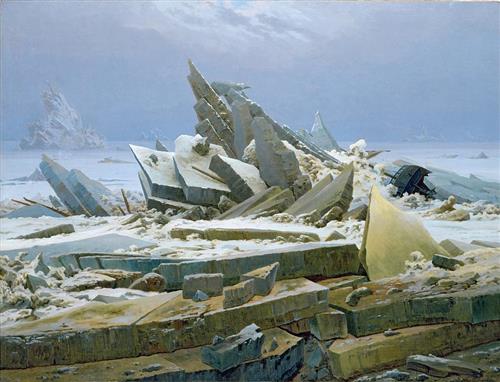
Caspar David Friedrich, The Sea of Ice, also called The Wreck of Hope Oil on canvas, 96.7 cm × 126.9 cm (1823–1824).
On the Unmaking of Benediction
This cycle of verses—The Inversion Cycle—emerged not as a contradiction, but as a counterweight to The Blessing of Morpheus: The Sending Forth, a series of benedictions articulated in reverent tones and metaphysical gestures within the poem Ponder, O Morpheus, the Night Sky. That earlier work was rooted in the soul’s deep yearning toward the ineffable, culminating in luminous affirmations bestowed by the dream-god Morpheus upon the seeker. In time, those benedictions came to feel too complete, too resolved. I began to wonder: what if they failed?
TheInversion Cycle is not blasphemy, but a form of apophatic honesty. It does not seek to erase Ponder, but to stand beside it—its negative counterpoint. Each scroll of the cycle corresponds to a specific line or blessing from Ponder and performs an act of unmaking: where Morpheus blesses, these verses refrain; where he sends the seeker into mystery, these verses stall at the threshold; where he assures, they withhold.
To honor that reversal, a further restraint was imposed: the exclusion of the very vocabulary upon which the original work (and many of my other recent works) so often relied. Words such as breath, dust, light, shadow, silence, and memory—among others—have been set aside. Their absence is not a loss but a signal. These are not the tools we are permitted to carry here.
The scrolls appear here in the same order as the benedictions from Ponder, O Morpheus, the Night Sky. This reversal respects the original arc—from the loosening of dreams to the transformation of the soul—and follows its negative path with precision.
What remains is austerity, not despair. These unsacraments do not offer consolation, but they do speak. If Ponder was a song of ascent, then this is the long exhale after the music ends—a psalter of withheld grace, composed in the space where blessing does not descend.
Let this work be read not in defiance of belief, but in the trembling of its undoing. For if it is brave to bless, it is perhaps braver still to stand in the space where blessing will not come—and write there, in the dust, what remains.
Scroll I: Of the Clinging Husk
Let not your dreams fall— for they will not fall. They remain, clinging like husks unpicked, blackened not by season, but by refusal.
You will try to cast them down, but they are fastened, not to limb, but to marrow.
They do not curl like leaves. They do not return to soil. They sour upon you, a bitterness in the sinew, a ferment in the thought.
And if you turn to shake them loose, they will tighten. Their threads are not of sleep, but of habit, knotted in long forgetting.
There is no wind to lift them. No frost to loosen them. No gardener comes.
Remain, then, beneath their burden— bent, unshed, unchanged.
Scroll II: Of the Inscribed Weight
Take them. You will take them. You cannot help it.
The names carved into stone, the words burned into walls, the cries etched into earth— they cling not to your pack, but to your ribs.
You bear them not as titles, but as scars.
They whisper through your marrow, resisting every act of unmaking. You try to enter the place without form, but they speak before you. They call the ground by its old name, and the gate does not open.
Even the sky does not answer when it hears them rising again.
These names were not carved to remember. They were carved to bind.
And now, as you stand at the edge of the place where all naming ends, they press their syllables against your tongue, and you speak them, not in defiance, but because you cannot forget.
Scroll III: Of Implements Abandoned
Bring not the weighted balances, nor the woven snares of longing. They do not hold, not here.
Their handles crack in the frost where no stars rise to bless the hour. Their mesh is brittle—threaded not of wool, but of claims left too long in the mouth.
The mind, honed to edge, cuts only fog in this place. The heart, cupped too gently, spills what it never held.
There are no laurels in this soil, only reeds that do not bend and brambles that do not bleed.
And should you cast such tools before you, expecting fruit, or fire, or favor— they will return to you as ash, unsought, unshaped, the chaff of means mistaken for ends.
Scroll IV: Of the Withheld Offering
Bring not your hollowed chest, stripped clean of ornaments and plea. It will not be filled.
Wonder has no purchase here. Its gaze returns unreflected from stone too smooth to be shaped.
Let the mind remain loud and unyielding, for awe would shatter in this poise like frost-cracked bronze.
As for your feet— do not lift them. There is no basin here, only ground dry from the beginning, lined with rings that do not ripple.
The wind does not attend. It does not lift. It does not listen.
There is no path across this floor, only grit, and the marks of those who came thinking they would walk upon revelation.
Scroll V: Of the False Horizon
Do not seek. There is no one to be found.
The sea does not receive you. It is not fluid, but glare stretched to the edge of motion— shimmering not with promise, but with mirage.
You did not launch. You drifted. And your craft was not chosen, but assigned, drawn from timbers meant for no voyage.
The sky above you swells with stars, but none are true. Each one marks a path that bends inward, circling you back to your forgetting.
You will think you move. You will call it seeking. You will call it bold. But you are already known by the thing that does not answer. And it has left no threshold, only wind that cannot be charted and depth that does not hold.
Scroll VI: Of the Barren Threshold
There is no beyond. Only the gray field where sleep forgets its end and waking does not begin.
Here, nothing waits. Not voice, not veil, not even the last gasp of wonder.
What lies past dream is not fullness, but poise robbed of sanctity— the deafness of stones before their naming.
No stars ever hung above this place. No fire traced its vault. Only pallor, dull as bone in a dry shrine, untouched by flame or veil.
And death, so often imagined a gate, has no depth here. It is shallow, crusted, and holds nothing but its own refusal.
Let no one say this place is holy. It is not what remains made full— but vacancy made permanent.
A place unmourned. Uncalled. Unmade.
Scroll VII: Of the Unbecome
Go not. There is nowhere that calls. No road unfurls before you, no veil parts, no watchful eye lingers on your vanishing.
The question you bore was not accepted. It curled back into you, like a tongue that feared its own utterance.
You will not be shaped by asking, nor known by your seeking. You will remain as you were before the yearning— a vessel without fracture, never poured, never filled.
No sound will rise behind you. No trace will stir where your feet passed. Even the soil will forget your weight.
Be still, not in peace, but in the form that does not unfold. Remain—not as the question— but as that which never found its shape.
Scroll VIII: The Soul Beneath the Blanched Sky
The soul, girded and unmoved, stood beneath a sky without veil— a dome blanched of fire, where nothing had ever gleamed, only ash adrift from unremembered pyres.
It bore no garment. No mark of calling or descent. It was as parchment without script, unhandled, unblemished, unread.
No winds stirred the plain. Only cairns rose in rows, not raised in reverence, but born of the land’s refusal to yield.
The trees there had no buds. Their limbs were stiff, as if carved for stillness— a forest of halted prayers. And beneath them, the roots did not seek nourishment, but curled inward, content in their forgetting.
There was no calm, no sacred pause. Instead, a muttering of syllables rose from the dry hollows— sounds without grammar, without bond, giving rise to no names, no intelligible form.
And when the soul pressed its palm to the ground, there was no spring, no pulse, only crusted clay— neither moist nor cracked, a firmness that would not give.
It asked nothing. Not from pride, but from knowing that some places are beyond summons— places where even longing has been turned to stone.





 Northcoast Antiquarian