I. Stillness Before the Descent What stirs in silence but the thought of falling? The soul leans forward at the edge of time, Where earth gives way to rhythm without measure— No firmament beneath, no axis left to climb. The wind is absent here. The light, unsure. All motion trembles on the breath of stillness. We speak of peace, yet dread the calmest shore— For we have built our gods from fear and witness.
II. The Water Below Not storm, not wave, nor tempest’s hissing swell, But quiet depth—the fathomless unknown, Uncoiling silence from a buried bell Where light has never touched the sea-worn stone. Here dwell no monsters, save the mind’s own eye. The fear is not of drowning, but of seeing— That which reflects not sky, but self, and why The soul recoils from naked being.
III. The Humbling The sea does not instruct with word or wind— It shapes the soul by salt and slow erosion. A kneeling cliff, worn smooth where waves have pinned Each boast to sand, each name to dark devotion. The deeper still you go, the less you hold— No torch remains, no doctrine, no command. The deep forgives, but never does it fold— It presses wonder into trembling hand.
IV. What Remains So is the fear a gift, once held aright— A trembling compass on the soul’s long chart. For he who feared the deep, yet dared its night, Returns not wise—but hollowed, whole of heart. He cannot speak of what he saw below, Only that silence taught him how to kneel. And those who know will know. The rest may go To read their truths upon a turning wheel.
Pieter Bruegel the Elder, The Tower of Babel (c. 1563, oil on panel) Kunsthistorisches Museum, Vienna
Utopias, like theoretical economic models and theological constructs, are among the most daring expressions of human thought. Each arises from an impulse toward order and improvement, born of the conviction that the present is insufficient and the future can be shaped. Yet despite their elevated origins, these frameworks call to be eschewed—not for the good they propose, but for the horrors they have enabled when unmoored from humility and constraint.
The history of ideas is littered with systems that began in hope and ended in terror. Plato’s Republic, with its philosopher-kings and rigid class hierarchy, inspired centuries of authoritarian dreams. Soviet central planning promised rational allocation but delivered famine and repression. The Puritan theocracy in Massachusetts Bay sought godly perfection but produced witch trials and exile for dissenters. Each began as a vision of human flourishing—the utopian city, the rationalized economy, the purified creed—yet furnished the blueprints for regimes of control.
Nor is such danger confined to leftist excesses or theological zealotry. In Chile, the 1973 overthrow of Salvador Allende led not only to political violence, but also to the forceful imposition of a radical free-market model under General Pinochet, guided by economists trained in the Chicago School. The result was economic restructuring praised by some for its efficiency, yet experienced by many as immiseration and repression. Here, too, theory eclipsed humanity. Market mechanisms became commandments; dissenters were not debated but disappeared. What was billed as liberation through market freedom became another apparatus of dominance—less visible, perhaps, but no less brutal. The lesson is not partisan, but perennial: when theory is elevated above persons, systems serve themselves.
Elevated to ideology, models cease to be guides and become chains. They offer certainty in place of inquiry, coherence in place of complexity, and purpose in place of personhood. What begins as vision hardens into decree; what is meant as a lens becomes law. Mao’s Great Leap Forward exemplified this transformation: an economic model promising industrial prosperity became an unyielding doctrine that cost millions of lives when reality refused to conform to theory.
When the model becomes sacred, deviation becomes heresy. And where heresy is named, there follow inevitably the commissars, the inquisitors, the doctrinaires—those who patrol the borders of the permissible. Stalin’s show trials eliminated those who questioned economic orthodoxy. Both Catholic Inquisitions and Protestant persecutions took inhuman measures against those who strayed from their respective versions of theological purity. McCarthyism destroyed careers in service of ideological conformity. All operated in service of the model, the path, the “truth”—though truth, in such hands, is no longer a horizon toward which one travels, but a cudgel with which to enforce obedience. And perhaps there is no final truth to be had, only a multiplicity of partial illuminations, glimpsed through the mist, refracted through fallible minds.
And yet, it would be a grave error to reject these models wholesale. A utopia, though unattainable, directs the gaze beyond the immediate—Martin Luther King Jr.’s “Dream” inspired civil rights progress precisely because it painted a picture of what America could become. A well-crafted economic model brings coherence to chaotic phenomena: Keynesian theory, whatever its limitations, helped navigate the Great Depression by providing a framework for understanding how governments might respond to economic collapse. A theological vision offers moral orientation and poetic resonance—liberation theology in Latin America, despite its political complications, channeled Christian teaching toward concrete concern for the poor and oppressed.
When held lightly—non-dogmatically, open to revision, aware of their limits—such models are not prisons but tools. They help us navigate complexity, but they must never be mistaken for the complexity itself. The Chicago School economists who influenced policy in the 1980s offered valuable insights about market mechanisms, but when their models became gospel rather than guides, the result was often ideology that ignored market failures and social costs.
The question, then, is one of balance. Can aspiration be disentangled from absolutism? Can man dream without dictating, model without mastering, believe without binding? This is no easy task, for humanity is rarely a creature of balance. We veer, we commit, we grasp too tightly. The same revolutionary fervor that toppled the Bastille eventually devoured its own children in the Terror. But the remedy is not the renunciation of vision; it is the cultivation of humility within vision. It is the refusal to equate map with territory, model with meaning, doctrine with destiny.
If balance is the ideal, then it must rest not on detachment but on a deeper fidelity—one that refuses both rigidity and relativism. This is not a call to valueless existence, but to the most valued existence—one that honors core commitments through responsive attention rather than rigid prescription. The danger lies not in caring deeply about human flourishing, justice, or freedom, but in believing we possess the universal formula for achieving these goods. True fidelity to our highest values often requires abandoning our preconceptions about how they must be realized. It demands constant attentiveness to circumstances, genuine openness to what the moment requires, and the intellectual courage to adjust course when reality refuses to conform to our expectations. The principled life is not one that follows predetermined blueprints, but one that remains alert to the irreducible complexity of human need and the ever-changing demands of genuine care.
To live without models is to drift. To live by them uncritically is to be enslaved. Wisdom lies in the middle path: to aspire without illusion, to theorize without tyranny, and to seek the better without forgetting the cost of the best. In this fragile equilibrium lies the noblest promise of human reason—not to control the world, but to understand it more justly, and to live within it more wisely. And in that wisdom, to leave room for the truth that ever escapes us.
He lifts himself from bed without remark to meet the worn, repeated tasks at hand. No record marks the ground on which he strains— no witness, no laurel, no acclaim. His strength lies not in storied deed but labor plain: a hearth kept warm, a family fed, life sustained. No tale is told, no stone inscribed or raised— the ordinary man, in toil, is born.
The meaning lies in being, not in praise; in beauty glimpsed, not possessed though understood. No crowns he needs nor feast days held for him; his worth is in the craft, the nail, the wood. He does not seek to master, nor to flee, but walks the field, or mends a gate, or tends a tree. In passing light, in gesture undesigned, a truth is touched, not grasped, yet binds.
The purpose is in others—in shared bread, the coat repaired, the cup placed in the hand; in love soft-spoken, faithful in its giving, not in the vow proclaimed, but in the deed. His days are stitched with care that shows no seam, his name unsung, his work by others’ need. Though he may pass unnamed when he is gone, he will have sown the path that others walk upon.
“Il faut imaginer Sisyphe heureux.” (“One must imagine Sisyphus happy.”) —Albert Camus, Le Mythe de Sisyphe (1942)
But perhaps he was mistaken. Perhaps the truth is simpler: When the stone is gone, the man remains.
Sisyphus Undone; or, It Was Tuesday
by Donald S. Yarab
He rose, as ever, with the morning’s breath, the hill still steep, the silence oddly wide. No stone to greet him with its weight or will— no groan of earth, no task to be defied.
The gods were gone. Their laughter had grown faint, or else the air refused to carry sound. The path he wore through centuries lay bare, a scar now healing into senseless ground.
He searched for signs: a crack, a trace, a mark, but found no proof that toil had ever been. His hands, once strong with strain, now idle hung, still shaped by burdens long dissolved within.
He sat. The dust rose lightly at his knee. A lark began to sing, then flew away. The sky, untroubled, held no word for him. The world had turned. It was another day.
What is the self when labor fades to wind? What is the myth once struggle slips its chain? He breathed. No answer stirred the lucid air. The hill was whole. The man was left, and plain.
A meditation on the limits of theological language and the mystery of the Divine, this contemplative essay explores apophatic mysticism, the inadequacy of creeds, and the symbolic power of maps—blending poetic introspection with a life lived in scholarship, service, and creative expression.
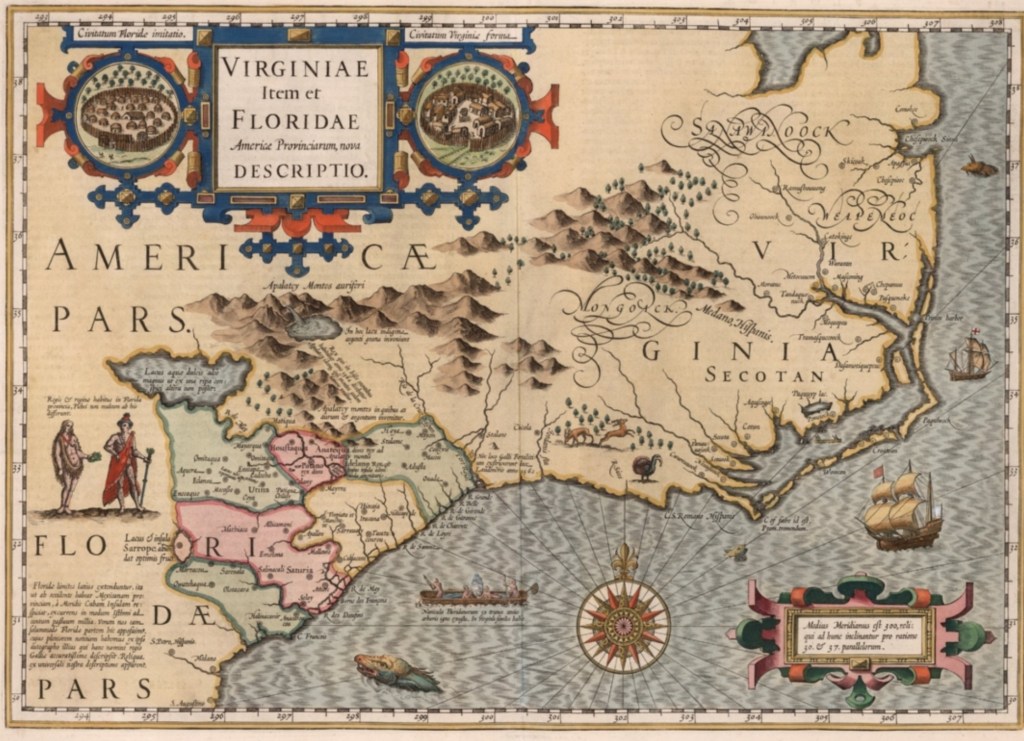
Virginiae Item et Floridae Americae Provinciarum, nova Descriptio. Map by Gerard Mercator (1512–1594), Jodocus Hondius (1563–1612), and Hendrik Hondius (1597–1651). Published in 1623 by Hendricus Hondius, Amsterdam. Image courtesy of the David Rumsey Map Collection, David Rumsey Map Center, Stanford Libraries. Licensed under Creative Commons CC BY-NC-SA 3.0.
Raised within the Romano-Byzantine tradition—formed by both the Roman and Byzantine Catholic rites—I was shaped by a confluence of liturgical beauty, theological depth, and mystical reverence. From that upbringing, there remains not merely memory, but a lasting affection for the rhythm and substance of the faith of my youth. It is not simply a cultural inheritance, but a formative lens through which the sacred, the communal, and the mysterious first revealed themselves. Yet, it would not be accurate to describe my present stance as that of a lapsed Catholic, nor as an atheist, nor as one alienated from the Church. Alienation implies disaffection or estrangement born of expectation unmet or betrayal suffered. What remains is neither rejection nor rebellion, but something quieter and more reflective—a posture of reverent detachment that neither clings nor condemns.
Any attempt to articulate my position must begin by acknowledging the futility of articulation itself—at least in matters concerning the Divine. The belief that the Divine wholly exceeds the bounds of human comprehension and articulation grows only firmer over time. All creeds, revelations, and theological systems—however earnest or inspired—are, in the end, efforts to sketch with a cramped human lexicon and limited imagination that which lies beyond even the highest powers of conception. Far from illuminating the Divine, such efforts only obscure its immensity by imposing upon it our narrow symbols and forms.
Better to liken our theological endeavors to the drawing of maps—maps sketched by explorers who had never seen the coasts they sought to chart. Just as early cartographers filled the margins with dragons, saints, and imagined cities, we adorn the unknown with creeds, cosmologies, and commandments. These are sincere efforts, yet they more often reflect our hopes and fears than reveal any transcendent truth. The more intricate the system, the more seductive the illusion that the map is the territory. But the Divine is not a line upon a page. It is the sea beneath the sea monster, the silence beyond the compass rose, the continent whose very existence remains unknown. To name the Divine is already to misname it; to describe is to distort.
Such a perspective finds its truest expression in apophatic mysticism—the via negativa, the way of negation—a tradition articulated by Pseudo-Dionysius the Areopagite, a Christian thinker of the late fifth to early sixth century whose writings permeate the Catholic tradition through the works of Thomas Aquinas, Bonaventure, and the Spanish mystics, reminding us that the path of unknowing is not a break from faith, but one of its most ancient and revered expressions. In this light, God is not wise, not good, not just, not loving—not because the Divine lacks these qualities, but because our highest notions of them remain shadows cast by a light we cannot behold. Whatever we say of the Divine, however conceived, the most faithful statement is this: our words fall short.
Even so, human beings remain kataphatic creatures as well—creatures who long to speak, to name, to worship, to relate. Thus arises a kataphatic-apophatic tension, a profound and permanent unease between the impulse to speak of the Divine and the recognition that all speech fails. Hymns, liturgies, cathedrals, and doctrines are all human responses to this tension—not to capture the Divine, but to reach toward it, however falteringly. These gestures deserve neither scorn nor uncritical assent. They should be honored, but held lightly, cherished as poems rather than mistaken for proofs.
This tension extends beyond the realm of theology into the very nature of being itself. In a moment of quiet reflection, I found myself asking: “Where is Am I?”—caught between breath and thought, a question turning circles in the hollow of my chest. Am I the echo, or the voice that trembles back? A fragment drifting through the hour, a flicker in the endless light, unsure if I was ever whole or if the pieces were ever mine to find. Such a question is not mere existential uncertainty, but a recognition that the self, like the Divine, eludes definitive capture.
No formal creed or written revelation authored by man commands my assent, however noble or inspired it may be. Faith is not placed in these constructions, though the sacred yearning from which they arise is deeply respected. They are echoes of an original voice no longer heard directly, outlines of a presence glimpsed but never grasped. Like the adornments on ancient maps, these expressions are beautiful and sincere, but they are not to be mistaken for the thing itself.
To some, this may resemble agnosticism, though that word has become burdened with meanings it was never intended to carry—meanings of indecision, skepticism, or apathy. What is expressed here is none of those. It is not a shrug of the shoulders, but a bow of the head. Not the silence of the indifferent, but of the reverent. Not ignorance, but a conscious unknowing—a sacred refusal to impose limitation upon that which exceeds all bounds. This is why I eschew agnostic labels in favor of mystical ones—for the mystic does not claim ignorance of the Divine but acknowledges that true knowledge of it transcends conventional understanding.
What remains, then, is a life lived in contemplation of the ineffable—a contemplation that finds expression through creative work. In poetry, music, and essay, I reach toward that which cannot be directly named. When I write of the “eternal now” where “yesterday, tomorrow, and today collapse,” or compose lyrics that honor Humilitatem Initium Sapientiae, I am not merely creating art but engaging in a form of contemplative practice. These creative acts serve as bridges, not only between myself and the ineffable, but also between myself and others who share this reverent space, regardless of their formal religious affiliations or φιλοσοφίαι (philosophies or wisdom traditions).
The path ahead is not marked by certainty but by awe, not by declarations but by listening. Mystery is not something to be solved, but something to be honored. Years of formal study—first in history and religious studies as an undergraduate, then as a teacher of both subjects, and later through a long career in civil rights law and public service—have only deepened the awareness that human systems, whether intellectual, doctrinal, or legal, ultimately encounter their limits at the threshold of the sacred. In this, the apophatic tradition offers a spiritual home—a dwelling place where reverence begins precisely where language ends. If there is a guiding light for such a path, it is humility—humilitatem initium sapientiae—not merely as a moral posture, but as a metaphysical necessity. That teaching, which echoes throughout Thomas à Kempis’ The Imitation of Christ, remains not only a personal motto, but a settled conviction: that wisdom begins when one ceases to pretend to possess it.
Near the staircase in my front hallway hangs an early map of the New World—an artifact I have long cherished. Its artistry is matched only by its courage, for it dares to depict what was not yet known. Near the region now recognized as Virginia and the Carolinas, a sea monster rises from the ocean’s depths, signaling peril or wonder—perhaps both. On the land itself, figures of “natives” stand, imagined by a hand that never walked those coasts. That map does not record the world; it records what the world dared to imagine. So, too, do our theologies populate the margins of metaphysical uncertainty with monsters and angels, commandments and visions. They are imaginative acts—sincere, flawed, luminous. And like that map, they are to be cherished not for their precision but for what they reveal of the human longing to reach into mystery with word and symbol, with ink and awe. In their earnest striving, they remind us: we are always sketching the edge of the unknown, even when we know we cannot cross it.




 Northcoast Antiquarian