
Ohio’s Tax Burden Inversion

How Two Decades of Income Tax Cuts for the Wealthy Shifted the Load onto Property Owners and Renters

During the most recent reappraisal for property taxes, thousands of Cuyahoga County residents opened their mailboxes to find reappraisal notices that made their stomachs drop. Property values had climbed by an average of 32% county-wide, with East Cleveland residents facing increases of 67% and Maple Heights 59%.

Michael Chambers, Cuyahoga County Auditor, reported that, for 71-year-old Parma resident Agnes Gallo, this meant her home’s value rose by $76,000, pushing her annual tax bill up nearly $950. “This is outrageous,” she said. “People can’t afford to live in their own houses.” He also said that single mother Roni Menefee, facing a 49% valuation hike, admitted she was considering leaving Ohio altogether: “We’re hardly living in Beverly Hills here.”

County officials insist that House Bill 920 prevents taxes from rising dollar-for-dollar with property values. But for seniors on fixed incomes or working families barely hanging on, even modest increases can be destabilizing. More than 20,000 residents filed complaints, with thousands of adjustments granted. Still, the anger lingers—and justifiably so.

The Long-Term Tax Shift

That anger is rooted in two decades of deliberate state policy. Since 2005, Ohio’s Republican lawmakers have steadily cut the personal income tax, reducing rates most sharply at the top. Over time, these cuts drained nearly $13 billion annually from state revenues.

With less money flowing from the state to schools, libraries, and local governments, communities were forced to raise more themselves. And because they are prohibited from taxing investments or capital gains—the kinds of income more common among the wealthy—the primary tool left was the property tax (although many municipalities also increased their local income taxes-Cleveland voters narrowly approved an increase in its income tax from 2 percent to 2.5 percent in 2016).

The outcome: in 2024, Ohioans paid $23.9 billion in property taxes—more than they contributed through sales taxes ($13.7 billion) or income taxes ($9.5 billion). The most regressive form of taxation has become the backbone of public services.

Put plainly: the legislature cut income taxes for the wealthy, and forced everyone else—retired, middle-class, working-class, and poor—to make up the difference through higher property taxes.

The Nonprofit Inversion

At the same time, Ohio has allowed exemptions and abatements to balloon. Nearly $90 billion in property value—17% of the state’s total—is exempt from taxation, up from 14% two decades ago.

The largest single category? Abatements, totaling $26.6 billion. These were meant as temporary incentives to spur growth but are now permanent fixtures. Even utilities, which have captive consumers and guaranteed profits, receive abatements for investments they would make anyway.

And then there are the so-called nonprofits. Their tax-exempt status rests on public benefit, yet their leaders are not infrequently paid like corporate executives:

InstitutionLeaderAnnual CompensationTax/Exemption Status
Cleveland ClinicDr. Tomislav Mihaljevic, CEO≈ $7 million (2023)Vast campus tax-exempt as nonprofit hospital
Ohio State UniversityTed Carter Jr., President≈ $1.3 million (2024)University property tax-exempt
Ohio State UniversityRyan Day, Head Football Coach≈ $10–12.5 million (contracted 2025)Public university benefiting from exemptions
Hawken School (Private)D. Scott Looney, Head of School≈ $1.05 million (2023, IRS Form 990)Elite private school, property tax-exempt

These institutions are sheltered from taxes while ordinary citizens—many of whom can barely make ends meet—are expected to pay “full freight.”

Renters Pay Too

The burden does not end with homeowners. Renters also pay indirectly, as landlords pass on property tax hikes through higher rents.

In 2023, Ohio saw some of the steepest rent increases in the nation:

Cincinnati: one-bedroom rents up 17% year-over-year.

Columbus: also up 17%.

Central Ohio: squeezed further by Intel, Amazon, and data center developments.

Statewide: over 700,000 renter households are “severely cost-burdened,” spending more than half their income on housing.

Even those who do not own property are being priced out of Ohio’s communities.

Populist Anger and the Ballot Box

It is no wonder, then, that frustration has spilled into politics. In 2025, an all-volunteer group began gathering signatures for a constitutional amendment to abolish property taxes entirely. Organizers say they are moving forward “no matter what” lawmakers do, because people feel they “no longer have a voice in this government.”

The proposal is extreme. Abolishing property taxes would blow a $23 billion hole in funding for schools, libraries, mental health services, and parks. Replacing it with sales taxes could require rates as high as 20%. Yet the fact that such a movement exists—and is gaining traction—reveals how deeply citizens feel abandoned.

They no longer trust lawmakers who, for twenty years, cut income taxes for the rich while pushing costs onto everyone else, especially the working class, seniors, and the poor. They see abatements handed to billion-dollar institutions and “nonprofits” with millionaire executives, while seniors in Parma and renters in Columbus face bills that are unsustainable.

The Choice Ahead

Ohio’s property tax crisis is not an accident. It is the inevitable result of two decades of choices:

Cut income taxes for the wealthy.

Hand abatements to billion-dollar institutions.

Shift the burden onto homeowners, renters, and the poor.

The result is predictable: the young leave by choice, the old leave by necessity, and those who remain are angry enough to contemplate abolishing the system entirely.

Eliminating property taxes outright is likely not the answer—it would devastate schools, libraries, and local services. But for many Ohioans, it may feel like the only way to force state leaders to listen. When lawmakers protect the powerful and ignore the cries of ordinary citizens, radical proposals become the only language that carries weight.[1]

And the cry is not simply to be heard. It is to be relieved—to be lifted out from under a system of taxation that has become oppressive, unfair, and in many instances, unsustainable. Until that relief is real and tangible, until fairness is restored, the ballot box will remain the people’s only instrument. And if the choice is between leaving their homes or leaving the system as it is, more and more Ohioans will choose to abandon the system itself.

The choice is no longer between reform or complacency. It is between reform or rupture.


[1] Some might dismiss the property tax abolition initiative as folly that would devastate local services. But terror concentrates the mind wonderfully. When gerrymandered legislative maps silence voters’ voices in normal governance, when the legislature attempts to eliminate or dilute ballot initiatives entirely, and when even successful citizen initiatives are ignored by lawmakers and courts, extreme measures become rational responses. The terror that grips policy makers, and concentrates their focus if voters eliminate $23 billion in local funding, might finally force the political class that has spent decades redistributing wealth upward to confront the unsustainable system they’ve created. Sometimes breaking a captured system is the only way to build a fair one.

Smoke Without Borders: Cleveland’s Air Quality Alerts and Canada’s Wildfire Crisis


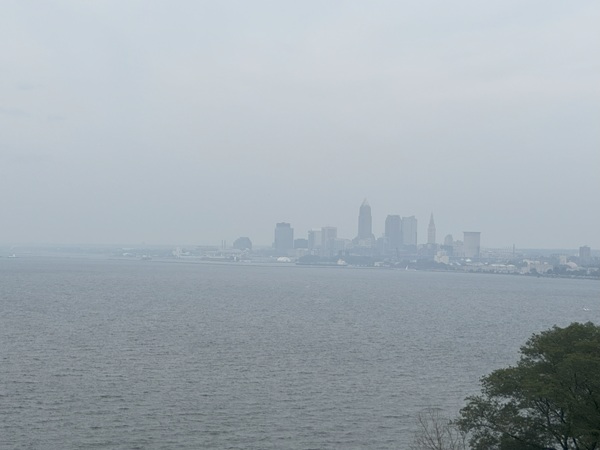
Canadian wildfire smoke causes an afternoon haze on August 4, 2025, obscuring the view of Lake Erie and downtown Cleveland, Ohio. Photograph by John K. Jones
Canadian wildfire smoke causes an afternoon haze on August 4, 2025, obscuring the view of Lake Erie and downtown Cleveland, Ohio. Photograph by John K. Jones.

This morning I awoke—yet again—to an air quality alert in Cleveland. These warnings have become disturbingly routine. Yet there is nothing routine about them. Sometimes the smoke is plainly visible, a dull haze hanging over Lake Erie; other times the sky appears deceptively clear, even as sensors warn of danger. Each alert is not only a public health signal but also a tangible indicator of the broader climate crisis—one that too many still deny.

I. Not a New Story, but a New Scale

Canada has long experienced wildfires, particularly within its vast boreal forests, as part of natural ecological cycles. However, the severity of recent fire seasons represents a dramatic departure from historical norms. In 2023, Canada endured its most destructive wildfire season on record, with more than 18.5 million hectares (over 45 million acres) burned—more than two and a half times the previous record and roughly seven times the long-term annual average.[1]

II. Why Canada Is Burning More Than Ever

1. Climate Change Accelerates the Threat

Canada’s climate is warming at roughly twice the global average (approximately 2°C since 1950 compared to the global average of 1.1°C), and in some northern regions nearly three times faster.[2] This accelerated warming produces hotter, drier vegetation that becomes fuel for wildfires, extends the fire season well beyond historical norms, and increases the frequency of lightning storms that ignite many of these blazes.[3]

2. Boreal Forest Vulnerability and Ecological Shifts

While boreal forests are adapted to periodic fire, the new scale and intensity of burning can overwhelm their capacity for regeneration. Repeated megafires may transform vast areas into grasslands or savannas, disrupting ecosystems and releasing massive stores of carbon into the atmosphere.[4]

3. Human Activity and Legacy Fire-Management Models

Though many fires are sparked by lightning, human activities—campfires, discarded cigarettes, sparks from machinery—remain a significant cause. Decades of fire suppression, along with the decline of Indigenous controlled-burn practices, have also left forests dense and fuel-rich, primed for catastrophic fires when drought and heat arrive.[5]

III. Cleveland Downwind

Wildfire smoke respects no borders. Carried by wind patterns and jet streams, it regularly drifts into the Midwest and Northeast. In Cleveland, this has meant days when the Air Quality Index rises into the “unhealthy for sensitive groups” range or worse. Fine particulate matter (PM₂.₅—particles smaller than 2.5 micrometers) can penetrate deep into the lungs and enter the bloodstream, aggravating heart and lung conditions and increasing health risks for vulnerable populations. Elevated ground-level ozone, worsened by heat, compounds these dangers.[6]

The reality is that Cleveland residents now regularly breathe air compromised by fires burning hundreds or thousands of miles away—a stark reminder of how interconnected our environmental challenges have become.

IV. A Shared Crisis

This is not merely a Canadian issue—or solely a U.S. problem. It is a continental and global crisis, rooted in climate change and demanding coordinated action in emissions reduction, forest management, and public health preparedness.

V. Closing Reflection

Tomorrow’s sunrise over Lake Erie may bring either full clarity or another haze alert. Regardless, the truth remains: our climate is changing faster than our institutions, our habits, or our response. The question is not whether the air tomorrow will be breathable. The question is whether we are prepared to protect it—not only here, but everywhere.


References

  1. “2023 Canadian Wildfires,” Wikipedia, accessed August 8, 2025, https://en.wikipedia.org/wiki/2023_Canadian_wildfires.
  2. “Climate Change in Canada,” Wikipedia, accessed August 8, 2025, https://en.wikipedia.org/wiki/Climate_change_in_Canada.
  3. “Expert Insight: Canada Is Warming Faster than Anywhere Else on Earth,” Western University News, January 2024, https://news.westernu.ca/2024/01/expert-insight-canada-is-warming-faster-than-anywhere-else-on-earth/.
  4. Kasha Patel, “Canada’s Wildfires Are Changing the Landscape for Decades to Come,” Washington Post, July 11, 2025, https://www.washingtonpost.com/weather/2025/07/11/canada-wildfire-smoke-forests-landscape-change/.
  5. Aryn Baker, “We’ve Entered the Age of the Megafire,” Time, July 2024, https://time.com/7299284/age-of-mega-wildfires-climate-change/.
  6. David Abel, “Wildfire Smoke Is Increasing across New England,” Boston Globe, August 5, 2025, https://www.bostonglobe.com/2025/08/05/metro/wildfire-smoke-increasing-across-new-england/.

The Browns Stadium Boondoggle: Elite Socialism in Action

Cleveland Browns Stadium

The Browns stadium deal is not merely a bad investment—it is a paradigm of elite hypocrisy, a socialist redistribution of public wealth upward, executed by lawmakers who claim allegiance to free‑market principles while enacting policies that privatize profit and publicize risk.

Earlier this year, Ohio’s Republican supermajority passed legislation requiring that high school students be instructed in the virtues of capitalism.¹ At the same time, these very lawmakers voted to seize $600 million from the state’s unclaimed‑property fund—money legally belonging to ordinary Ohioans—and redirect it to fund a $2.4 billion private stadium project for billionaire owners Jimmy and Dee Haslam. That is not capitalism. That is elite socialism, a state‑directed transfer of private/collective resources to elite private interests.

The Haslams, whose estimated net worth exceeds $8.5 billion, are not merely beneficiaries of state largesse—they are its architects. Whether the team remains in downtown Cleveland (with the city offering $461 million in renovations) or relocates to Brook Park with state and county subsidies, the outcome is the same: private/public funds extracted to enhance elite private empires.

Let us strip away the euphemisms. This is not a “public–private partnership.” It is a state‑sanctioned seizure and redistribution of wealth, orchestrated by legislators who demand work requirements, means testing, and behavioral monitoring for ordinary Ohioans receiving food, housing, or healthcare assistance—but offer no such oversight when the recipient wears a suit and owns a football team.²

When working families receive modest aid, it is denounced as “government dependency.” When billionaires receive hundreds of millions in public money, it is praised as “economic development.” This is not pedestrian ideological inconsistency; it is class warfare masquerading as policy.

County Executive Chris Ronayne called the proposal “piracy,” rightly charging that lawmakers are robbing Bob and Betty Buckeye to pay Jimmy and Dee Haslam.³ And indeed, the state has now declared the unclaimed‑property fund reverts to public ownership after ten years—not to be reinvested in public education or healthcare, but to underwrite the speculative ventures of the ultra‑wealthy.

Even the supposed safeguards are laughable: a mere $50 million in escrow from the Haslams, and another $50 million line of credit—a token hedge against a half‑billion‑dollar state exposure. Meanwhile, individuals requesting a few hundred dollars in public aid are subjected to rigorous oversight and bureaucratic suspicion.

This arrangement is a perfect study in the moral inversion of modern American political economy: public discipline for the broad citizenry, public indulgence for the rich; free‑market platitudes for the powerless, centralized socialism for the powerful.

This stadium subsidy is merely the latest manifestation of a systematic pattern—from pharmaceutical companies capturing billions in public research funding while charging monopoly prices for resulting drugs, to defense contractors operating on cost-plus arrangements that guarantee profits regardless of performance, to agricultural corporations receiving millions in annual subsidies while preaching individual responsibility. The Browns deal simply makes visible what usually operates through more obscure channels.

This is not merely the marginalization of the interests of the poor, working, and middle classes, but the broader appropriation of public resources away from the citizenry at large—those who should have access to public investment without facing moral scrutiny, bureaucratic suspicion, or ideological disapproval.

It is telling that both Policy Matters Ohio and the Buckeye Institute—voices from the ideological left and right—oppose the deal. They understand, as do many citizens, that this is not governance in the public interest. It is the use of state authority to engineer a systematic upward redistribution of wealth, cloaked in the language of jobs and development.

The real divide in America is not between socialism and capitalism—it is between elite socialism, in which wealth is extracted and insulated for the privileged, and democratic socialism, in which collective resources are used for collective needs. (Ours has always been a mixed economy—part capitalist, part socialist, the latter increasingly tilted toward elite interests—though this has rarely been acknowledged in our political discourse.) Until we name this truth and demand ideological consistency from our legislators, we will continue subsidizing billionaires while denying the citizenry investment—and calling it “fiscal responsibility.”

The scaffolding of economic life already exists. The only question is whether it will remain a scaffold supporting billionaires or be reclaimed as a structure serving all the people.

NOTES:

¹ Senate Bill 17, signed by Gov. Mike DeWine in March 2024, requires ten principles of “free market capitalism” to be taught as part of financial literacy courses required for high school graduation. The Ohio House passed the bill 66–26 in February 2024. See: Ohio Capital Journal, “Ohio House passes bill that would add capitalism to high school financial literacy curriculum,” Feb. 12, 2024.

The Statehouse News Bureau, “Former Gov. Rhodes said ‘Profit isn’t a dirty word.’ Now, Ohio students will learn about capitalism,” Mar. 15, 2024.

² See, e.g., Ohio Administrative Code 5101:4‑3‑13 and 5101:4‑9‑09 (SNAP work registration, employment/training and sanctions); 5101:1‑3‑12 (Ohio Works First requiring 30–55 hours/week of work). Ongoing eligibility mandates include documentation of income, assets, and residency. No equivalent oversight applies to recipients of corporate subsidies or stadium funding.

³ Chris Ronayne described the plan as “akin to piracy” and stated, “This is not just robbing Peter to pay Paul, this is robbing Bob and Betty Buckeye to pay Jimmy and Dee Haslam.” See: WKYC, “Ohio’s unclaimed funds could help build Browns stadium: Here’s how to see if any belong to you,” June 5, 2025. wkyc.com

Axios Cleveland, “Ohio Senate proposes $600 million Browns stadium subsidy using taxpayers’ unclaimed funds,” June 4, 2025.

DeNatale, Dave, Lynna Lai, and Peter Fleischer. “Ohio Senate approves its version of budget, including $600M for new Cleveland Browns domed stadium in Brook Park.” WKYC, June 11, 2025.

⁴ Should the Browns remain in downtown Cleveland, the city’s proposed $461 million commitment is expected to come from municipally issued bonds, potentially backed by revenues through the Cleveland–Cuyahoga County Port Authority or tax levies. The Port Authority, which regularly issues loans and revenue bonds to spur commercial development, functions as a centralized mechanism for steering public resources—effectively a form of state planning within a nominally capitalist framework, choosing economic “winners” with public backing.

General sources consulted: Associated Press, Axios Cleveland, The Guardian, New York Post

From the Tatra Mountains to the Mahoning Valley: A Yarab Family History

And the video is here:

A YARAB FAMILY HISTORY

A video best viewed on a large computer screen or television screen.

The video and PDS below were prepared for an upcoming family reunion.

In the event that the video quality is lacking, your screen is too small, or the screen moves by too quickly, a PDF of the video is available below, along with some helpful charts. Also, I have the video available as a PowerPoint – contact me if you would like it in that format.