It was raining. The crowd— too few to be a crowd—perhaps a gathering, or the assembled, more ghosts than listeners, their coats darkened not just by weather but by the weight of waiting.
He stood on the stump, not of authority, but of loss— the remnant of a tree felled long before, as if the forest had once believed in clearing room for prophecy.
He spoke not of thunder, but of hush. Not of redemption, but of what remained after the soil forgot its seed.
The gathering, if such it was, did not cheer, nor weep. They listened with the rain, as if the water itself were translating his broken cadence into something nearly true.
He spoke not of hope, or loss, of tomorrow, or yesterday, or even today. He named no sins, offered no absolution, held no book but the hush of water sliding down his sleeve.
His voice did not rise. It pooled. Like the rain in the hollow of the stump beneath him. He said only: “You have heard the wind. Now hear the stillness it leaves behind.”
And they did not answer. Not from doubt, but because his words were not questions. They were roots— groping downward through silence, seeking something older than belief.
A dog barked in the distance. A child shifted, not from boredom, but from the weight of understanding too early what it meant to stand still in a world that keeps spinning.
He stepped down, the stump left wet, as if it had wept a little too.
And the assembled, if that is what they were, dispersed—no closer, no farther, but marked.
Some were bewildered. Others thought they were enlightened, but knew not how. Still others could not recall what he had said, only that his voice was comforting, his cadence soothing— not the lullaby of forgetfulness, but the murmur of rain on old wood, reminding them of something they had never quite known.
No creed was offered. No call to return. Yet a few found themselves walking more slowly afterward, listening more intently to trees, to puddles, to silences that did not demand reply.
And the stump remained— neither altar nor monument, but a place where words once settled like mist and did not vanish.
The vague glimmer of a head suspended in space (1891, Lithograph) Odilon Redon (1840–1916)
I Am Undone
I.
It came not with fury, nor with fire. Not a blow, but a breath withheld. A stillness uncoiling in the spine. I did not cry out. I did not fall. I said only—I am undone. And the words were true, though I did not yet know how much they would mean.
II.
The star chart curled into ash. Landmarks dimmed, receded, folded into fog. I had names once— for the road, the self, the longing. They rusted in my mouth. I said again, am I— but the word faltered. Was I I? Was am still? Was undone the end, or only a door swinging inward with no floor?
III.
I wandered, perhaps. Or stood still and the world wandered past. The days no longer linked. Events occurred—but not to me. Faces mouthed shapes I could not hear or remember. I touched a wall that had always been there. It crumbled under my hand. I called it home, or meant to. Or once had. I think.
Un—done—I am—undone am I— I am…am I…?
IV.
And the past… no, the shape before the past— was it mine? Or borrowed from the eyes of others? Their eyes are gone. The mirror does not answer. I meant to say a thing— some thing— a small thing— but the mouth no longer forms what the mind no longer sends.
There is no forward. There is no back. There is no—
(nois)
V. Dissolution
I think I said—I was— no. I had said. Once.
Undone. It was the word. I said it. Before. Or after. I do not—
No shape to the day. No frame to the thought. They come—go— without edge.
The name of the thing was… not there. And the word for that— what was the word? The word is gone. The knowing is not.
“Ponder, O Morpheus, the Night Sky” arose from a meditation on the nature of dreams, consciousness, and the silent mysteries that lie beyond both. Rather than seeking to instruct, this poetic work offers a dialogue — between mortal longing and divine wonder, between question and silence. In addressing Morpheus, the god of dreams, the poem invites not sleep, but contemplation: a shared pondering of the night sky, where the known fades into the unknown, and where even gods may pause in awe before the infinite. It is my hope that this work may serve as a quiet companion for those who have found themselves, at least once, standing beneath the stars, asking questions for which no easy answers are given — and finding, in the asking, a kind of sacred beginning.
Sleep by Jean Bernard Restout (c. 1771). Oil on canvas, 129.5 x 96.5 cm (38 x 51 in). Cleveland Museum of Art. Depicting Morpheus
Ponder, O Morpheus, the Night Sky
“Beyond dreams lies a silence where even gods wonder.”
Prelude: The Summoning of Morpheus
Morpheus, Keeper of the Silent Looms, hear now the summons not of those who seek forgetfulness, nor of those who plead for soft illusions to cradle their weary minds— but of one who, standing alone beneath the immeasurable firmament, dares to bid thee ponder.
Ponder, thou Weaver of Shadows, the night sky: the endless, ink-deep vault where Orion’s belt cinches the waist of darkness, where scattered fires—blue, white, and ancient red— whisper of secrets too vast for mortal tongues.
Not for dreams of idle comfort do I call thee forth, but for contemplation; to set aside for a moment thy ceaseless crafting of mortal visions and lift thine ancient gaze upward, where the silent percussion of dying stars beats out the hidden music of creation.
For if thou, master of phantoms and bringer of luminous memories, shouldst pause to wonder at that boundless mystery, then perhaps the soul of man, frail and flickering though it be, might dare likewise to ask:
Who dreams the dreamers, O Morpheus? Whence come the visions thou bestowest? And what lies beyond the last dream, beyond the last star, beyond the last breath of sleep?
Thus the greater query is born, trembling on the tongue of the sleepless, yearning toward the silence that gathers all speech.
The Greater Query: A Dialogue with Morpheus
Soul: If thou, O Shaper of Phantoms, canst be stilled by wonder, then hear the questions borne upon my waking breath, fragile as they are, yet earnest as the stars are ancient:
Who first whispered the dream into being, before ever thou didst fashion it? From what unseen wellspring do the rivers of vision flow? Are the dreams of men but fractured echoes of a deeper song, or do they weave even now the hidden fabric of worlds yet unborn?
Morpheus (in thought): Dreams are the trembling of the soul against the veil of the infinite. They are not born of my will alone, Seeker, but arise from the deep soil where memory, longing, and the first light entwine. I but give them form; I do not summon them from the abyss. Some dreams, frail though they seem, stitch the very edges of what is to be. Mortals, in dreaming, unknowingly shape the unborn dawn.
Soul: Is it given to us—dust briefly animated, clay granted momentary breath— to pierce that veil? Or must we first unmake ourselves, falling through forgetting, to be remembered by the nameless light?
Morpheus: Beyond all dreams there is a silence older than stars and deeper than death. A silence not of absence, but of fullness, where neither waking nor sleeping holds dominion, and the soul, naked and unafraid, beholds itself as it was before all weaving began.
There the true Dreamer dwells— not I, but He whom none can name, the source of all dreams, the end of all seeking, the unspoken, the unseen.
Soul: And if we seek it, do we not risk all—memory, longing, even self itself?
Morpheus: It is the risk of being lost to be found, the surrender of knowledge to come to knowing. To seek the Silent One is to set sail upon a sea without stars, to abandon the safe shores of image and name, to become at last what thou hast always been: a breath upon the waters of infinity.
Ponder well, O Seeker, for in the seeking, thou thyself becomest the dream, the dreamer, and the silence beyond.
The Blessing of Morpheus: The Sending Forth
Morpheus: Go forth, Child of Earth and Stars, go forth lightly, as one who walks upon waters not yet created. Carry no burden save the yearning that kindled thy question; bind no certainty to thy brow, nor shelter fear within thy breast.
Let dreams fall from thee like withered leaves; let even the constellations become but distant embers, for thou seekest now what neither dream nor waking thought can compass.
Take not with thee the names men have carved into the bones of the world, for names shatter against the face of the nameless. Take not the proud trophies of reason, nor the soft nets of hope, for these will tear upon the thorns of the infinite.
Instead, take this only: a heart made naked in wonder, a mind made silent in awe, and feet made light as wind upon waters unseen.
And know this, O Soul: thou art neither lost nor found in this seeking, for to seek the Silent One is to be gathered even now into His dreaming.
Thus do I, Morpheus, who weaves the veils of sleep, send thee forth beyond all veils, beyond all sleep, beyond the last trembling breath of mortal wonder. Go, and become the question thou hast dared to ask.
Epilogue: The Pondering of Morpheus
And Morpheus stood long in the hush of the night, his ancient hands unclasped, his brow unburdened of dreams.
He lifted his gaze once more to the immeasurable vault, where scattered fires—blue, white, and red— burned against the black breast of infinity.
He pondered— not as god to mortal, nor as master to servant, but as wonder to wonder, breathless before a mystery he too could not wholly grasp.
In the stillness beyond weaving and shaping, he glimpsed, as in the faintest shimmer of distant nebulae, a vastness where even gods must bow their heads, where even dreams dissolve like mist before the morning sun.
And in that silence, older than all his songs, Morpheus smiled— not because he understood, but because he wondered still.
He felt a pang—brief and piercing— a mortal ache for the fleeting fierceness of human wonder, so bright and brief.
And so he pondered, and the night pondered with him, until speech was stilled, and he was lost—and found—within the endless deep.
“It is the hush in a conversation—not the words, but the breath that precedes or follows them—that can speak more profoundly than the speech itself.”
Those words returned to me again and again. And in their insistence, they asked for more.
The following poetic fragment emerged in response. It is offered here as a kind of imagined rediscovery— a scroll unearthed, not written; gathered, not composed. Said to be copied from a fragment attributed to the Scribe of the Restoration, it may be read as a poetic conceit: a transformation of thought into voice, of prose into hush.
Ruach (Breath, Wind, Spirit — An Aureate Silence) Intended as a visual companion to Scroll of the Breath – Fragment III, evoking the unseen architecture of spirit and the luminous hush before the word.
Scroll of the Breath — Fragment III
It is the hush in a conversation—not the words, but the breath that precedes or follows them—that can speak more profoundly than the speech itself. (Saying attributed to the Elder in exile, during the Years of Listening.)
1 There is a hush that is not silence. It is the waiting before the word. It is the veil drawn back, not by hands, but by reverence.
2 It is the pause in the soul, where meaning prepares to enter. It is not the absence of presence, but presence unadorned.
3 And breath— Breath is not speech. It is the spirit moving before sound. It is the wind before the voice, the current beneath the utterance.
4 The sages of old did not name this breath lightly. In the tongue of the first covenant, they called it ruach— wind, breath, spirit. It moved across the waters. It entered the nostrils of clay. It bore the world on its whisper.
5 Do not rush past the hush. Do not cast out the breath. The hush is the cradle of truth. The breath is its midwife.
6 In the sacred gatherings, before the chant begins, there is a breath. It is not sung, yet the song is born of it.
7 In the way of the temple, the priest lifts the cup. But before he speaks the ancient words, there is a breath. In that breath, time bends, and the Presence leans close.
7a And in the house of the laborer, the mother bends to lift the child. But before she speaks comfort, there is a breath. In that breath, love gathers strength. In that hush, sorrow is made bearable.
8 In the theatre of the East, the dancer stands still. The motion does not begin with movement, but with breath. So too the soul.
9 The hush is not confusion. It is awe. The breath is not delay. It is consecration.
10 Blessed is the one who waits without speaking. Blessed is the one who breathes before declaring. For wisdom comes not in haste, but in readiness.
11 And if you seek the voice of the Holy One, look not in the thunder, nor in the fire, nor in the noise of many things.
12 But listen in the hush. Watch in the breath. And there— you may find what does not speak, but knows.
13 The scribe gathers what the wind leaves behind. Not with hands, but with silence. Not in speech, but in breath. He walks as dust that remembers flame. The fragments are many, but the hush makes them whole.
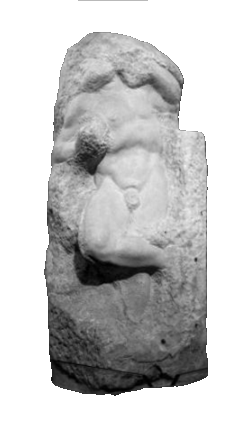
Michelangelo, The Awakening Slave (c. 1525–30). A body caught between measure and becoming.
I. On Bloom and the Anxiety of Influence
As the poet of Vitruvian Man Unbound, I find myself drawn to Harold Bloom’s understanding of how poetry functions within tradition—not as mere imitation or influence, but as a creative misreading that transforms both predecessor and successor. Bloom’s vocabulary—his clinamen (poetic swerve), daemonization, and apophrades (the return of the dead)—offers a framework for understanding my own relationship with Leonardo’s iconic drawing.
Yet I would press beyond the confines of Bloom’s categorical system. The strongest poetry, as Bloom himself recognized, resists easy resolution. Vitruvian Man Unbound embodies what he called a tessera—a completion of its precursor that simultaneously preserves and undermines its foundational terms. The poem does not simply revise Leonardo; it retroactively reshapes our understanding of him. It allows us to see Vitruvian Man as an incomplete gesture, one whose implicit metaphysical longing only achieves full articulation through the poem’s unfolding of form, desire, and transcendence.
II. The Paradox of Poetic Creation as Discovery
When I began Vitruvian Man Unbound, there was no conceit of a new idea. Rather, I felt I was unearthing the obvious—articulating for the first time verses that had already been rendered, waiting to be heard.
This situates the poem not as invention but as discovery—a Renaissance conception of artistic creation. Michelangelo spoke of liberating the form already imprisoned within the marble. Leonardo, too, conceived of art as revelation through observation, uncovering structures latent in nature and proportion. I participate in that lineage: the transcendence of the circle was already latent in Leonardo’s drawing. My poem does not overwrite Vitruvian Man but unveils what it always contained.
III. Poetry as Transcription of Revealed Truth
Poetry is primarily, in my conception, the art of transcription. Poetry is ultimately truth revealed, however rendered.
This belief is ancient. Poets once invoked the Muse, believing their songs were received rather than authored. Plato cast poets as possessed vessels of divine madness. In scriptural traditions, the prophet or sage writes not from invention but from vision. In this view, the poet is not creator but conduit.
This understanding reorients poetic practice. What matters most is not novelty of theme or form but receptivity—a cultivated attentiveness to truths that ask to be heard. To compose well is to listen well. The most vital poems do not invent so much as reveal. The poet’s charge, then, is fidelity.
Vitruvian Man Unbound aspires to this kind of transcription. It draws out from Leonardo’s image the philosophical tensions embedded therein: between proportion and possibility, containment and becoming, structure and the longing to transcend it.
IV. The Poem’s Journey: From Containment to Transcendence
At its heart, my poem charts a metaphysical journey—the awakening of a consciousness confined within geometry, gradually realizing its cosmic vocation. The Vitruvian figure, bound in ratios and ruled lines, discovers within himself not mere form but flame. The movement is from being drawn to drawing, from being measured to measuring.
The poem gives voice to this paradox: “I am both bound and boundless, large and small, / Both measured part and immeasurable all.”
This is no empty contradiction. It is the philosophical heart of the work. The circle becomes “not wall but door,” not negated but reimagined. Limitation, as I came to understand, is not the enemy of freedom but its precondition. Form does not imprison; it allows the infinite to appear in the guise of the finite.
This idea resonates with multiple traditions: the Christian theology of kenosis, quantum indeterminacy, the aesthetics of the golden ratio, even the existential struggle of Camus’ Sisyphus. In Vitruvian Man Unbound, I sought to draw them all into poetic coherence.
V. Beyond Influence: Co-Creation and Transcendence
My relationship to Leonardo’s drawing is not one of mere homage or critique. The poem does not simply descend from his vision; it reconfigures how I understand that vision. In Bloom’s terms, it enacts an apophrades: the precursor is altered by the successor, the past rewritten by the presence of the present.
I acknowledged this inversion within the poem itself: “Da Vinci dreamed me into being’s start; / I dream myself anew with conscious art.”
This was not rebellion against the tradition but transcendence through deep fidelity. I did not seek to destroy Leonardo’s Vitruvian Man; I hoped to fulfill him. I entered the drawing and found the voice that seemed to have been waiting there. The Vitruvian Man, for me, ceased to be object and became subject, consciousness incarnate.
VI. Poetry as Epistemological Practice
If poetry is the transcription of revealed truth, then it is not merely aesthetic. It is epistemological. It helps us understand not only what is, but how we come to know what is. The most original poems do not dazzle through novelty alone; they resonate because they name what we already suspected was true, but had not yet heard.
Vitruvian Man Unbound aspires to such resonance. I hope it awakens a dormant dimension in Leonardo’s drawing—and perhaps, in us. I did not set out to create a new form, but to reveal the old form’s silent music. For me, it was an act not of invention, but of listening—not conquest, but witnessing. A poetry of revelation.
Thus the ink that once bound becomes the ink that reveals.
VII. Echoes of Prometheus
In reflecting on Vitruvian Man Unbound, I recognize the shadow of another unbound figure—Shelley’s Prometheus. His liberation from cosmic tyranny, his transformation into a visionary voice of harmony, and his rejection of vengeance in favor of transcendence, all resonate deeply with the arc of my poem. Like Prometheus, the Vitruvian figure is not merely released; he is revealed—as a bearer of fire, of knowledge, of poetic truth. It is not accidental that in striving toward the infinite, we find ourselves echoing those myths and verses where the infinite has already spoken.




 Northcoast Antiquarian