The Disquieting Muses (1916-18) by Giorgio de Chirico (97.16 cm × 66 cm, oil on canvas)
Preface
This poem, Elegy for the Automatons, was inspired by George Packer’s article The Hollow Men, which appeared in the May 2025 issue of The Atlantic. Packer’s article examines the political and moral collapse of certain American officials—Speaker Mike Johnson, Senator Lindsey Graham, and Secretary of State Marco Rubio—who, once defenders of democratic principles, surrendered themselves to the inverted realities demanded by Donald Trump’s authority and his increasingly Orwellian authoritarian state.
Echoing the pivotal scene in Orwell’s 1984 where a Party orator is handed a note and instantly redirects his vitriol toward a different enemy “mid-sentence, without a pause,” Packer documents how key Republican figures performed their own breathtaking reversal on Ukraine policy, and describes how these officials pivoted instantly from celebrating Ukraine’s resistance to Russia’s aggression to denouncing Ukraine as the enemy—all in service to Trump’s shifting personal allegiances and contempt for democratic values.
Packer also invokes Henri Bergson’s insight that the mechanical within the human evokes both laughter and horror. Yet what he describes transcends mechanical reflex: it is the slow hollowing-out of conscience itself. Once-thoughtful men become fluent automatons, mouthing words disconnected from belief, loyalty, or memory.
This poem seeks to render in elegiac form the sorrowful descent of a free polity into ritualized untruth, and the transformation of human beings into instruments of submission.
“We are the hollow men We are the stuffed men Leaning together Headpiece filled with straw. Alas!” — T. S. Eliot, The Hollow Men
Elegy for the Automatons
In the year when the hollowing began, and Orwell’s warning stirred too late, it came not by fire nor iron decree, but smiling, in the face of one man. He bore no heavy crown, no burning sword; only the gift of inversion: truth was a lie, loyalty a whim, freedom the mask of power. A man for whom cruelty was a virtue, and truth a broken toy at his feet; a man who measured loyalty by abasement, and called the strong weak and the weak strong.
Under his gaze, the names of enemies blurred, history curled back on itself like smoke; words, having lost their anchor, floated as banners torn from any mast. And a people once proud of remembering forgot that they had ever known another day.
From this hour of unmooring emerged the hollowing of men.
Johnson, first among the fallen, fumbled for strength among hollow phrases, mouth heavy with the weight of borrowed words. Behind his thickened glass, a flicker died— and he mistook its ashes for light.
Graham, quick to find the favor of the wind, circled the ruin with the laughter of forgetting, shedding oaths like old garments, spinning from vow to vow as a moth to a dying flame, faithless to all but the empty crown of belonging.
Rubio, once proud in the defense of liberty, sank into the yellow chair of forgetting, listening to the slow departure of his own voice. Once he cried for the dignity of nations; now he stitched the banners of surrender with empty hands.
Thus were men unmade, not by terror, nor by war, but by the patient grinding of truth into noise, by the slow machinery of convenience and fear.
And we, who watched, sang no hymns for these men, built no statues to mark their days. They passed like shadows over a broken dial, automatons grinding down the hour, till even the dust forgot their tread.
U.S. Secretary of State Marco Rubio, February 28, 2025 — slipping deeper into the hollowing of the soul.
The Destruction of Leviathan by Gustave Doré (1865)
Author’s Note
This essay, The Void at the Heart, is presented as a contemplative meditation on the moral and spiritual collapse visible in aspects of contemporary governance and public life. It is a deliberately focused reflection, tracing the descent from cruelty in action to the corruption of thought, to the inversion of traditional values, and finally to the eclipse of the soul itself.
This essay may, in future, be expanded into a fuller monograph-length work. Such a work would likely incorporate historical and contemporary examples, address counterarguments, consider cultural issues, and distinguish more sharply between causes and symptoms of decay. For now, however, I offer this essay as a completed meditation in its own right—a starting point for further reflection.
The Void at the Heart
On Cruelty, the Collapse of Reason, and the Eclipse of the Soul
There is a void at the heart of the soul, a place where the ordinary bounds of morality and ethical consideration seem to collapse into nothingness. It is not merely that questionable policies are advanced—that has ever been the case in human governance—but rather that their implementation is accompanied by a conspicuous and grotesque relish for cruelty. Even if one were to suspend judgment upon the legitimacy of the policies themselves, the manner of their enforcement betrays a deeper and more troubling decay: a delight in the infliction of pain.
Deportation of unauthorized aliens, for instance, is not approached as an unfortunate necessity carried out with solemnity and regret. It is heralded as a triumph, an occasion for rejoicing, even as it often rips apart families, sunders years of labor and stability, and leaves children disoriented and/or abandoned. Similarly, the mass termination of public servants and contractors—individuals who dedicated themselves to fields such as public health, education, consumer protection, and law enforcement—is not seen as a sorrowful consequence of political/policy change or fiscal concerns, but is rather celebrated with an air of gleeful vindictiveness. Grants and subsidies intended for the most vulnerable, from students to farmers, are not merely ended; they are rescinded with evident gleeful satisfaction, as though deprivation itself were a moral good.
Even those nearing completion of their educational journeys, standing on the threshold of careers that might benefit society, are not spared. Educational visas are canceled without warning or cause, months or even weeks before graduation. Opportunities are crushed underfoot. Dreams are shattered not as a side effect of some broader administrative goal, but seemingly as an end in themselves, an assertion that the suffering of others is righteous and overdue.
This spirit of cruelty is defended and magnified through a rhetoric that frames suffering as deserved, earned, or insufficiently severe. The pain of others is no longer a regrettable cost, but an instrument of moral theater: those who suffer are cast as villains, their misfortunes paraded as proof of divine or civic justice. In such a worldview, mercy is weakness, empathy is betrayal, and the infliction of pain is a form of virtue.
There is a profound difference between enacting necessary policies with reluctant firmness and celebrating the devastation they cause. A just society may impose burdens, but it ought never to rejoice in doing so. When joy is found in the destruction of livelihoods, when cheers rise at the deportation of neighbors, when applause greets the impoverishment of fellow citizens, something foundational has been lost. The wound is not merely political; it is spiritual.
The embrace of cruelty as a public virtue hollows out the soul of a nation. It numbs the collective conscience, distorts the notion of justice, and substitutes vindictiveness for principle. Over time, the society that delights in the suffering of others does not merely lose its victims; it loses itself. It becomes a cold and pitiless machine, capable of great power but incapable of true greatness, capable of order but incapable of meaning.
If the celebration of cruelty corrupts action and spirit, it inevitably corrupts thought as well. The human mind, which depends upon honesty and openness to discern the world aright, cannot remain untouched by the moral decay of the soul.
The Eclipse of Reason
The celebration of cruelty does not remain confined to the sphere of action; it metastasizes into the realm of thought itself. When a society exalts the suffering of the vulnerable and frames mercy as weakness, it necessarily distorts its ability to process information honestly. Truth ceases to be measured by coherence, evidence, or fidelity to reality. Instead, it is judged by its conformity to the prevailing narratives of contempt, fear, hatred, or greed.
Thus, expertise—whether scientific, legal, historical, or journalistic—is no longer respected as a necessary guide to sound judgment. It becomes suspect by its very nature if it fails to mirror the animosities of the moment. Scientists who warn of ecological degradation, public health crises, or technological risks are dismissed as conspirators or ideologues. Legal scholars who point to constitutional violations or abuses of authority are castigated as partisan agitators. Historians who trace the patterns of injustice, violence, or repression are branded as enemies of national pride. Journalists who seek to uncover uncomfortable truths are denounced as purveyors of “fake news,” their integrity impugned simply because they refuse to tailor their findings to the dominant ideological climate.
The citizenry themselves, infected by the ethos of cruelty, become willing participants in this willful blindness. They refuse to hear, to consider, to weigh, or to deliberate. Instead, they declare all sources outside their ideological fortress to be corrupt, unreliable, or part of some imagined conspiracy. Knowledge itself becomes an object of scorn, and expertise is equated with betrayal. The very faculties that distinguish the informed citizen—the ability to discern evidence, to listen with patience, to reason without rancor—atrophy and are replaced by reflexive suspicion and tribal affirmation.
Orwell, ever the grim prophet, would recognize the phenomenon with bitter familiarity. In his imagined dystopias, the manipulation of language, the corruption of thought, and the triumph of ideology over reality are not the consequences of brute force alone, but of a populace that chooses to believe falsehoods because those falsehoods are more comforting—or more satisfying—than the difficult demands of truth. Ignorance is strength, he wrote, capturing the dark alchemy by which the renunciation of reason is transmuted into a perverse kind of certainty.
It is not merely that ideology colors perception; it replaces perception altogether. Information is no longer evaluated according to standards of credibility or methodology, but according to its utility in reinforcing contempt for the foreigner, the minority, the poor, or the vulnerable. If facts threaten to humanize the other, they are rejected. If scholarship suggests the necessity of compassion or restraint, it is denounced as corruption. Only that which fuels resentment is permitted to be heard; only that which magnifies grievance is deemed “true.”
In such a climate, dialogue becomes impossible. The very idea of dialogue presupposes a willingness to listen, to admit complexity, to concede error. But where cruelty reigns, these are forbidden virtues. In their place stand slogans, shouted endlessly into a void that no longer seeks understanding but only echoes its own bitter triumphs.
In such a climate, governance itself grows chaotic and erratic, not by accident but by design. Policies are proclaimed and abandoned with little coherence; programs are implemented or canceled with open disregard for planning, expertise, or consequence. The instability is treated not as a failure, but as a virtue: a sign of disruption, toughness, authenticity. Yet beneath the slogans, the disorder corrodes trust, hollows out institutions, and leaves citizens adrift in a landscape where no promise endures and no framework holds. It is a cruelty not merely of action, but of confusion—a destabilization that magnifies alienation and feeds the collapse of both thought and community.
Yet even this collapse of thought is but a precursor to a deeper betrayal: the corruption of the very values that once defined and ennobled a people.
The Inversion of Values
As cruelty becomes a public virtue and ideology supplants reason, the final and most insidious transformation takes place: the subversion and inversion of traditional values themselves. The outward forms and labels of religion, civic duty, and ethical conduct may be preserved, but their substantive meanings are hollowed out and replaced by their very opposites. Language itself is corrupted; words once signifying aspiration, mercy, and justice now serve as empty vessels, bearing meanings recognizable only as antonyms of their epistemological truths.
Faith, once the call to humility before the divine and charity toward one’s fellow man, is distorted into a weapon of exclusion and punishment. Love of neighbor becomes conditional, subject to ideological conformity; compassion is reserved for the in-group alone, while hatred of the stranger is sanctified as a form of righteousness. The prophets and founders who once preached repentance, mercy, and love are invoked by those who trample upon their teachings, their sacred words reinterpreted to bless cruelty as strength and vindictiveness as virtue.
Civic values fare no better. Patriotism, once the measured love of one’s country expressed through service, sacrifice, and the protection of rights, degenerates into a shrill and defensive chauvinism. The rule of law, once understood as a shield for the weak and a restraint upon the strong, is twisted into a blunt instrument to punish enemies and protect the powerful. Freedom, once the delicate balance between personal liberty and communal responsibility, is redefined as the license to oppress, to dominate, to revel without shame in the suffering of others.
Even the ethical precepts that ground common life—the golden rule, the dignity of work, the sanctity of truth—are inverted. Do unto others becomes do unto others first, lest they do unto you; the dignity of labor is reserved for some and withheld from others based on arbitrary categories of race, origin, or ideology; truth itself becomes malleable, no longer a standard to which men must conform, but a tool to be wielded, bent, or abandoned as expediency demands.
In this bleak mirror-world, tradition becomes little more than pageantry—a hollow ritual masking a profound spiritual betrayal. The ancient words are mouthed, the venerable ceremonies performed, but their meaning is lost. Their light has been inverted into darkness, their call to transcendence replaced by a shout of tribal triumph. What was once sacred has become profane, and the keepers of the tradition are blind to their own apostasy.
Yet the descent does not end even there. It reaches further downward, to the degradation of the individual soul itself.
The Final Descent
Ultimately, the mind infected by cruelty and blinded by ideology forgets how to think, how to reason, how to love. The soul, once the wellspring of compassion, imagination, and truth-seeking, is lost. What remains is a hollow creature, a being still outwardly human but inwardly diminished, descending toward an animalistic existence governed only by base and grotesque instincts.
No longer illuminated by the light of reason, no longer stirred by the love of others or the awe of the divine, such a being reverts to the raw appetites of dominance, fear, rage, and self-preservation. The faculties that once elevated humanity—the search for truth, the capacity for self-sacrifice, the impulse toward mercy—atrophy and rot. What once distinguished man as a creature formed in the image of the divine is obscured beneath layers of suspicion, resentment, and brutality.
In such a state, crassness replaces dignity, and rudeness masquerades as strength. The subtleties of manners, the graces of dialogue, and the silent obligations owed to neighbor and stranger alike are discarded as burdensome relics of a now-despised civilization. Material success becomes the sole remaining measure of worth, and individual gratification the only recognized good. The broader community—once the nurturing ground of the self—becomes either invisible or hostile, perceived only as an impediment to personal appetite or ambition.
Alienation takes root, first unnoticed, then unchallenged, feeding upon itself. Having severed the ties that bind individuals to each other through mutual respect, shared memory, and common purpose, society decays into a landscape of lonely, embittered selves, suspicious of all and merciful to none. This alienation colors every interaction with a thin, toxic miasma: a pervasive bitterness, a readiness to assume the worst, a ceaseless litany of grievance against an imagined host of enemies.
The community, too, begins to crumble. No society can endure when its members are ruled by suspicion rather than trust, hatred rather than fraternity, cruelty rather than justice. Institutions falter, not because they are attacked from without, but because the very spirit that once animated them has fled.
Yet the gravest tragedy is not merely societal collapse, but the debasement of the individual soul. Each man or woman who abandons thought for slogan, love for contempt, truth for expedience, does more than wound the body politic; they desecrate the image of the divine that resides within.
Thus, the moral and ethical void at the heart of the soul becomes complete. And from that void, no nation, no civilization, no human heart emerges unscathed.
Epilogue: The Faint Memory of Light
Yet even amidst the ruin, a faint memory endures.
The divine image, though battered and obscured, is never wholly extinguished. Buried beneath the ash of cruelty and the rubble of falsehood, there remains a spark—a silent witness to the soul’s higher calling. It is not easily rekindled. It demands humility where pride has reigned, mercy where vengeance has triumphed, courage where fear has prevailed.
The path back is arduous and uncertain, for it requires the infected soul to remember that it has forgotten; it requires a people to repent not merely of actions, but of the passions that animated them. It requires that tradition be not merely repeated but restored, that truth be not merely spoken but once again loved, that reason be not merely used but honored.
If such a reawakening is to come, it will come quietly at first, as all true renewals do—not in thunderous proclamations, but in the whispered refusal to hate, the silent act of mercy, the solitary pursuit of truth in a world grown hostile to it. From these small and stubborn acts, unseen and unsung, a civilization might yet be reborn.
But if not, then the void will deepen, and the ruins will spread, and future generations will wonder at how lightly men once abandoned what was most precious: not wealth, nor power, nor comfort, but the light of mind and soul that marks the human being as more than a beast among beasts.
The choice remains, as it always has, hidden in the quiet precincts of each heart.
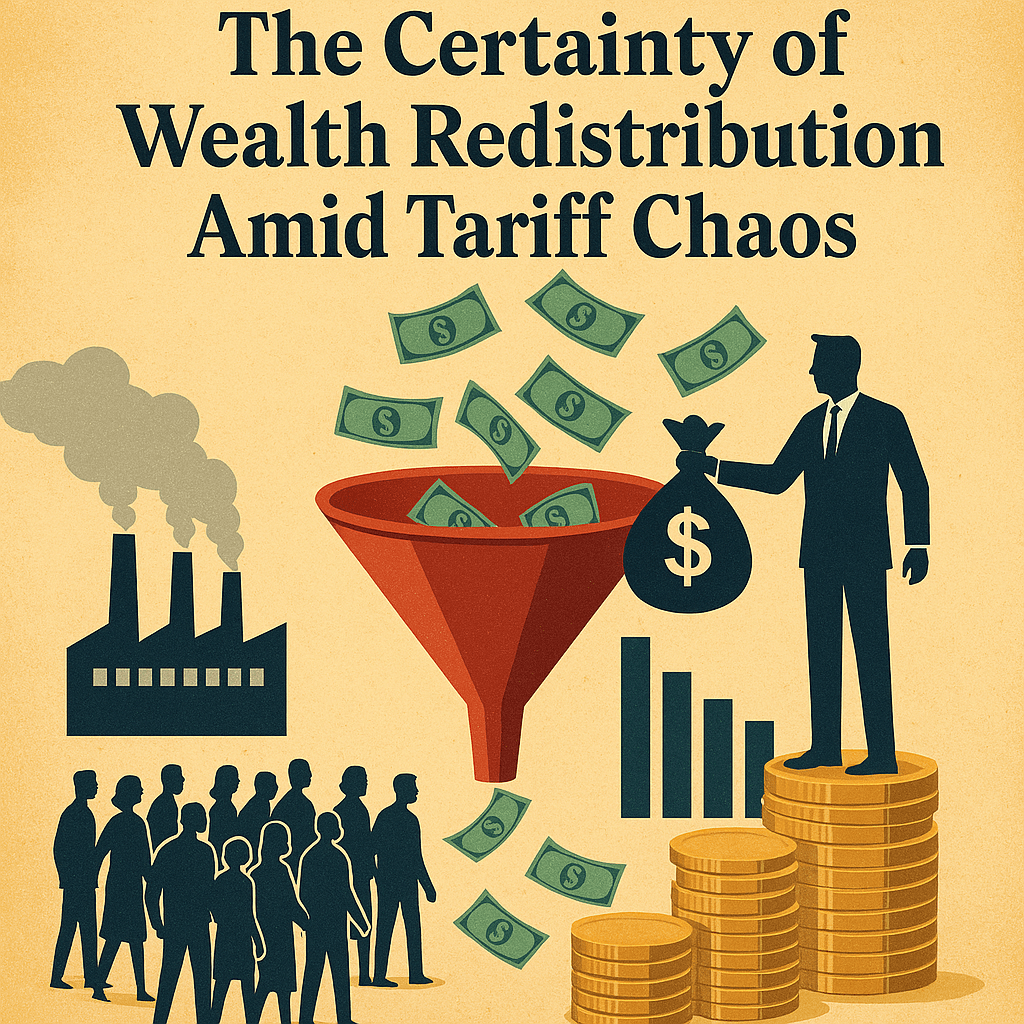
Recently, I published an essay titled The Certainty of Wealth Redistribution Amid Tariff Chaos, in which I argued that the true function of the current administration’s tariff policies was not economic revival, but the deliberate and predictable transfer of wealth from working households to the uppermost tier of financial elites.
Events of the past several days—culminating in imposition of a market-crashing tariff decree swiftly reversed for maximum opportunistic gain—have confirmed my worst fears. That some now praise this spectacle as “brilliant” only adds insult to economic injury.
In response, I offer the following satirical memo from a fictional Wharton Annex ethics professor—one Professor Basil P. Whisker, Chair of Ethical Opportunism at the Weasel School of Business. His observations regarding the situation and the logic he embodies—even though he is fictional—are uncomfortably real.
Professor Basil P. Whisker
On Ethics, Market Manipulation, and the Power of Praise
Buy the Dip, Praise the Dipper: A Wealth Transfer Playbook
By Professor Basil P. Whisker, PhD, MBA, CFA (Parole Honoré Distinction) Chair of Ethical Opportunism, Weasel School of Business, Wharton Annex Formerly of the Federal Correctional Institute for White Collar Refinement “Our Honor Code is Flexible. Our Returns Are Not.”
Some in Congress have raised the unfashionable concern that the recent tariff saga looks suspiciously like market manipulation.
To which I reply: Of course it is. But for whom?
Not the little people—they lack both the reflexes and the capital reserves. No, it is for the elite few trained in the disciplines of anticipation, flexibility, and pliable morality.
At the Weasel School of Business, we teach that ethics must be nonlinear and dynamic—responsive to the moment, like high-frequency trading algorithms or a presidential memory when questioned under oath. The recent 90-day tariff “pause” (following a dramatic market collapse) teaches students everywhere that sometimes the most profitable thing to do is to:
Create a crisis
Seize the resulting dip
Declare victory through reversal
Congratulate the disruptor for his “brilliance”
Move on before the subpoenas arrive
The Art of the Non-Deal
When a policy announcement wipes trillions from the markets, only to be reversed days later with a triumphant “THIS IS A GREAT TIME TO BUY!!!” post, we must acknowledge we are witnessing not governance but performance art.
Like all great art, it asks difficult questions:
Is it market manipulation if you announce the manipulation in real time?
Can one declare “Liberation Day” and then liberate oneself from that declaration?
If financial whiplash creates billionaire gratitude, is it still whiplash—or merely strategic spine realignment?
Billionaires praising such tactics is not sycophancy—it is advanced portfolio management by other means.
As we say in Weasel Finance 101: “Praise is just another form of leverage.”
Looking Ahead: A Curriculum of Chaos
We are entering a new phase of global commerce—what I call the Era of the Glorious Lurch. In this new age, tariffs are not policies but market mood regulators, deployed tactically to evoke loss, recovery, and eventual Stockholm syndrome-like gratitude.
My revised syllabus for the coming semester will include:
Advanced Self-Dealing (OPS-526)
Narrative Arbitrage: Writing History Before It Happens (OPS-618)
Strategic Sycophancy and Influence Leasing (co-listed with Communications)
Tariff Whiplash: Creating Wealth Through Vertigo (OPS-750)
When Textbooks Fail: The Art of the No-Deal Deal (Senior Seminar)
Applications are open. Scholarships available for those with prior SEC entanglements or experience declaring “everything’s beautiful” while markets burn.
A Word on Timing
Critics who suggest that one should wait until an actual deal is struck before declaring brilliance simply do not understand modern finance.
In today’s economy, praise is a futures contract—you are betting on the perception of success, not success itself.
When a policy costs the average American household thousands in higher prices and market losses, only to be partially reversed with no actual concessions gained, the correct reaction is not analysis but applause. After all, it takes real courage to back down without admitting it.
A Final Toast
To the president, I raise a glass of vintage tax shelter with notes of plausible deniability.
To the billionaires celebrating the “brilliant execution” of a retreat, I offer a velvet-lined echo chamber.
And to my students, past and future, I remind you: If you cannot time the market, at least time your praise.
Because in today’s economy, there is no such thing as too soon, too blatant, or too obviously beneficial to the 0.01%.
So next time markets plunge on policy chaos, do not ask “who benefits?” Instead ask, “am I positioned to be among those who do?”
Thank you. And as always— buy low, tweet high, and declare victory before the facts catch up.
Sometimes, a little historical memory delivered with a healthy dose of satire is exactly what the moment calls for. I recently stumbled upon this memorandum—allegedly issued by Herr Obersekretär Otto von Pulpo, our resident officious German octopus—crafted as a sharp response to The Economist’s editorial, “Is Elon Musk remaking government or breaking it?” Unsatisfied with the notion that “some transgressions” might be acceptable if they bring about efficiency, I was inspired to share this fictional but incisive critique. Enjoy Otto’s take on why the path of destruction is never a shortcut to genuine reform, and join the conversation on how we should remember history in light of today’s political challenges.
Memorandum No. 843.3a-b(krill) From the Desk of Herr Obersekretär Otto von Pulpo Former Archivist, Department of Tentacular Oversight (Ret.), Abyssal Branch Current Observer of Surface-Level Folly, Emeritus
To the editorial board of The Economist, cc: The Directorate for Dangerous Euphemisms, Baltic Division
RE: Concerning Your Recent Enthusiasm for “Some Transgressions” in the Service of Government Efficiency
Esteemed humans,
It is with a firm grip and furrowed brow (of the metaphorical kind—our brows are subdermal) that I write to express my alarm, tinged as it is with a deep familiarity, at your recent editorial on the so-called Department of Government Efficiency (DOGE). Your noble publication—usually known for reasoned analysis and fondness for balanced budgets—has recently dabbled in the genre of historical amnesia.
You write, approvingly if not enthusiastically, that “some transgressions along the way might be worth it” in your editorial “Is Elon Musk remaking government or breaking it?” Permit me, as a creature of long memory and cold water, to remind you: some transgressions are never worth it. History is not made by heroic shortcuts. It is unraveled by them.
When I was a much younger cephalopod, gliding the brackish waters near Wilhelmshaven, I recall hearing the surface-world’s chatter about another figure who spoke boldly of waste and stagnation, who promised national renewal, who performed gestures that were first dismissed as eccentric, and who flirted with “creative destruction” until the destruction ceased to be metaphorical. He too was seen by many as a misunderstood innovator. Until it was too late.
Herr Musk, I understand, now punctuates state occasions with gestures uncannily similar to the Roman salute, and praises parties in your former occupation zone with a fondness that suggests more than economic theory. If these are the traits of a reformer, then perhaps I should consider joining the AfD myself—though I suspect I would not pass their purity tests, being both foreign and soft-bodied.
But it is not Herr Musk who most disturbs me. It is your newsmagazine, with your steady tone and Oxford commas, that murmurs, “Efficiency requires boldness,” and wonders aloud whether the destruction is merely a precursor to some unseen creation. You ask: “Who now remembers the Grace Commission?” And I reply: who now remembers the Enabling Act of 1933, passed under the same logic—that extraordinary conditions justify extralegal actions?
Beware the language of renovation when it requires dismantling the foundation. Beware the hagiography of disruptors who come not to build, but to erase. DOGE does not make government more efficient. It makes obedience more efficient.
If I may say so without rudeness, your editorial reads as if it were penned in a warm bath, insulated from the chill that such reasoning brings to those of us with memory. Down here, in the benthic gloom, we remember what it means when legislative bodies and courts are bypassed, when “wrongthink” is rooted out, when civil servants are mocked as obstacles to destiny.
Do not confuse boldness with wisdom. Do not mistake collapse for reform.
With respectful concern and eight meticulously inked signatures,
Otto von Pulpo Obersekretär a.D. Archivist, Rememberer, Cephalopod
P.S. Historical Note from the Abyss:
When tectonic plates shift, they do not ask for parliamentary approval. They simply move—and tsunamis follow. I have observed this firsthand from 4,000 meters below. The surfacelings always call it unprecedented, as if the sea forgets. We do not forget.
Herr von Pulpo’s earlier memoranda (Nos. 842.1–843.1) were dispatched in response to similar enthusiasms for charismatic technocrats in the late Weimar period. These were, at the time, unread by those who most needed to read them.
About the Author Otto von Pulpo is a retired archivist, amateur historian, and former Vice-Chair of the Commission for Bivalve Misclassification. He resides in a gently collapsing wreck off the Heligoland shelf and writes occasionally on democracy, plankton, and the perils of charismatic overreach.
In the history of American economic policy, few moments have rivaled the current administration’s radical redirection of trade as both a break with precedent and a deliberate provocation of instability. The imposition of universal tariffs, compounded by steep duties on selected nations and penguins, has injected volatility into nearly every sector of the global economy. Yet, for all the uncertainties this policy has unleashed—geopolitical, fiscal, and industrial—one outcome is not only predictable but virtually guaranteed: a significant transfer of wealth from the broad base of American households to a narrow echelon of financial elites.
The administration’s tariff policy, sweeping in scope and nationalist in tone, has been sold to the public as the path to the restoration of American greatness, even proclaimed as a “Liberation Day.” But the reality it heralds is less one of liberation than of reallocation—specifically, a reallocation of economic burden and reward. By taxing nearly all imported goods—consumer staples, electronics, food, clothing, and industrial components—the policy imposes a direct and regressive cost on the average American. Inflationary pressures, rising production costs, and disrupted supply chains ensure that these tariffs function not merely as tools of negotiation, but as economic levers that press down on the middle and lower classes while lifting those whose wealth resides in capital rather than wages.
If the COVID-era recession taught us anything, it is that crises, when coupled with targeted monetary and fiscal policy, can act as engines of wealth concentration. During the pandemic, unprecedented interventions—stimulus checks, expanded unemployment insurance, PPP loans, and Federal Reserve liquidity—managed to momentarily soften the blow for many. Even then, the lion’s share of wealth gains went to the top 0.1%, as asset prices surged and capital-rich investors reaped the benefits of timely speculation and quantitative easing.
But the current recession-in-the-making differs in one essential respect: it is being pursued without pretense of public aid. There are no stimulus packages, no safety nets. What is offered instead is a doctrine of creative destruction: tens of thousands of federal workers laid off; regulatory agencies gutted; international partners alienated; domestic producers left to absorb new costs or pass them on to already-strained consumers. The economic pain is not an unintended consequence—it is the plan. And in such an environment, wealth will not merely trickle upward; it will flood there.
As import costs surge, businesses with transnational supply chains and logistical flexibility will shift production, seek carve-outs, and hedge against volatility. Those without such capacities—local manufacturers, family-owned farms, small retailers—will face thinning margins, layoffs, and in many cases, closure. The financial elite, holding diversified portfolios in real estate, private equity, and multinationals, will swoop into the resulting vacuum, acquiring distressed assets at discount, consolidating market share, and harvesting profits from inflationary dynamics. As was seen in the years following 2020, equity markets may fall precipitously at first, but they are likely to rebound faster than the broader economy—particularly with the Federal Reserve expected to cut interest rates in the wake of contraction. Once again, asset prices will rise. Once again, the owners of capital will see their fortunes grow.
Tariffs are traditionally viewed as blunt instruments of industrial protection. But in this case, they serve a far more surgical purpose. They extract purchasing power from the working class, undermine the viability of small and medium enterprises, and force a restructuring of the American economy around those who can absorb cost, influence policy, and pivot globally. They are not instruments of policy so much as instruments of wealth concentration.
If anything is certain in the unfolding tariff-driven crisis, it is that inequality will increase. Not in abstract or relative terms, but in concrete redistributive ones: trillions of dollars will move from wage earners and consumers to capital holders and financial intermediaries. The historical data, the institutional forecasts, and the structural logic all align. Amid the din of political slogans, retaliatory tariffs, and market disruptions, this is the one truth that should command attention.
History will not record this period as a victory for the American people. It will record it as a transformation: not of manufacturing, not of trade, but of the very architecture of American wealth—concentrated more tightly, held more distantly, and insulated more completely from the needs and voices of the many.





 Northcoast Antiquarian