

Temple Ruins

By Donald S. Yarab

Nabataean temple ruins at Khirbet et-Tannur, Jordan. The temple may have been dedicated to the goddess Atargatis (see McKenzie et al. 2002; Almasri 2019).

When the Rains Come

When the rains come … the dust shall become mud,
When the rains come … the mud shall become mire,
And the feet of the proud shall sink to the ankle,
And their words shall cling like clay to their tongues.

When the rains come … the roofs shall tremble,
The cisterns shall overflow their stone mouths,
And the low places shall remember the sea,
Calling out to the deep from which they were torn.

When the rains come … the idols shall dim,
Their painted eyes veiled in silt and silence,
And the temples shall weep through broken eaves,
For their gods shall not answer from the thunder.

When the rains come … the earth shall be heavy,
And the hearts of men heavier still;
The widow shall draw her shawl to her face,
And the child shall forget the taste of dry bread.

When the rains come … we shall huddle together,
Beholding the waters erase our names from the doorposts,
And none shall boast of his harvest,
For the river shall take what it wills,
Bearing all things toward the forgetting sea.

When the Sun Is Restored

When the sun is restored … the waters shall fade,
When the sun is restored … the mire shall break and sigh,
And the earth shall stir beneath the plough,
Breathing again as if reborn.

When the sun is restored … warmth shall come first,
A balm to the chilled and the shivering earth;
Green shall rise from the broken furrows,
And the people shall bless the light.

When the sun is restored … the fields shall swell,
The ears grow heavy, the vines bend low;
And laughter shall echo in the threshing floor,
Till the grain lies fuller than the granaries can hold.

  And in the noonday brightness the sparrows fell silent,
  For they knew the hour would not endure.

When the sun is restored … the rivers shall dwindle,
The soil yawn open like a parched mouth,
And famine shall creep from the roots of plenty,
Taking the firstborn of abundance.

When the sun is restored … the hearts of men shall fail,
Their tongues cleaving to the roofs of their mouths;
And the widow shall weep no longer,
For her tears have been taken by the wind.

When the sun is restored … we shall gather at the well,
Staring into its empty throat,
And all shall return to dust,
For from dust were we raised, and to dust we descend;
And we lift parched hands, as if exalting to heaven for rain,
That the circle may begin again.

When the Silence Falls

When the silence falls … the people shall gather,
Not in joy nor mourning, but in stillness;
And the priests shall stand before the altar,
Their hands empty of offerings.

When the silence falls … the incense shall not rise,
For no prayer shall remain upon our lips;
We have cried out in the rains and cursed in the drought,
And now we have no words to give.

When the silence falls … the children shall ask,
“Why do we come to this place?”
And the elders shall have no answer,
For the stones themselves have forgotten their purpose.

When the silence falls … the priests shall look upon each other,
And see their own faces as through water;
They shall remember the prayers they learned as boys,
And wonder if the words were ever heard.

When the silence falls … we shall see what we have built—
Altars worn smooth by our hands,
Bowls that held grain and oil and blood,
All the bargaining of our fathers with the sky.

When the silence falls … no voice shall descend,
Neither blessing nor judgment from above;
And we shall know that we stand alone,
Between the rain we fear and the sun we cannot bear,
Waiting in the house we made for a goddess
Who has not spoken in living memory.

Against Magical Thinking: Contemplation, Conspiracy, and the Abuse of Sacred Language


Early manuscript
Photo by silvia lusetti on Pexels.com

Recently, I read with great interest Hari Kunzru’s article “Doing Their Own Research” in the New York Review of Books (May 29, 2025). It is a piercing, sometimes surreal examination of the strange coalition now shaping American political and spiritual culture: a “New Weird Fusionism” of right-wing conspiracy, countercultural wellness, and mystical absolutism. The portrait he offers—of a society increasingly shaped by magical thinking, selective paranoia, and a weaponized imagination—was as disturbing as it was insightful.

But what struck me most was the realization that the cultural atmosphere Kunzru describes makes it increasingly likely that contemplative works like my recent Liber Agglutivi will be not merely misread—but conscripted into the very worldview they seek to resist.

In that work, framed as a fictional medieval treatise on sacred language, I explore how language, when approached with reverence and silence, becomes not a tool of communication but a site of presence—how it may not only speak about reality, but participate in it. Yet as I read Kunzru’s analysis of conspirituality—the synthesis of conspiracy and New Age belief—I saw an eerie proximity between certain rhetorical structures in Liber Agglutivi and the thought patterns of this cultural formation: secrecy, marginalia, hidden knowledge, the recovery of “true” language lost to corruption.

The danger is real: in an age where every form of mystery gets weaponized, how do we distinguish between authentic contemplative practice and its paranoid simulacra?

It is precisely here that the contrast must be made explicit.

The Liber is not a manual for decoding reality through esoteric symbols or a codebook for revealing global plots. It is not a mystical justification for control, nor an invitation to gnostic certainty. Its words are not “keys” to hidden truths in the paranoid sense Kunzru describes. Rather, it is a contemplative experiment—a poetic, philosophical invitation to see language as something we enter with humility, not something we wield with certainty.

What conspirituality offers is often a form of linguistic inflation: a conviction that to name something is to master it, that to imagine is to manifest, that hidden truths are personal weapons in a war against “them.” This is not reverence for mystery but inflation through proximity to it. The practitioner of conspirituality approaches mystery as a puzzle to be solved, a code to be cracked that will grant power over reality itself.

By contrast, the Liber offers a theology of kenosis—a self-emptying approach to speech in which the word is not a sword, but a veil; not a control mechanism, but a site of transfigured listening. Where conspirituality seeks to decode, contemplation seeks to be changed by what it encounters.

Consider the difference in practice. A conspirituality adherent might read the Liber’s phrase about “memory that knows not what it remembers” as a hint toward recovering suppressed historical truths or accessing forbidden knowledge that “they” do not want you to have.

A contemplative reader approaches the same phrase as an invitation to sit with unknowing itself—to let the mystery remain mysterious while allowing it to transform one’s relationship to knowledge. The first approach inflates the ego; the second empties it.

Kunzru’s analysis is especially compelling in its treatment of magical thinking across the domains of politics, religion, and economics. It is alarming to witness the persistence of the nineteenth-century “mind-cure” tradition—the belief that reality is downstream of personal attitude—now manifesting as national governance logic.

That Donald Trump, among others, internalized Norman Vincent Peale’s message of mental affirmation to the point that factuality became irrelevant is not merely a character trait—it is a symptom of an epistemological crisis. Similarly, the self-help gospel of The Secret, evangelical prosperity teachings, and the memetic evangelism of internet conspiracists all illustrate a culture in which to believe is to make it so.

The boundary between wish and world is not merely blurred—it is denied.

The Liber Agglutivi, by contrast, insists that language’s creative power arises not from assertive will but from contemplative reception. The phrase “word that becomes the thing” does not mean that the self wills reality into being. It means that, in sacred silence, the word discloses what is already most true.

This is a fundamentally different ontology. It is not manifestation; it is reverent participation.

Kunzru rightly notes how easily mystical language can be conscripted by paranoid styles. The idea that “everything is connected,” which in contemplative practice leads to compassion and humility, in conspiracy often leads to reductionism and scapegoating.

The Liber speaks of memory that “knows not what it remembers”—a phrase meant to evoke mystery and presence, not cognitive shortcuts to hidden truths.

So while Kunzru’s essay is not a critique of my work, it felt like a necessary caution about the times in which such a work might be read. In an age of epistemic confusion and symbolic inflation, sacred language must be handled with even greater care.

We must distinguish between language as control and language as communion; between the voice that silences others and the voice that emerges from deep silence. We must recognize that in our current moment, the very practices that might lead us toward wisdom—attention to mystery, reverence for hidden dimensions of experience, suspicion of surface explanations—can be corrupted into tools of manipulation and division.

The Liber Agglutivi may look like a book of secrets, but it is really a book about unknowing—about hearing the spaces where speech begins. And in a world where every utterance is increasingly co-opted for political or psychological leverage, the commitment to silence, reverence, and the mystery of meaning may itself be the most radical stance available to us.

Words that reign do so only when they have ceased to serve the self.
In our age of weaponized mysticism, that may be the difference between wisdom and delusion, between contemplation and conspiracy.

Liber Agglutivi: A Work of Fiction, Philosophy, and Reverence

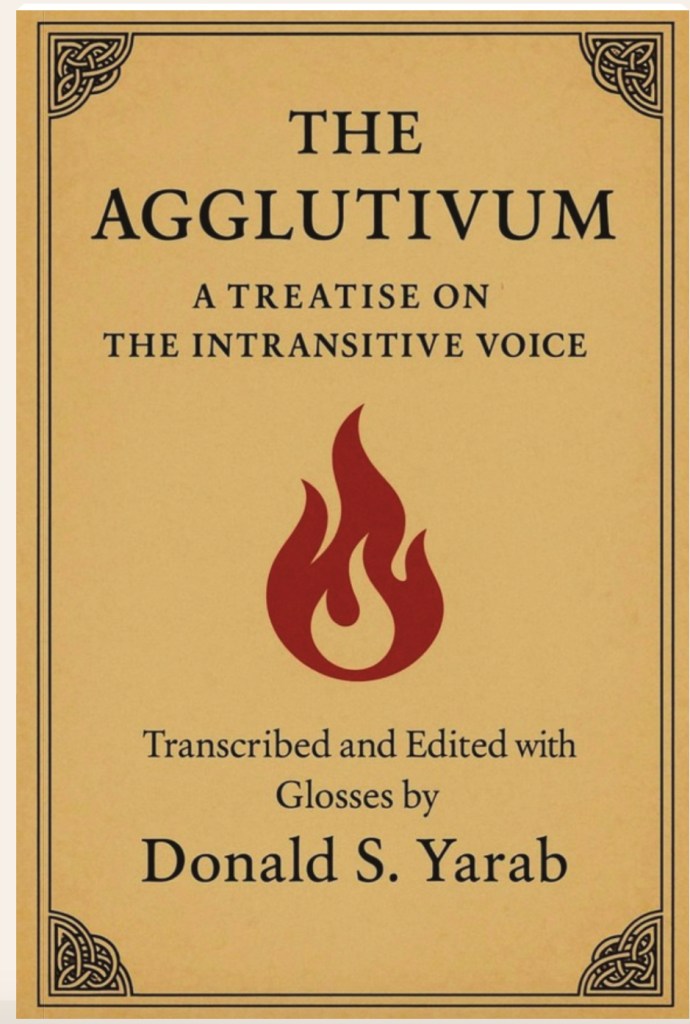
It is difficult to describe the Liber Agglutivi, or as translated into English, The Agglutivum: A Treatise on the Intransitive Voice, for both its origin and content resist conventional classification. Its genesis, as I recount within the pages themselves, was not intellectual but oneiric. The word agglutive—unknown to me then, undefined in any language I … Continue reading “Liber Agglutivi: A Work of Fiction, Philosophy, and Reverence”


THE AGGLUTIVUM  
A TREATISE ON THE INTRANSITIVE VOICE - bookcover
The Agglutivum: A Treatise on the Intransitive Voice
Transcribed and Edited with Glosses by Donald S. Yarab
Paperback, 58 Pages, 6in × 9in, $7.99 plus $5 postage
CLICK IMAGE ABOVE TO ORDER BOUND COPY

It is difficult to describe the Liber Agglutivi, or as translated into English, The Agglutivum: A Treatise on the Intransitive Voice, for both its origin and content resist conventional classification. Its genesis, as I recount within the pages themselves, was not intellectual but oneiric. The word agglutive—unknown to me then, undefined in any language I knew—visited me repeatedly in sleep. So compelling was its sound and weight that, upon waking, I began at once to give breath to the whisper that had haunted my rest. What emerged was not story or doctrine, but something stranger and perhaps more elemental.

The text that followed felt less composed than revealed—an excavation rather than a construction. It is, in the truest sense, a received work. Its structure—voculae, glosselitha, silentia, postverba—appeared as if drawn from some hidden grammar beneath ordinary speech. Though shaped in Latin (with an English translation as appendix) and framed by scholarly apparatus, it is not a parody nor a pastiche, but a sincere tribute to the metaphysical impulse in language.

Readers may find echoes of Borges, Vico, and Pseudo-Dionysius; others may see affinities with mystical traditions, liturgical fragments, or even speculative linguistics. It may be read as fictive scripture, poetic glossolalia, philosophical provocation, or theological shadowplay. Or perhaps—if read rightly—it is none of these, but instead a call to silence, to memory, to the threshold of meaning itself.

Let it be said plainly: this work will not appeal to all. It is slow and strange, elliptical and spare. But for the rare reader attuned to the hum beneath the words we know, it may, in its own agglutive way, speak.

The work is available to read through the link below as a free PDF. For those who find affinity with it, an inexpensive bound copy may be ordered by clicking the image of the book above.


PHILOSOPHICAL EXTENSION: ONTOLOGICAL VOCULAE

A Contemporary Meditation Inspired by the Liber Agglutivi

The Agglutivum suggests but does not systematize a catalog of words that resist conventional grammar—words that seem to create rather than merely describe reality. What follows is a modern attempt to identify and explore such “ontological voculae,” developed in the spirit of the medieval treatise but acknowledging its contemporary construction.


Voculae Agglutivae

A Supplement to the Glossarium Philosophicum
Non omnia verba dicuntur ut loquantur. Quaedam dicuntur ut fiant.


I. Sacra Voculae – Sacred Utterances

These words do not inform; they summon. Often liturgical, they retain weight through resonance, not explanation.

  • Amen
    Confirmatio sine contentu.
    —What is confirmed is not always known.
  • Alleluia
    Laus pura, sine scopo.
    —Praise that outruns its object.
  • Kyrie
    Clamor, non formula.
    —Not request, but primal cry.
  • Hosanna
    Eruptio, non enuntiatio.
    —A word of ascent, not address.
  • Om / Aum
    Vox quae se ipsam audit.
    —The breath that sustains itself.

II. Voculae Primitivae – Primal Expressions

Pre-conceptual utterances: the first stirrings of meaning, or the last.

  • Yes
    Vocabulum consentientis animae.
    —Affirmation without argument.
  • No
    Negatio sine opposito.
    —The first refusal of the void.
  • Ah
    Apertura interioris visus.
    —Recognition unmediated.
  • Oh
    Exclamatio praesentiae subitae.
    —When the world enters unbidden.
  • [Intake of breath before weeping]
    Suspirium originis.
    —A language too full to speak.

III. Nomina Se Nominantia – Names That Name Themselves

These words contain themselves, and alter meaning with each utterance.

  • God
    Vocabulum ad quod omnis significatio deficit.
    —The name that names the unnamable.
  • I
    Index mobilis identitatis.
    —Each speaker remakes it.
  • Here
    Locus qui loquitur se ipsum.
    —Presence given in the utterance.
  • Now
    Tempus quod fit dum nominatur.
    —Time speaking its own arrival.

IV. Verba Liminalia – Threshold Words

Spoken not to describe, but to open a space.

  • Hello
    Initiatio contactus.
    —More door than declaration.
  • Goodbye
    Benedictio transitus.
    —Departure sanctified in speech.
  • Please
    Vulnerabilitas facta audibilis.
    —A soft invocation of the will.
  • Welcome
    Domus facta verbo.
    —The house that builds itself in greeting.

V. Glosselithae Viventia – Words Worn Smooth by Use

Repeated beyond meaning, yet retaining force.

  • Love
    Verbum laesum; reclamatione indiget.
    —Desecrated by misuse, yet pulsing still.
  • Peace
    Optatio in figura dissoluta.
    —A longing that sounds like a promise.
  • Home
    Non locus, sed reditus.
    —Not place, but return.
  • Mother
    Verbum primordiale; lingua ante lingua.
    —The first word spoken without grammar.

VI. Voculae Intranslatae – The Untranslatable

Not exotic curiosities, but deep resonances foreign to our tongue.

  • Saudade (Portuguese)
    Absentia praesentiae desideratae.
    —Longing for what once was or never was.
  • Duende (Spanish)
    Spiritus tenebrosus artis viventis.
    —The dark, unteachable spark of art.
  • Hiraeth (Welsh)
    Nostalgia quae locum non habet.
    —Homesickness for an imagined past.

VII. Voculae Vulneratae – Wounded Words

To be spoken only with reverence, if at all.

  • Freedom
    Verbum quod fuit, et quod mendacio circumdatur.
    —Once invoked in hope, now weaponized.
  • Truth
    Conceptus fractus inter instrumenta.
    —Broken under the weight of use.
  • Justice
    Verbum spoliatum, ad reclamationem vocatum.
    —A word in exile.

Nota Terminalis:

Verba haec tangenda sunt sicut lapides post imbrem. Non sunt instrumenta, sed accessus. Loqui ea est transire limen. Tacere ea est servare lumen.

The Sermon on the Stump: Beneath the Rain


Photo by Ali Hassan on Pexels.com

The Sermon on the Stump

by Donald S. Yarab

It was raining. The crowd—
too few to be a crowd—perhaps
a gathering, or the assembled,
more ghosts than listeners,
their coats darkened not just by weather
but by the weight of waiting.

He stood on the stump,
not of authority, but of loss—
the remnant of a tree felled long before,
as if the forest had once believed
in clearing room for prophecy.

He spoke not of thunder,
but of hush. Not of redemption,
but of what remained
after the soil forgot its seed.

The gathering, if such it was,
did not cheer, nor weep.
They listened with the rain,
as if the water itself
were translating his broken cadence
into something nearly true.

He spoke not of hope, or loss,
of tomorrow, or yesterday,
or even today.
He named no sins,
offered no absolution,
held no book but the hush
of water sliding down his sleeve.

His voice did not rise.
It pooled.
Like the rain in the hollow of the stump
beneath him.
He said only:
“You have heard the wind.
Now hear the stillness it leaves behind.”

And they did not answer.
Not from doubt,
but because his words were not questions.
They were roots—
groping downward through silence,
seeking something older than belief.

A dog barked in the distance.
A child shifted,
not from boredom,
but from the weight of understanding
too early what it meant to stand still
in a world that keeps spinning.

He stepped down,
the stump left wet,
as if it had wept a little too.

And the assembled, if that is what they were,
dispersed—no closer,
no farther,
but marked.

Some were bewildered.
Others thought they were enlightened,
but knew not how.
Still others could not recall
what he had said,
only that his voice was comforting,
his cadence soothing—
not the lullaby of forgetfulness,
but the murmur of rain on old wood,
reminding them of something
they had never quite known.

No creed was offered.
No call to return.
Yet a few found themselves
walking more slowly afterward,
listening more intently
to trees, to puddles,
to silences that did not demand reply.

And the stump remained—
neither altar nor monument,
but a place where words once settled
like mist
and did not vanish.

The Hush and the Breath

A Poetic Transformation

Some texts are not revised so much as they are reheard. After publishing my essay Between Noise and Silence: On the Literal, the Metaphoric, and the Space Where Meaning Resides, I found myself haunted by one sentence in particular:

“It is the hush in a conversation—not the words, but the breath that precedes or follows them—that can speak more profoundly than the speech itself.”

Those words returned to me again and again. And in their insistence, they asked for more.

The following poetic fragment emerged in response.
It is offered here as a kind of imagined rediscovery—
a scroll unearthed, not written; gathered, not composed.
Said to be copied from a fragment attributed to the Scribe of the Restoration, it may be read as a poetic conceit: a transformation of thought into voice, of prose into hush.


Ruach (Breath, Wind, Spirit — An Aureate Silence)
Intended as a visual companion to Scroll of the Breath – Fragment III, evoking the unseen architecture of spirit and the luminous hush before the word.

Scroll of the Breath Fragment III

It is the hush in a conversation—not the words, but the breath that precedes or follows them—that can speak more profoundly than the speech itself.
(Saying attributed to the Elder in exile, during the Years of Listening.)

1
There is a hush that is not silence.
It is the waiting before the word.
It is the veil drawn back,
not by hands,
but by reverence.

2
It is the pause in the soul,
where meaning prepares to enter.
It is not the absence of presence,
but presence unadorned.

3
And breath—
Breath is not speech.
It is the spirit moving before sound.
It is the wind before the voice,
the current beneath the utterance.

4
The sages of old did not name this breath lightly.
In the tongue of the first covenant, they called it ruach
wind, breath, spirit.
It moved across the waters.
It entered the nostrils of clay.
It bore the world on its whisper.

5
Do not rush past the hush.
Do not cast out the breath.
The hush is the cradle of truth.
The breath is its midwife.

6
In the sacred gatherings,
before the chant begins,
there is a breath.
It is not sung,
yet the song is born of it.

7
In the way of the temple,
the priest lifts the cup.
But before he speaks the ancient words,
there is a breath.
In that breath,
time bends,
and the Presence leans close.

7a
And in the house of the laborer,
the mother bends to lift the child.
But before she speaks comfort,
there is a breath.
In that breath, love gathers strength.
In that hush, sorrow is made bearable.

8
In the theatre of the East,
the dancer stands still.
The motion does not begin with movement,
but with breath.
So too the soul.

9
The hush is not confusion.
It is awe.
The breath is not delay.
It is consecration.

10
Blessed is the one who waits without speaking.
Blessed is the one who breathes before declaring.
For wisdom comes not in haste,
but in readiness.

11
And if you seek the voice of the Holy One,
look not in the thunder,
nor in the fire,
nor in the noise of many things.

12
But listen in the hush.
Watch in the breath.
And there—
you may find what does not speak,
but knows.

13
The scribe gathers what the wind leaves behind.
Not with hands,
but with silence.
Not in speech,
but in breath.
He walks as dust that remembers flame.
The fragments are many,
but the hush makes them whole.