
Challenging the Illusion: AI Text Detection and Human Perception

La Trahison des Images [The Treachery of Images]
(oil on canvas, 1928-9) by René Magritte (1898-1967).
Los Angeles County Museum of Art.

Once again, a word that appears with some frequency in my writing (delve) is maligned as an indicator of AI authorship. But, at least in this instance, it comes within the context of an essay that includes a warning that humans are only under the illusion that they can detect AI written material. The essay in which the aspersion occurs also accurately notes that studies have shown that a well-written AI prompt has often been adjudged by reviewers as more surely written by a human than a piece written, indeed, by a human. The study in circulation demonstrating the latter, written by individuals associated with the Department of Cognitive Science, UC San Diego, does not look like it was written by humans, no matter how many times I review it, but that is attributable to a different bias, not AI.

Ethan Mollick, a writer whose insights at www.oneusefulthing.org are always worth exploring, recently captured my attention with his thought-provoking essay Post-apocalyptic Education. In a section aptly titled, “The Illusions,” Mollick states:

People can’t detect AI writing well. Editors at top linguistics journals couldn’t. Teachers couldn’t (though they thought they could – the Illusion again). While simple AI writing might be detectable (“delve,” anyone?), there are plenty of ways to disguise “AI writing” styles through simple prompting. In fact, well-prompted AI writing is judged more human than human writing by readers

Ha! that parenthetical regarding the word delve, included to provide a small exception to the author’s point, is no exception, at least when it comes to my writing.

Navigating Chaos: Personal Journey Through Fables, Poetry, and Lyrics

“The Wanderer Above the Sea of Fog” (oil on canvas, c. 1818) by Caspar David Friedrich (1774-1840). Hamburger Kunsthalle, Hamburg.

In light of my recent endeavors—posting fables, poetry, and lyrics for songs—it is essential to clarify my intentions. These creations, though shared in this space, are not primarily intended as offerings to others, though I am pleased if others find them of some utility. Rather, they represent my personal journey to navigate and comprehend the tumultuous landscape—the chaos—of my mind, my life, and my community. Chaos, in this context, is not pejorative; rather, it encapsulates the full spectrum of human experience—joy and sorrow, triumph and defeat, despair and hope, connection and isolation, fear and wonder, intellect and confusion. It embodies, in essence, the unadorned human condition.

Thus, these fables, poetry, and lyrics are not exercises in narcissistic introspection but rather unvarnished articulations of my attempt to discern order, meaning, or purpose—if any is to be found—from the chaos, and to commit my journey to metaphorical paper. To others, many of the words, allusions, and themes recording my thoughts may remain obscure, inaccessible, or even enigmatic—yet each word, allusion, and theme was chosen with care, purpose, and meaning, even if others cannot grasp it. And so it must be.

As these ramblings take form, I have noticed recurrent themes and words surfacing. In time, I shall undoubtedly delve more deeply into these themes, as they surely reveal either truths or obsessions that I should explore more systematically for my own edification. I may also conduct a census of the recurrent words—if only to either find more synonyms or avoid redundancy.

In the meantime, I apologize for the occasional poorly written or contrived poem, fable, or lyric. I also ask for your patience with those that you find incomprehensible, though artful—I assure you that they have deep meaning to me. Bear this fool kindly, as a fool must pursue his ramblings!

The Art of Language: Exploring the Beauty and Power of the Written Word

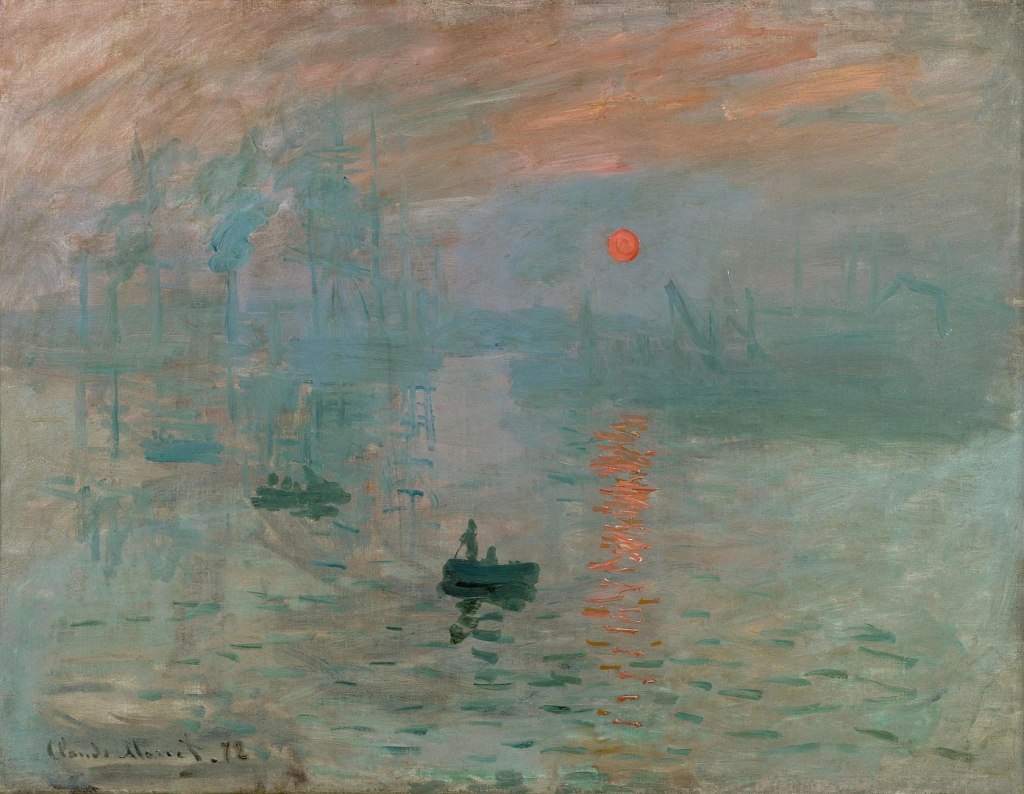
Impression, Sunrise (oil on canvas, 1872) by Claude Monet. The painting’s subtle interplay of light, color, and form mirrors the delicate balance required in crafting a well-written sentence, paragraph, or tale. The art of communication on canvas.

Language is beautiful. Every language, I imagine, holds within it a unique splendor, a symphony of sounds and meanings that resonate with the human experience. It is a medium of endless subtlety and flexibility, capable of expressing the most nuanced thoughts and the deepest emotions. A single word or phrase can carry extraordinary weight, encapsulating the full spectrum of human expression, from the profound to the mundane.

Language is a vessel for wisdom, humor, and frivolity alike. With just a few well-chosen words, one can impart lessons that echo through time, evoke laughter that lightens the heart, or create moments of joy that linger in the memory. It is delicate, yet strong—able to convey the lightest touch of affection or the heaviest burden of sorrow.

Yet, the true power of language lies in the words themselves. Words are the building blocks of language, each one a gem with its own distinct hue, tone, and resonance. While some may not give much thought to their choice of words, and are indifferent or careless in their selection, I hold that choosing the right word is an art of the utmost consequence. Every word carries its own timbre, a unique vibration that justifies its existence in a sentence, distinguishing it from others that may seem similar on the surface but convey subtly different meanings.

To me, words are not mere vessels of communication, but carefully chosen notes in the symphony of expression. The nuances between synonyms are not trivial; they are the very essence of precision in language. It is this precision that breathes life into writing, allowing it to resonate with readers in the way that only the perfect word can. In the delicate interplay of vocabulary, each word plays its part, contributing to a harmony that is richer and more meaningful than the sum of its parts. This meticulous selection is not just a preference but a necessity for the craft, as it ensures that the language not only conveys a message but does so with the exact emotion, clarity, and impact intended.

My particular fondness lies with the written word, for I find that I am no longer the extemporaneous orator I once was, no longer as quick in constructing or articulating speech. Above all, I aspire to become more artful in the crafting and presentation of my writing, so that it may be more pleasing both when read and recited. In this pursuit, I seek to imbue each phrase with the perfect blend of sound and meaning, creating a text that is not only clear but also resonant—a true expression of the beauty that language, at its best, can achieve. To be sure, I shall often falter in this endeavor, particularly after having written daily primarily as an attorney for over thirty years, but it is my earnest hope that, with continued practice, the failures will diminish and the successes will grow more frequent.

The Nightingale and the Rose: A Fable told by Lysander Aesopides

Swallow and Peony (woodblock print, pre-1945), Ohara Koson (1877-1945).

The Nightingale and the Rose

In a secluded grove, hidden deep within an ancient forest, there lived a nightingale whose song was unmatched by any other creature. Every evening, as the sun dipped below the horizon, the nightingale would perch on a high branch and sing, filling the air with melodies so beautiful that even the stars seemed to pause and listen.

In the center of the grove grew a single rosebush, its flowers the color of a blush at dawn, delicate and fragrant. The nightingale loved the rosebush with all its heart, for it saw in the rose a beauty that mirrored its own song. Night after night, the nightingale would sing to the rose, hoping that the rose might hear the song and return its love.

But the rose, though beautiful, was unaware of the nightingale’s affection. It stood rooted in the earth, its petals turned toward the sun, drinking in the light and warmth. The rose did not understand the nightingale’s song, for it had never known love beyond the gentle caress of the morning dew or the kiss of the afternoon breeze.

One night, as the nightingale sang its most heartfelt melody, the moonlight filtered through the leaves, casting a silvery glow over the grove. The nightingale, filled with longing, poured all its love into the song, hoping to reach the rose’s heart.

The rose, touched by the nightingale’s song, began to stir. Its petals trembled, and for the first time, it felt something more than just the sun’s warmth or the wind’s touch. It felt the nightingale’s love, pure and unyielding. But the rose could not return this love in the way the nightingale desired. It could only bloom as it always had, beautiful but distant, its heart locked away in its delicate petals.

The nightingale, realizing that the rose could never love it as it loved the rose, sang one final song, a song of acceptance and farewell. It was a song that spoke of the beauty of love, even when unreturned, and of the joy in loving without expectation.

As the nightingale’s song faded into the night, the rose shed a single petal, a silent token of its appreciation for the nightingale’s devotion. The nightingale, with a heart full of love but no bitterness, flew away into the night, knowing that its love, though unrequited, had been true and pure.

The rose continued to bloom, its beauty admired by all who passed, but it was never the same after that night. It had been touched by the nightingale’s love, and though it could not return it, the memory of that love remained within its petals, giving them a deeper, more resonant hue.

Moral of the Fable

Love, even when unreturned, is a gift that enriches both the giver and the recipient. True love is selfless and does not demand reciprocation, finding its own beauty in the act of loving.

A Lyrical Treat Inspired by the Fable

A Four Stanza “Poem” based on the Fable set to a medieval-folk theme. Lyrics by Donald S. Yarab, Music by Udio.com.

Crafting Artful Fables: The Mastery of Language and Meaning

Le rat de ville et le rat des champs (engraving from Book I, Fable IX, Fables de La Fontaine avec les dessins de Gustave Doré, 1867) by Gustave Doré (1832-83).

In contemplating my deep appreciation for reading and, more recently, writing fables, I find that these concise narratives, though brief, demand a mastery of language that is both artful and precise. The essence of a fable lies in its ability to convey profound moral lessons within the confines of a few well-chosen words, a task that requires the storyteller to employ language that is rich in metaphor and layered with meaning. Unlike a novel or even a short story, a fable’s economy of expression does not diminish its impact; rather, it enhances the potency of its message. The challenge and joy of crafting such a tale lie in the careful selection of words that resonate with readers of all ages and backgrounds, evoking emotions and intellectual insights that extend far beyond the surface of the text.

Moreover, the fable’s ability to transcend its limited word count is akin to the skill of a master artist who, with a few deft strokes, can create a visual masterpiece that captivates and educates. A master artist, much like a skilled fable writer, transcends the literal confines of their medium, whether it be canvas, paper, or marble. Their work is not merely a representation of reality, but an evocative expression that stirs the viewer’s emotions, provokes thoughtful interpretations, and invites intellectual exploration. Through the careful selection of color, composition, and form, the master artist imbues the visual elements with a depth that speaks to the human condition in ways that are both subtle and profound. The true artistry lies in this ability to craft a visual narrative that compels the observer to look beyond the surface, uncovering layers of meaning and insight that resonate long after the initial encounter. In this way, the artist’s canvas becomes a gateway to a richer understanding of the world, much as the carefully chosen words of a fable reveal truths that extend far beyond their brevity.

It is also why I often choose to illustrate each fable I create with a carefully selected work of art. The artwork not only complements the story but also symbolizes the underlying lesson, even if only metaphorically.

The master weaver of fables must tell a compelling story as they intricately weave a fine lesson into the tapestry with limited threads, but threads of extraordinary and precious value. Each word, each phrase, contributes to the intricate design of the narrative, ensuring that every element is essential to its overall impact. In this way, the fable becomes not just a story, but a distilled form of wisdom, crafted with precision and care, imparting lessons with an elegance and economy unmatched by other literary forms. It is this confluence of art and intellect that makes the reading and writing of fables a deeply rewarding pursuit, one that continues to captivate my imagination and inspire my creative endeavors.