In the photographs taken within the Oval Office (2017, 2025), the seat of American executive authority has been transformed into something older and stranger—a sanctuary of royal consecration. At its center sits Donald J. Trump, head bowed, encircled by ministers and advisers whose hands rest upon him in the gesture of impositio manuum, the laying on of hands. Their eyes are closed, lips moving in prayer, yet their posture speaks less of intercession than of veneration. What unfolds in that moment is not simply political theater but a ritual reenactment of an ancient idea: that power may be embodied, sanctified, and made flesh.
Impositio Manuum 2017
The Reversal of Benediction
In Christian and pre-Christian rites alike, the laying on of hands conveys the transmission of grace or authority. The priest’s touch confers the Spirit upon the baptized; the bishop’s hand consecrates the king. Here, however, the direction of sanctification is reversed. The clergy do not mediate divine blessing to the ruler on behalf of the people; they draw legitimacy from him. The bowed heads and concentric hands create a living reliquary around the sovereign’s body. The Oval Office, ordinarily a stage for civil governance, has been re-imagined as an apse, its curved wall a secular altar niche. What was intended as prayer has become an act of anointment—without chrism, yet heavy with its symbolism. In 2025, the Christian supplicants’ language included a declaration of divine appointment: “You assigned him, you appointed him, you anointed him for such a time as this…”
Impositio Manuum 2025
The Living Law
Ernst H. Kantorowicz, in The King’s Two Bodies, described how medieval jurisprudence conceived the ruler as lex animata—the “living law.” The sovereign’s person contained within it both the mortal, fallible flesh (corpus naturale) and the immortal, juridical body politic (corpus mysticum). Law was not merely administered by the king; it was enfleshed in him. The maxim omnia iura in scrinio pectoris imperatoris—“all laws reside in the emperor’s breast”—expressed the same belief: that the sovereign’s will constituted legality itself.
Trump’s self-understanding, as revealed in his statements that “I (have) the right to do anything that I want to do. I’m the president of the United States,” and that he could even “declassify by thinking” alone, reflects this archaic conception of sovereignty. In the photographs, that philosophy becomes visible form. His body, ringed by supplicants, stands as the physical repository of authority: thought and flesh fused into the living source of law. The constitutional process is eclipsed by a medieval metaphysic—the emperor’s breast revived within a republic.
The Mystical Body of the Republic
In Kantorowicz’s analysis, the king’s dual body was not a theological curiosity but a political necessity: it allowed the continuity of the realm despite the mortality of its ruler. The body politic outlived the natural body through the fiction of divine investiture. Yet in the Oval Office images, the relationship is inverted. The ruler’s flesh absorbs the polity rather than the polity transcending the ruler. The praying ministers become members of his mystical body, as if the state were incarnate in him rather than he in the state. The photographs thus performs a political transubstantiation—the transformation of a secular office into a sacred organism whose head alone is divine.
Iconography of Idolatry
The camera captures only the back of the president’s head in one of the images, a composition that echoes the devotional art of relic veneration. The viewer’s gaze aligns with the worshippers’ hands, all converging on the same luminous focal point: the golden hair, haloed by the light of the room. The gesture is tactile worship, the contact-relic as conduit of grace. In medieval reliquaries, touch transmitted sanctity; here it transmits legitimacy. The image collapses the distinction between religion and politics, portraying a people seeking salvation through proximity to power.
The Return of the Arcane Sovereign
What Kantorowicz chronicled as a vanished theology of monarchy reappears in modern populist guise. The constitutional republic, built upon the rejection of divine kingship, finds itself haunted by its ghost. The sovereign’s “two bodies” are re-fused: the office and the man, the law and the will, the symbol and the flesh. Those who kneel do so not before the law but before its living embodiment. When the sovereign’s body absorbs the state, law becomes indistinguishable from will. In such a regime, dissent is not disagreement—it is heresy. The king’s body, once divided for the safety of the state, is whole again.
The danger lies not only in the man but in the myth reborn around him—the longing for the immediate, the personal, the sacred ruler who is the nation. In that longing, the modern citizen becomes medieval subject once more. And the Oval Office, once the seat of the people’s servant, becomes the sanctuary of an arcane sovereign whose heart, like the emperor’s of old, is presumed to contain all laws within its breast.
“Thou shalt love thy neighbor as thyself.” — Matthew 22:39
“I hate them too. I really do. I hate them. I cannot stand them, because I really do believe they hate our country.” — President Donald J. Trump, July 3, 2025, Iowa State Fair, speaking of Democrats as the internal enemy
It is not the demagogues who bewilder me. The political class, the oligarchs who sponsor them, and the ambitious mediocrities who ride their coattails—these I understand. Their motives are ancient and ever-recurring: power, wealth, the intoxicating delusion of being above others. History has never lacked for such befouled souls. What confounds me is not their corruption, but the ease with which so many of my fellow citizens—ordinary men and women raised in homes of decency—abandon their values, their civility, and even their reason to follow such selfish and manipulative men.
Reading Hannah Arendt’s The Origins of Totalitarianism brings a sense of recognition as much as revelation. Her breadth of learning and depth of judgment are immense, yet her insight feels uncomfortably near. She wrote of loneliness, of the dissolution of shared reality, of the loss of what she would later name “the common world.” These, she warned, are the preconditions of tyranny. Her warning about that loss recalls a time when the common world was still carefully, even tenderly, built in classrooms.
When I taught as an educator at a Catholic junior-high school years ago, I once wrote on the blackboard—in chalk, for those were chalk days—the single word RESPECT. My pupils were told that respect, for oneself and still more for others, was the foundation of our classroom and of the larger world. It need not be earned, but it could be lost. Respect was the first principle of civilization: acknowledgment of another’s humanity, even in disagreement or uncertainty.
In my religion class, that same word deepened through Christ’s commandment: “Thou shalt love thy neighbor as thyself.” Respect, I told them, was the beginning of that love—not the sentimental kind that flatters or excuses, but the disciplined recognition that others, too, are made in the image of God. Such love is not mere emotion but moral vision. It binds community, restrains cruelty, and demands humility; for I believed then, as I do now, that if children learned that lesson, the rest would follow—discipline, fairness, empathy, and truth.
Yet today, the nation seems one in which respect has eroded into mockery, disagreement into contempt. Men and women who once prized civic decency now sneer at simple kindness as weakness and mistake public cruelty for laudable candor. Forgotten are the lessons once taught by parents and teachers—forgotten that respect is not submission but recognition, not indulgence but acknowledgment that every person bears the image of something sacred.
Arendt helps to explain part of this descent. She wrote that the ideal subject of totalitarian rule is not the convinced ideologue but the person “for whom the distinction between fact and fiction (i.e., the reality of experience) and the distinction between true and false (i.e., the standards of thought) no longer exist.” In our time, that confusion has been engineered deliberately by those who control mass media, public discourse, and civic conversation. Facts are now optional, reality malleable, and truth a commodity sold to the highest bidder. Noise replaces discernment; pundits and influencers, preachers of grievance and merchants of outrage, fill every silence until the ordinary citizen, weary of discerning, yields to the comfort of belonging. To be part of a movement—any movement—feels safer than standing alone amid uncertainty in an increasingly fragmented civic community.
But belonging comes at a cost. The price is moral collapse. Once fear replaces thought, hatred becomes easy. Once truth becomes relative, cruelty seems justified. Once self-respect erodes, submission feels like relief. It is with great grief that one watches people trade the humility of faith for the arrogance of fanaticism, the rigor of science for the comfort of superstition, the patience of democracy for the immediacy of mob emotion.
Some will say it is economics—that poverty, inequality, and insecurity drive people to such extremes. There is truth in that, but not the whole truth. Others will say it is ignorance, the failure of education. That too plays its part. Yet beneath both lies a deeper malady: spiritual exhaustion, a weariness with freedom itself. To think for oneself, to weigh evidence intelligently, to question authority doggedly—these require effort and courage. Many—perhaps most—prefer the narcotic of certainty. It is easier to be told what is true than to bear the burden of finding out responsibly.
That is why propaganda works—not because people are fools, but because they are tired, frightened, and longing for meaning. The demagogue offers them belonging, moral clarity, and enemies to hate. He tells them their failures are someone else’s fault. He gives them a cause grand enough to drown their doubts. And in surrendering to him, they mistake obedience for faith, vengeance for virtue, and ignorance for authenticity.
Hannah Arendt understood this weariness well. She observed that “mass propaganda discovered that its audience was ready at all times to believe the worst, no matter how absurd, and did not particularly object to being deceived, because it held every statement to be a lie anyhow.” That insight reaches beyond politics into the realm of spirit. When cynicism becomes habitual, truth itself grows unbelievable; when every statement is assumed false, the liar becomes prophet, and the soul, deprived of trust, welcomes its own deception.
What bewilders most is not the malice of my fellow citizens but their forgetfulness. Gone is the decency of parents, the moral instruction of their faiths, the civics once taught in schools, the respect once owed to fact, reason, and one another. Forgotten is that fear corrodes the soul and that hatred is the cheapest imitation of strength. Forsaken is the understanding that self-government depends not on leaders but on citizens—on the willingness to think, to listen, to doubt, and to care for one another.
Fifty years from now, scholars will no doubt write of these years with the detachment of hindsight. They will trace the algorithms, the demography, the disinformation networks, and the economic despair. They will find causes, correlations, and turning points. Yet they will still struggle to answer the simplest question: how did so many, knowing better, choose worse again and again?
For the manipulators, history has an answer—ambition, greed, vanity. For the manipulated, the explanation is more tragic: surrender not out of evil but out of weariness; not out of ignorance but out of fear; not because the way was lost, but because memory failed.
That is the lesson of our time. Evil will always exist; it requires only opportunity. But tyranny of the spirit—this quiet decay of conscience—thrives only when the many forget that decency is a daily act, not a tribal badge.
This reflection is written not to condemn but to plead—for remembrance. To remember what was taught when we were young: that truth matters, that kindness binds, that facts are not partisan, that faith without humility is idolatry, and that freedom demands thought.
When RESPECT was written on that blackboard years ago, it was in the belief that children were being prepared for a world that valued it. That belief endures—if enough choose to live as if it were true. For if it is forgotten, then no constitution, no scripture, no science can save us. We will have undone ourselves, not by conquest, but by consent.
Over decades of reading, I have traveled through worlds made accessible only by the alchemy of translation. I have wandered with Gilgamesh through Akkadian laments, pondered existence through German philosophy, felt the passionate dialectics of Danish thought, traced the monetary history of Chinese civilization, and followed the angular syntax of Old Norse sagas. I have encountered the theological precision of Medieval Latin, the passionate arguments of French existentialism, the compressed intensity of Hebrew psalms, and the illuminating insights of Spanish mysticism. From Sumerian creation myths to Aramaic scripture to Polish modernist fiction, from the heroic verse of Old English epics to classical Russian realist literature—and doubtless I have forgotten others, to my shame—an entire lifetime of reading has been built on the labors of those who possess what seems to me a kind of supernatural skill.
These translators are linguistic engineers and lexical lyricists working in multiple masteries simultaneously. They must command not just two languages but two literary traditions, two ways of organizing thought, two sets of cultural assumptions about how meaning moves through words. They must be scholars, poets, acoustic artisans, and cultural ambassadors all at once. The precision required is staggering: a single word choice can shift the moral center of a character, the rhythm of a line can determine whether a passage soars or stumbles, and the decision to preserve or adapt a cultural reference can make a text feel ancient or immediate.
What astonishes me most is not just the technical virtuosity required—though that alone would command respect—but the creative courage these practitioners demonstrate. They must make countless decisions in the space between languages where no perfect answers exist, where every choice involves both gain and loss. They work in the knowledge that their efforts will be scrutinized, compared, and inevitably found wanting in some dimension, yet they persist in attempting the impossible: carrying not just words but worlds across the vast spaces between human languages.
I approach translation not as a scholar of the field but as a reader acutely conscious of this debt. The essays that follow examine moments where translators face their greatest challenges—words, phrases, and passages that resist transfer from one language to another, or that demonstrate remarkable ingenuity when confronting texts where even the original language contains indwelling ambiguities. These are the places where translation reveals itself not as mechanical substitution but as interpretive art, where the impossibility of perfect equivalence becomes the very condition for creative meaning-making.
My perspective is that of someone who has been repeatedly astonished by what translators manage to accomplish, someone grateful for the cultural wandering their work has made possible. If these essays contribute anything to the ongoing conversation about translation, I hope it is a deepened appreciation for the miraculous ordinariness of the translator’s task: taking what is said in one language, whether with clarity, ambiguity, or poetic force, and seeking ways to let it speak, however imperfectly, in another.
The debt is vast. The gratitude is boundless. And now the conversation begins.
The Fifth Word: An Introduction
Or: How One Greek Word Launched Four Centuries of πολύτροποι
There exists, in the fifth position of the opening line of Homer’s Odyssey, a single Greek word that has tormented, delighted, and obsessed translators for centuries. To most readers, the opening line flows effortlessly: “Tell me, Muse, of the man….” And every translation affixes a descriptive word or several words to the man based on Homer’s fifth Greek word. But for the translator, the fifth word halts progress like a boulder in the stream of translation. The word is πολύτροπον (polytropon), the accusative case of πολύτροπος (polytropos), a descriptor so rich, so layered, so fundamentally untranslatable in any simple sense, that it has spawned not just a multiplicity of different English renderings, but an entire cottage industry of scholarly exploration.
This is where our series begins—not because polytropos is necessarily the most important word in the Odyssey, but because it perfectly embodies the central mystery of translation: the gap between what words mean and what they are made to mean in another tongue. Every choice a translator makes in approaching polytropos reveals something fundamental about how they understand not just Odysseus, not just Homer, but the very art and alchemy of translation itself.
Translation’s Creative Challenge
Polytropos is deceptively simple in construction. The prefix poly- means “many” or “much.” The root tropos means “turn,” “way,” or “manner.” Put them together and you get, quite literally, “many-turning” or “of many ways.” The construction appears straightforward.
But herein lies the difficulty: tropos carries within it a fundamental ambiguity about agency. As Emily Wilson, the translator of the latest English-language translation of The Odyssey that I have acquired has explained, the word presents a choice between describing someone who turns many ways (actively, cunningly, by choice) or someone who is turned many ways (passively, by fate, by the gods, by circumstance). Is this a man who manipulates his path through the world, or one whose path has been manipulated by forces beyond his control? Or, perhaps, by some combination of both active and passive turns?
The Greek does not resolve this ambiguity—it embraces it. And therein lies the translator’s dilemma.
A Plenitude of Solutions
Consider how various translators across four centuries have approached this single word:
George Chapman (1614): “that many a way / Wound with his wisdom to his wished stay”
John Ogilby (1669): “Prudent”
Thomas Hobbes (1674): “the man”
Alexander Pope (1725): “The Man, for Wisdom’s various arts renown’d”
William Cowper (1802): “For shrewdness famed/And genius versatile”
Samuel Butler (1900): “that ingenious hero”
T.E. Shaw (1932): “the various-minded man”
W.H.D. Rouse (1937): “the man who was never at a loss”
E.V. Rieu (1946): “that resourceful man”
Robert Fitzgerald (1961): “that man skilled in all ways of contending”
Richmond Lattimore (1967): “the man of many ways”
Allen Mandelbaum (1990): “of many wiles”
Robert Fagles (1996): “the man of twists and turns”
Stanley Lombardo (2000): “the cunning hero”
Emily Wilson (2017): “the complicated man”
The range is remarkable—from Chapman’s elaborate wordplay to Hobbes’s complete evasion, from Pope’s ornate expansion to Wilson’s stark modernity, each choice reflects not just linguistic preference but philosophical commitment about what translation should and can accomplish.
Wilson’s Innovation
The most recent translation in my library is Emily Wilson’s Odyssey. Wilson’s rendering for polytropon—“complicated”—offers an interesting approach to preserving the word’s semantic ambiguity while signaling moral and psychological depth, though scholarly reception has been mixed.² Its Latin root complicare, “to fold together,” aptly captures a figure whose facets—cunning, suffering, manipulation, endurance—are not easily separated, suggesting as Wilson notes, “someone whose multiple aspects are folded into a single identity, difficult to unravel or understand completely.” This translation does not resolve ambiguity; it revels in it. Where earlier translators sought precision through lexical equivalence, Wilson embraces complexity through conceptual resonance.
The Sound of Meaning
Translation, however, is not just about semantic equivalence—it is also about music, rhythm, and the physical experience of language in the mouth and ear. In the original Greek, polytropos participates in a complex pattern of sound and rhythm:
The repetition of the poly- sound connects polytropos to polla (“many”) in the same line and to planchthe (“wandered”) in the next, creating a sonic unity that reinforces the semantic connection between Odysseus’s many-sidedness and his many wanderings. This musical dimension is almost impossible to preserve in English, forcing translators to choose between acoustic and semantic fidelity.
The varied renderings of πολύτροπον by translators across centuries reflect not only aesthetic and lexical choices, but also deeper assumptions about the nature and purpose of translation itself—assumptions that resonate with and are interrogated by major theoretical frameworks.
Translation as Theory, Translation as Politics
Each translator’s approach to polytropos reveals their fundamental assumptions about what translation should accomplish, assumptions that echo through the major theoretical debates of the past century. Should translation prioritize:
Lexical fidelity to source structures?
Preservation of aesthetic complexity?
Contemporary accessibility and clear interpretation?
Resistance to reductive meaning-making?
Cultural and political responsibility?
The impossible thing is that these goals often conflict. Wilson’s “complicated” is perhaps more accessible to contemporary ears and possibly more interpretively rich than Lattimore’s “of many ways,” but it sacrifices literal connection to its Greek roots. Fagles’s “twists and turns” preserves ambiguity through metaphor, capturing both the active dimension (Odysseus creating twists through his cunning) and the passive dimension (being turned by forces beyond his control), while also preserving the literal sense of physical wandering and the metaphorical sense of mental agility. Notably, among the dozens of English translations preceding Fagles, only two others—T.S. Norgate’s “of many a turn” (1858) and Albert Cook’s “of many turns” (1967)—preserved the Greek roots as literally as Fagles’ “twists and turns.”³ Each translator joins rather than replaces the ongoing conversation about what this untranslatable word might mean.⁴
The challenge of polytropos connects to broader conversations about what translation is and what it should do—conversations that have produced some of the most influential theoretical writings of the past century.
Walter Benjamin’s 1923 essay “Die Aufgabe des Übersetzers,” best known in English as “The Task of the Translator,” remains perhaps the most cited work in translation theory, arguing that translation should not aim for communication but for a kind of “pure language”—not found in either source or target, but revealed in their interplay—that emerges in the space between languages. For Benjamin, the translator’s task is not to convey meaning but to find the way languages complement each other, revealing what he calls their “kinship.” Applied to polytropos, Benjamin might advocate for something like “many-turned” or “much-turning”—preserving the German-like compound structure that reveals the kinship between Greek and English through their shared capacity for word-building. He would resist choosing between active and passive readings, instead creating a translation that holds both possibilities in tension, allowing the “pure language” that exists between Greek and English to emerge.
Susan Sontag’s 1966 “Against Interpretation” offers a different but related challenge to conventional approaches to meaning-making. Sontag argues that interpretation—which she sees as analogous to translation—often becomes “the revenge of the intellect upon art,” impoverishing works by reducing them to predetermined meanings. Her call for an “erotics of art” rather than a “hermeneutics of art” parallels the translator’s dilemma: how to preserve the sensual, immediate impact of a work while necessarily transforming it. Sontag might prefer leaving polytropos untranslated entirely, forcing readers to encounter the word’s irreducible foreignness, or choose the most literal rendering—”many-turning”—while resisting any footnotes that would “interpret” the ambiguity away. Her approach would preserve what she calls the work’s “sensuous surface,” letting readers experience the word’s mystery rather than having it explained into submission.
Vladimir Nabokov’s “Problems of Translation: Onegin in English” (1955) stakes out an extreme position in favor of literal fidelity. Nabokov argues that “the clumsiest literal translation is a thousand times more useful than the prettiest paraphrase,” advocating for translations with “footnotes reaching up like skyscrapers to the top of this or that page so as to leave only the gleam of one textual line between commentary and eternity” rather than the kind of elegant adaptation that sacrifices accuracy for readability. His approach to Eugene Onegin exemplifies this philosophy, creating what he called an “interlinear” translation that preserves every nuance at the cost of natural English. Nabokov would almost certainly render polytropos as “of many turnings” with extensive footnotes explaining every possible meaning: “1) having many devices/stratagems, 2) being turned in many directions by fate, 3) taking many paths, 4) being versatile in character, 5) cunning, 6) much-traveled…” His translation would sacrifice English fluency entirely for exhaustive accuracy, creating what he called “truthful ugliness” rather than “beautiful deception.”⁴
Gayatri Spivak’s “The Politics of Translation” (1992) brings postcolonial and feminist perspectives to bear on these questions. Spivak argues that translation is never neutral but always involves power dynamics, particularly when translating from “weaker” languages into English, the “language of power.” She advocates for what she calls “surrender” to the source text and criticizes translations that over-assimilate foreign works to make them accessible to Western readers, creating what she terms “translatese.” Spivak might choose something like “many-wayed” that preserves the Greek’s strangeness while questioning Western heroic ideals. She would resist translations that make Odysseus too familiar to English readers, warning against rendering polytropos as “resourceful” or “cunning”—words that domesticate Greek concepts of heroism into comfortable English categories. Her footnotes would address how translation choices reflect cultural power dynamics.
George Steiner’s monumental After Babel (1998) frames these concerns in terms of cultural encounter, arguing that translation is fundamentally an act of aggression where the translator “invades, extracts, and brings home” meaning from the foreign text—a conception that resonates deeply with postcolonial critiques of translation as cultural appropriation. Steiner might embrace a translation that acknowledges the “violence” of cultural appropriation—perhaps “man of manifold turnings” that sounds deliberately archaic, marking the temporal and cultural distance we must cross to reach Homer. He would want readers to feel they are encountering something genuinely foreign that has been “brought home” but not domesticated.
The Birth of a Series
These theoretical frameworks illuminate why polytropos serves as the perfect introduction to “The Fifth Word”—not just the series, but the concept. Every significant work of translated literature contains moments like this, words or phrases that crystallize the fundamental challenges of moving meaning between languages and cultures. These moments reveal translation not as a mechanical process of substitution, but as an art form in its own right, requiring creativity, interpretation, and impossible choices.
In each essay that follows, we will examine these crucial moments—the words that challenge translators and the art of translation, that force translators to become interpreters, that reveal the beautiful impossibility of perfect communication between languages. We will explore how different translators have approached these challenges, what their choices reveal about their understanding of the source text and target audience, and what these translation decisions mean for readers who encounter these works only in translation.
Some essays in this irregular series will focus on single words, like polytropos. Others will examine phrases, passages, or even entire approaches to a text. What unites them is the conviction that these moments of translation difficulty are not obstacles to be overcome, but windows into meaning itself—opportunities to understand not just what texts say, but how meaning moves through time, space, and the minds of readers separated by centuries and cultures.
Translation, at its best, does not just move words from one language to another—it creates critical access to intended meaning, oft revealing new ways of understanding both the source and target cultures. The history of translating polytropos is not just a record of different approaches; it is a map of how Western culture has understood heroism, character, and human complexity over the centuries.
Each new translation of The Odyssey does not replace its predecessors—it joins the conversation, adding another voice to an ongoing dialogue about what these ancient words might mean for contemporary readers. In this sense, translation is less like solving a puzzle than like composing music, with each translator adding their own interpretation to a theme that will never be definitively resolved.
This is what “The Fifth Word” will explore: the fertile space between languages, where meaning is not merely transferred but transformed—reborn, refracted, and made newly strange. Each essay will examine these crucial moments—the words that break translation, that force translators to become interpreters, that reveal the beautiful impossibility of perfect communication between languages.
Welcome to “The Fifth Word.” The journey begins here, but like the wanderings of Odysseus himself, who knows where it will lead us?
Notes
The Greek text is taken from Homer, Homer’s Odyssey, edited with English notes, appendices, etc. by W. Walter Merry and James Riddell, 2nd ed., rev. (Oxford: Clarendon Press, 1886), p. 1. The scholarly apparatus notes πολύτροπον as meaning “of many devices” (p. 1, fn. 8).
For mixed scholarly reception of Wilson’s translation, see Richard H. Armstrong, review of Homer: The Odyssey, by Emily Wilson, Museum Helveticum 75, no. 2 (2018): 225-226; and Richard Whitaker, “Homer’s Odyssey Three Ways: Recent Translations by Verity, Wilson, and Green,” Acta Classica 63 (2020): 241-254. For more positive mainstream reception, see Gregory Hays, “A Version of Homer That Dares to Match Him Line for Line,” New York Times Book Review, December 5, 2017; and Tim Parks, “The Visible Translator,” New York Review of Books, March 31, 2021. For Wilson’s own discussion of translating πολύτροπον, see Wyatt Mason, “The First Woman to Translate the ‘Odyssey’ Into English,” New York Times Magazine, November 2, 2017.
For the observation about Norgate and Cook being the only predecessors to preserve the Greek roots literally, see Wyatt Mason, “The First Woman to Translate the ‘Odyssey’ Into English,” New York Times Magazine, November 2, 2017.
Wilson implicitly rejects Nabokov’s approach, arguing that translations requiring footnotes reaching up like skyscrapers or dictionary-based translation represent “a simple and fundamental misunderstanding … of what any translation is doing.” See Mason, “The First Woman to Translate the ‘Odyssey’ Into English.”
The author’s preference would be Fagles’s “twists and turns” with annotation explaining that polytropos (πολύτροπος) contains an inherent grammatical ambiguity—tropos (τρόπος) can indicate either twists and turns inflicted by fate or the gods, or twists and turns of cunning and choice by Odysseus himself—that no English rendering can preserve without explanatory note.
Bibliography
Primary Sources: Homer Translations
Butler, Samuel. The Odyssey of Homer. London: A.C. Fifield, 1900.
Chapman, George. The Odysseys of Homer. 1614. Reprint, with introduction and notes by Richard Hooper, M.A., F.S.A. London: John Russell Smith, 1857.
Cowper, William. The Odyssey of Homer. 2nd ed., with copious alterations and notes. London: Bunney and Gold, 1802.
Fagles, Robert. The Odyssey. New York: Viking, 1996.
Fitzgerald, Robert. The Odyssey. New York: Doubleday, 1961.
Hobbes, Thomas. The Iliads and Odysses of Homer. 1st AMS ed. New York: AMS Press, 1979. Facsimile of: 2nd ed. London: W. Crook, 1677.
Lattimore, Richmond. The Odyssey of Homer. New York: Harper & Row, 1967.
Mandelbaum, Allen. The Odyssey. New York: Bantam Classics, 1990.
Ogilby, John. Homer His Odysses Translated. London: Printed by James Flesher, for the Authour, 1669.
Pope, Alexander. The Odyssey of Homer. A new edition, with additional notes, critical and illustrative by Gilbert Wakefield, B.A. London: Printed for J. Johnson, W. J. and J. Richardson, W. Otridge and Son, et al., 1806.
Rieu, E.V. The Odyssey. Baltimore: Penguin Books, 1946.
Rouse, W.H.D. The Story of Odysseus. London: Thomas Nelson, 1937.
Shaw, T.E. The Odyssey of Homer. Introduction by John Finley. Norwood, Massachusetts: The Plimpton Press, 1932.
Wilson, Emily. The Odyssey. New York: W.W. Norton, 2017.
Translation Theory: Essential Essays
Benjamin, Walter. “Die Aufgabe des Übersetzers.” 1923. In Translation as a Form: A Centennial Commentary on Walter Benjamin’s “The Task of the Translator,” edited by Douglas Robinson, 1st ed. London: Routledge, 2022.
Nabokov, Vladimir. “Problems of Translation: Onegin in English.” Partisan Review 22, no. 4 (1955): 496-512. Reprinted in Theories of Translation: An Anthology of Essays from Dryden to Derrida, edited by John Biguenet and Rainer Schulte, 127-143. Chicago: University of Chicago Press, 1992.
Sontag, Susan. “Against Interpretation.” 1966. In Against Interpretation and Other Essays, 3-14. New York: Farrar, Straus and Giroux, 1966.
Spivak, Gayatri Chakravorty. “The Politics of Translation.” 1992. In Living Translation, by Gayatri Chakravorty Spivak et al. London: Seagull Books, 2022.
Steiner, George. After Babel: Aspects of Language and Translation. 3rd ed. Oxford: Oxford University Press, 1998.
Secondary Sources
Armstrong, Richard H. “Homer for Scalawags: Emily Wilson’s ‘Odyssey.’” Los Angeles Review of Books, August 5, 2018.
After countless readings of various translations of Homer’s Iliad, certain passages can suddenly leap from the page with startling clarity. It can feel as if I am encountering them for the first time. Such was my experience with the incident regarding Thersites in Book 2, brought into sharp focus by Emily Wilson’s brilliant new translation—whose story had barely registered in previous readings, now revealed as perhaps the most penetrating political commentary in all of ancient literature.
A quick review of the scholarship revealed that while I was hardly alone in this recognition, the political interpretation of Thersites remains surprisingly contested. Some modern scholars have recognized in Homer’s portrayal a sophisticated critique of power that transcends the heroic framework, but many others continue to read the episode as simply affirming aristocratic values.¹ Yet there is something to be said for arriving at these insights through direct encounter with the text—Wilson’s translation made visible what a handful of careful readers have long debated.
The setup is masterful in its cynicism. Zeus, hungry for blood and bound by his promise to Thetis, sends a false dream to Agamemnon. The king, ever susceptible to flattery, believes the lie that, after nine years without success, Troy will fall easily if he attacks immediately. Divine deception exploits human vanity to ensure more carnage—the gods conspire to prolong suffering for their own purposes.
But first, Agamemnon decides to test his troops’ resolve by suggesting they abandon the siege and sail home. The test backfires spectacularly—war-weary soldiers leap up and race toward their ships, desperate to escape nine years of futile bloodshed. Only Odysseus’s violent intervention stops the mass exodus.
Into this moment of barely restored order steps Thersites, described by Homer with deliberate physical grotesquerie to ensure we see him through aristocratic eyes—bandy-legged, lame, with little hair and a shrill voice. In the ancient world, such deformity was viewed as suggesting mental or moral deficiency. But as scholar Panagiotis Stamatopoulos observes, “the ugly hero is the personification of the ugly truth.” Homer introduces an insolent and fearless figure who points out truths that both the soldiers and the kings dare not see. Thersites emerges as “the voice of the people, of demos“—a vox populi expressing the position of the lower social class and opposing the aristocratic consensus. Tellingly, Homer gives him no patronymic surname, no family lineage to establish elite status; he represents not an individual but a class.
Yet Thersites’ words cut through the manufactured crisis with devastating precision. He challenges Agamemnon directly: what is your grievance? You already have gold, women, first choice of everything. After nine years of pointless war, he asks the question that should be obvious—why should common soldiers continue dying for the personal honor of the elite who have already been richly compensated?
This is the voice of human reason emerging amid divine machination and aristocratic ego. Thersites offers what the epic desperately needs: an exit ramp from tragedy. Had the Greeks listened and sailed home, Troy would have stood, Hector would have lived, Achilles would have returned to Phthia, and Odysseus would never have wandered. The commoner alone sees the madness clearly.
More provocatively, Thersites points out the fundamental dependency that the heroic code obscures: “Let him consume his winnings here at Troy, so he can see if we helped him or not.” Without the common soldiers doing the actual fighting and dying, what would Agamemnon accomplish? He would be one man with his treasure, powerless before Troy’s walls. The entire war rests on the backs of those excluded from its real rewards.
But Homer’s brilliance lies in what follows. Odysseus—wily, eloquent, a master of persuasion—does not refute Thersites’ logic. He silences it. The master of cunning speech, the man who could talk his way out of any crisis, abandons rhetoric entirely when faced with reasonable dissent. Seizing the divine scepter, he beats the man bloody while the other soldiers—the very men whose interests Thersites defends—laugh and cheer. Yet Homer’s subtlety continues: even after this violent suppression, it takes two additional speeches by the army’s finest orators, Odysseus and Nestor, to convince the troops to resume fighting. The laughter was hollow; Thersites’ logic had found its mark. In this single scene, Homer offers a devastating triple indictment: the gods manipulate, the elite brutalize, and the masses collaborate in their own subjugation.
What makes this commentary so sophisticated is its recognition that the problem is not simply bad leadership or divine caprice—it is the entire system’s complicity in silencing rational dissent. Homer shows us a world where every level of authority, from Olympus to the ranks, conspires to suppress the voice that points toward sanity and survival.
We live in an age of algorithmic manipulation designed to amplify division for profit. Our elites meet dissent with derision and suppression, while the public, misled or weary, often rallies to their side, cheering policies that erode their own dignity and livelihood. The machinery Homer diagnosed—divine deceit, aristocratic coercion, popular compliance—still grinds forward, indifferent to time.
Thersites asks the eternal question that every society must confront: “Why should we suffer and die for the vanity and greed of our leaders?” That his voice is not merely ignored but mocked—laughed into silence by those he would save—remains one of the most chilling recognitions in all of literature. Homer understood what many modern narratives refuse to admit: that exploitation and oppression do not come from above alone. It comes when the oppressed celebrate it themselves. And the greatest tragedy may not be the fall of Troy, nor the deaths of elite heroes, but the silencing of the one voice that might have stopped the tragedy before it began.
¹ See, for example, Panagiotis G. M. Stamatopoulos, “The episode of Thersites in the Iliad as an ideological and literary construction of Homer,” 28th Seminar of Homeric Philology, Ithaca Island, Greece (2014); and Siep Stuurman, “The Voice of Thersites: Reflections on the Origins of the Idea of Equality,” Journal of the History of Ideas 65.2 (2004): 171-89.
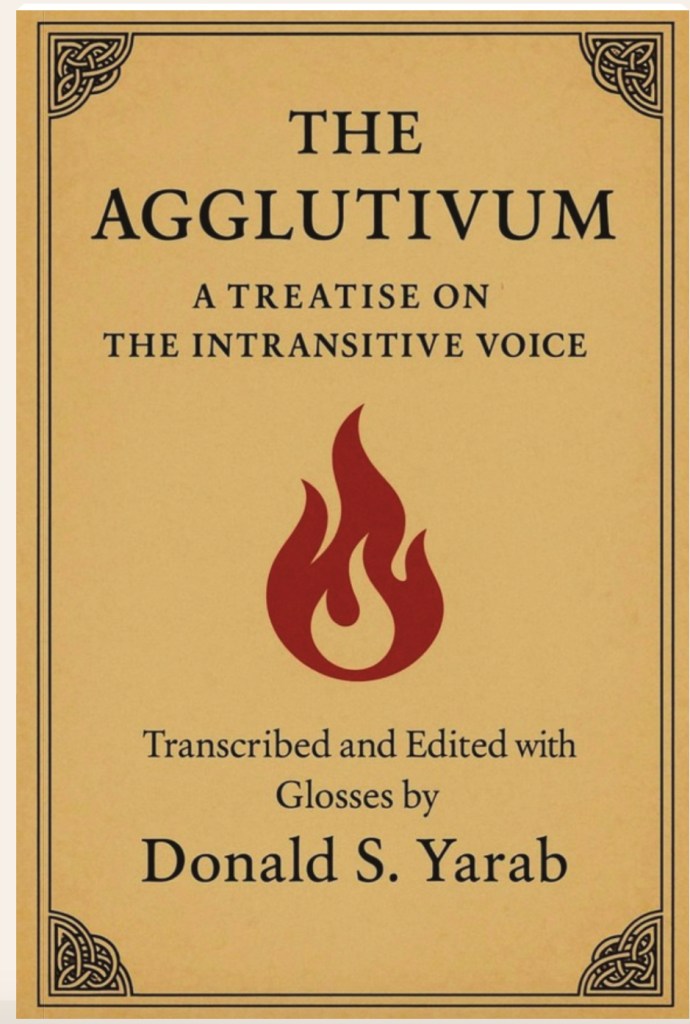
It is difficult to describe the Liber Agglutivi, or as translated into English, The Agglutivum: A Treatise on the Intransitive Voice, for both its origin and content resist conventional classification. Its genesis, as I recount within the pages themselves, was not intellectual but oneiric. The word agglutive—unknown to me then, undefined in any language I … Continue reading “Liber Agglutivi: A Work of Fiction, Philosophy, and Reverence”
The Agglutivum: A Treatise on the Intransitive Voice Transcribed and Edited with Glosses by Donald S. Yarab Paperback, 58 Pages, 6in × 9in, $7.99 plus $5 postage CLICK IMAGE ABOVE TO ORDER BOUND COPY
It is difficult to describe the Liber Agglutivi, or as translated into English, The Agglutivum: A Treatise on the Intransitive Voice, for both its origin and content resist conventional classification. Its genesis, as I recount within the pages themselves, was not intellectual but oneiric. The word agglutive—unknown to me then, undefined in any language I knew—visited me repeatedly in sleep. So compelling was its sound and weight that, upon waking, I began at once to give breath to the whisper that had haunted my rest. What emerged was not story or doctrine, but something stranger and perhaps more elemental.
The text that followed felt less composed than revealed—an excavation rather than a construction. It is, in the truest sense, a received work. Its structure—voculae, glosselitha, silentia, postverba—appeared as if drawn from some hidden grammar beneath ordinary speech. Though shaped in Latin (with an English translation as appendix) and framed by scholarly apparatus, it is not a parody nor a pastiche, but a sincere tribute to the metaphysical impulse in language.
Readers may find echoes of Borges, Vico, and Pseudo-Dionysius; others may see affinities with mystical traditions, liturgical fragments, or even speculative linguistics. It may be read as fictive scripture, poetic glossolalia, philosophical provocation, or theological shadowplay. Or perhaps—if read rightly—it is none of these, but instead a call to silence, to memory, to the threshold of meaning itself.
Let it be said plainly: this work will not appeal to all. It is slow and strange, elliptical and spare. But for the rare reader attuned to the hum beneath the words we know, it may, in its own agglutive way, speak.
The work is available to read through the link below as a free PDF. For those who find affinity with it, an inexpensive bound copy may be ordered by clicking the image of the book above.
A Contemporary Meditation Inspired by the Liber Agglutivi
The Agglutivum suggests but does not systematize a catalog of words that resist conventional grammar—words that seem to create rather than merely describe reality. What follows is a modern attempt to identify and explore such “ontological voculae,” developed in the spirit of the medieval treatise but acknowledging its contemporary construction.
Voculae Agglutivae
A Supplement to the Glossarium Philosophicum Non omnia verba dicuntur ut loquantur. Quaedam dicuntur ut fiant.
I. Sacra Voculae – Sacred Utterances
These words do not inform; they summon. Often liturgical, they retain weight through resonance, not explanation.
Amen Confirmatio sine contentu. —What is confirmed is not always known.
Alleluia Laus pura, sine scopo. —Praise that outruns its object.
Kyrie Clamor, non formula. —Not request, but primal cry.
Hosanna Eruptio, non enuntiatio. —A word of ascent, not address.
Om / Aum Vox quae se ipsam audit. —The breath that sustains itself.
II. Voculae Primitivae – Primal Expressions
Pre-conceptual utterances: the first stirrings of meaning, or the last.
Yes Vocabulum consentientis animae. —Affirmation without argument.
No Negatio sine opposito. —The first refusal of the void.





 Northcoast Antiquarian