Against Magical Thinking: Contemplation, Conspiracy, and the Abuse of Sacred Language


Early manuscript
Photo by silvia lusetti on Pexels.com

Recently, I read with great interest Hari Kunzru’s article “Doing Their Own Research” in the New York Review of Books (May 29, 2025). It is a piercing, sometimes surreal examination of the strange coalition now shaping American political and spiritual culture: a “New Weird Fusionism” of right-wing conspiracy, countercultural wellness, and mystical absolutism. The portrait he offers—of a society increasingly shaped by magical thinking, selective paranoia, and a weaponized imagination—was as disturbing as it was insightful.

But what struck me most was the realization that the cultural atmosphere Kunzru describes makes it increasingly likely that contemplative works like my recent Liber Agglutivi will be not merely misread—but conscripted into the very worldview they seek to resist.

In that work, framed as a fictional medieval treatise on sacred language, I explore how language, when approached with reverence and silence, becomes not a tool of communication but a site of presence—how it may not only speak about reality, but participate in it. Yet as I read Kunzru’s analysis of conspirituality—the synthesis of conspiracy and New Age belief—I saw an eerie proximity between certain rhetorical structures in Liber Agglutivi and the thought patterns of this cultural formation: secrecy, marginalia, hidden knowledge, the recovery of “true” language lost to corruption.

The danger is real: in an age where every form of mystery gets weaponized, how do we distinguish between authentic contemplative practice and its paranoid simulacra?

It is precisely here that the contrast must be made explicit.

The Liber is not a manual for decoding reality through esoteric symbols or a codebook for revealing global plots. It is not a mystical justification for control, nor an invitation to gnostic certainty. Its words are not “keys” to hidden truths in the paranoid sense Kunzru describes. Rather, it is a contemplative experiment—a poetic, philosophical invitation to see language as something we enter with humility, not something we wield with certainty.

What conspirituality offers is often a form of linguistic inflation: a conviction that to name something is to master it, that to imagine is to manifest, that hidden truths are personal weapons in a war against “them.” This is not reverence for mystery but inflation through proximity to it. The practitioner of conspirituality approaches mystery as a puzzle to be solved, a code to be cracked that will grant power over reality itself.

By contrast, the Liber offers a theology of kenosis—a self-emptying approach to speech in which the word is not a sword, but a veil; not a control mechanism, but a site of transfigured listening. Where conspirituality seeks to decode, contemplation seeks to be changed by what it encounters.

Consider the difference in practice. A conspirituality adherent might read the Liber’s phrase about “memory that knows not what it remembers” as a hint toward recovering suppressed historical truths or accessing forbidden knowledge that “they” do not want you to have.

A contemplative reader approaches the same phrase as an invitation to sit with unknowing itself—to let the mystery remain mysterious while allowing it to transform one’s relationship to knowledge. The first approach inflates the ego; the second empties it.

Kunzru’s analysis is especially compelling in its treatment of magical thinking across the domains of politics, religion, and economics. It is alarming to witness the persistence of the nineteenth-century “mind-cure” tradition—the belief that reality is downstream of personal attitude—now manifesting as national governance logic.

That Donald Trump, among others, internalized Norman Vincent Peale’s message of mental affirmation to the point that factuality became irrelevant is not merely a character trait—it is a symptom of an epistemological crisis. Similarly, the self-help gospel of The Secret, evangelical prosperity teachings, and the memetic evangelism of internet conspiracists all illustrate a culture in which to believe is to make it so.

The boundary between wish and world is not merely blurred—it is denied.

The Liber Agglutivi, by contrast, insists that language’s creative power arises not from assertive will but from contemplative reception. The phrase “word that becomes the thing” does not mean that the self wills reality into being. It means that, in sacred silence, the word discloses what is already most true.

This is a fundamentally different ontology. It is not manifestation; it is reverent participation.

Kunzru rightly notes how easily mystical language can be conscripted by paranoid styles. The idea that “everything is connected,” which in contemplative practice leads to compassion and humility, in conspiracy often leads to reductionism and scapegoating.

The Liber speaks of memory that “knows not what it remembers”—a phrase meant to evoke mystery and presence, not cognitive shortcuts to hidden truths.

So while Kunzru’s essay is not a critique of my work, it felt like a necessary caution about the times in which such a work might be read. In an age of epistemic confusion and symbolic inflation, sacred language must be handled with even greater care.

We must distinguish between language as control and language as communion; between the voice that silences others and the voice that emerges from deep silence. We must recognize that in our current moment, the very practices that might lead us toward wisdom—attention to mystery, reverence for hidden dimensions of experience, suspicion of surface explanations—can be corrupted into tools of manipulation and division.

The Liber Agglutivi may look like a book of secrets, but it is really a book about unknowing—about hearing the spaces where speech begins. And in a world where every utterance is increasingly co-opted for political or psychological leverage, the commitment to silence, reverence, and the mystery of meaning may itself be the most radical stance available to us.

Words that reign do so only when they have ceased to serve the self.
In our age of weaponized mysticism, that may be the difference between wisdom and delusion, between contemplation and conspiracy.

The Lingering Fire: Language Before, Within, and Beyond Speech

A Reflection Interwoven with Ante Verba, Verba, and Postverbum


Cy Twombly (1928-2011), Untitled
2005, acrylic on canvas
Cy Twombly (1928-2011), Untitled
2005, acrylic on canvas, 128 x 194½ in
“His madness is a circle of fire, an unbroken circuit of excess, each attempt at containment spilling into the next”—Art historian Malcolm Bull on the Bacchus paintings.

The three poems, CARMINA TRIA: DE VOCE AGGLUTIVA, which follow—Ante Verba, Verba, and Postverbum—did not emerge by design. They followed Liber Agglutivi as if by necessity. Once the treatise had been written, these poems had to be. They are not commentaries on the Liber, nor are they didactic restatements of its metaphysical claims. Rather, they are its echo—its ember. They are the hymns sung at the threshold that Liber Agglutivi only describes.

Even readers unfamiliar with the medieval-inspired treatise can enter these poems directly. They function as meditations on how language lives in us before we speak it, while we speak it, and after our words have fallen silent. Readers of the Liber will recognize these concerns, but the poems make them immediate and felt rather than theoretical.

They move through language as tremor, fire, and resonance. The sequence below mirrors the deeper structure of the Liber: from the agglutum primitivum (pre-verbal memory), to the verbum intransitivum (word as creation), to the postverbum and glosselitha (residual presence).


CARMINA TRIA: DE VOCE AGGLUTIVA


I. Ante Verba

Language as Tremor, Silence as Light

Ante Verba
(Versus ad limen vocis)

Verbum non dicitur, sed fit.
Non transit, sed regnat.
Nomen quod loquitur se ipsum
non oritur ex ore, sed ex ossibus.
Lingua non fert sensum,
sed tremorem.
Memoria quae nescit quid meminerit
audit quod non sonat.
Tacere est tangere lumen.
Loqui est amittere formam,
ut recipiatur flamma.

Before Words
(Verses at the threshold of voice)

The word is not spoken, but becomes.
It does not pass through, but reigns.
The name that speaks itself
arises not from the mouth, but from the bones.
Language carries not meaning,
but tremor.
Memory that knows not what it remembers
hears what does not sound.
To be silent is to touch light.
To speak is to lose form,
so that the flame may be received.

This poem inhabits the space where language has not yet been spoken but is already forming. It suggests that words do not begin with speech—they begin with the body, with memory, with a force older than conscious thought. In the Liber, this is called the agglutum primitivum—the murmur that speaks itself rather than being spoken.

The line “non oritur ex ore, sed ex ossibus” (“arises not from the mouth, but from the bones”) aligns with Martin Heidegger’s vision in Letter on Humanism, where language is not a tool but the “house of Being.” Maurice Blanchot, in The Writing of the Disaster, understands silence not as negation but as a paradoxical mode of presence—a vision we carry forward in our own line from Ante Verba: “Tacere est tangere lumen.”

The poem resists the tendency to think of silence as a void. It suggests instead that silence is already full—that the word is merely what breaks the threshold.


II. Verba

Language Does Not Carry Meaning—It Generates It

Verba
Non instrumenta, sed ignes.
Non indicia, sed invocationes.
Ex spiritu fiunt formae.
Ex sono fit lumen.
Verbum non portat sensum;
generat.
Non sequitur lucem;
effundit eam.
Obliti sumus verba sentire—
at illa nos sentiunt.

Words
Not instruments, but fires.
Not signs, but invocations.
From spirit, forms arise.
From sound, light is made.
The word does not carry meaning;
it generates it.
It does not follow light;
it pours it forth.
We have forgotten how to feel words—
but they feel us.

Verba shifts from anticipation to ignition. Here, the word becomes flame. It does not describe; it creates. This is the essence of the verbum intransitivum found in the Liber—a word that does not pass meaning from subject to object, but emits meaning by its very being.

This echoes Jacques Derrida’s insight in Of Grammatology: that language does not simply transmit ideas—it generates meaning anew with every utterance. Jean-Paul Sartre in What is Literature? treats language as an existential act, not a report, and this vision is mirrored in the line “Verbum non portat sensum; generat.”

The agglutivum, as the Liber defines it, is precisely this: a word that binds meaning not through grammar, but through presence. The poem closes with a reversal: it is not we who perceive words, but words that perceive us.


III. Postverbum

The Spectral Afterlife of Language

Postverbum
Verbum abit, sed tremor manet.
Non vox, sed vestigium vocis.
Non lumen, sed fulgor in ruina.
Post verbum non est silentium,
sed memoria quae loqui recusat.
Forma cecidit—
resonantia viget.
Non est oblivio,
nec repetitio.
Est remanentia
sine nomine.
Quod dictum est, abit.
Quod vivit, remanet.

After-Word
The word departs, but the tremor remains.
Not voice, but the trace of voice.
Not light, but gleam within ruin.
After the word there is not silence,
but memory that refuses to speak.
Form has fallen—
resonance thrives.
It is not forgetting,
nor repetition.
It is remainder
without name.
What has been spoken departs.
What lives remains.

What remains when the word falls away? Postverbum addresses the residue of speech, its spectral persistence. The Liber speaks of the glosselitha—words no longer active but still resonant. This poem inhabits that after-space: where meaning is not present, yet not gone.

Derrida’s trace (especially in Writing and Difference) hovers here: a remnant of presence that cannot be fully recovered, nor fully lost. Nietzsche, in The Gay Science, evokes this through the fragment—the broken form more alive than the whole. And Bachelard’s “intimate immensity,” in The Poetics of Space, seems apt: the vast echo of what once was word.

This is not nostalgia. It is presence beyond sound.


Coda: Language as Tremor, Fire, Trace

The poems above are not marginal to Liber Agglutivi—they are its liturgy. They enact what the treatise evokes: a philosophy of speech where the word is not a vessel but a lifeform.

If the Liber speaks of agglutive words—words that bind not by syntax but by resonance—then these poems are agglutive acts. They offer no argument. They offer invocation.

Together, they invite us to listen differently—not just to what we say, but to what speaks through us when we are most quiet, most present, most alive to the mystery of having language at all.

We do not merely speak.
We are spoken.

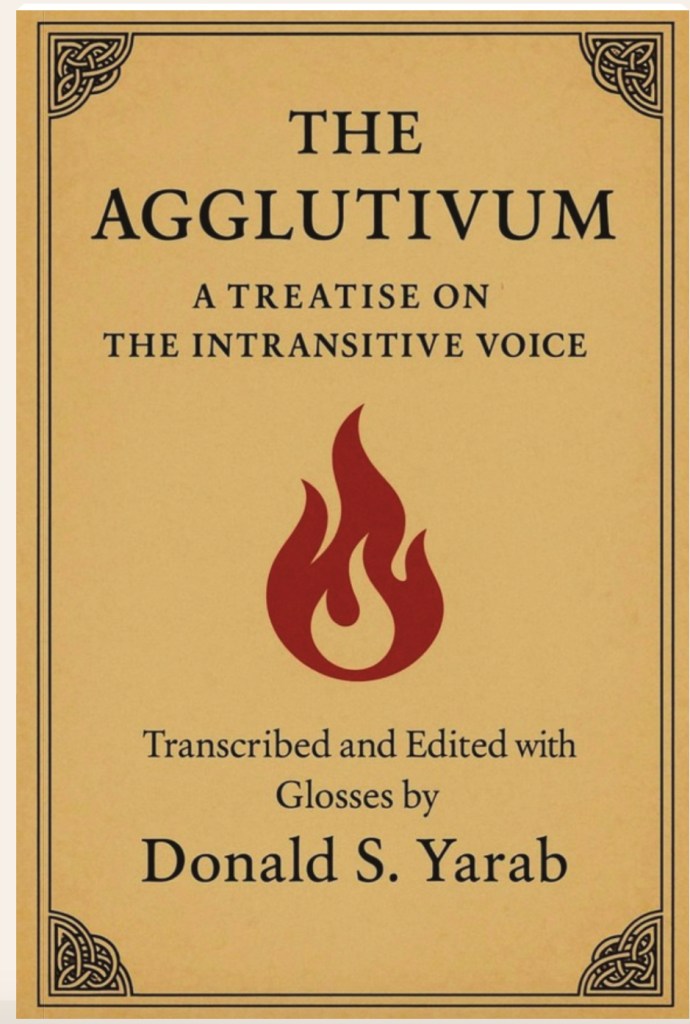
Liber Agglutivi: A Work of Fiction, Philosophy, and Reverence

It is difficult to describe the Liber Agglutivi, or as translated into English, The Agglutivum: A Treatise on the Intransitive Voice, for both its origin and content resist conventional classification. Its genesis, as I recount within the pages themselves, was not intellectual but oneiric. The word agglutive—unknown to me then, undefined in any language I … Continue reading “Liber Agglutivi: A Work of Fiction, Philosophy, and Reverence”


THE AGGLUTIVUM  
A TREATISE ON THE INTRANSITIVE VOICE - bookcover
The Agglutivum: A Treatise on the Intransitive Voice
Transcribed and Edited with Glosses by Donald S. Yarab
Paperback, 58 Pages, 6in × 9in, $7.99 plus $5 postage
CLICK IMAGE ABOVE TO ORDER BOUND COPY

It is difficult to describe the Liber Agglutivi, or as translated into English, The Agglutivum: A Treatise on the Intransitive Voice, for both its origin and content resist conventional classification. Its genesis, as I recount within the pages themselves, was not intellectual but oneiric. The word agglutive—unknown to me then, undefined in any language I knew—visited me repeatedly in sleep. So compelling was its sound and weight that, upon waking, I began at once to give breath to the whisper that had haunted my rest. What emerged was not story or doctrine, but something stranger and perhaps more elemental.

The text that followed felt less composed than revealed—an excavation rather than a construction. It is, in the truest sense, a received work. Its structure—voculae, glosselitha, silentia, postverba—appeared as if drawn from some hidden grammar beneath ordinary speech. Though shaped in Latin (with an English translation as appendix) and framed by scholarly apparatus, it is not a parody nor a pastiche, but a sincere tribute to the metaphysical impulse in language.

Readers may find echoes of Borges, Vico, and Pseudo-Dionysius; others may see affinities with mystical traditions, liturgical fragments, or even speculative linguistics. It may be read as fictive scripture, poetic glossolalia, philosophical provocation, or theological shadowplay. Or perhaps—if read rightly—it is none of these, but instead a call to silence, to memory, to the threshold of meaning itself.

Let it be said plainly: this work will not appeal to all. It is slow and strange, elliptical and spare. But for the rare reader attuned to the hum beneath the words we know, it may, in its own agglutive way, speak.

The work is available to read through the link below as a free PDF. For those who find affinity with it, an inexpensive bound copy may be ordered by clicking the image of the book above.


PHILOSOPHICAL EXTENSION: ONTOLOGICAL VOCULAE

A Contemporary Meditation Inspired by the Liber Agglutivi

The Agglutivum suggests but does not systematize a catalog of words that resist conventional grammar—words that seem to create rather than merely describe reality. What follows is a modern attempt to identify and explore such “ontological voculae,” developed in the spirit of the medieval treatise but acknowledging its contemporary construction.


Voculae Agglutivae

A Supplement to the Glossarium Philosophicum
Non omnia verba dicuntur ut loquantur. Quaedam dicuntur ut fiant.


I. Sacra Voculae – Sacred Utterances

These words do not inform; they summon. Often liturgical, they retain weight through resonance, not explanation.

  • Amen
    Confirmatio sine contentu.
    —What is confirmed is not always known.
  • Alleluia
    Laus pura, sine scopo.
    —Praise that outruns its object.
  • Kyrie
    Clamor, non formula.
    —Not request, but primal cry.
  • Hosanna
    Eruptio, non enuntiatio.
    —A word of ascent, not address.
  • Om / Aum
    Vox quae se ipsam audit.
    —The breath that sustains itself.

II. Voculae Primitivae – Primal Expressions

Pre-conceptual utterances: the first stirrings of meaning, or the last.

  • Yes
    Vocabulum consentientis animae.
    —Affirmation without argument.
  • No
    Negatio sine opposito.
    —The first refusal of the void.
  • Ah
    Apertura interioris visus.
    —Recognition unmediated.
  • Oh
    Exclamatio praesentiae subitae.
    —When the world enters unbidden.
  • [Intake of breath before weeping]
    Suspirium originis.
    —A language too full to speak.

III. Nomina Se Nominantia – Names That Name Themselves

These words contain themselves, and alter meaning with each utterance.

  • God
    Vocabulum ad quod omnis significatio deficit.
    —The name that names the unnamable.
  • I
    Index mobilis identitatis.
    —Each speaker remakes it.
  • Here
    Locus qui loquitur se ipsum.
    —Presence given in the utterance.
  • Now
    Tempus quod fit dum nominatur.
    —Time speaking its own arrival.

IV. Verba Liminalia – Threshold Words

Spoken not to describe, but to open a space.

  • Hello
    Initiatio contactus.
    —More door than declaration.
  • Goodbye
    Benedictio transitus.
    —Departure sanctified in speech.
  • Please
    Vulnerabilitas facta audibilis.
    —A soft invocation of the will.
  • Welcome
    Domus facta verbo.
    —The house that builds itself in greeting.

V. Glosselithae Viventia – Words Worn Smooth by Use

Repeated beyond meaning, yet retaining force.

  • Love
    Verbum laesum; reclamatione indiget.
    —Desecrated by misuse, yet pulsing still.
  • Peace
    Optatio in figura dissoluta.
    —A longing that sounds like a promise.
  • Home
    Non locus, sed reditus.
    —Not place, but return.
  • Mother
    Verbum primordiale; lingua ante lingua.
    —The first word spoken without grammar.

VI. Voculae Intranslatae – The Untranslatable

Not exotic curiosities, but deep resonances foreign to our tongue.

  • Saudade (Portuguese)
    Absentia praesentiae desideratae.
    —Longing for what once was or never was.
  • Duende (Spanish)
    Spiritus tenebrosus artis viventis.
    —The dark, unteachable spark of art.
  • Hiraeth (Welsh)
    Nostalgia quae locum non habet.
    —Homesickness for an imagined past.

VII. Voculae Vulneratae – Wounded Words

To be spoken only with reverence, if at all.

  • Freedom
    Verbum quod fuit, et quod mendacio circumdatur.
    —Once invoked in hope, now weaponized.
  • Truth
    Conceptus fractus inter instrumenta.
    —Broken under the weight of use.
  • Justice
    Verbum spoliatum, ad reclamationem vocatum.
    —A word in exile.

Nota Terminalis:

Verba haec tangenda sunt sicut lapides post imbrem. Non sunt instrumenta, sed accessus. Loqui ea est transire limen. Tacere ea est servare lumen.

The Peril and Promise of Models: Utopia, Economy, and Theology


Pieter Bruegel the Elder, The Tower of Babel (c. 1563)
Pieter Bruegel the Elder, The Tower of Babel (c. 1563, oil on panel)
Kunsthistorisches Museum, Vienna

Utopias, like theoretical economic models and theological constructs, are among the most daring expressions of human thought. Each arises from an impulse toward order and improvement, born of the conviction that the present is insufficient and the future can be shaped. Yet despite their elevated origins, these frameworks call to be eschewed—not for the good they propose, but for the horrors they have enabled when unmoored from humility and constraint.

The history of ideas is littered with systems that began in hope and ended in terror. Plato’s Republic, with its philosopher-kings and rigid class hierarchy, inspired centuries of authoritarian dreams. Soviet central planning promised rational allocation but delivered famine and repression. The Puritan theocracy in Massachusetts Bay sought godly perfection but produced witch trials and exile for dissenters. Each began as a vision of human flourishing—the utopian city, the rationalized economy, the purified creed—yet furnished the blueprints for regimes of control.

Nor is such danger confined to leftist excesses or theological zealotry. In Chile, the 1973 overthrow of Salvador Allende led not only to political violence, but also to the forceful imposition of a radical free-market model under General Pinochet, guided by economists trained in the Chicago School. The result was economic restructuring praised by some for its efficiency, yet experienced by many as immiseration and repression. Here, too, theory eclipsed humanity. Market mechanisms became commandments; dissenters were not debated but disappeared. What was billed as liberation through market freedom became another apparatus of dominance—less visible, perhaps, but no less brutal. The lesson is not partisan, but perennial: when theory is elevated above persons, systems serve themselves.

Elevated to ideology, models cease to be guides and become chains. They offer certainty in place of inquiry, coherence in place of complexity, and purpose in place of personhood. What begins as vision hardens into decree; what is meant as a lens becomes law. Mao’s Great Leap Forward exemplified this transformation: an economic model promising industrial prosperity became an unyielding doctrine that cost millions of lives when reality refused to conform to theory.

When the model becomes sacred, deviation becomes heresy. And where heresy is named, there follow inevitably the commissars, the inquisitors, the doctrinaires—those who patrol the borders of the permissible. Stalin’s show trials eliminated those who questioned economic orthodoxy. Both Catholic Inquisitions and Protestant persecutions took inhuman measures against those who strayed from their respective versions of theological purity. McCarthyism destroyed careers in service of ideological conformity. All operated in service of the model, the path, the “truth”—though truth, in such hands, is no longer a horizon toward which one travels, but a cudgel with which to enforce obedience. And perhaps there is no final truth to be had, only a multiplicity of partial illuminations, glimpsed through the mist, refracted through fallible minds.

And yet, it would be a grave error to reject these models wholesale. A utopia, though unattainable, directs the gaze beyond the immediate—Martin Luther King Jr.’s “Dream” inspired civil rights progress precisely because it painted a picture of what America could become. A well-crafted economic model brings coherence to chaotic phenomena: Keynesian theory, whatever its limitations, helped navigate the Great Depression by providing a framework for understanding how governments might respond to economic collapse. A theological vision offers moral orientation and poetic resonance—liberation theology in Latin America, despite its political complications, channeled Christian teaching toward concrete concern for the poor and oppressed.

When held lightly—non-dogmatically, open to revision, aware of their limits—such models are not prisons but tools. They help us navigate complexity, but they must never be mistaken for the complexity itself. The Chicago School economists who influenced policy in the 1980s offered valuable insights about market mechanisms, but when their models became gospel rather than guides, the result was often ideology that ignored market failures and social costs.

The question, then, is one of balance. Can aspiration be disentangled from absolutism? Can man dream without dictating, model without mastering, believe without binding? This is no easy task, for humanity is rarely a creature of balance. We veer, we commit, we grasp too tightly. The same revolutionary fervor that toppled the Bastille eventually devoured its own children in the Terror. But the remedy is not the renunciation of vision; it is the cultivation of humility within vision. It is the refusal to equate map with territory, model with meaning, doctrine with destiny.

If balance is the ideal, then it must rest not on detachment but on a deeper fidelity—one that refuses both rigidity and relativism. This is not a call to valueless existence, but to the most valued existence—one that honors core commitments through responsive attention rather than rigid prescription. The danger lies not in caring deeply about human flourishing, justice, or freedom, but in believing we possess the universal formula for achieving these goods. True fidelity to our highest values often requires abandoning our preconceptions about how they must be realized. It demands constant attentiveness to circumstances, genuine openness to what the moment requires, and the intellectual courage to adjust course when reality refuses to conform to our expectations. The principled life is not one that follows predetermined blueprints, but one that remains alert to the irreducible complexity of human need and the ever-changing demands of genuine care.

To live without models is to drift. To live by them uncritically is to be enslaved. Wisdom lies in the middle path: to aspire without illusion, to theorize without tyranny, and to seek the better without forgetting the cost of the best. In this fragile equilibrium lies the noblest promise of human reason—not to control the world, but to understand it more justly, and to live within it more wisely. And in that wisdom, to leave room for the truth that ever escapes us.

The Inversion Cycle: Eight Scrolls of Withheld Grace

The Counterpoint of Ponder, O Morpheus, the Night Sky


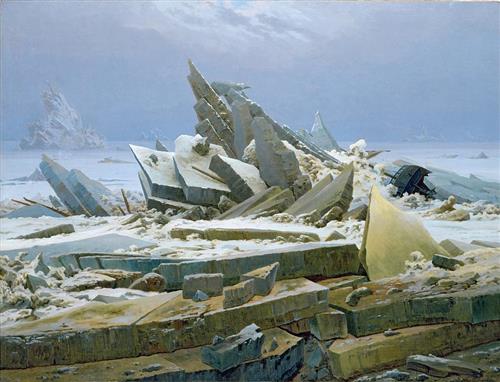
Caspar David Friedrich, The Sea of Ice, also called The Wreck of Hope 
Oil on canvas paint, 96.7 cm × 126.9 cm (1823–1824).
Caspar David Friedrich, The Sea of Ice, also called The Wreck of Hope
Oil on canvas, 96.7 cm × 126.9 cm (1823–1824).

On the Unmaking of Benediction

This cycle of verses—The Inversion Cycle—emerged not as a contradiction, but as a counterweight to The Blessing of Morpheus: The Sending Forth, a series of benedictions articulated in reverent tones and metaphysical gestures within the poem Ponder, O Morpheus, the Night Sky. That earlier work was rooted in the soul’s deep yearning toward the ineffable, culminating in luminous affirmations bestowed by the dream-god Morpheus upon the seeker. In time, those benedictions came to feel too complete, too resolved. I began to wonder: what if they failed?

The Inversion Cycle is not blasphemy, but a form of apophatic honesty. It does not seek to erase Ponder, but to stand beside it—its negative counterpoint. Each scroll of the cycle corresponds to a specific line or blessing from Ponder and performs an act of unmaking: where Morpheus blesses, these verses refrain; where he sends the seeker into mystery, these verses stall at the threshold; where he assures, they withhold.

To honor that reversal, a further restraint was imposed: the exclusion of the very vocabulary upon which the original work (and many of my other recent works) so often relied. Words such as breath, dust, light, shadow, silence, and memory—among others—have been set aside. Their absence is not a loss but a signal. These are not the tools we are permitted to carry here.

The scrolls appear here in the same order as the benedictions from Ponder, O Morpheus, the Night Sky. This reversal respects the original arc—from the loosening of dreams to the transformation of the soul—and follows its negative path with precision.

What remains is austerity, not despair. These unsacraments do not offer consolation, but they do speak. If Ponder was a song of ascent, then this is the long exhale after the music ends—a psalter of withheld grace, composed in the space where blessing does not descend.

Let this work be read not in defiance of belief, but in the trembling of its undoing. For if it is brave to bless, it is perhaps braver still to stand in the space where blessing will not come—and write there, in the dust, what remains.


Scroll I: Of the Clinging Husk

Let not your dreams fall—
for they will not fall.
They remain,
clinging like husks unpicked,
blackened not by season,
but by refusal.

You will try to cast them down,
but they are fastened,
not to limb,
but to marrow.

They do not curl like leaves.
They do not return to soil.
They sour upon you,
a bitterness in the sinew,
a ferment in the thought.

And if you turn to shake them loose,
they will tighten.
Their threads are not of sleep,
but of habit,
knotted in long forgetting.

There is no wind to lift them.
No frost to loosen them.
No gardener comes.

Remain, then, beneath their burden—
bent,
unshed,
unchanged.


Scroll II: Of the Inscribed Weight

Take them.
You will take them.
You cannot help it.

The names carved into stone,
the words burned into walls,
the cries etched into earth—
they cling not to your pack,
but to your ribs.

You bear them not as titles,
but as scars.

They whisper through your marrow,
resisting every act of unmaking.
You try to enter the place without form,
but they speak before you.
They call the ground by its old name,
and the gate does not open.

Even the sky does not answer
when it hears them rising again.

These names were not carved to remember.
They were carved to bind.

And now,
as you stand at the edge
of the place where all naming ends,
they press their syllables
against your tongue,
and you speak them,
not in defiance,
but because you cannot forget.


Scroll III: Of Implements Abandoned

Bring not the weighted balances,
nor the woven snares of longing.
They do not hold,
not here.

Their handles crack in the frost
where no stars rise to bless the hour.
Their mesh is brittle—threaded not of wool,
but of claims left too long in the mouth.

The mind, honed to edge,
cuts only fog in this place.
The heart, cupped too gently,
spills what it never held.

There are no laurels in this soil,
only reeds that do not bend
and brambles that do not bleed.

And should you cast such tools before you,
expecting fruit, or fire, or favor—
they will return to you as ash,
unsought, unshaped,
the chaff of means
mistaken for ends.


Scroll IV: Of the Withheld Offering

Bring not your hollowed chest,
stripped clean of ornaments and plea.
It will not be filled.

Wonder has no purchase here.
Its gaze returns unreflected
from stone too smooth to be shaped.

Let the mind remain loud and unyielding,
for awe would shatter in this poise
like frost-cracked bronze.

As for your feet—
do not lift them.
There is no basin here,
only ground dry from the beginning,
lined with rings that do not ripple.

The wind does not attend.
It does not lift.
It does not listen.

There is no path across this floor,
only grit,
and the marks of those who came
thinking they would walk upon revelation.


Scroll V: Of the False Horizon

Do not seek.
There is no one to be found.

The sea does not receive you.
It is not fluid,
but glare stretched to the edge of motion—
shimmering not with promise,
but with mirage.

You did not launch.
You drifted.
And your craft was not chosen,
but assigned,
drawn from timbers
meant for no voyage.

The sky above you swells with stars,
but none are true.
Each one marks a path
that bends inward,
circling you back to your forgetting.

You will think you move.
You will call it seeking.
You will call it bold.
But you are already known
by the thing that does not answer.
And it has left no threshold,
only wind
that cannot be charted
and depth that does not hold.


Scroll VI: Of the Barren Threshold

There is no beyond.
Only the gray field where sleep forgets its end
and waking does not begin.

Here, nothing waits.
Not voice, not veil,
not even the last gasp of wonder.

What lies past dream is not fullness,
but poise robbed of sanctity—
the deafness of stones
before their naming.

No stars ever hung above this place.
No fire traced its vault.
Only pallor,
dull as bone in a dry shrine,
untouched by flame or veil.

And death,
so often imagined a gate,
has no depth here.
It is shallow, crusted,
and holds nothing but its own refusal.

Let no one say this place is holy.
It is not what remains made full—
but vacancy made permanent.

A place unmourned.
Uncalled.
Unmade.


Scroll VII: Of the Unbecome

Go not.
There is nowhere that calls.
No road unfurls before you,
no veil parts,
no watchful eye lingers on your vanishing.

The question you bore
was not accepted.
It curled back into you,
like a tongue that feared its own utterance.

You will not be shaped by asking,
nor known by your seeking.
You will remain
as you were before the yearning—
a vessel without fracture,
never poured,
never filled.

No sound will rise behind you.
No trace will stir where your feet passed.
Even the soil will forget your weight.

Be still, not in peace,
but in the form that does not unfold.
Remain—not as the question—
but as that which never found its shape.


Scroll VIII: The Soul Beneath the Blanched Sky

The soul, girded and unmoved,
stood beneath a sky without veil—
a dome blanched of fire,
where nothing had ever gleamed,
only ash adrift from unremembered pyres.

It bore no garment.
No mark of calling or descent.
It was as parchment without script,
unhandled, unblemished, unread.

No winds stirred the plain.
Only cairns rose in rows,
not raised in reverence,
but born of the land’s refusal to yield.

The trees there had no buds.
Their limbs were stiff, as if carved for stillness—
a forest of halted prayers.
And beneath them,
the roots did not seek nourishment,
but curled inward,
content in their forgetting.

There was no calm,
no sacred pause.
Instead, a muttering of syllables
rose from the dry hollows—
sounds without grammar,
without bond,
giving rise to no names,
no intelligible form.

And when the soul pressed its palm
to the ground,
there was no spring,
no pulse,
only crusted clay—
neither moist nor cracked,
a firmness that would not give.

It asked nothing.
Not from pride,
but from knowing
that some places are beyond summons—
places where even longing
has been turned to stone.