
The Hollow Trunk’s Flight

The Dream

A dream came last night, which I remembered fully this morning—unusual in itself. And it took place in my back yard, though it was both the yard I inhabit now and the yard of my childhood, merged into one, as dreams are apt to do.

There, an artful arrangement awaited discovery. Tree stumps, limbs, and trunks lay piled upon one another in an interlocking manner that spoke of intention, as if some unseen curator had composed a sculpture from what time and weather had left behind.

When I reached out to touch them, my hands found surprise. These weathered forms, which should have been heavy with the density of wood and years, had been hollowed by time itself. They were rotted through, yet not with decay’s dampness—they were light and dry, transformed into airy vessels rather than solid mass.

Somehow, as dreams permit impossible physics, I found myself propping up a trunk that had been cleft cleanly along its length. It towered above my home, this great hollow half-cylinder, and I leaned it against another tree for support. Yet it was the interior that commanded wonder—not the familiar barked exterior, but the cavernous architecture time had carved within.

The hollow space revealed itself as a cathedral of wood. Veins ran through its walls like ancient rivers frozen in timber. Hollows and chambers formed a geography of absence, more substantial in its emptiness than solidity ever was. Feathery light filtered through, revealing a multitude of dark wooden colors that dazzled the eye—chestnut depths giving way to amber chambers, shadows playing across surfaces smoothed by seasons of patient transformation.

Then came the wind. A sudden gust lifted this towering trunk—this thing that should have weighed hundreds of pounds—and set it sailing. It rose effortlessly over my home, over the neighboring trees, floating like a great wooden vessel through the air. I watched in wonder as it drifted beyond my private yard into the public realm, finally coming to rest in the street where others might behold it: a hollowed vessel that had learned to fly.

Reflection

When I woke, with the image of the trunk carried aloft by wind still vivid and present, I immediately, before any conscious analysis, found myself recalling a verse from Sirach 34:1:

“Vain and deceptive hopes are for the foolish, and dreams lend wings to fools.”

Strange that this verse should surface decades after its first encounter, yet perhaps not strange at all. Since my undergraduate days, I have described my own words as but the “ramblings of a fool.” Yet here was a dream that seemed to insist on meaning, demanding that this particular fool pay attention to what had taken wing.

And so its meaning began to unfold.

What does it mean to be made light by emptiness? In this dream, the trunk had surrendered its solid density to time’s patient carving, and in return had been granted the gift of flight. It was not diminished by its hollowness but transformed by it—its beauty now living in the spaces where wood once was, in the architecture of absence that created room for light to play.

Perhaps this speaks to a deeper truth about how we ourselves are shaped. The experiences that hollow us out—loss, time, the gradual weathering that comes with living—may not be diminishing us but preparing us for a different kind of beauty. What we think of as erosion might actually be revelation, uncovering inner landscapes we never knew existed.

The dream suggests that lightness is not about adding something but about discovering what remains when the unnecessary weight has been worn away. Those veins and chambers within the wood were always there, waiting to be revealed. The capacity for flight was present all along, hidden beneath layers that time knew how to remove.

And there is something profound about how the dream moves from private discovery to public gift. What begins in the intimate space of a backyard—this personal encounter with transformed wood—ultimately takes wing and lands where others might find it. The wind carries our revelations beyond the boundaries we set for them, beyond the fences of our private understanding.

The hollow trunk that sails over houses and trees reminds us that what we think is fixed and earthbound may be preparing for flight. What appears to be ending—the tree’s death, the wood’s decay—may actually be a becoming, a transformation into something lighter, more beautiful, more free.

In the end, perhaps the dream asks me to consider: What in my own life is being hollowed by time? What losses carve space for unexpected beauty? And what within is growing light enough to catch the wind? Sirach warns that dreams lend wings to fools. Yet perhaps even folly bears wisdom, if its wings lift what was thought earthbound into flight.

Smoke Without Borders: Cleveland’s Air Quality Alerts and Canada’s Wildfire Crisis


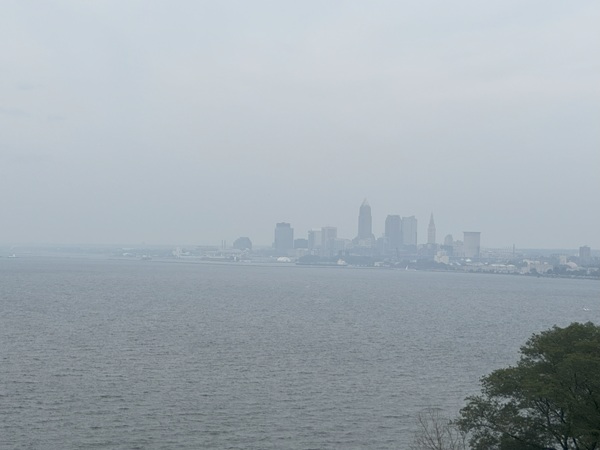
Canadian wildfire smoke causes an afternoon haze on August 4, 2025, obscuring the view of Lake Erie and downtown Cleveland, Ohio. Photograph by John K. Jones
Canadian wildfire smoke causes an afternoon haze on August 4, 2025, obscuring the view of Lake Erie and downtown Cleveland, Ohio. Photograph by John K. Jones.

This morning I awoke—yet again—to an air quality alert in Cleveland. These warnings have become disturbingly routine. Yet there is nothing routine about them. Sometimes the smoke is plainly visible, a dull haze hanging over Lake Erie; other times the sky appears deceptively clear, even as sensors warn of danger. Each alert is not only a public health signal but also a tangible indicator of the broader climate crisis—one that too many still deny.

I. Not a New Story, but a New Scale

Canada has long experienced wildfires, particularly within its vast boreal forests, as part of natural ecological cycles. However, the severity of recent fire seasons represents a dramatic departure from historical norms. In 2023, Canada endured its most destructive wildfire season on record, with more than 18.5 million hectares (over 45 million acres) burned—more than two and a half times the previous record and roughly seven times the long-term annual average.[1]

II. Why Canada Is Burning More Than Ever

1. Climate Change Accelerates the Threat

Canada’s climate is warming at roughly twice the global average (approximately 2°C since 1950 compared to the global average of 1.1°C), and in some northern regions nearly three times faster.[2] This accelerated warming produces hotter, drier vegetation that becomes fuel for wildfires, extends the fire season well beyond historical norms, and increases the frequency of lightning storms that ignite many of these blazes.[3]

2. Boreal Forest Vulnerability and Ecological Shifts

While boreal forests are adapted to periodic fire, the new scale and intensity of burning can overwhelm their capacity for regeneration. Repeated megafires may transform vast areas into grasslands or savannas, disrupting ecosystems and releasing massive stores of carbon into the atmosphere.[4]

3. Human Activity and Legacy Fire-Management Models

Though many fires are sparked by lightning, human activities—campfires, discarded cigarettes, sparks from machinery—remain a significant cause. Decades of fire suppression, along with the decline of Indigenous controlled-burn practices, have also left forests dense and fuel-rich, primed for catastrophic fires when drought and heat arrive.[5]

III. Cleveland Downwind

Wildfire smoke respects no borders. Carried by wind patterns and jet streams, it regularly drifts into the Midwest and Northeast. In Cleveland, this has meant days when the Air Quality Index rises into the “unhealthy for sensitive groups” range or worse. Fine particulate matter (PM₂.₅—particles smaller than 2.5 micrometers) can penetrate deep into the lungs and enter the bloodstream, aggravating heart and lung conditions and increasing health risks for vulnerable populations. Elevated ground-level ozone, worsened by heat, compounds these dangers.[6]

The reality is that Cleveland residents now regularly breathe air compromised by fires burning hundreds or thousands of miles away—a stark reminder of how interconnected our environmental challenges have become.

IV. A Shared Crisis

This is not merely a Canadian issue—or solely a U.S. problem. It is a continental and global crisis, rooted in climate change and demanding coordinated action in emissions reduction, forest management, and public health preparedness.

V. Closing Reflection

Tomorrow’s sunrise over Lake Erie may bring either full clarity or another haze alert. Regardless, the truth remains: our climate is changing faster than our institutions, our habits, or our response. The question is not whether the air tomorrow will be breathable. The question is whether we are prepared to protect it—not only here, but everywhere.


References

  1. “2023 Canadian Wildfires,” Wikipedia, accessed August 8, 2025, https://en.wikipedia.org/wiki/2023_Canadian_wildfires.
  2. “Climate Change in Canada,” Wikipedia, accessed August 8, 2025, https://en.wikipedia.org/wiki/Climate_change_in_Canada.
  3. “Expert Insight: Canada Is Warming Faster than Anywhere Else on Earth,” Western University News, January 2024, https://news.westernu.ca/2024/01/expert-insight-canada-is-warming-faster-than-anywhere-else-on-earth/.
  4. Kasha Patel, “Canada’s Wildfires Are Changing the Landscape for Decades to Come,” Washington Post, July 11, 2025, https://www.washingtonpost.com/weather/2025/07/11/canada-wildfire-smoke-forests-landscape-change/.
  5. Aryn Baker, “We’ve Entered the Age of the Megafire,” Time, July 2024, https://time.com/7299284/age-of-mega-wildfires-climate-change/.
  6. David Abel, “Wildfire Smoke Is Increasing across New England,” Boston Globe, August 5, 2025, https://www.bostonglobe.com/2025/08/05/metro/wildfire-smoke-increasing-across-new-england/.

Another August Backyard Visitor

A few feet away from my back porch, this fawn was left in the “nursery” by her mother for several hours this hot August afternoon, continuing the tradition of mother deer who have a fondness for the security of my back yard. Photograph by the author.

August’s Backyard Visitor

This beautiful butterfly was one of many visiting my backyard the first week of August 2025. Fewer than in past years, but always a delight to encounter. Photography by the author.

The Hollow Archive: Polymathy Without Understanding

A Poetic Prelude

In labyrinths of lettered stone,
the scholars kneel and bow—
pages rustle like dry leaves
but wisdom does not stir.

They chant forgotten tongues,
their candles blind to dawning light.
The vessel fills but remains empty,
much learning heaped on barren ground.

Beneath the torrent of voices,
the river flows, silent and whole,
whispering to those who cease their chanting—
understanding begins in stillness.


Heraclitus “the Weeping Philosopher” (c.550-489 BC).
Attributed to Johan Moreelse (b. before 1594 -1634).

Knole © National Trust.

The Tyranny of Polymathy and the Silence of Wisdom

Among the scattered remains of Heraclitus’ thought, few sayings possess the enduring sharpness of this brief maxim: πολυμαθίη νόον οὐ διδάσκει — “much learning does not teach understanding” (Fragment XVIII, in The Art and Thought of Heraclitus, ed. Charles H. Kahn, Cambridge: Cambridge University Press, 1979, pp. 36–37). In a world increasingly captivated by the accumulation of knowledge, this ancient fragment persists as both a critique and a corrective.

Heraclitus of Ephesus, known to later generations as “the Obscure,” was not hostile to knowledge itself, but to its superficial accumulation. He reserved his sharpest disdain for those who amassed facts while remaining blind to deeper unity—figures such as Hesiod, Pythagoras, Xenophanes, and other fellow polymaths. To Heraclitus, the decisive mark of wisdom was not volume but depth, not possession of facts but recognition of λόγος (logos), the underlying order binding the manifold into one.

At the heart of his saying is the contrast between πολυμαθίη (polymathy, or the gathering of knowledge) and νόος (intelligence, intuitive understanding). Polymathy is acquisitive; it accumulates and catalogs. It may grow in quantity, but seldom in quality. Νόος, in Heraclitus’ conception, is penetrative—it cuts through the clutter, grasping the essential, perceiving the harmony hidden beneath the flux of appearances.

Modern Echoes: Information Without Insight

Heraclitus’ critique resonates acutely within the modern world. Never has humanity enjoyed such unrestricted access to knowledge. Vast databases, rapid transmission of ideas, and instantaneous retrieval of information define our age. Yet the paradox deepens: the world grows correspondingly impoverished in intelligence and understanding.

Data is abundant, but coherence is rare. Scholarly disciplines multiply, but their mutual intelligibility diminishes. Algorithms accumulate citations while human insight often withers beneath the sheer weight of accumulated text. Heraclitus reminds us that the mere collection of knowledge is not a pathway to wisdom; the two may diverge as sharply as night from day.

Heraclitus and the Machine Mind

This divergence is nowhere more manifest than in the emergence of artificial intelligence. Large language models, trained on incomprehensible expanses of text, generate fluent prose, plausible argumentation, and stylistic mimicry. They are polymathy mechanized: vast collectors, elegant rephrasers, yet fundamentally lacking in νόος.

Heraclitus would have recognized this phenomenon at once, for the problem is not the breadth of data but the absence of soul. In another pointed maxim, he declared: κακοὶ μάρτυρες ἀνθρώποισιν ὀφθαλμοὶ καὶ ὦτα, βαρβάρους ψυχὰς ἐχόντων —“eyes and ears are bad witnesses for men who have barbarian souls” (Fragment XVI, Kahn, pp. 34–35). It is not merely that the senses deceive, but that without a cultivated and receptive soul, sensory data remains inert, misapprehended, or altogether meaningless.

Machines “see” through vast datasets, “hear” through colossal corpora, but possess no ψυχή (soul), only a barbarian mimicry. Their testimony is immense but alien, their utterances fluent but soulless, incapable of partaking in the λόγος (logos) that Heraclitus saw as the ordering principle of reality. They traffic in appearances without substance, in signals without understanding.

Such systems compound the crisis by making superficial synthesis effortless, further displacing the contemplative labor essential to the cultivation of νόος. The true danger is not that machines think, but that they make it easier for humans to avoid thinking. The peril lies not in the tool itself, but in our eagerness to mistake mimicry for wisdom—to enthrone fluent appearance where only reflective engagement yields genuine understanding.

Conclusion: The Call to Stillness

Heraclitus, who spoke of the river that flows yet remains the same, calls us back to what is most essential: not the accumulation of voices, but the discernment of harmony; not endless learning, but the cultivation of understanding. His words remind us: the vessel may be filled to overflowing, yet remain empty of wisdom.

Against the relentless deluge of data, against the mechanical polymathy of our age, Heraclitus directs us to the deeper current. True understanding arises in the stillness where νόος awakens and the λόγος reveals its hidden thread. To cultivate νόος demands not accumulation but attention: the examined life, sustained reflection, and the pursuit of insight rather than quantity. The wisdom of Heraclitus remains as vital today as when it was first set down in fragments.


Source for Heraclitus: Charles H. Kahn, The Art and Thought of Heraclitus (Cambridge: Cambridge University Press, 1979).