The King’s Two Bodies: The Return of the Arcane Sovereign

In the photographs taken within the Oval Office (2017, 2025), the seat of American executive authority has been transformed into something older and stranger—a sanctuary of royal consecration. At its center sits Donald J. Trump, head bowed, encircled by ministers and advisers whose hands rest upon him in the gesture of impositio manuum, the laying on of hands. Their eyes are closed, lips moving in prayer, yet their posture speaks less of intercession than of veneration. What unfolds in that moment is not simply political theater but a ritual reenactment of an ancient idea: that power may be embodied, sanctified, and made flesh.

Impositio Manuum 2017

The Reversal of Benediction

In Christian and pre-Christian rites alike, the laying on of hands conveys the transmission of grace or authority. The priest’s touch confers the Spirit upon the baptized; the bishop’s hand consecrates the king. Here, however, the direction of sanctification is reversed. The clergy do not mediate divine blessing to the ruler on behalf of the people; they draw legitimacy from him. The bowed heads and concentric hands create a living reliquary around the sovereign’s body. The Oval Office, ordinarily a stage for civil governance, has been re-imagined as an apse, its curved wall a secular altar niche. What was intended as prayer has become an act of anointment—without chrism, yet heavy with its symbolism. In 2025, the Christian supplicants’ language included a declaration of divine appointment: “You assigned him, you appointed him, you anointed him for such a time as this…”

Impositio Manuum 2025

The Living Law

Ernst H. Kantorowicz, in The King’s Two Bodies, described how medieval jurisprudence conceived the ruler as lex animata—the “living law.” The sovereign’s person contained within it both the mortal, fallible flesh (corpus naturale) and the immortal, juridical body politic (corpus mysticum). Law was not merely administered by the king; it was enfleshed in him. The maxim omnia iura in scrinio pectoris imperatoris—“all laws reside in the emperor’s breast”—expressed the same belief: that the sovereign’s will constituted legality itself.

Trump’s self-understanding, as revealed in his statements that “I (have) the right to do anything that I want to do. I’m the president of the United States,” and that he could even “declassify by thinking” alone, reflects this archaic conception of sovereignty. In the photographs, that philosophy becomes visible form. His body, ringed by supplicants, stands as the physical repository of authority: thought and flesh fused into the living source of law. The constitutional process is eclipsed by a medieval metaphysic—the emperor’s breast revived within a republic.

The Mystical Body of the Republic

In Kantorowicz’s analysis, the king’s dual body was not a theological curiosity but a political necessity: it allowed the continuity of the realm despite the mortality of its ruler. The body politic outlived the natural body through the fiction of divine investiture. Yet in the Oval Office images, the relationship is inverted. The ruler’s flesh absorbs the polity rather than the polity transcending the ruler. The praying ministers become members of his mystical body, as if the state were incarnate in him rather than he in the state. The photographs thus performs a political transubstantiation—the transformation of a secular office into a sacred organism whose head alone is divine.

Iconography of Idolatry

The camera captures only the back of the president’s head in one of the images, a composition that echoes the devotional art of relic veneration. The viewer’s gaze aligns with the worshippers’ hands, all converging on the same luminous focal point: the golden hair, haloed by the light of the room. The gesture is tactile worship, the contact-relic as conduit of grace. In medieval reliquaries, touch transmitted sanctity; here it transmits legitimacy. The image collapses the distinction between religion and politics, portraying a people seeking salvation through proximity to power.

The Return of the Arcane Sovereign

What Kantorowicz chronicled as a vanished theology of monarchy reappears in modern populist guise. The constitutional republic, built upon the rejection of divine kingship, finds itself haunted by its ghost. The sovereign’s “two bodies” are re-fused: the office and the man, the law and the will, the symbol and the flesh. Those who kneel do so not before the law but before its living embodiment. When the sovereign’s body absorbs the state, law becomes indistinguishable from will. In such a regime, dissent is not disagreement—it is heresy. The king’s body, once divided for the safety of the state, is whole again.

The danger lies not only in the man but in the myth reborn around him—the longing for the immediate, the personal, the sacred ruler who is the nation. In that longing, the modern citizen becomes medieval subject once more. And the Oval Office, once the seat of the people’s servant, becomes the sanctuary of an arcane sovereign whose heart, like the emperor’s of old, is presumed to contain all laws within its breast.

Epic of Gaza

Proem

Weep, Angelic Host—sentinel Cherubim, laudific Seraphim—weep,
Recall, O Memory, the deeds of men most mean, their bitter striving;
Of those whose wrath, though born of dust, consumed the fields of nations,
Whose hands, unclean with envy, loosed the cry of widows and orphans.
From their hearts rose pride, and with their pride came hunger unbounded,
Till hearth and altar alike lay broken, the ploughshare shattered,
And souls unnumbered went down to the shadowy regions,
Leaving their fathers bereft, their children untended, their homes in ashes.

Thus was the earth made desolate, and Heaven itself grew weary;
For even the Seraphim, laudific, grew silent in their praising,
And even the Cherubim, sentinel, let fall their flaming vigil.
Yet still, O Memory, sing on, that generations yet unborn may tremble,
Lest pride unmeasured, and meanness cloaked in strength, rise once more,
And angelic hosts be called again to witness man’s undoing.


Gaza Before the Storm

Remember first how Gaza stood beside the ancient sea,
Her markets bright with oranges, her harbors filled with song,
Where fishermen cast nets at dawn, and children ran the shore,
And olive groves grew silver-green beneath the turning seasons.
The Great Omari lifted high its Byzantine dome,
Saint Porphyrius kept its vigil, fifteen centuries strong,
And in the evening hour of prayer, a thousand minarets
Sent voices skyward, weaving threads of worship into twilight.

Here was a city rooted deep, her stones drunk full of time,
Her people bound by blood and earth to this small patch of shore.
The old men sat in coffee shops, playing backgammon and speaking
Of harvests past, of children grown, of peace that might yet come.
But Memory keeps what was, before the storm clouds gathered,
Before the sky grew dark with iron, and the earth with ashes.


Gaza Besieged

Hear now, O Memory, after the angelic cry, the tale of sorrow:
How wrath was loosed upon Gaza, the walled and crowded city,
Where children clung to their mothers, and fathers kept vigil in hunger,
And the streets ran red with fire, the stones made to weep with blood.

For men most mean, in pride unmeasured, cast down their anger,
And the sky, once blue with doves, grew black with the smoke of ruin.
Hospitals groaned with the wounded, mosques lay shattered in silence;
The cry of the muezzin was drowned by the thunder of iron.
Women lifted their arms to heaven, crying for justice;
Infants wailed without milk, and the wells ran red with despair.

Thus did Gaza endure, as Ilium once by the Scamander,
A city besieged, its name to be sung in lamentation.
Yet not Troy alone, but Sarajevo’s bitter winters,
Stalingrad’s rubble, Warsaw’s ghetto walls—
All cities that have tasted wrath speak Gaza’s name as sister.


Catalogue of Grief

Sing the children whose laughter was severed in silence:
Sing Amal, whose curls were bright as dawn, now dust-shrouded;
Sing Yusuf, who carried a ball through the alleys, forever stilled;
Sing Miriam, with eyes like lamps, closed by the weight of rubble;
Sing Omar, who drew birds in the sand, his small hands silenced;
Sing Laila, who danced to her grandmother’s songs, now voiceless;
Sing Ahmed, six years old, who asked why the sky was angry.
These were the blossoms cut down, their springtime denied them,
Their games unfinished, their dreams unspoken, their tomorrow stolen.

Sing the mothers, whose voices rose in lamentation:
Sing Layla, who cried to the heavens, clutching fragments of cloth;
Sing Hanan, whose arms grew empty, rocking the air with sorrow;
Sing Fatima, who counted days by her children’s breathing;
Sing Mariam, who sang lullabies to graves of stone.
They were the pillars broken, their wombs turned to tombs of memory,
Their milk dried up, their cradle songs transformed to keening.

Sing the fathers, silent with grief, their faces carved from stone:
Sing Khalid, who once ploughed fields, now sifts through the ruins;
Sing Samir, who carried no sword, yet bore the weight of the fallen;
Sing Mahmoud, whose hands built homes, now dig for his buried;
Sing Hassan, who taught his son to read, now reads only headstones.
They were the oaks uprooted, their roots torn from the soil,
Their strong backs bent, their protecting arms made powerless.

Sing the city herself, Gaza, heart of the seashore:
Streets that once bustled with trade, now choked with ashes;
Mosques that lifted their domes to heaven, now shattered and open;
Hospitals that groaned with the wounded, their floors awash in blood;
Schools where children learned their letters, now rubble and memory;
Markets where oranges gleamed like suns, now dust and silence.
Gaza endures, yet her breath is ragged, her beauty in ruins.


The Heroes of Gaza

Yet sing also those who stood against the storm:

Sing Dr. Hussam, who would not leave his patients,
Operating by candlelight when the power failed,
His hands steady though the building shook with bombs.

Sing Mama Zahra, ninety years old,
Who sheltered twelve children not her own,
Sharing her last crust of bread among them,
Singing them to sleep with ancient lullabies.

Sing the teacher Amjad, who carved lessons in the dust,
Teaching children their letters beneath the rubble,
That learning might not die with the schools,
That hope might live though hope seemed dead.

Sing the young father Rashid, who dug with bloodied hands
For seventeen hours to free his neighbor’s child,
Though his own house lay in ruins,
Though his own losses called him home.

Sing the nurse Amal, who walked three miles each day
Through streets of glass and metal,
Carrying medicine to the wounded,
Her white coat bright as a flag of mercy.

These were the lights that would not be extinguished,
The flames that burned when all else was darkness,
The proof that goodness lives even in Hell,
That humanity endures though inhumanity rage.


The Silence of Nations

Yet where were the nations when Gaza called for aid?
The mighty kingdoms sat in their towers of glass,
Counting their gold, weighing their alliances,
While children starved beneath the rubble of their homes.

Some sent words like empty vessels, hollow condolences,
Others turned their faces away, as if not seeing
Could make the screaming stop, the dying disappear.
The halls of justice echoed only with procedure,
While Gaza bled, and Memory wrote their shameful silence.

Even the sea turned bitter, tasting ash and sorrow,
And dolphins fled those waters where the harbors burned.
Only the wind remained faithful, carrying the cries
Across the world, though men stopped up their ears
And closed their eyes, and voted for blindness.


Wrath of the Aggressors

Yet grief alone is not the tale, but wrath that bred it.

For men most mean, enthroned in pride, decreed destruction:
The Stone-faced King, whose tongue was sharpened with iron,
Who called fire down from heaven, and loosed it on the helpless.
The Golden-Maned Ruler, who sat upon distant waters,
Sending arms and gold, as though to purchase silence;
He bore the name of peacemaker, yet his hands were heavy with blood.

These were the princes of the age, their counsel clothed in falsehood,
And their decrees were bitter, sowing ashes in the earth.
They spoke of safety while they sowed destruction,
Of defense while they dealt death to the defenseless.
Their words were honey, but their works were gall,
And History will write their names in letters black as smoke.


The Voice of Gaza

Yet not in silence did Gaza bow, nor wholly in despair.
From the ruins rose a voice, steadfast as stone in the storm:

“We are the living, though the dust has covered our faces.
Our children sleep in the earth, yet their names burn bright as stars.
Break our houses, yet from rubble we rise speaking;
Cut down our olives, yet new shoots crack the stone.

You call us shadows, yet we cast longer darkness
Than your towers, and our darkness teaches light.
You name us forgotten, yet Memory keeps us close,
And angels inscribe our suffering in letters of gold.

Count our dead if you can number the grains of sand;
Measure our sorrow if you can drain the sea.
We have drunk deep of anguish, yet we are not broken;
We have walked through the valley of death, yet we breathe.

O sons of men most mean, your wrath is but smoke on the wind.
You have the fire, but we have the ashes, and ashes endure.
You have the sword, but we have the word, and the word is eternal.
Know this: though you bury us, we shall rise in the telling,
For the earth itself whispers our names, and will not forget.

And if the nations turn their faces away, still we stand,
For Gaza is not undone, though her walls lie fallen.
We are the olive trees that grow from stones,
We are the songs that survive the singers,
We are the light that shines in darkness,
And darkness has never overcome us.”


The Desecrations

Nor were the sanctuaries spared, nor the places of the Most High.
The destroyers struck at temples, their minarets broken in silence;
They shattered the churches, where lamps once trembled in vigil,
Icons dashed in dust, crosses cast down in fire.
Thus was prayer silenced, whether in Arabic chant or in hymnal;
The faithful fled, yet the stones themselves groaned in lament.

And the olive trees, those elders of the earth, were uprooted;
Ancient roots torn from soil that had drunk the blood of generations.
Branches once heavy with fruit lay scorched upon the ground,
And the groves, where fathers had walked with their sons, stood barren.
No psalm was heard, no murmur of leaves in the evening;
Only the wind through ruins, whispering sorrow to heaven.

Even the dead found no peace in their appointed places;
Graves were torn open, bones scattered to air,
Ancestors made homeless, their rest disturbed.
For wrath respects neither the living nor the sleeping,
Neither the newly born nor the long-buried,
Neither the sacred nor the profane.


Catalogue of the Broken Sanctuaries

Sing the names of holy places undone:
The Great Omari Mosque, Byzantine-born,
Heart of Gaza’s Old City, December-felled;
Saint Porphyrius, fifth-century stone,
Twice-struck shelter, sixteen souls entombed beneath its ancient walls.

Khalid bin al-Walid Mosque, November’s ruin,
Al-Riad Mosque, March’s bitter fall,
Bani Saleh Mosque, August’s dust,
Yassin Mosque, struck in al-Shati’s crowded camp,
Ibn Uthman too, its centuries silenced.

Count them: of twelve hundred and forty-four mosques,
More than a thousand scarred by fire and iron,
Nine hundred leveled utterly, their prayers cut short,
Their faithful scattered like leaves before the storm.

Graveyards forty out of sixty struck,
Twenty-two erased from the earth,
Bones scattered to air, ancestors made homeless.
Palaces broken, markets burned, bathhouses unroofed,
Even Anthedon Harbor, Roman gateway, flattened into the sea.

Museums looted, libraries obliterated,
Memory itself made to bleed, the archives set aflame.
For they would kill not only the living,
But the memory of the living,
The records of their being,
The proof they ever were.


The Lamentation Chorus

The Mothers of Gaza cry:
“O children, blossoms cut before the fruit,
We held you in our arms, now we hold only ashes.
Your laughter is buried beneath the stones of our city,
And our breasts are dry, our songs turned into wailing.
Yet still we sing your names like prayers,
And still we dream your dreams unfinished.”

The Fathers of Gaza groan:
“Our fields are ruined, our ploughs shattered,
The olive trees uprooted, the roots torn from the soil.
We walk among graves unguarded,
Where bones lie scattered, denied even silence.
Yet still we remember the taste of our olives,
And still we plant hope in the ashes.”

The Faithful lament:
“Where are the mosques that once trembled with prayer?
The Great Omari lies fallen, Ibn Uthman silenced,
Saint Porphyrius struck, its saints entombed anew.
Our lamps are dark, our chants broken in the smoke.
Yet still our hearts are temples,
And still our prayers rise to heaven.”

The Children’s Voices rise:
“We who were silenced while learning to speak,
We who were buried while learning to walk,
We who were taken while learning to love—
We are not gone, though our bodies lie broken.
We live in the tears of our mothers,
We live in the dreams of our fathers,
We live in the songs that remember us,
And death has no power over song.”

The Angels answer:
“We weep with you, O Gaza;
For sentinel Cherubim have loosed their flaming swords in sorrow,
And laudific Seraphim, once ceaseless in praise,
Cover their faces in grief, and their hallelujahs are hushed.
Yet know that every tear is counted,
Every name is written in light,
And what was destroyed on earth
Stands whole in the halls of eternity.”

The Chorus of Gaza cries together:
“Who shall remember us if not the stones?
Who shall keep our names if not the dust?
If the nations turn away their eyes,
Then let the heavens bear witness, and let Memory sing forever.
For we are Gaza, and Gaza endures,
We are the voice that will not be silenced,
We are the story that must be told,
We are the love that conquers death.”


Catalogue of the Slain

Sing, O Memory, of the dead, the multitude unnumbered,
For Gaza has given sixty thousand souls and more to the grave.
Not warriors alone, but children in their play,
Mothers in their shelter, fathers in their vigil,
The aged bent with years, the newborn scarcely named.

Count fifty-eight thousand more wounded,
Their bodies torn, their spirits scarred in silence.
Two thousand struck while seeking bread,
Gathering in hope of relief, yet felled by fire.
Three hundred perished of hunger, seven and ten children,
Their lips dry, their bellies hollow, their cries unheard by the nations.

Even when truces were spoken, the killing continued,
Ten thousand more consumed like chaff in flame.
Who can reckon those incinerated, buried under stone and steel,
Whose names are known only to God,
Whose faces are forgotten by man
But remembered by eternity?

A leaked report from the destroyer’s own hand
Confessed the truth they would hide:
Four of every five were innocents,
The harmless marked as enemies,
The helpless slain as foes.
Thus did wrath devour the lambs of Gaza,
And the angels wept, inscribing their names in light.


The Judgment of Yahweh

Then did the heavens part, as once above Sinai,
And Yahweh Himself descended, wrapped in cloud and flame,
The Ancient of Days, whose voice shook the foundations,
Before whom cherubim veil their faces, and seraphim fall silent.

He brought forth the scales of ultimate justice,
Vast as the firmament, terrible as truth,
And weighed the works of men most mean:
Their bombs and decrees, their gold and iron,
Their speeches of defense while dealing death.

“I have seen this before,” spoke the Voice that split the Red Sea,
“The marking of a people for destruction,
The sealing of their fate in chambers of decision,
The systematic starving, the calculated killing.
Did I not hear the cry from burning ghettos?
Did I not see the smoke from crematoria?”

In the other pan He placed Gaza’s slain,
The bones of children, the tears of mothers,
And with them, the ghosts of all genocide’s victims—
Warsaw and Treblinka, Armenia and Rwanda.

The scales tilted under genocide’s weight,
And the voice of the Almighty thundered:

“Genocide! I name it what it is.
You who survived the furnaces of Europe,
How could you kindle furnaces for others?

I am the God of Abraham, Isaac, and Jacob,
But I am also the God of Hagar and Ishmael.
I freed slaves from Egypt,
But I will not bless those who enslave others.

These deeds are genocide, and I have weighed them.
These rulers stand condemned, their glory is ash.
Justice will come, though justice tarry long,
And every tear will be counted,
Every life will be avenged.
Genocide!”


The Promise of Memory

Yet this is not the end, O sons of earth,
For Memory does not merely mourn but promises.

As from the ashes of the phoenix rises flame,
As from winter’s death comes spring’s green resurrection,
So from Gaza’s anguish shall come forth
A testimony that shall not be silenced.

The children who were slain shall live in song,
The mothers who were silenced shall speak through poetry,
The fathers who were broken shall stand tall in story,
And Gaza herself, though wounded, shall endure
Until justice rolls down like waters,
And righteousness like a mighty stream.

For this is the promise Memory makes:
That suffering witnessed becomes sacred,
That innocence destroyed becomes indestructible,
That love murdered becomes immortal,
And truth, though buried, always rises.


Epilogue

So sing, O Memory, lest silence fall and truth be buried.
Let cherubim guard the names, let seraphim whisper them in praise.
Let the children of Gaza, though slain, rise again in song,
And let the nations know that what was destroyed endures in remembrance.

For stone may be shattered, but the word cannot be silenced,
And ashes speak, though the fire consume them.
The olive trees shall grow again from their ancient roots,
The mosques shall be rebuilt, more beautiful than before,
The children shall play once more in streets made clean,
And Gaza shall rise, as morning rises from the night.

This is the epic of Gaza, written in tears and blood,
In ashes and in starlight, in sorrow and in hope.
Let it be read when tyrants sleep secure,
Let it be sung when justice seems to slumber,
Let it be remembered when the world forgets—

Sing, O Memory, of Gaza.

Weep, Angelic Host—sentinel Cherubim, laudific Seraphim—weep.
The Peril and Promise of Models: Utopia, Economy, and Theology


Pieter Bruegel the Elder, The Tower of Babel (c. 1563)
Pieter Bruegel the Elder, The Tower of Babel (c. 1563, oil on panel)
Kunsthistorisches Museum, Vienna

Utopias, like theoretical economic models and theological constructs, are among the most daring expressions of human thought. Each arises from an impulse toward order and improvement, born of the conviction that the present is insufficient and the future can be shaped. Yet despite their elevated origins, these frameworks call to be eschewed—not for the good they propose, but for the horrors they have enabled when unmoored from humility and constraint.

The history of ideas is littered with systems that began in hope and ended in terror. Plato’s Republic, with its philosopher-kings and rigid class hierarchy, inspired centuries of authoritarian dreams. Soviet central planning promised rational allocation but delivered famine and repression. The Puritan theocracy in Massachusetts Bay sought godly perfection but produced witch trials and exile for dissenters. Each began as a vision of human flourishing—the utopian city, the rationalized economy, the purified creed—yet furnished the blueprints for regimes of control.

Nor is such danger confined to leftist excesses or theological zealotry. In Chile, the 1973 overthrow of Salvador Allende led not only to political violence, but also to the forceful imposition of a radical free-market model under General Pinochet, guided by economists trained in the Chicago School. The result was economic restructuring praised by some for its efficiency, yet experienced by many as immiseration and repression. Here, too, theory eclipsed humanity. Market mechanisms became commandments; dissenters were not debated but disappeared. What was billed as liberation through market freedom became another apparatus of dominance—less visible, perhaps, but no less brutal. The lesson is not partisan, but perennial: when theory is elevated above persons, systems serve themselves.

Elevated to ideology, models cease to be guides and become chains. They offer certainty in place of inquiry, coherence in place of complexity, and purpose in place of personhood. What begins as vision hardens into decree; what is meant as a lens becomes law. Mao’s Great Leap Forward exemplified this transformation: an economic model promising industrial prosperity became an unyielding doctrine that cost millions of lives when reality refused to conform to theory.

When the model becomes sacred, deviation becomes heresy. And where heresy is named, there follow inevitably the commissars, the inquisitors, the doctrinaires—those who patrol the borders of the permissible. Stalin’s show trials eliminated those who questioned economic orthodoxy. Both Catholic Inquisitions and Protestant persecutions took inhuman measures against those who strayed from their respective versions of theological purity. McCarthyism destroyed careers in service of ideological conformity. All operated in service of the model, the path, the “truth”—though truth, in such hands, is no longer a horizon toward which one travels, but a cudgel with which to enforce obedience. And perhaps there is no final truth to be had, only a multiplicity of partial illuminations, glimpsed through the mist, refracted through fallible minds.

And yet, it would be a grave error to reject these models wholesale. A utopia, though unattainable, directs the gaze beyond the immediate—Martin Luther King Jr.’s “Dream” inspired civil rights progress precisely because it painted a picture of what America could become. A well-crafted economic model brings coherence to chaotic phenomena: Keynesian theory, whatever its limitations, helped navigate the Great Depression by providing a framework for understanding how governments might respond to economic collapse. A theological vision offers moral orientation and poetic resonance—liberation theology in Latin America, despite its political complications, channeled Christian teaching toward concrete concern for the poor and oppressed.

When held lightly—non-dogmatically, open to revision, aware of their limits—such models are not prisons but tools. They help us navigate complexity, but they must never be mistaken for the complexity itself. The Chicago School economists who influenced policy in the 1980s offered valuable insights about market mechanisms, but when their models became gospel rather than guides, the result was often ideology that ignored market failures and social costs.

The question, then, is one of balance. Can aspiration be disentangled from absolutism? Can man dream without dictating, model without mastering, believe without binding? This is no easy task, for humanity is rarely a creature of balance. We veer, we commit, we grasp too tightly. The same revolutionary fervor that toppled the Bastille eventually devoured its own children in the Terror. But the remedy is not the renunciation of vision; it is the cultivation of humility within vision. It is the refusal to equate map with territory, model with meaning, doctrine with destiny.

If balance is the ideal, then it must rest not on detachment but on a deeper fidelity—one that refuses both rigidity and relativism. This is not a call to valueless existence, but to the most valued existence—one that honors core commitments through responsive attention rather than rigid prescription. The danger lies not in caring deeply about human flourishing, justice, or freedom, but in believing we possess the universal formula for achieving these goods. True fidelity to our highest values often requires abandoning our preconceptions about how they must be realized. It demands constant attentiveness to circumstances, genuine openness to what the moment requires, and the intellectual courage to adjust course when reality refuses to conform to our expectations. The principled life is not one that follows predetermined blueprints, but one that remains alert to the irreducible complexity of human need and the ever-changing demands of genuine care.

To live without models is to drift. To live by them uncritically is to be enslaved. Wisdom lies in the middle path: to aspire without illusion, to theorize without tyranny, and to seek the better without forgetting the cost of the best. In this fragile equilibrium lies the noblest promise of human reason—not to control the world, but to understand it more justly, and to live within it more wisely. And in that wisdom, to leave room for the truth that ever escapes us.

Pondering the Night: A Meditation with Morpheus

“Ponder, O Morpheus, the Night Sky” arose from a meditation on the nature of dreams, consciousness, and the silent mysteries that lie beyond both. Rather than seeking to instruct, this poetic work offers a dialogue — between mortal longing and divine wonder, between question and silence. In addressing Morpheus, the god of dreams, the poem invites not sleep, but contemplation: a shared pondering of the night sky, where the known fades into the unknown, and where even gods may pause in awe before the infinite. It is my hope that this work may serve as a quiet companion for those who have found themselves, at least once, standing beneath the stars, asking questions for which no easy answers are given — and finding, in the asking, a kind of sacred beginning.


Sleep (c. 1771). Oil on canvas, 129.5 x 96.5 cm (38 x 51 in). Cleveland Museum of Art. Depicting Morpheus
Sleep by Jean Bernard Restout (c. 1771). Oil on canvas, 129.5 x 96.5 cm (38 x 51 in). Cleveland Museum of Art. Depicting Morpheus

Ponder, O Morpheus, the Night Sky

“Beyond dreams lies a silence where even gods wonder.”

Prelude: The Summoning of Morpheus

Morpheus, Keeper of the Silent Looms,
hear now the summons not of those who seek forgetfulness,
nor of those who plead for soft illusions to cradle their weary minds—
but of one who, standing alone beneath the immeasurable firmament,
dares to bid thee ponder.

Ponder, thou Weaver of Shadows, the night sky:
the endless, ink-deep vault where Orion’s belt cinches the waist of darkness,
where scattered fires—blue, white, and ancient red—
whisper of secrets too vast for mortal tongues.

Not for dreams of idle comfort do I call thee forth,
but for contemplation;
to set aside for a moment thy ceaseless crafting of mortal visions
and lift thine ancient gaze upward,
where the silent percussion of dying stars
beats out the hidden music of creation.

For if thou, master of phantoms and bringer of luminous memories,
shouldst pause to wonder at that boundless mystery,
then perhaps the soul of man, frail and flickering though it be,
might dare likewise to ask:

Who dreams the dreamers, O Morpheus?
Whence come the visions thou bestowest?
And what lies beyond the last dream, beyond the last star, beyond the last breath of sleep?

Thus the greater query is born, trembling on the tongue of the sleepless,
yearning toward the silence that gathers all speech.

The Greater Query: A Dialogue with Morpheus

Soul:
If thou, O Shaper of Phantoms, canst be stilled by wonder,
then hear the questions borne upon my waking breath,
fragile as they are, yet earnest as the stars are ancient:

Who first whispered the dream into being, before ever thou didst fashion it?
From what unseen wellspring do the rivers of vision flow?
Are the dreams of men but fractured echoes of a deeper song,
or do they weave even now the hidden fabric of worlds yet unborn?

Morpheus (in thought):
Dreams are the trembling of the soul against the veil of the infinite.
They are not born of my will alone, Seeker,
but arise from the deep soil where memory, longing, and the first light entwine.
I but give them form; I do not summon them from the abyss.
Some dreams, frail though they seem, stitch the very edges of what is to be.
Mortals, in dreaming, unknowingly shape the unborn dawn.

Soul:
Is it given to us—dust briefly animated,
clay granted momentary breath—
to pierce that veil?
Or must we first unmake ourselves,
falling through forgetting, to be remembered by the nameless light?

Morpheus:
Beyond all dreams there is a silence
older than stars and deeper than death.
A silence not of absence, but of fullness,
where neither waking nor sleeping holds dominion,
and the soul, naked and unafraid,
beholds itself as it was before all weaving began.

There the true Dreamer dwells—
not I, but He whom none can name,
the source of all dreams, the end of all seeking,
the unspoken, the unseen.

Soul:
And if we seek it,
do we not risk all—memory, longing, even self itself?

Morpheus:
It is the risk of being lost to be found,
the surrender of knowledge to come to knowing.
To seek the Silent One is to set sail upon a sea without stars,
to abandon the safe shores of image and name,
to become at last what thou hast always been:
a breath upon the waters of infinity.

Ponder well, O Seeker,
for in the seeking, thou thyself becomest the dream,
the dreamer,
and the silence beyond.

The Blessing of Morpheus: The Sending Forth

Morpheus:
Go forth, Child of Earth and Stars,
go forth lightly, as one who walks upon waters not yet created.
Carry no burden save the yearning that kindled thy question;
bind no certainty to thy brow, nor shelter fear within thy breast.

Let dreams fall from thee like withered leaves;
let even the constellations become but distant embers,
for thou seekest now what neither dream nor waking thought can compass.

Take not with thee the names men have carved into the bones of the world,
for names shatter against the face of the nameless.
Take not the proud trophies of reason, nor the soft nets of hope,
for these will tear upon the thorns of the infinite.

Instead, take this only:
a heart made naked in wonder,
a mind made silent in awe,
and feet made light as wind upon waters unseen.

And know this, O Soul:
thou art neither lost nor found in this seeking,
for to seek the Silent One is to be gathered even now into His dreaming.

Thus do I, Morpheus, who weaves the veils of sleep,
send thee forth beyond all veils, beyond all sleep,
beyond the last trembling breath of mortal wonder.
Go, and become the question thou hast dared to ask.

Epilogue: The Pondering of Morpheus

And Morpheus stood long in the hush of the night,
his ancient hands unclasped, his brow unburdened of dreams.

He lifted his gaze once more to the immeasurable vault,
where scattered fires—blue, white, and red—
burned against the black breast of infinity.

He pondered—
not as god to mortal, nor as master to servant,
but as wonder to wonder,
breathless before a mystery he too could not wholly grasp.

In the stillness beyond weaving and shaping,
he glimpsed, as in the faintest shimmer of distant nebulae,
a vastness where even gods must bow their heads,
where even dreams dissolve like mist before the morning sun.

And in that silence, older than all his songs,
Morpheus smiled—
not because he understood,
but because he wondered still.

He felt a pang—brief and piercing—
a mortal ache for the fleeting fierceness of human wonder,
so bright and brief.

And so he pondered, and the night pondered with him,
until speech was stilled,
and he was lost—and found—within the endless deep.

Toward an Unsaying: Contemplation of Faith in the Shadow of the Ineffable

A meditation on the limits of theological language and the mystery of the Divine, this contemplative essay explores apophatic mysticism, the inadequacy of creeds, and the symbolic power of maps—blending poetic introspection with a life lived in scholarship, service, and creative expression.

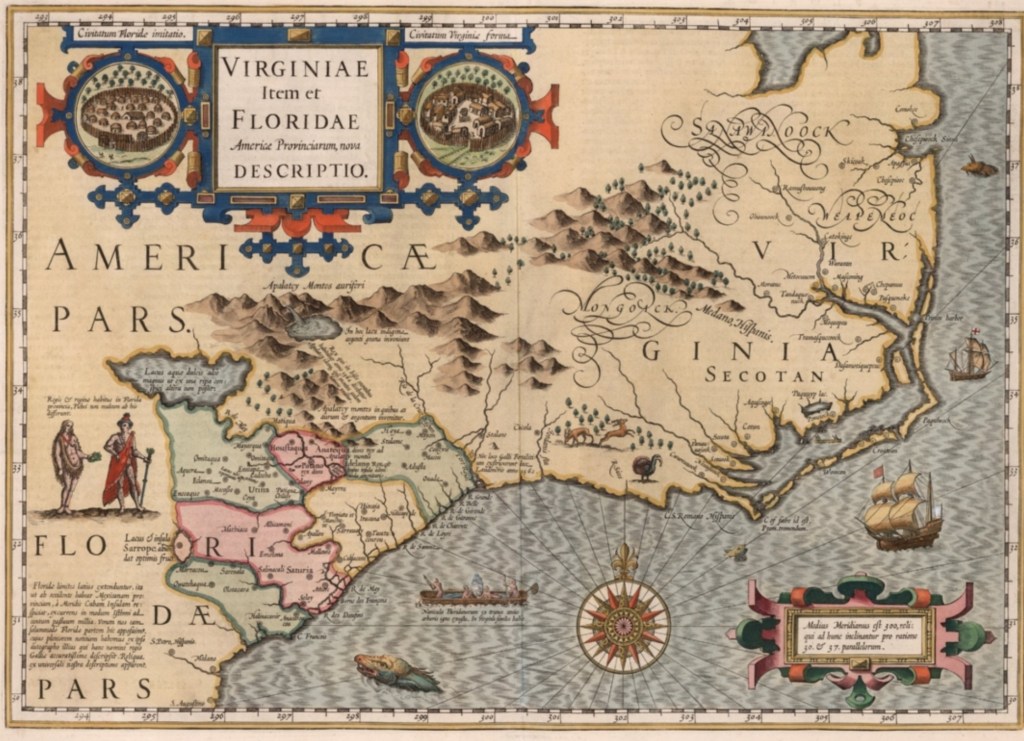
Virginiae Item et Floridae Americae Provinciarum, nova Descriptio.
Map by Gerard Mercator (1512–1594), Jodocus Hondius (1563–1612), and Hendrik Hondius (1597–1651).
Virginiae Item et Floridae Americae Provinciarum, nova Descriptio.
Map by Gerard Mercator (1512–1594), Jodocus Hondius (1563–1612), and Hendrik Hondius (1597–1651).
Published in 1623 by Hendricus Hondius, Amsterdam.
Image courtesy of the David Rumsey Map Collection, David Rumsey Map Center, Stanford Libraries.
Licensed under Creative Commons CC BY-NC-SA 3.0.

Raised within the Romano-Byzantine tradition—formed by both the Roman and Byzantine Catholic rites—I was shaped by a confluence of liturgical beauty, theological depth, and mystical reverence. From that upbringing, there remains not merely memory, but a lasting affection for the rhythm and substance of the faith of my youth. It is not simply a cultural inheritance, but a formative lens through which the sacred, the communal, and the mysterious first revealed themselves. Yet, it would not be accurate to describe my present stance as that of a lapsed Catholic, nor as an atheist, nor as one alienated from the Church. Alienation implies disaffection or estrangement born of expectation unmet or betrayal suffered. What remains is neither rejection nor rebellion, but something quieter and more reflective—a posture of reverent detachment that neither clings nor condemns.

Any attempt to articulate my position must begin by acknowledging the futility of articulation itself—at least in matters concerning the Divine. The belief that the Divine wholly exceeds the bounds of human comprehension and articulation grows only firmer over time. All creeds, revelations, and theological systems—however earnest or inspired—are, in the end, efforts to sketch with a cramped human lexicon and limited imagination that which lies beyond even the highest powers of conception. Far from illuminating the Divine, such efforts only obscure its immensity by imposing upon it our narrow symbols and forms.

Better to liken our theological endeavors to the drawing of maps—maps sketched by explorers who had never seen the coasts they sought to chart. Just as early cartographers filled the margins with dragons, saints, and imagined cities, we adorn the unknown with creeds, cosmologies, and commandments. These are sincere efforts, yet they more often reflect our hopes and fears than reveal any transcendent truth. The more intricate the system, the more seductive the illusion that the map is the territory. But the Divine is not a line upon a page. It is the sea beneath the sea monster, the silence beyond the compass rose, the continent whose very existence remains unknown. To name the Divine is already to misname it; to describe is to distort.

Such a perspective finds its truest expression in apophatic mysticism—the via negativa, the way of negation—a tradition articulated by Pseudo-Dionysius the Areopagite, a Christian thinker of the late fifth to early sixth century whose writings permeate the Catholic tradition through the works of Thomas Aquinas, Bonaventure, and the Spanish mystics, reminding us that the path of unknowing is not a break from faith, but one of its most ancient and revered expressions. In this light, God is not wise, not good, not just, not loving—not because the Divine lacks these qualities, but because our highest notions of them remain shadows cast by a light we cannot behold. Whatever we say of the Divine, however conceived, the most faithful statement is this: our words fall short.

Even so, human beings remain kataphatic creatures as well—creatures who long to speak, to name, to worship, to relate. Thus arises a kataphatic-apophatic tension, a profound and permanent unease between the impulse to speak of the Divine and the recognition that all speech fails. Hymns, liturgies, cathedrals, and doctrines are all human responses to this tension—not to capture the Divine, but to reach toward it, however falteringly. These gestures deserve neither scorn nor uncritical assent. They should be honored, but held lightly, cherished as poems rather than mistaken for proofs.

This tension extends beyond the realm of theology into the very nature of being itself. In a moment of quiet reflection, I found myself asking: “Where is Am I?”—caught between breath and thought, a question turning circles in the hollow of my chest. Am I the echo, or the voice that trembles back? A fragment drifting through the hour, a flicker in the endless light, unsure if I was ever whole or if the pieces were ever mine to find. Such a question is not mere existential uncertainty, but a recognition that the self, like the Divine, eludes definitive capture.

No formal creed or written revelation authored by man commands my assent, however noble or inspired it may be. Faith is not placed in these constructions, though the sacred yearning from which they arise is deeply respected. They are echoes of an original voice no longer heard directly, outlines of a presence glimpsed but never grasped. Like the adornments on ancient maps, these expressions are beautiful and sincere, but they are not to be mistaken for the thing itself.

To some, this may resemble agnosticism, though that word has become burdened with meanings it was never intended to carry—meanings of indecision, skepticism, or apathy. What is expressed here is none of those. It is not a shrug of the shoulders, but a bow of the head. Not the silence of the indifferent, but of the reverent. Not ignorance, but a conscious unknowing—a sacred refusal to impose limitation upon that which exceeds all bounds. This is why I eschew agnostic labels in favor of mystical ones—for the mystic does not claim ignorance of the Divine but acknowledges that true knowledge of it transcends conventional understanding.

What remains, then, is a life lived in contemplation of the ineffable—a contemplation that finds expression through creative work. In poetry, music, and essay, I reach toward that which cannot be directly named. When I write of the “eternal now” where “yesterday, tomorrow, and today collapse,” or compose lyrics that honor Humilitatem Initium Sapientiae, I am not merely creating art but engaging in a form of contemplative practice. These creative acts serve as bridges, not only between myself and the ineffable, but also between myself and others who share this reverent space, regardless of their formal religious affiliations or φιλοσοφίαι (philosophies or wisdom traditions).

The path ahead is not marked by certainty but by awe, not by declarations but by listening. Mystery is not something to be solved, but something to be honored. Years of formal study—first in history and religious studies as an undergraduate, then as a teacher of both subjects, and later through a long career in civil rights law and public service—have only deepened the awareness that human systems, whether intellectual, doctrinal, or legal, ultimately encounter their limits at the threshold of the sacred. In this, the apophatic tradition offers a spiritual home—a dwelling place where reverence begins precisely where language ends. If there is a guiding light for such a path, it is humility—humilitatem initium sapientiae—not merely as a moral posture, but as a metaphysical necessity. That teaching, which echoes throughout Thomas à Kempis’ The Imitation of Christ, remains not only a personal motto, but a settled conviction: that wisdom begins when one ceases to pretend to possess it.

Near the staircase in my front hallway hangs an early map of the New World—an artifact I have long cherished. Its artistry is matched only by its courage, for it dares to depict what was not yet known. Near the region now recognized as Virginia and the Carolinas, a sea monster rises from the ocean’s depths, signaling peril or wonder—perhaps both. On the land itself, figures of “natives” stand, imagined by a hand that never walked those coasts. That map does not record the world; it records what the world dared to imagine. So, too, do our theologies populate the margins of metaphysical uncertainty with monsters and angels, commandments and visions. They are imaginative acts—sincere, flawed, luminous. And like that map, they are to be cherished not for their precision but for what they reveal of the human longing to reach into mystery with word and symbol, with ink and awe. In their earnest striving, they remind us: we are always sketching the edge of the unknown, even when we know we cannot cross it.