Beyond the One Map: Toward a Craft-Based Understanding of Human Inquiry

Modern scholarship’s great temptation—one that has often spilled into civic and cultural life—has been the pursuit of totality: to trace coherence from the disorder that followed revolutions, continental wars, and world wars, gathering fragments into systems that promised to restore meaning to the wreckage of history. Across disciplines—from medieval literary studies to economics, from art history to psychology—the twentieth century witnessed a striking convergence toward singular, systematic frameworks. Ernst Robert Curtius organized literature around recurring topoi;[1] Erwin Panofsky read art through iconographic programs;[2] Carl Gustav Jung distilled human experience into archetypes; and economists—whether Marxist or neoclassical (the dominant free-market orthodoxy, often traced back to Adam Smith)—sought universal laws governing production and exchange. Each claimed to reveal the deep structure beneath surface variation. Each, in claiming totality, shaded toward ideology—becoming, in some instances, rigid orthodoxy.[3]

This essay argues for another path: treat systematic frameworks as tools rather than truths; judge methods by the illumination they afford rather than by their doctrinal purity; and acknowledge the irreducible complexity of human phenomena. This is not relativism—some interpretations are demonstrably better than others. Rather, it is the recognition that inquiry dealing with meaning-making beings is fundamentally a craft requiring practical wisdom (phronēsis), not a science discovering exceptionless laws.

The Pattern of Capture

The mid-century turn toward formalism and structuralism did not arise by accident. Disciplines sought scientific legitimacy: systematic method, universal patterns, predictive power. The result was a proliferation of One Map systems.

In literary studies, New Criticism treated texts as autonomous formal objects; structuralists sought universal narrative grammars. Curtius’s monumental European Literature and the Latin Middle Ages catalogued the enduring armature of topoi that seemed to organize the Western tradition. In art history, Panofsky’s iconology promised the decipherment of hidden programs and symbolic orders, making artworks legible as texts within overarching schemas. In psychology, rival schools—psychoanalytic, behaviorist, cognitive—each claimed the key to the mind’s machinery; Jung added a transhistorical repertoire of archetypes as the psyche’s deep code. In economics, Marxism and neoclassical theory offered total pictures—historical materialism on the one hand; rational, utility-maximizing agents in equilibrium on the other—each confident that its lawlike structures governed the social world.

What these systems shared was the conviction that beneath diversity lay discoverable, general structures—topoi, archetypes, economic laws, narrative grammars. Master the structure and one could, in principle, explain everything within the domain. Deviations became error, noise, or “false consciousness” in need of correction.

Powerful incentives drove the turn. The prestige of natural science encouraged methodological mimicry. The chaos of revolutions and wars, whether on battlefields or in the life of ideas, created a hunger for stable foundations. Professionalization rewarded methods that could be taught, replicated, and certified. There was genuine intellectual exhilaration in finding patterns that seemed to recur across times and cultures.

The cost was equally great. Every framework, in sharply illuminating some aspects, systematically obscured others. The formalist who honed attention to technique missed history. The Marxist who foregrounded class dynamics missed irreducible symbolic or aesthetic meaning. The psychoanalyst who reduced motivation to the unconscious discounted deliberation and norm-following. The economist who modeled rational actors abstracted away meaning, culture, emotion, and power.

Worse, frameworks became tribal identities. Scholars and others did not merely use Marxist analysis or formalist reading; they were Marxists or formalists. To question the framework threatened belonging, status, and career. Method hardened into movement.

The Metacritical Turn—and Its Recurrence

By the 1960s–70s, reactions emerged. Poststructuralists such as Derrida and Foucault exposed the fissures and power-saturated operations of totalizing systems. Thomas Kuhn argued that scientific paradigms are historically contingent and periodically overturned.[4] Feminist and postcolonial critics showed how seemingly universal structures often encoded particular (male, Western) vantage points.

These critiques were clarifying. They revealed the politics of knowledge, the contingency of canons, the slipperiness of signification. Yet the tragedy is familiar: many of these movements reproduced the error they named. Poststructuralism ossified into an orthodoxy policed by jargon; feminist and postcolonial discourses fractured into camps, each claiming the right diagnosis; Kuhn’s paradigm talk became a ready instrument for dismissing unwelcome evidence (“that is just your paradigm”). The critics of ideology birthed new ideologies.

The recurrence is not mysterious. Academic, social, and political life rewards membership and defensible positions. Deep engagement breeds emotional investment. Intellectual communities cohere around shared tools, which then become badges. Psychologically, human beings prefer coherent worldviews; critiques of totality tend, over time, to totalize themselves.

The consequence is a landscape of warring camps, each armed with a schema, each convinced of its sufficiency, each systematically blind to what it excludes.

The Pattern Persists

The tendency has not abated. Contemporary scholarship, while more fragmented than the mid-century consolidations, continues to generate frameworks that, having illuminated genuine blindnesses, themselves become new orthodoxies.

In literary studies, identity-based criticism has made permanent contributions: revealing whose voices were systematically silenced, exposing how “universal human experience” often encoded particular (white, male, Western) perspectives, opening canons to previously excluded works, and showing how power operates through representation. These insights cannot and should not be reversed. Yet in many disciplines, identity analysis is in practice often treated as mandatory—as if race, gender, and colonial dynamics exhaust what makes literature significant. Aesthetic achievement, formal innovation, philosophical depth, or meanings that transcend identity categories risk dismissal as naive or complicit evasion. A tool that reveals crucial dimensions has become, in practice, the only lens deemed legitimate.

In art history, social approaches rightly challenged the fantasy of autonomous art divorced from material conditions. Examining how patronage, markets, institutions, and class relations shape artistic production has enriched understanding immeasurably. But when this insight hardens into orthodoxy, artworks risk reduction to mere symptoms of social forces—historical documents that could be replaced by period photographs without loss. What makes something art rather than illustration, what constitutes aesthetic achievement, why this painting rather than another—these questions become suspect, dismissed as formalist mystification.

In psychology, cognitive neuroscience has genuinely advanced understanding of how brain mechanisms underlie mental phenomena. Neuroimaging and computational models provide knowledge unavailable to earlier approaches, and any comprehensive psychology must integrate these findings. Yet when neural accounts claim completeness, they eliminate what phenomenological and psychodynamic traditions captured: what experience is like from the inside, how people create meaning, how culture shapes consciousness, and the reality of conscious deliberation. Persons become brains; intentions become activations; meanings dissolve into mechanisms.

In history, social history’s turn toward “history from below”—material conditions, ordinary lives, structural forces—corrected the great-man myopia of earlier approaches and revealed how the non-elite shaped events. This expansion of historical vision is irreversible progress. But the corresponding neglect of how individuals, ideas, and political decisions matter—how Lincoln’s choices, Robespierre’s rhetoric, or Empress Dowager Cixi’s interventions in succession and reform, which may be judged to have prolonged the Qing dynasty, hastened its fall, or proved irrelevant against structural inevitabilities—represents a new distortion. Agency disappears into forces; contingency into necessity.

In economics, behavioral approaches rightly demonstrate that people are not the perfectly rational calculators of neoclassical models. Incorporating psychology into economic analysis addresses real limitations. Yet these insights typically remain within the neoclassical framework as corrective patches rather than fundamentally reconceiving how culture, meaning, power, and institutions shape economic life. The model receives adjustments; the model’s adequacy remains unquestioned.

Each new framework sees genuinely what its predecessor missed. Identity criticism perceives exclusions that formalism could not. Social art history grasps material conditions that connoisseurship ignored. Neuroscience reveals mechanisms that behaviorism and psychoanalysis could only theorize. Social history captures structural forces that political narrative obscured. These are real advances, not fashions.

But each also misses what its predecessor saw—and tends toward its own totality despite beginning as correction. Identity criticism risks losing the aesthetic. Social approaches risk losing the artwork. Neuroscience risks losing the person. Social history risks losing agency. The tools that should be added to the kit instead displace previous tools.

What is not happening is accumulation—the steady building of a varied toolkit where new approaches supplement rather than replace useful older ones. A mature literary criticism would use identity analysis and formalist attention to craft and historical context and aesthetic response, depending on what the text requires. A comprehensive psychology would integrate neuroscience and phenomenology and social context and developmental history. The skilled interpreter today should command these multiple approaches—not choosing between them but deploying each where it illuminates. Exceptions exist: some cognitive scientists integrate neuroimaging with phenomenological reports; some art historians combine social analysis with formal attention; interdisciplinary centers occasionally foster genuine synthesis. But these remain minority practices, swimming against dominant institutional currents rather than exemplifying them. Whether such emerging synthetic approaches represent genuine accumulation or merely the next turn of the cycle remains to be seen. Meanwhile, disciplines continue to trade one narrow lens for another, each generation convinced it has finally escaped narrowness by adopting the current correction.

The pattern is structural, not accidental. Professional incentives reward sharp breaks over synthesis. Tribal dynamics require scholars to define themselves against predecessors, not as continuators. The genuine difficulty of using multiple frameworks simultaneously encourages retreat to single-method mastery. And every framework that proves illuminating in some cases tempts practitioners to apply it universally—if identity criticism works brilliantly here, why not everywhere? The cycle repeats: insight hardens into ideology; correction becomes constraint; the tool claims to be the only tool needed.

The Category Error

The deeper problem is categorical. Objects of natural science lack interiority. Molecules do not interpret norms, pursue purposes, or remember. For entities without meanings, general law is the right instrument.

Human beings, by contrast, are meaning-making creatures who simultaneously:

calculate and improvise,
follow scripts and invent norms,
respond to incentives and pursue ideals,
act from unconscious drives and exercise conscious choice,
inherit traditions and forge new symbols,
seek survival and cultivate gratuitous beauty,
are biologically constrained and culturally various,
experience wonder, fear, shame, delight, duty.

Any framework that captures only one dimension—economic calculation, unconscious motivation, cultural determination, biological drive—remains partial. The person buying bread engages in exchange, enacts identity, satisfies hunger, recalls childhood, manages anxiety, enjoys form and fragrance, and participates in a regime of power. No single map captures this simultaneity.

Disciplines that study such beings—history, anthropology, sociology, economics, psychology, literary criticism—are, at their core, interpretive arts. They require:

Judgment rather than algorithm,
Phronēsis rather than procedure,
Tacit knowledge learned by apprenticeship rather than fully codified rules,
Rule-following attunement that resists complete formalization,
Contextual sensitivity to what matters here,
Tolerance for ambiguity without surrendering evaluative standards.

Attempts to make these disciplines “scientific” by imposing formal models with universal reach typically expunge the very features that make human life human: interpretation, normativity, innovation, and freedom.

The Cartographer’s Lesson

A parable. A cartographer produces an exquisite chart—precise, elegant, guild-approved. When caravans disappear along routes the chart marks as clear, he blames the travelers. When rivers shift and roads become swamps, he demands that administrators “restore” the world to match the drawing. When armed men raise tolls at chokepoints, he dismisses them as “marginalia.”

Meanwhile, a surveyor carries rough packets: flood records, bridge failures, toll schedules, sailors’ soundings, fragments of local lore. She uses whatever map fits this terrain; when none suffice, she walks and looks.

The cartographer confuses map and territory. The surveyor knows every map is a partial, provisional tool. When the cartographer finally admits that “the law of the land is not the land,” he learns what the surveyor already knew: use maps to begin understanding, not to replace it.

This is the stance human inquiry requires. Marxist  or neoclassical analysis, formalist poetics, psychoanalytic interpretation, rational-choice modeling—each is a map that foregrounds some contours while backgrounding others. The live question is never “Which map is true?” but “Which map (or combination) illuminates this terrain?”

Toward Methodological Craft

What does it mean to approach inquiry as craft?

Instrumental Pragmatism
Judge frameworks by illumination, not identity. Ask: does this help me understand this event, text, institution, behavior? Elegance is not a virtue if it casts decisive features into shadow.

Cultivated Eclecticism
Not dilettantism, but disciplined familiarity with multiple tools. A craftsperson keeps a varied kit and knows enough of each tool’s capabilities and limits to deploy it skillfully. This is harder than mastering a single framework—it requires years of practice with multiple traditions—but complex phenomena demand it.

Contextual Judgment (phronēsis)
No algorithm selects the right tool. Judgment forms through experience with cases, by seeing many patterns and exceptions, by learning what usually works where—and when to break one’s own habits. This is wisdom in Aristotle’s sense: the capacity to deliberate well about particulars.

Humble Acknowledgment of Limits
Every account is partial. The most honest claim is: “This framework reveals these aspects; others remain for other tools; still others remain opaque.” This is not relativism—we can distinguish better from worse interpretations—but recognition that comprehensiveness is impossible.

Results-Oriented Assessment
Evaluate interpretations by their explanatory and revelatory power—by whether they clarify evidence, accommodate counter-instances, and guide action—not by ritual conformity to a method. A method that violates orthodoxy but illuminates is superior to one that adheres but obscures.

Integration of the Shadow
Jung reminds us that the shadow we deny returns to trouble us.[5] What is true of the individual psyche is true also of our frameworks: each casts its own shadow, and what is banished comes back in altered form. The economic model cannot banish meaning and power; the formalist reading cannot banish history; the ideological critique cannot banish beauty and grace.

This posture is professionally risky. It builds no monolithic school, resists catechisms, and is harder to teach than technique. Judgment developed through apprenticeship cannot be reduced to steps in a textbook. The approach offers no easy tribal home. But it is the only posture proportionate to the subject.

This is not promiscuous eclecticism. Disciplined pluralism admits tools only insofar as they illuminate evidence, survive scrutiny against counter-instances, and cohere with established knowledge. The craftsman does not grab random implements but selects from a kit assembled through rigorous training. Bad interpretations remain bad—not because they violate methodological purity but because they distort evidence, ignore context, or fail explanatory tests. The point is that these evaluative standards are substantive (does it illuminate?) rather than procedural (does it follow the right method?).

Bread, Briefly

Consider bread. The economist sees prices and allocation; the anthropologist sees ritual identity; the historian sees revolutions sparked by grain shortages; the psychologist sees memory and comfort; the political theorist sees power over grain as power over people; the nutritionist sees macronutrients; the phenomenologist attends to the experience of crust and crumb. Each lens discloses a real aspect; none exhausts the thing. The person buying or baking bread engages all these dimensions simultaneously—and more besides, including whimsy, habit, and ineffable preference—and yet retains a mystery and irreducible particularity even after comprehensive analysis.

If bread—daily, simple bread—eludes total capture by any single framework, what hubris imagines that a theory could comprehend a people, a polity, an epoch?

The Political Parallel

The same craft logic applies to political economy. The modern state is neither pure predation (libertarian fantasy) nor pure salvation (vulgar statism). It is at once:

necessary infrastructure for complex life,
a perennial object of capture by interests,
the guarantor of freedom through law and its limiter through coercion,
creator and creature of market relations,
supplier of public goods and vector of exploitation.

Markets, likewise, excel at coordinating dispersed knowledge in some contexts and fail dramatically in others. The craftsman’s question is never “state or market?” but “which functions, organized how, accountable to whom, balanced by which constraints, under these conditions?”

Statesmanship, like scholarship, is an art of fitting means to circumstances. The statesman confronting an economic crisis needs to ask: Is this a moment for market incentives? For regulation? For direct provision? For some combination? The answer depends on diagnosis, not doctrine. Different problems require different tools. Ideological commitment to a single framework—whether libertarian, socialist, or technocratic—produces the intellectual equivalent of using a hammer on every problem because hammers are the only tool one recognizes.

Lineage of Craft

This essay’s argument stands within a tradition of pluralist and anti-foundationalist thought, indebted particularly to Isaiah Berlin’s value pluralism, Richard Rorty’s pragmatism, and Hans-Georg Gadamer’s hermeneutics, though it extends their insights across a broader range of disciplines and grounds them more explicitly in craft epistemology.[6]

Accordingly, this methodological stance is not a novel invention, nor is it “anything goes” relativism. It has a distinguished lineage. Aristotle distinguished epistēmē (demonstrable knowledge of universals) from phronēsis (practical wisdom about particulars) and technē (productive craft).[7] The human sciences, in his taxonomy, require phronēsis more than epistēmē—judgment about what to do in this case, not deduction from general laws.

Michael Polanyi taught that “we know more than we can tell,” that crucial expertise is tacit and transmitted by apprenticeship rather than explicit instruction.[8] The master craftsman knows when the wood will split, when the dough has risen enough, when the argument needs qualification—not by applying rules but through practiced sensitivity that cannot be fully articulated.

Wittgenstein observed that rule-following is socially embedded; the application of a rule is not itself rule-governed all the way down. At some point, as he wrote, “my spade is turned”—we act not from further rules but from trained judgment within a form of life.[9] This is not arbitrary; it is how competence actually works.

Clifford Geertz urged “thick description” in anthropology: embedding action in the “webs of significance” people themselves have spun, rather than subsuming it under general theory. [10] His interpretive approach recognized that understanding human behavior requires grasping the symbolic meanings actions hold for participants—meanings that are locally constructed and resist universal formalization.

These thinkers did not advocate methodological anarchy. They articulated rigors appropriate to human subjects: the discipline of attending carefully to context, of learning through practice, of acknowledging the limits of explicit formalization, of judging particulars wisely rather than applying universal rules mechanically.

Conclusion: Use This to Begin

The point is not to abandon systematic frameworks. Marxist analysis, formalist reading, psychoanalytic interpretation, economic modeling—all can illuminate. The point is to resist turning tools into totalities, to refuse the ideological capture that confuses method with truth.

What is required is methodological humility joined to practical ambition: admit partiality while pressing for understanding by bringing multiple tools to bear. This yields no catechism, no resting place, no easy fellowship. It is harder than certainty. It is also more honest, and more fruitful.

The best we can achieve is not final answers but better questions; not perfect maps but skillful navigation; not total theories but hard-won wisdom. The work asks for judgment, experience, humility—and the courage to say, at the edge of understanding, that the phenomenon retains depths we cannot plumb and possibilities we cannot predict.

The law of the land is not the land.
Light and shadow arise together.
Every map owes the world a margin.

Use this to begin.


Notes

[1] Ernst Robert Curtius, European Literature and the Latin Middle Ages, trans. Willard R. Trask (Princeton: Princeton University Press, 1983; first published 1953).

[2] Erwin Panofsky, Studies in Iconology: Humanistic Themes in the Art of the Renaissance (New York: Routledge, 2018; first published 1939). See especially “Introductory: Studies in Iconology,” 3-31.

[3] In principle, these approaches can serve as complementary tools—free market and Marxian analysis, for instance, each shedding light when applied together to an historical situation. Yet in practice, frameworks often ossify into rigid ideologies. Marxism once held this place in the USSR; neoclassical economics has increasingly assumed it in the United States. A striking example is Ohio’s 2025 mandate requiring all public universities to incorporate Adam Smith’s Wealth of Nations into a three-credit American civic literacy course, alongside the Constitution, the Federalist Papers, Lincoln’s addresses, and King’s Letter from Birmingham Jail. See Ohio Revised Code § 3345.382 (2025).

[4] Thomas S. Kuhn, The Structure of Scientific Revolutions (Chicago: University of Chicago Press, 2012; first published 1962).

[5] Carl Gustav Jung, “The Shadow,” in Aion: Researches into the Phenomenology of the Self, The Collected Works Works of C.G. Jung vol. 9, part 2, ed. and trans. by G. Adler & R.F.C. Hull (Princeton: Princeton University Press, 1979; first published 1959). Jung argued that the shadow comprises those aspects of the psyche that contradict the conscious self-image and are therefore repressed or denied; when unacknowledged, the shadow returns in distorted forms, and psychological wholeness requires consciously integrating what has been excluded.

[6] Isaiah Berlin, The Crooked Timber of Humanity: Chapters in the History of Ideas (Princeton: Princeton University Press, 2013); Richard Rorty, Philosophy and the Mirror of Nature (Princeton: Princeton University Press, 2009; first published 1979); Hans-Georg Gadamer, Truth and Method, trans. Joel Weinsheimer and Donald G. Marshall, 2nd rev. ed. (New York: Continuum, 1989).

[7] Aristotle, Nicomachean Ethics, Book VI, 1139a-1142a.

[8] Michael Polanyi, The Tacit Dimension (Garden City: Doubleday & Company, Inc., 1966), 4.

[9] Ludwig Wittgenstein, Philosophical Investigations, trans. G.E.M. Anscombe, P.M.S. Hacker, and J. Schulte (Oxford: Blackwell, 2009; first published 1953), §217: “‘How am I able to follow a rule?’—If this is not a question about causes, then it is about the justification for my acting in this way in complying with the rule. / Once I have exhausted the justification, I have reached bedrock, and my spade is turned. Then I am inclined to say: ‘This is simply what I do.’ / (Remember that we sometimes demand explanations for the sake not of their content, but for their form. Our requirement is an architectural one; the explanation a kind of sham corbel that supports nothing.)”

[10] Clifford Geertz, “Thick Description: Toward an Interpretive Theory of Culture,” in The Interpretation of Cultures (New York: Basic Books, 1973).

Method and Meaning in an Unteachable World

Prefatory Note

The following are two companion reflections—On Truth and Empirical Fact and No Arc, No Lessons—presented together under the shared heading Method and Meaning in an Unteachable World. Though each may stand alone, they are best read in conversation with one another. Both essays resist the comforting notion that history, literature, or art functions as teacher or guide, and instead consider interpretation as an act of encounter—provisional, situated, and shaped as much by silence as by statement.

The first essay explores the distinction between fact and truth, exploring how memory, intention, and metaphor complicate the act of knowing. The second rejects the idea that history bends toward moral instruction or cumulative wisdom, and instead proposes a posture of reflective attention to the recurring patterns and failures of the human condition.

Versions of both essays with full citations and scholarly apparatus are in preparation for future publication. What follows here is intended for open reading and contemplation.


On Truth and Empirical Fact

“You cannot step into the same river twice.”
—Heraclitus (Fragment 91, DK B91)

In the course of recent reflection, a distinction long known, but not always properly honored, must be drawn again: that between truth and empirical fact. Though often conflated in casual discourse, these are not synonymous—nor should they be.

An empirical fact is a datum: observed, measured, verified. It is the yield of experiment, the result of record, the artifact of sensory perception. That water boils at one hundred degrees Celsius at sea level is a fact. That a coin weighs 3.2 grams and bears a cross upon its reverse is a fact. That a battle was fought in the year 1066 may be supported by a host of facts: chronicles, bones, weaponry, et cetera. Such facts, when properly corroborated, are not unimportant. But they are not truth.

Truth, if it exists at all, is something larger, more elusive, more alive—not constructed by us, but encountered when consciousness prepares itself to receive what appears. It does not come when summoned, but when the conditions for its appearing have been made ready: doubt, humility, attention. It is apprehended in this prepared openness, grasped in the space between what is seen and what is understood.

Philosophers have long attended to this disjunction. Plato distinguished between the world of appearances and the world of eternal Forms, the former unstable, the latter enduring. Augustine found truth not in the fluctuating realm of sensory report, but in the divine Logos. Nietzsche, ever unsettling, dismissed truth as a “mobile army of metaphors”—useful, yes, but neither objective nor stable. Heidegger, resisting the reduction of truth to correctness, instead spoke of aletheia—not truth as correspondence, but as unconcealment, as that which emerges into view. And Gadamer—whose influence upon this approach is not accidental—taught that truth emerges in understanding itself, not as a proposition but as a happening, shaped by dialogue and historical consciousness.

Facts may be marshaled. Truth, by contrast, is survived.

Even intention, often treated as the surest witness to truth, must be interrogated. The poet’s intent, the author’s purpose, the painter’s design—these are not fixed coordinates but shifting recollections. Memory does not preserve; it reconstructs. And with each return to the well of what was once meant, the water tastes slightly different. Heraclitus observed that one cannot step into the same river twice—not only because the river flows, but because the self who steps in is no longer the same. So it is with intention. If asked now what was intended in a particular line or gesture, one may offer a reply—but it is a construction, shaped by who speaks now, not by who once acted. Intention, like truth, is not preserved in stillness—it is shaped in motion. It, too, is not possessed, but pursued.

In the poem At the Crossing, the aim was not to name truth—such a thing cannot be done—but to describe the space it haunts. The poem speaks of words that fracture, colors that deceive, touches that both reveal and withdraw. It ends not in assertion, but in a trembling, a silence where meaning nearly forms but does not solidify. A reader once dismissed it: “Life is too brief,” he said, “to spend in the space where meaning almost forms.” The impulse is understood. But the objection must be declined.

For it is in that space—that trembling margin—that life does happen. To live fully is not to claim truth as possession, but to encounter it as presence. Not to seal it in certainty, but to allow it to move, shadowlike, across the inner walls of the soul.

Empirical facts anchor us to the world. But truth is not what anchors—it is the thread we follow across the abyss.

And we follow it not with measuring tape, but with metaphor, with memory reshaped each time it stirs, with intention half-forgotten, and with the courage to walk where the light breaks, not where it rests.


No Arc, No Lessons: On Method, Encounter, and the Tragic Repetition of History

“To articulate the past historically does not mean to recognize it ‘the way it really was’… It means to seize hold of a memory as it flashes up at a moment of danger.”
—Walter Benjamin, Theses on the Philosophy of History

Each age brings forth its own imperative—shaped by its wounds, haunted by its questions, driven by its unspoken needs. The present is no exception. Whether in the study of history, the contemplation of art, or the exegesis of sacred or poetic texts, interpretation does not arise in a vacuum. It emerges from a condition: the place, the moment, the unease that calls forth inquiry. And yet, though each generation may believe itself newly burdened or singularly illuminated, the recurring gestures of human life belie that novelty. There are patterns, yes—but these do not confirm progress. They reveal persistence.

The idea that history bends—toward justice, truth, wisdom—is seductive. It offers shape to the shapeless, comfort to the anguished, and direction to the lost. But there is no arc. The metaphor distorts by promising what experience consistently denies. If history teaches, its students are unteachable. The same motives recur, the same errors repeat, the same vanities endure. Progress, when claimed, is often little more than a rearrangement of circumstance. The root remains.

The players do not change. Their names shift, their languages evolve, but their roles remain remarkably constant. Power is sought, justified, and abused. Fear is stoked and traded for security. Hope is minted into symbols, then worn threadbare. Love, loss, betrayal, glory, shame—these are the constants. The stages differ: the scenery updated, the choreography modernized. But the script draws upon ancient instincts. And the audience, again and again, forgets the last performance, believing the story to be new.

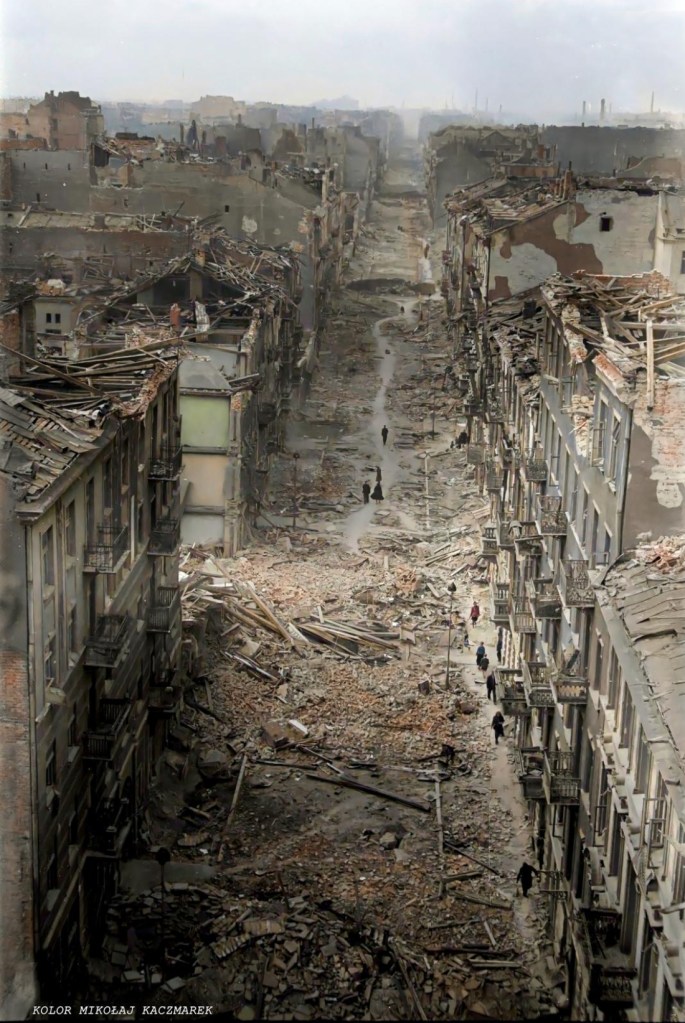
Images of Warsaw Ghetto 1943 and Gaza 2925 ruins ... same destruction, different players, same human patterns.

Interpretation, then, cannot rest on the assumption that knowledge leads to virtue or that understanding necessarily yields transformation. It may. But often it does not. History is not a teacher. Art is not a moralist. Scripture does not condescend to pedagogy. If anything is revealed, it is revealed despite the will to ignore, deny, or disfigure it.

This position echoes Walter Benjamin’s image of the Angel of History, whose face is turned toward the wreckage of the past even as a storm drives him blindly into the future—what we call progress. It stands also in contrast to the historicism that treats the past as lesson-book or path to telos. Gadamer reminds us that understanding is not methodical recovery, but an event of fusion between past and present. Yet this fusion must be entered with humility, not control.

Given the absence of reliable progress and the persistence of human patterns, interpretation requires a different posture—one that recognizes repetition, resists despair, and permits meaning to arise without demand. Method, in this context, must be understood not as a tool of conquest, but as a lens—no more authoritative than another, yet capable of bringing certain essences to the surface. Every method is partial, shaped by its assumptions, animated by its framing questions. No method sees the whole. Each reveals what it is attuned to find. Truth, if it appears at all, does so not as result, but as event—as something glimpsed when the interpreter is prepared to receive, not to impose.

Three words mark the contours of a fitting approach: nexus, interaction, and reflection.

Nexus identifies the place of convergence—where past and present, text and reader, artifact and witness intersect. It is not discovered in isolation, but emerges through relation. Interaction marks the dynamic movement within that convergence. Meaning is not fixed; it arises through tension, difference, and engagement. Reflection follows—contemplative, fragmentary, often incomplete. It does not assert finality but honors process. It acknowledges that memory reshapes what it recalls, that intention fades into approximation, and that even the most careful exegesis remains provisional.

This echoes the work of Paul Ricoeur, who reminds us that narrative, memory, and identity are always under construction—never final, always revised in the act of remembering. Warburg’s concept of Nachleben der Antike—the afterlife of antiquity—reveals how cultural symbols and images recur across historical periods not as static forms but as charged fragments, reanimated under new conditions, carrying both continuity and transformation in their repetitions. This persistence of symbolic forms across time exemplifies the broader pattern: not progress, but recurrence with variation.

From art, history, and sacred text, nothing must be demanded. They may instruct, but only when they are permitted to resist instruction. They may illuminate, but not on command. They may wound, they may deceive, or they may pass in silence. The encounter must be enough.

Empirical facts can be gathered. Archives can be organized. But truth, if it comes, does not arrive catalogued. It appears only when conditions are ready—when the reader or viewer stands not with certainty, but with openness. Not as master, but as interlocutor.

Too often, only the facts are preserved. They are worn as tokens of knowledge while the truth behind them—uncomfortable, paradoxical, demanding—is left behind. The lesser lesson becomes the badge of wisdom; the deeper truth is dismembered for convenience.

No arc. No grand instruction. Just the repetition of roles, the echo of stories, the persistence of hunger. Meaning, when it comes, comes not as reward, but as grace.

And yet, even in refusal, in distortion, in failure, there remains something sacred in the effort to attend. To see the pattern, not to worship it. To hear the old lines in new voices. To walk the ruins with open eyes, knowing that the script will be performed again.

The Peril and Promise of Models: Utopia, Economy, and Theology


Pieter Bruegel the Elder, The Tower of Babel (c. 1563)
Pieter Bruegel the Elder, The Tower of Babel (c. 1563, oil on panel)
Kunsthistorisches Museum, Vienna

Utopias, like theoretical economic models and theological constructs, are among the most daring expressions of human thought. Each arises from an impulse toward order and improvement, born of the conviction that the present is insufficient and the future can be shaped. Yet despite their elevated origins, these frameworks call to be eschewed—not for the good they propose, but for the horrors they have enabled when unmoored from humility and constraint.

The history of ideas is littered with systems that began in hope and ended in terror. Plato’s Republic, with its philosopher-kings and rigid class hierarchy, inspired centuries of authoritarian dreams. Soviet central planning promised rational allocation but delivered famine and repression. The Puritan theocracy in Massachusetts Bay sought godly perfection but produced witch trials and exile for dissenters. Each began as a vision of human flourishing—the utopian city, the rationalized economy, the purified creed—yet furnished the blueprints for regimes of control.

Nor is such danger confined to leftist excesses or theological zealotry. In Chile, the 1973 overthrow of Salvador Allende led not only to political violence, but also to the forceful imposition of a radical free-market model under General Pinochet, guided by economists trained in the Chicago School. The result was economic restructuring praised by some for its efficiency, yet experienced by many as immiseration and repression. Here, too, theory eclipsed humanity. Market mechanisms became commandments; dissenters were not debated but disappeared. What was billed as liberation through market freedom became another apparatus of dominance—less visible, perhaps, but no less brutal. The lesson is not partisan, but perennial: when theory is elevated above persons, systems serve themselves.

Elevated to ideology, models cease to be guides and become chains. They offer certainty in place of inquiry, coherence in place of complexity, and purpose in place of personhood. What begins as vision hardens into decree; what is meant as a lens becomes law. Mao’s Great Leap Forward exemplified this transformation: an economic model promising industrial prosperity became an unyielding doctrine that cost millions of lives when reality refused to conform to theory.

When the model becomes sacred, deviation becomes heresy. And where heresy is named, there follow inevitably the commissars, the inquisitors, the doctrinaires—those who patrol the borders of the permissible. Stalin’s show trials eliminated those who questioned economic orthodoxy. Both Catholic Inquisitions and Protestant persecutions took inhuman measures against those who strayed from their respective versions of theological purity. McCarthyism destroyed careers in service of ideological conformity. All operated in service of the model, the path, the “truth”—though truth, in such hands, is no longer a horizon toward which one travels, but a cudgel with which to enforce obedience. And perhaps there is no final truth to be had, only a multiplicity of partial illuminations, glimpsed through the mist, refracted through fallible minds.

And yet, it would be a grave error to reject these models wholesale. A utopia, though unattainable, directs the gaze beyond the immediate—Martin Luther King Jr.’s “Dream” inspired civil rights progress precisely because it painted a picture of what America could become. A well-crafted economic model brings coherence to chaotic phenomena: Keynesian theory, whatever its limitations, helped navigate the Great Depression by providing a framework for understanding how governments might respond to economic collapse. A theological vision offers moral orientation and poetic resonance—liberation theology in Latin America, despite its political complications, channeled Christian teaching toward concrete concern for the poor and oppressed.

When held lightly—non-dogmatically, open to revision, aware of their limits—such models are not prisons but tools. They help us navigate complexity, but they must never be mistaken for the complexity itself. The Chicago School economists who influenced policy in the 1980s offered valuable insights about market mechanisms, but when their models became gospel rather than guides, the result was often ideology that ignored market failures and social costs.

The question, then, is one of balance. Can aspiration be disentangled from absolutism? Can man dream without dictating, model without mastering, believe without binding? This is no easy task, for humanity is rarely a creature of balance. We veer, we commit, we grasp too tightly. The same revolutionary fervor that toppled the Bastille eventually devoured its own children in the Terror. But the remedy is not the renunciation of vision; it is the cultivation of humility within vision. It is the refusal to equate map with territory, model with meaning, doctrine with destiny.

If balance is the ideal, then it must rest not on detachment but on a deeper fidelity—one that refuses both rigidity and relativism. This is not a call to valueless existence, but to the most valued existence—one that honors core commitments through responsive attention rather than rigid prescription. The danger lies not in caring deeply about human flourishing, justice, or freedom, but in believing we possess the universal formula for achieving these goods. True fidelity to our highest values often requires abandoning our preconceptions about how they must be realized. It demands constant attentiveness to circumstances, genuine openness to what the moment requires, and the intellectual courage to adjust course when reality refuses to conform to our expectations. The principled life is not one that follows predetermined blueprints, but one that remains alert to the irreducible complexity of human need and the ever-changing demands of genuine care.

To live without models is to drift. To live by them uncritically is to be enslaved. Wisdom lies in the middle path: to aspire without illusion, to theorize without tyranny, and to seek the better without forgetting the cost of the best. In this fragile equilibrium lies the noblest promise of human reason—not to control the world, but to understand it more justly, and to live within it more wisely. And in that wisdom, to leave room for the truth that ever escapes us.

My Friend, You Were There: A Reflection on Complicity


Warsaw Ruins 1944
Warsaw 1944

History shows that evil rarely marches under banners we immediately recognize. Too often, it comes draped in righteousness, purity, and fear. This piece is a lament for how easily we have been—and still can be—drawn into the machinery of cruelty.


My Friend, You Were There

My friend,
When the Holy Catholic Church, seeking to preserve the Faith in all its radiant purity,
instituted the Inquisition,
you were there—
not as a bystander,
but as a willing voice.

You denounced the old widow,
who lived alone with her cat.
You whispered against the Jewish family—
familiar, yet forever marked as other—
and gave your assent to their undoing.

You crowded into the square to watch the trials.
You sang hymns
as the flames crowned their bodies with smoke.
You wept tears of joy
that the world was made purer that day.

My friend,
When the ships came heavy with human cargo,
and the auction blocks stained the soil,
you were there.

You placed your bids.
You weighed their flesh.
You wrote the laws that chained their children.

You sang hymns on Sunday,
and broke their backs on Monday.
You called it providence.
You called it order.

My friend,
When the traders came with flags and rifles,
when the rivers flowed with rubber and blood,
you were there.

You signed the charters.
You counted the profits.
You sold the shackles and the scales.

You called it commerce.
You called it destiny.

My friend,
When the banners of the Reich unfurled,
and the drums of destiny beat their hollow call,
you were there.

You shouted with the crowds
as glass shattered from shopfronts.
You signed the letters,
you cheered the laws,
you raised your hand high in salute.

You bought the house,
the shop,
the art your neighbors were forced to leave behind.

You praised the strong hand
that swept away the weak.
You rejoiced as neighbors vanished,
grateful that your streets were made clean.

My friend,
When Stalin summoned the will of the people
to root out the enemy within,
you were there.

You reported the whispered doubts
of your cousin,
your friend,
your brother.

You paraded with red flags
while the trucks rumbled into the night.
You filled the quotas.
You seized the land.
You counted the spoils
as others disappeared.

You sang of the bright tomorrow
as you cast your eyes down
and stepped over the absent.

My friend,
When Mao lifted the Little Red Book,
and the children cried out against their fathers,
you were there.

You led the chants.
You scrawled denunciations across the walls.
You struck the old professor who dared to hesitate.
You cheered as the temples fell,
and the old poems burned,
convinced you were building a paradise
on the bones of the past.

My friend,
When Pol Pot promised that the fields
would bloom with new life,
you were there.

You marched the teachers into the paddies.
You pointed the rifle.
You praised the year zero
that would erase the memory of all that came before.

You smiled
as the world was reborn in silence.

My friend,
When the generals rose in the name of order,
when the prisons filled and the stadiums overflowed,
you were there.

You nodded at the names.
You counted the profits.
You watched the blindfolded taken at night.

You called it security.
You called it salvation.

My friend,
You have always been there.

Only too late did you realize.
Only too late did you doubt—
but not much.

You fell silent,
lest you betray your doubt.
You looked away,
lest you see.

You told yourself it would be different this time.
You told yourself you had learned.
But the signs are familiar.
The words are familiar.
The silence is familiar.

And it is happening again.

The Danger of Literalist Thinking in the Face of Rising Authoritarianism in the United States

The Perils of Legalistic Literalism

Throughout history, authoritarianism has rarely invaded democracies through dramatic coups but rather through the gradual erosion of norms and institutions. This erosion is often enabled by what might be called “legalistic literalism”—a mindset that fixates on procedural adherence while remaining blind to broader patterns of democratic decay. This approach creates a dangerous paradox: by the time literalists acknowledge an authoritarian threat has crossed their arbitrary legal threshold, democratic safeguards have often already been fatally compromised.

The United States offers a compelling case study of this phenomenon. From the normalization of anti-democratic rhetoric during the current president’s first campaign to the institutional paralysis surrounding the January 6th insurrection and subsequent Supreme Court decisions expanding presidential immunity, literalist thinking has consistently undermined effective resistance to democratic deterioration. Now, with the current administration’s return to office, the administration has embraced an explicitly authoritarian approach. It has weaponized the Justice Department and haphazardly dismantled government agencies without required Congressional authorization—at times so maliciously and haphazardly that certain closures had to be reversed. Public servants have been fired, impeding the delivery of essential services to senior citizens, veterans, those seeking enforcement of their civil rights, and other citizens. Some, identified as the “other,” have been sent to what can only be described as concentration camps (in the British historical tradition thus far) in foreign countries or literally “lawless” territories under U.S. control (in the American historical tradition alas) pending their final disposition. Meanwhile, Congress has been marginalized, and executive orders are treated as beyond the oversight of Congress or the judiciary under the novel unitary executive theory propounded by the administration.

This pattern follows a recognizable trajectory observed in other democracies that have declined into authoritarian rule. What makes the American case particularly instructive is how adherence to procedural norms—supposedly the safeguard of democracy—has paradoxically accelerated democratic erosion by delaying meaningful resistance until institutional damage becomes nearly irreversible. Examining this process reveals not just the mechanics of democratic decline but also potential strategies for arresting it before critical democratic guardrails are wholly destroyed.

This essay examines how literalist thinking enables authoritarianism by exploring these key moments of institutional failure and draws lessons for preserving democratic systems against such threats.

The Warning Signs: Early Responses to Authoritarian Signals

The Normalization Phase (2015-2016)

When he emerged as a political figure, his rhetoric displayed clear authoritarian tendencies: praising dictators like Vladimir Putin and Kim Jong-un, threatening political opponents with imprisonment, attacking the press as “enemies of the people,” and suggesting he might not accept election results. These statements represented textbook warning signs familiar to scholars of democratic decline.

Yet the response from most institutional actors was profoundly literalist. Major media outlets normalized his rhetoric by treating it as conventional political hyperbole rather than dangerous authoritarianism. Legal scholars reassured the public that constitutional guardrails would hold. Political opponents dismissed him as unserious. The common refrain—“take him seriously, not literally”—embodied this literalist fallacy, suggesting that dangerous rhetoric was inconsequential until manifested in specific legal violations.

This response ignored historical lessons from democratic backsliding in countries like Hungary, Turkey, and Venezuela, where authoritarian leaders signaled their intentions through rhetoric long before implementing institutional changes. The literalist mindset demanded concrete proof before acknowledging threat—effectively demanding democracy show fatal symptoms before allowing preventative treatment.

Constitutional Optimism as Denial (2017-2019)

Once in office, he tested democratic guardrails through actions that challenged norms without clearly violating laws: firing FBI Director James Comey while citing the Russia investigation, demanding loyalty from law enforcement officials, attacking judges who ruled against him, and claiming “absolute immunity” from investigation.

The literalist response from many institutions was to examine each action in isolation rather than as part of a pattern of democratic erosion. This compartmentalization prevented the recognition of the cumulative threat. Many mainstream legal scholars maintained that since each action could be technically defended through creative legal interpretation, the system was holding.

This faith in procedural safeguards reflected a fundamental misunderstanding of how democracies die in the 21st century. As scholars Steven Levitsky and Daniel Ziblatt note in How Democracies Die, modern authoritarian leaders typically dismantle democracies through legal channels—exploiting ambiguities in legal systems rather than openly violating them. The literalist’s insistence on clear legal violations as the threshold for concern thus creates a perfect blind spot for detecting authoritarian encroachment.

This blindspot would prove particularly damaging as his presidency progressed, setting the stage for increasingly bold challenges to democratic norms that would eventually culminate in the events surrounding the 2020 election.

Institutional Paralysis: January 6th and Its Aftermath

The events surrounding January 6th, 2021, represent perhaps the clearest example of how literalist thinking enables authoritarianism. For months, he and his allies laid groundwork to overturn the election: filing dozens of baseless lawsuits, pressuring state officials to “find” votes, attempting to manipulate the Justice Department, and promoting alternative slates of electors.

The Failure of Preventative Response

Despite these clear warning signs, many institutions remained paralyzed by literalist reasoning. Political leaders insisted on waiting for an unambiguous “red line” to be crossed. Law enforcement agencies, despite intelligence warnings about violence, hesitated to prepare adequately for January 6th partly due to concerns about appearing to take sides in what was framed as a “political dispute” rather than an attempted coup.

This paralysis extended to Congress, where even after the Capitol was breached, a significant number of legislators proceeded with objections to electoral votes—adhering to a procedural approach even as the violent consequences of that approach unfolded around them.

The Accountability Gap

In the aftermath, literalist thinking continued to impede accountability. Criminal prosecutions moved at a glacial pace, constrained by procedures designed for ordinary criminal cases rather than threats to democracy itself. The impeachment process failed when many senators cited procedural objections about impeaching a former president—a literalist reading that ignored the purpose of impeachment as a safeguard against future threats to democracy.

Perhaps most concerning was the judiciary’s response. Courts processing January 6th cases often treated them as ordinary criminal matters rather than components of an attempted coup, focusing on specific statutory violations while avoiding broader questions about democracy and insurrection. This procedural compartmentalization helped normalize an unprecedented assault on democratic transition.

As Daniel Ziblatt observed, the January 6th attack and his subsequent pardoning of rioters highlighted two cardinal rules of a healthy democracy: You have to accept election results, win or lose, and you cannot engage in violence or threaten violence to hold onto power. The failure to enforce these principles further illustrates how literalist hesitation in addressing democratic threats emboldens authoritarian actors.

This failure of accountability created a dangerous precedent, setting the stage for the next phase of democratic erosion: the judiciary’s formal expansion of executive power beyond democratic constraints.

Judicial Complicity and the Supreme Court’s Role

The Supreme Court’s decision in Trump v. United States (2024) exemplifies how literalist legal reasoning can provide cover for authoritarianism. By granting unprecedented immunity to presidents, the Court elevated a narrow textual reading over consideration of how such immunity would affect democratic accountability.

The ruling effectively places presidents above the law, making future accountability nearly impossible. While meticulously parsing eighteenth-century texts and precedents, the Court showed remarkable blindness to the real-world impact: a president who had already attempted to overturn an election was being granted expanded immunity just as he prepared to potentially retake office with explicit promises of retribution against opponents.

This decision represented the culmination of a years-long process of judicial capture that extended well beyond this single ruling. Justices Samuel Alito and Clarence Thomas had been implicated in significant ethics scandals, including undisclosed luxury vacations, private jet travel, and real estate deals with billionaires who had interests before the Court. Rather than addressing these clear conflicts of interest through meaningful ethics reforms, the Court responded with voluntary, unenforceable guidelines that preserved the appearance of judicial independence while allowing substantive corruption to continue.

These ethics scandals revealed a deeper problem: the Court’s legitimacy was being undermined not just by individual rulings but by both the perception and reality that justices were entangled with wealthy interests seeking to reshape American governance. The corruption evident in these scandals aligned key justices with the very oligarchic forces backing authoritarian politics—creating a dangerous alliance between judicial power and anti-democratic wealth.

The Oligarchic Capture of Democratic Institutions

The literalist approach fails not only through procedural blindness but also by ignoring the economic power dynamics that increasingly shape American governance. The same oligarchic network supporting judicial capture has also backed authoritarian political movements and organizations, such as the Federalist Society, recognizing that an authoritarian turn benefits economic elites through deregulation, tax policies, and suppression of labor rights.

Congress’ failure to act against judicial corruption stems not merely from procedural timidity but from financial entanglement with the same oligarchs and corporate interests that have corrupted the courts. This same timidity was on display in Senate Minority Leader Chuck Schumer’s decision to support a Republican-crafted Continuing Resolution (CR) to extend government funding, despite opposition from within his own party and others opposed to authoritarian encroachment. His rationale—that blocking the bill would allow the president and his oligarchic side-kick to seize more power through a government shutdown—illustrates how institutional leaders often capitulate to authoritarian pressure rather than risk direct confrontation. This type of preemptive surrender, justified through procedural pragmatism, ultimately facilitates democratic erosion rather than preventing it.

The assumption that democratic institutions operate independently of economic influence is a dangerous literalist fallacy. The reality is that concentrated wealth has created a feedback loop where economic power translates into political influence, which in turn creates policies that further concentrate wealth. This cycle has accelerated democratic erosion by ensuring that institutional responses to authoritarianism remain weak and ineffective, constrained by the same economic interests that benefit from democratic decline.

The Road Ahead

Democracy in the U.S. is at a precarious moment. The literalist approach to democratic defense has repeatedly failed to prevent authoritarian encroachment. The path forward requires:

  1. Recognizing that democracy dies through legal channels, not just through obvious coups.
  2. Understanding that economic oligarchy and political authoritarianism are mutually reinforcing threats.
  3. Prioritizing substantive democratic values over procedural formalism.
  4. Building coalitions willing to take political risks to preserve democratic governance.

For citizens, this means moving beyond the assumption that legal procedures alone will protect democracy. For institutions, it means developing the courage to defend democratic principles even when doing so challenges conventional interpretations of their role.

Effective resistance to authoritarianism requires not just procedural vigilance but moral courage—the willingness to recognize patterns of democratic erosion before they manifest in unambiguous legal violations. It requires understanding that democracy depends not just on rules but on shared commitments to democratic values that transcend legalistic interpretations.

By the time an authoritarian breaks the law, they have already rewritten the rules. The fight for democracy must begin long before that point.