
Method and Meaning in an Unteachable World

Prefatory Note

The following are two companion reflections—On Truth and Empirical Fact and No Arc, No Lessons—presented together under the shared heading Method and Meaning in an Unteachable World. Though each may stand alone, they are best read in conversation with one another. Both essays resist the comforting notion that history, literature, or art functions as teacher or guide, and instead consider interpretation as an act of encounter—provisional, situated, and shaped as much by silence as by statement.

The first essay explores the distinction between fact and truth, exploring how memory, intention, and metaphor complicate the act of knowing. The second rejects the idea that history bends toward moral instruction or cumulative wisdom, and instead proposes a posture of reflective attention to the recurring patterns and failures of the human condition.

Versions of both essays with full citations and scholarly apparatus are in preparation for future publication. What follows here is intended for open reading and contemplation.


On Truth and Empirical Fact

“You cannot step into the same river twice.”
—Heraclitus (Fragment 91, DK B91)

In the course of recent reflection, a distinction long known, but not always properly honored, must be drawn again: that between truth and empirical fact. Though often conflated in casual discourse, these are not synonymous—nor should they be.

An empirical fact is a datum: observed, measured, verified. It is the yield of experiment, the result of record, the artifact of sensory perception. That water boils at one hundred degrees Celsius at sea level is a fact. That a coin weighs 3.2 grams and bears a cross upon its reverse is a fact. That a battle was fought in the year 1066 may be supported by a host of facts: chronicles, bones, weaponry, et cetera. Such facts, when properly corroborated, are not unimportant. But they are not truth.

Truth, if it exists at all, is something larger, more elusive, more alive—not constructed by us, but encountered when consciousness prepares itself to receive what appears. It does not come when summoned, but when the conditions for its appearing have been made ready: doubt, humility, attention. It is apprehended in this prepared openness, grasped in the space between what is seen and what is understood.

Philosophers have long attended to this disjunction. Plato distinguished between the world of appearances and the world of eternal Forms, the former unstable, the latter enduring. Augustine found truth not in the fluctuating realm of sensory report, but in the divine Logos. Nietzsche, ever unsettling, dismissed truth as a “mobile army of metaphors”—useful, yes, but neither objective nor stable. Heidegger, resisting the reduction of truth to correctness, instead spoke of aletheia—not truth as correspondence, but as unconcealment, as that which emerges into view. And Gadamer—whose influence upon this approach is not accidental—taught that truth emerges in understanding itself, not as a proposition but as a happening, shaped by dialogue and historical consciousness.

Facts may be marshaled. Truth, by contrast, is survived.

Even intention, often treated as the surest witness to truth, must be interrogated. The poet’s intent, the author’s purpose, the painter’s design—these are not fixed coordinates but shifting recollections. Memory does not preserve; it reconstructs. And with each return to the well of what was once meant, the water tastes slightly different. Heraclitus observed that one cannot step into the same river twice—not only because the river flows, but because the self who steps in is no longer the same. So it is with intention. If asked now what was intended in a particular line or gesture, one may offer a reply—but it is a construction, shaped by who speaks now, not by who once acted. Intention, like truth, is not preserved in stillness—it is shaped in motion. It, too, is not possessed, but pursued.

In the poem At the Crossing, the aim was not to name truth—such a thing cannot be done—but to describe the space it haunts. The poem speaks of words that fracture, colors that deceive, touches that both reveal and withdraw. It ends not in assertion, but in a trembling, a silence where meaning nearly forms but does not solidify. A reader once dismissed it: “Life is too brief,” he said, “to spend in the space where meaning almost forms.” The impulse is understood. But the objection must be declined.

For it is in that space—that trembling margin—that life does happen. To live fully is not to claim truth as possession, but to encounter it as presence. Not to seal it in certainty, but to allow it to move, shadowlike, across the inner walls of the soul.

Empirical facts anchor us to the world. But truth is not what anchors—it is the thread we follow across the abyss.

And we follow it not with measuring tape, but with metaphor, with memory reshaped each time it stirs, with intention half-forgotten, and with the courage to walk where the light breaks, not where it rests.


No Arc, No Lessons: On Method, Encounter, and the Tragic Repetition of History

“To articulate the past historically does not mean to recognize it ‘the way it really was’… It means to seize hold of a memory as it flashes up at a moment of danger.”
—Walter Benjamin, Theses on the Philosophy of History

Each age brings forth its own imperative—shaped by its wounds, haunted by its questions, driven by its unspoken needs. The present is no exception. Whether in the study of history, the contemplation of art, or the exegesis of sacred or poetic texts, interpretation does not arise in a vacuum. It emerges from a condition: the place, the moment, the unease that calls forth inquiry. And yet, though each generation may believe itself newly burdened or singularly illuminated, the recurring gestures of human life belie that novelty. There are patterns, yes—but these do not confirm progress. They reveal persistence.

The idea that history bends—toward justice, truth, wisdom—is seductive. It offers shape to the shapeless, comfort to the anguished, and direction to the lost. But there is no arc. The metaphor distorts by promising what experience consistently denies. If history teaches, its students are unteachable. The same motives recur, the same errors repeat, the same vanities endure. Progress, when claimed, is often little more than a rearrangement of circumstance. The root remains.

The players do not change. Their names shift, their languages evolve, but their roles remain remarkably constant. Power is sought, justified, and abused. Fear is stoked and traded for security. Hope is minted into symbols, then worn threadbare. Love, loss, betrayal, glory, shame—these are the constants. The stages differ: the scenery updated, the choreography modernized. But the script draws upon ancient instincts. And the audience, again and again, forgets the last performance, believing the story to be new.

Images of Warsaw Ghetto 1943 and Gaza 2925 ruins ... same destruction, different players, same human patterns.

Interpretation, then, cannot rest on the assumption that knowledge leads to virtue or that understanding necessarily yields transformation. It may. But often it does not. History is not a teacher. Art is not a moralist. Scripture does not condescend to pedagogy. If anything is revealed, it is revealed despite the will to ignore, deny, or disfigure it.

This position echoes Walter Benjamin’s image of the Angel of History, whose face is turned toward the wreckage of the past even as a storm drives him blindly into the future—what we call progress. It stands also in contrast to the historicism that treats the past as lesson-book or path to telos. Gadamer reminds us that understanding is not methodical recovery, but an event of fusion between past and present. Yet this fusion must be entered with humility, not control.

Given the absence of reliable progress and the persistence of human patterns, interpretation requires a different posture—one that recognizes repetition, resists despair, and permits meaning to arise without demand. Method, in this context, must be understood not as a tool of conquest, but as a lens—no more authoritative than another, yet capable of bringing certain essences to the surface. Every method is partial, shaped by its assumptions, animated by its framing questions. No method sees the whole. Each reveals what it is attuned to find. Truth, if it appears at all, does so not as result, but as event—as something glimpsed when the interpreter is prepared to receive, not to impose.

Three words mark the contours of a fitting approach: nexus, interaction, and reflection.

Nexus identifies the place of convergence—where past and present, text and reader, artifact and witness intersect. It is not discovered in isolation, but emerges through relation. Interaction marks the dynamic movement within that convergence. Meaning is not fixed; it arises through tension, difference, and engagement. Reflection follows—contemplative, fragmentary, often incomplete. It does not assert finality but honors process. It acknowledges that memory reshapes what it recalls, that intention fades into approximation, and that even the most careful exegesis remains provisional.

This echoes the work of Paul Ricoeur, who reminds us that narrative, memory, and identity are always under construction—never final, always revised in the act of remembering. Warburg’s concept of Nachleben der Antike—the afterlife of antiquity—reveals how cultural symbols and images recur across historical periods not as static forms but as charged fragments, reanimated under new conditions, carrying both continuity and transformation in their repetitions. This persistence of symbolic forms across time exemplifies the broader pattern: not progress, but recurrence with variation.

From art, history, and sacred text, nothing must be demanded. They may instruct, but only when they are permitted to resist instruction. They may illuminate, but not on command. They may wound, they may deceive, or they may pass in silence. The encounter must be enough.

Empirical facts can be gathered. Archives can be organized. But truth, if it comes, does not arrive catalogued. It appears only when conditions are ready—when the reader or viewer stands not with certainty, but with openness. Not as master, but as interlocutor.

Too often, only the facts are preserved. They are worn as tokens of knowledge while the truth behind them—uncomfortable, paradoxical, demanding—is left behind. The lesser lesson becomes the badge of wisdom; the deeper truth is dismembered for convenience.

No arc. No grand instruction. Just the repetition of roles, the echo of stories, the persistence of hunger. Meaning, when it comes, comes not as reward, but as grace.

And yet, even in refusal, in distortion, in failure, there remains something sacred in the effort to attend. To see the pattern, not to worship it. To hear the old lines in new voices. To walk the ruins with open eyes, knowing that the script will be performed again.

Bread, Balance, and the Burden of Freedom in Dostoevsky’s The Grand Inquisitor

A Meditation on the Grand Inquisitor in Light of Metaphor and Meaning

“Man seeks not so much God as the miraculous… For man seeks not so much freedom as someone to bow before.”
The Grand Inquisitor, The Brothers Karamazov

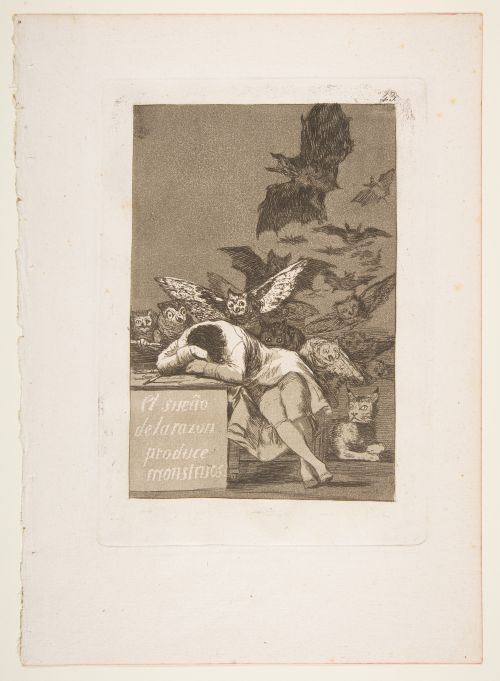
Francisco Goya’s The Sleep of Reason Produces Monsters (1799)—an image of what emerges when the mind abdicates its responsibility: not freedom, but fantasy; not peace, but nightmare. Where reason sleeps, the trinity of miracle, mystery, and authority awakens to devour.

In Dostoevsky’s The Brothers Karamazov, the tale of the Grand Inquisitor remains one of the most unsettling parables in modern literature. Told by Ivan Karamazov to his younger brother Alyosha, the fable imagines Christ returning during the Spanish Inquisition—only to be arrested and silenced by the Church. The Inquisitor, a cardinal of imposing intellect and grave compassion, does not accuse Christ of falsehood, but of cruelty: You gave them freedom, he says, when they needed bread. You gave them mystery, when they needed answers. You gave them love, when they needed order.

There was a time, decades ago, in the earnest conviction of my youth, when I found myself perplexed by the Grand Inquisitor’s logic. I did not admire him, nor excuse his authoritarianism, but I recognized the ache that underpinned his argument. Bread matters. Peace matters. Even then, I sensed the moral gravity of the dilemma he posed: How does one respond to suffering in a world that is often brutal, hungry, and unforgiving?

But I also responded viscerally to something else: the pen of Dostoevsky was not just crafting a fable, but weaponizing a caricature. The Inquisitor was not simply a tragic figure—he was also a polemic against Catholicism, a projection of Dostoevsky’s own religious bigotry. As someone educated within the Catholic tradition, I saw the ugliness beneath the fable—the prejudice tucked behind the parable’s grandeur. The critique was not only of power, but of Rome. The Inquisitor’s mitre bore the unmistakable weight of Jesuit anti-types, cloaked in suspicion and veiled accusation. My disquiet, then, was not only with the Inquisitor’s words, but with the frame within which they were uttered.

And yet, despite its polemical underpinnings, the parable remains one of the most profound meditations on freedom and faith in modern literature. Its imaginative force exceeds its prejudices. The Inquisitor endures not only as a critique, but as a haunting embodiment of the human temptation to trade liberty for comfort.

And that temptation has not faded. The Grand Inquisitor endures because he gives voice to something deeply human, and psychologically real: the desire for security, for certainty, for order amidst chaos. It is a desire that remains active—arguably ascendant—in our own time. One hears the Inquisitor’s voice today in populist strongmen, in the cynical strategist’s smirk, in the media apparatus that soothes while it divides, and in slogans that promise greatness through obedience—Make America Great Again, for instance, the rallying cry of a leader who proclaimed, “I am the only one who can save this nation,” inviting not deliberation, but devotion. The trinity he offers—miracle, mystery, and authority—is the very catechism of modern demagoguery.

This reflection, then, is not a defense of the Inquisitor, but an attempt to understand his appeal, and to reclaim the concepts he distorts. In my recent essay on literalism, metaphor, and balance, I sought to describe the menace of the literalist disposition—a mentality that cannot live with ambiguity, that flees from the poetic, and that finds in surface meaning a shield against the deeper, riskier call of the soul. Here, I apply that lens to the Inquisitor’s three pillars.

Miracle and the Tyranny of the Literal

The Inquisitor offers miracle as literal spectacle: bread conjured from stone, laws suspended, proof offered to silence doubt. He rebukes Christ for refusing to perform such signs in the desert, calling His restraint an act of cruelty rather than spiritual wisdom.

Even as a young reader, I did not mistake the Inquisitor’s miracle for holiness. But I understood that hunger cannot be spiritualized away. In a world where the body is often broken before the spirit can rise, the refusal to give bread seems harsh.

What I have since come to understand is that bread must be shared, not wielded—and that miracles, if they mean anything at all, must point beyond themselves. A miracle that ends conversation is not a miracle but a manipulation.

We have seen modern versions of such miracles: promises made and spectacles staged not to elevate understanding, but to prove power. Consider the border wall—hailed not merely as a policy, but as a singular, salvific act. Its construction, real or exaggerated, was brandished as proof of providence, as the visible sign that the nation could be made great, pure, and safe again. Nor was it the only such “miracle.” Similar wonders were promised: the immediate end of the Russian invasion of Ukraine, the revival of a fading industrial economy, the return of jobs long gone, and the rapid reordering of the global market in our favor. These, too, were presented as guarantees—not to be debated, but to be believed. And like the Inquisitor’s miracles, they have largely yet to be seen.

In my essay on literalism and metaphor, I argued that literalism becomes a menace when it displaces metaphor—when it insists on one meaning, one proof, one visible sign. The Inquisitor’s miracles are precisely that: spectacles that end the need for faith. They are miracles without meaning.

Mystery and the Collapse of Metaphor

The Inquisitor’s use of mystery is a case study in spiritual containment. Mystery becomes the guarded unknown, parceled out by clerical authority to pacify rather than provoke. It is not a sacred unknowing, but a fog of confusion meant to keep the people docile.

But true mystery, like true metaphor, does not confuse—it illuminates by depth. It renders the world porous to truth. It refuses finality not because it is evasive, but because it is more honest than premature closure allows.

I did not reject mystery in youth, nor do I now. But I reject the collapse of mystery into secrecy, the transformation of the ineffable into the inaccessible. Metaphor must breathe. Mystery must invite. When weaponized, they become not sacred, but sinister.

In our current dysfunctional era, mystery is often replaced by conspiracy—a counterfeit that plays the same psychological role, offering significance without wisdom, awe without humility. The literalist disposition, fearing true complexity, gravitates toward these shallow depths. Conspiracy is mystery stripped of humility. It retains the trappings of hidden knowledge but closes the mind rather than opening it. It flatters the believer with secrets while shielding them from ambiguity. It is not reverence for the unknown, but a refuge from the supposed unbearable complexity of reality.

We see this vividly in the ecosystem of conspiracy theories surrounding Trump’s political movement. Whether it is the belief that a global cabal of elites and pedophiles is secretly running the world (QAnon), or that massive voter fraud orchestrated by shadowy networks altered the outcome of the 2020 election, or that figures like Barack Obama, Hillary Clinton, or George Soros are puppet-masters in an international scheme to undermine American sovereignty—each offers an illusion of secret insight in place of the real work of understanding. These narratives are not pursued for their truthfulness but for their emotional certainty. They replace sacred mystery with a kind of gnosis—fierce, insular, and self-reinforcing.

And like the Inquisitor’s mystery, they are not shared to free the soul, but to bind it—to a worldview, to a figure (whether cult, religious, or political leader, a distinction without merit or significance), to a sense of exceptionalist belonging. The effect is not illumination but containment.

Authority and the Displacement of Balance

The Inquisitor’s authority is final, paternal, and brutal in its compassion. It replaces freedom with peace, conscience with obedience. Its appeal lies not only in its force, but in its promise: You no longer have to choose. I will choose for you. And I will feed you.

As I have aged, I have come to see that this vision is not merely imposed—it is desired. Much of the populace is psychologically predisposed to respond favorably to such authority, whether it comes in vestments or slogans. It offers relief from the burden of discernment. It relieves the anxiety of paradox.

This recognition—that the hunger for certainty is as much internal as external—has shaped my own philosophical trajectory.

And that is where the menace lies. This is not a top-down problem alone, but a convergence of design and desire. The Inquisitor gives the people what they already, in some meaningful manner, want: a world made safe through submission. The leader becomes the sole interpreter of truth, the guarantor of safety, the vessel of meaning. Authority becomes a theology in itself.

We have seen this in our time, where devotion to a figure supplants loyalty to principle. When a leader proclaims “I am the only one who can save this nation,” and is met not with unease but with cheers, authority has ceased to be a mediating presence and has become a metaphysical claim. It no longer balances tension; it obliterates it.

In contrast, the authority I defended in my earlier essay was not coercive, but mediating—a balancing presence, a harmonizing voice. It does not dominate or dismiss. It holds the tension without collapsing it. It does not provide peace through closure, but through co-suffering. It listens. It waits.

The Bread and the Burden

So no, I did not approve of the Grand Inquisitor—not in youth, not now. But I acknowledged, and still acknowledge, the ache beneath his argument. It was not cruelty that made him persuasive, but compassion twisted into control—a desire to ease pain by removing the possibility of choice.

What I now see more clearly is that this fable is not merely a theological drama. It is a psychological map. The Grand Inquisitor is the high priest of the literalist disposition—offering miracle that silences, mystery that obscures, authority that absolves.

That disposition is not confined to Dostoevsky’s century. It is at work now—in every movement that prefers spectacle to sign, dogma to dialogue, power to presence. It thrives in political rhetoric, in media narratives, in spiritual systems that replace grace with control.

Dostoevsky does not argue against it. Christ does not rebut it. He answers with a kiss.

A kiss without domination.
A kiss that respects freedom.
A kiss that does not resolve the tension, but chooses to love within it.

That is the burden of freedom: not only to bear it ourselves, but to offer it to others, knowing they may prefer their chains.

To offer bread, but not as bribe.
To teach, but not as demand.
To speak, but not to silence.
To live, still and quietly,
within the balance that resists the Inquisitor’s call.

To refuse the miracle that enslaves,
To offer bread and still preserve the soul,
That is the quiet defiance the world most needs.

Between Noise and Silence: On the Literal, the Metaphoric, and the Space Where Meaning Resides

Rembrandt, “Philosopher in Contemplation” (1632). A quiet spiral of thought, descending into the hush between certainties.

“The soul speaks most clearly when the tongue is still.”

There are days now, more frequent than before, when I find myself recoiling—not from people, exactly, but from a certain tone, a cast of mind. It is the literalists who unsettle me. Those who cling to the concrete as though it were the last raft afloat. The older I grow, with my silvered hair, the more their certainties feel not reassuring but menacing. It is not their knowledge I fear—it is their refusal to admit the unknown, the unspoken, the not-yet-understood.

And yet, I do not mean to dismiss the literal out of hand. I was trained in it. I lived among it. I applied law to facts with the solemn responsibility of rendering findings in civil rights complaints—decisions that shaped lives, guided by precedent, statute, regulation, policy, and the weight of written word. The literal is necessary. It is the groundwork. The shared foundation upon which meaning may be built. One must know the noise, the surface of things, before any deeper hearing is possible. Literalism is not, in itself, a failing. But to dwell in it wholly, to build a temple upon it without windows or doors—that is a failure of imagination and perhaps of courage.

There is something holy, or at least essential, in the gaps. The hush between words. The pause before reply. The silence that says more than any explanation could. It may be peace. It may be sorrow. It may be nothing at all—and that nothing may yet be everything.

The paradox thickens with age. I cannot dismiss the concrete—it is how we meet one another—but I also cannot abide those who live only by its rule. The world is not built entirely of clarity, nor is it meant to be. There is a path somewhere between the clamor and the silence, and perhaps I am only now beginning to find it.

The literal is our first tongue. It is how the child learns: this is a stone; that is a tree. Language builds the world we inhabit. And in that naming, in that first apprenticeship to the visible and the graspable, we are equipped with the tools to navigate life’s surfaces. We learn to classify, to divide, to act. It is a necessary scaffolding, even beautiful in its clarity.

But what follows—what truly shapes the soul—is what one does once that scaffolding has served its purpose. It is in the gaps, the silences, the places where the scaffolding falls away, that something more begins.

The darkness between the stars, or perhaps the light that filters through cracks in ancient stone, draws us to pause. It is not the substance, but the space between the substance, that calls us to deeper thought. The hush in a conversation—not the words, but the breath that precedes or follows them—can speak more profoundly than the speech itself. The crevice between certainties is where wonder slips in.

In these spaces we do not necessarily find answers. Sometimes we find transformative questions. Sometimes only presence. And sometimes only ourselves, which may be enough.

There is a wisdom in the void that no amount of noise can manufacture. Not the nihilism of meaninglessness, but the reverent recognition that meaning, like light, often travels best through emptiness.

To live entirely in the measured and known is to dwell in a museum of certainties—tidy, lifeless, unmoved. But to discard all that for a world of formless suggestion is to risk disappearance. The task is to dwell attentively in both: to know the stone as stone, and then sit long enough beside it to feel what it is not.

There are those who seek certainty in everything—in people, in relationships, in experiences, in outcomes. They crave contracts over conversation, definitions over dialogue. To them, ambiguity is a flaw, unpredictability a failure. But in securing themselves against uncertainty, they forfeit something essential. They miss the quickening of the heart in a half-spoken promise, the richness of a glance misunderstood, the poetry of a thing only half-comprehended but wholly felt.

To insist that the world always yield its meaning—immediately, exhaustively—is to mistake life for a mechanism. To live without risk, without the possibility of being undone or remade, is to refuse the privilege of being human.

And yet, those who flee entirely into mystery—who refuse form, who reject grounding—are no better served. Obscurity for its own sake is not wisdom but evasion. To veil oneself in metaphor to avoid responsibility is no more noble than to cling to literalism out of fear.

We are not machines. Nor are we vapor. We are, maddeningly and gloriously, both. We are flesh and thought, bone and breath, anchored and floating. And it is precisely in that stretch between—the literal and the allusive, the known and the unknown—that we are most fully human.

To demand certainty is to deny the thrill of becoming. To refuse structure is to forgo the beauty of its breaking. Somewhere in that middle space, between what can be said and what must be felt, is where the soul begins to sing.

And so we return to the hush. That space which is not absence but presence unspoken. The unanswered breath, suspended between question and reply, is not a failure of speech but its fulfillment. There, in that breath, we are closest to the truth—not because we grasp it, but because we cease grasping.

It is silence that answers most deeply. Not the silence of indifference, nor of ignorance, but the silence of presence—unadorned, uninsistent, abiding. The kind of silence that rests beside you like a companion who has nothing to prove. A silence that allows space for your own self to rise up, or dissolve, or simply be.

There are things that cannot be said, and yet are spoken in the pauses between words. There are truths that cannot be held, but are felt in the stillness between certainties. And perhaps the deepest form of knowledge is not in knowing, but in listening long enough to no longer need to.

The literal gives us form, but the silence between the forms gives us meaning. The prose of the world teaches us its names, but it is the poetry of its silences that teaches us our own.

I do not know if this is wisdom, or simply age. But I have come to suspect that the truest things—love, sorrow, grace, wonder—do not arrive in declarations. They appear instead in the gaps, in the long glances, in the word left unspoken. They arrive in silence. And in that silence—between noise and silence—we are not alone.