A prehistoric footprint at White Sands National Park in New Mexico, approximately 23,000 years old. Photograph by Dan Odess, courtesy of the National Park Service.
Inspiration for poetry often arises from the most innocuous moments. The following poem emerged after I entered a room and, in a moment of confusion (more and more frequent, sadly), questioned why I had entered the room—but in my muddled state, I bungled the question. Struck by my mangled verbs, I realized the existential weight of what I had inadvertently asked myself. It instantly became clear that I should craft a short poem exploring existential uncertainty and fragmented consciousness based on what I had asked in my muddled state, and thus Where is Am I? was born.
Where is Am I?
Where is Am I? Caught between the breath and thought, a question turning circles in the hollow of my chest. I seek the ground, yet find the sky— or is it neither, just the haze of dreams long folded into day?
Am I the echo, or the voice that trembles back? The shadow of a shadow, a footfall lost to time’s soft track?
Where is Am I? A fragment drifting through the hour, a flicker in the endless light, unsure if I was ever whole or if the pieces were ever mine to find.
“The Wanderer Above the Sea of Fog” (oil on canvas, c. 1818) by Caspar David Friedrich (1774-1840). Hamburger Kunsthalle, Hamburg.
In light of my recent endeavors—posting fables, poetry, and lyrics for songs—it is essential to clarify my intentions. These creations, though shared in this space, are not primarily intended as offerings to others, though I am pleased if others find them of some utility. Rather, they represent my personal journey to navigate and comprehend the tumultuous landscape—the chaos—of my mind, my life, and my community. Chaos, in this context, is not pejorative; rather, it encapsulates the full spectrum of human experience—joy and sorrow, triumph and defeat, despair and hope, connection and isolation, fear and wonder, intellect and confusion. It embodies, in essence, the unadorned human condition.
Thus, these fables, poetry, and lyrics are not exercises in narcissistic introspection but rather unvarnished articulations of my attempt to discern order, meaning, or purpose—if any is to be found—from the chaos, and to commit my journey to metaphorical paper. To others, many of the words, allusions, and themes recording my thoughts may remain obscure, inaccessible, or even enigmatic—yet each word, allusion, and theme was chosen with care, purpose, and meaning, even if others cannot grasp it. And so it must be.
As these ramblings take form, I have noticed recurrent themes and words surfacing. In time, I shall undoubtedly delve more deeply into these themes, as they surely reveal either truths or obsessions that I should explore more systematically for my own edification. I may also conduct a census of the recurrent words—if only to either find more synonyms or avoid redundancy.
In the meantime, I apologize for the occasional poorly written or contrived poem, fable, or lyric. I also ask for your patience with those that you find incomprehensible, though artful—I assure you that they have deep meaning to me. Bear this fool kindly, as a fool must pursue his ramblings!
In an earlier posting I explored the origins of the Yarab surname, tracing it back to the Slovak surname Jaráb, which is related to the Czech word for crane, jeřáb. That essay also discussed the Eurasian crane, significant in Slovak culture, and explored the symbolic traits associated with cranes across various cultures. Such traits include wisdom, vigilance, mercy, and grace. Cranes also feature prominently in the mythology and folklore of many civilizations, including the Bashghirds, Arabs, Greeks, Koreans, and Japanese. After investing so much time in the research, I decided to write a poem, or lyrics, and set it to music using Udio.com. The result is above. For a detailed understanding of the various references in the lyrics of the song, please visit the posting at On The Origins of the Yarab Surname.
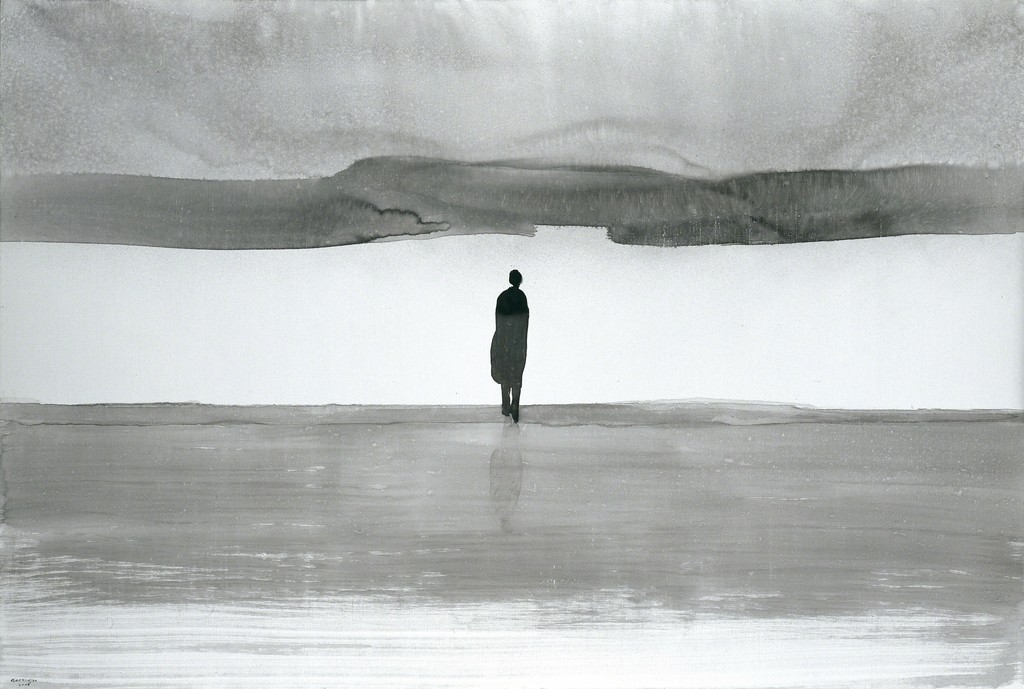
In “L’attente (Waiting) [2004]” by Gao Xingjian, the author finds an appropriate artwork to illustrate his reflections on retreating into a world of words as a sanctuary from the harsh external world, but also as a form of self-imposed isolation. The poem expresses the duality of words as both protection and confinement, shaping the author’s existence, reflecting a life intertwined with letters, sheltered yet constrained by the fortress of his mind.In “L’attente (Waiting) [2004]” by Gao Xingjian, the author finds an appropriate artwork to illustrate his reflections on retreating into a world of words as a sanctuary from the harsh external world, but also as a form of self-imposed isolation. The poem expresses the duality of words as both protection and confinement, shaping the author’s existence, reflecting a life intertwined with letters, sheltered yet constrained by the fortress of his mind.
L’attente (Waiting) [2004] by Gao Xingjian (b. 1940).
As I am confounded by life now, as I was in my youth, I retreat, as always, into a world of words, written on pages and assembled in books. These books surround me, forming walls that at times serve as battlements, the fortifications protecting me from the external perils of an incomprehensible, harsh, and hostile world, or so I tell myself. In other moments, however, these same walls are the confines of a cell, isolating me in solitude, depriving me of the air, sustenance, and human interactions necessary to life and sanity. Thus, the world of words is both my sanctuary and prison.
Of course, playing the poet much of late, and a bad one at that, I transmogrified the above thoughts, into the following:
I retreat, as always, into words, Pages inked and bound in books, Encircled by these silent guards, My fortress walls, my quiet nooks.
At times they stand as battlements, Shielding me from the world’s disdain, A citadel where reason reigns, Against the chaos, fear, and pain.
Yet oft they turn to prison walls, Confines of a solitary cell, Where air and sustenance are scarce, And human warmth does not dwell.
This paradox my soul sustains, A life in letters intertwined, Sheltered by and yet constrained, By the fortress of my mind.
On Sunday evening, as the sun had just receded and I returned home, I found myself in my backyard. There, I witnessed the flicker of light from the tail of a lightning bug, the first I had seen this summer. In that instant, a crash of childhood memories, from so many decades ago, flooded my mind. It is remarkable how a single sight, much like a familiar smell, can trigger memories from so long ago.
The next morning, still smiling from the memories elicited by that twinkle in the night, I quickly sketched out the recollections that had cascaded through my mind in that luminous instant. I then spent a little time shaping them into form. For better or for worse, here is the result. I imagine only my siblings can fully appreciate these memories, as they are so deeply family-centric.
Memory Fragments of a Mahoning Valley Childhood
In the heart of summer, lightning bugs glowed bright, Church festivals thrived, Saint Luke’s, Saint Pat’s in the night. The Canfield Fair’s grand end of summer delight, A crush of people, crash-up derby, under starry twilight.
Handel’s Ice Cream, a seasonal treasure so sweet, A&W root beer floats, a frothy, chilled treat. Sunday drives through Mill Creek Park’s serene retreat, Fresh bread’s aroma from Schwebel’s bakery street.
Poulakos donuts after Sunday mass, divine, Pierogies with butter and onions, St. Stan’s line. Idora Park’s Wild Cat, Jack Rabbit in summertime, Learning to swim at the downtown Y, feeling fine.*
Downtown shopping at Woolworth and Strouss, a spree, Barney Bean, Gilligan’s Island, and more on TV. Isaly’s chip chop ham sandwiches, more than we’d plea, Dad’s Friday night football games on AM frequency.
Bowling leagues, Dusi Music, Conti Dance’s beat, Mom at ceramics studio, weekly meet. Family dinners nightly when Dad came home to eat, Vegetable garden’s bounty, homegrown treats so neat.
Bicycles, unicycles, basketballs in the drive, Chalk drawings, sandboxes, tree forts where dreams thrive. Imagination abundant, throughout the neighborhood we’d roam, Mahoning Valley memories, forever our home.
*In truth, I disliked the swimming lessons at the Y, the water was so cold that I shivered incessantly, teeth chattering and lips turning blue, every lesson — oh, and let me tell you that the smell of chlorine was overwhelming!