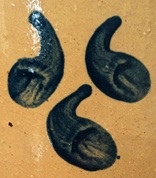
Enlargement of the highly stylized bird motif on the American stoneware discussed in this post.
This exquisite example of American stoneware features a masterfully rendered cobalt blue depiction of a bird on its front, with gracefully detailed tail feathers and flowing, artistic lines. On the reverse, a simple yet elegant cluster of cobalt motifs, suggestive of floral forms with delicate stamen emerging from their centers, complements the primary design. Together, these elements create a charming piece that beautifully bridges utility and artistry.
American Stoneware, later 19th century, featuring bird motif. From the author’s collection.
The reverse design consists of a trio of stylized floral motifs, each appearing to have stamen delicately emerging from the center.
Historical Context
Stoneware was a cornerstone of 19th-century domestic life, essential for food preparation and storage. By the mid-19th century, stoneware shifted from ovoid shapes to more cylindrical forms, as seen in this vessel. This stylistic transition helps to date such pieces, with cylindrical containers typically associated with the latter half of the century.
New York State became a leading center for stoneware production, with its extensive canal system facilitating the transport of white clay from New Jersey and the distribution of finished goods across the region. Potters adorned these utilitarian wares with freehand cobalt designs, firing them in salt-glaze kilns to achieve their characteristic shiny finish.
The artistic designs on such stoneware, often created by untrained but skilled potters, are now celebrated as American folk art. Birds and floral motifs were among the most popular subjects, making this piece an exceptional representation of the genre.
Key Features
Primary Design: Freehand cobalt bird with stunningly detailed tail feathers, noted for its fluid and dynamic form.
Secondary Design: A trio of cobalt blue floral motifs on the reverse, each appearing to have stamen delicately emerging from the center, providing balance and artistic flair.
Additional Details: Cobalt highlights on the handles, a thoughtful touch indicative of the potter’s attention to detail.
Dimensions: 11 inches in height x 7 inches wide (flaring to 8 1/4 inches at top rim)
Condition: Very good for its age with minor glaze imperfections typical of the period. No cracks, chips, or restorations.
Artistic and Functional Legacy
This stoneware vessel exemplifies the creative spirit of 19th-century American potters, who transformed everyday objects into enduring works of art. Though utilitarian in origin, the piece’s intricate designs and craftsmanship ensure its lasting appeal as a collector’s item and a testament to the era’s artistry.
Guillaume Guillon Lethière (French, 1760 – 1832) The Death of Virginia, about 1825–1828, Oil on paper, mounted on canvas. Unframed: 73.5 × 117 cm (28 15/16 × 46 1/16 in.). The J. Paul Getty Museum, Los Angeles, 2023.7
Livy’s History of Early Rome offers a timeless case study in the corruption of power through the story of Verginia. In Book 3, Appius Claudius – a member of the decemviri tasked with codifying Roman law – becomes consumed by lustful desire for Verginia, a young woman of plebeian birth. Unable to win her through legitimate means, he orchestrates a fraudulent court case to claim her as a slave, abusing his authority to ensure the verdict.
When her father Verginius, a soldier, arrives to defend his daughter, he finds the machinery of justice has been wholly perverted to serve Appius’s desires. Faced with no recourse against this tyranny, Verginius takes his daughter’s life in the forum rather than see her enslaved and defiled. His tragic act galvanizes both the people and army, leading to the overthrow of the decemviri and restoration of constitutional government.
The story has relevance today as we witness how unchecked power still corrupts, with modern figures who – like Appius – seduce both masses and elites with promises of reform while pursuing personal gain and dismantling democratic safeguards. The allusive poem I drafted below below explores this persistent danger, using Verginia’s sacrifice to illuminate the cost of our collective failure to recognize and resist tyranny in its early stages.
The Wages of Compromise: The Blood of Verginia
Beneath the rostra’s shadowed height, he stood, The man whose gilded words had bought the crowd. Their cheer, a wreath for virtue misconstrued, Their gaze averted, though his deeds grew loud. What harm, they thought, if petty sins abound? A jest, a taunt, though brazen, met no plea; The slights were not whispered, though unjust, Personal gain o’er public trust was clear to see.
Yet they excused what honesty would shun, For promised change, for vengeance lightly jested. The wrongs of old made present wrongs seem none; A brighter future claimed, though untested. And so, unchecked, his shadow stretched and grew, Till justice bowed before his grim designs. A father’s hand, with love and fury true, Struck down the bonds of tyranny’s confines.
Her blood, a warning, sanctified the square, The people’s slumber shattered by her cry. The forum rang with shouts that pierced the air, The dream of freedom breathed, though she must die. No longer could they feign or look away— Their wish for ease had birthed a tyrant’s reign. The jest of vengeance turned to ash that day, And Appius fled, undone by grief and shame.
Let not the lesson fade within our time: That deeds unchallenged fester into might. To mock the law, to cloak a crime sublime In promised gold, ensures the coming blight. The people’s trust, the lords’ approving nod, May crown a man or break his staff and rod.
Gaius (Caligula). AD 37-41. Æ Sestertius. Photograph from CNG, Triton XXVII Auction, Lot 675.
The Roman Emperor Caligula, to demonstrate his contempt for the Roman Senate, appointed, by some accounts, his horse, Incitatus, to the Senate so that the horse could be made a consul of Rome. This ancient tale is called to mind by events of recent days, but not for reasons many may suspect. The following poem of Zbigniew Herbert (translated by Oriana Ivy) suggests that the horse had merits as an appointee which many of the recent suggested appointees do not.
***
Caligula Speaks
Among all the citizens of Rome
I loved only one
Incitatus–a horse
when he entered the Senate
the unstainable toga of his coat
gleamed in the midst
of purple-lined assassins
Incitatus possessed many merits
he never made speeches
had a stoic temperament
I think at night in the stable he read the philosophers
I loved him so much that one day I decided to crucify him
but his noble anatomy made it impossible
he accepted the honor of consulship with indifference
exercised authority in the best manner
that is not at all
he would not be persuaded toward a lasting liason
with my second wife Caesonia
thus unfortunately the lineage of centaur caesars
was not engendered
that’s why Rome fell
I determined to have him declared a god
but on the ninth day before the February calends
Cherea Cornelius Sabinus and the other fools
interfered with my pious plans
he accepted the news of my death with calm
was thrown out of the palace and condemned to exile
he bore this blow with dignity
he died without descendants
slaughtered by a thick-skinned butcher from Ancium
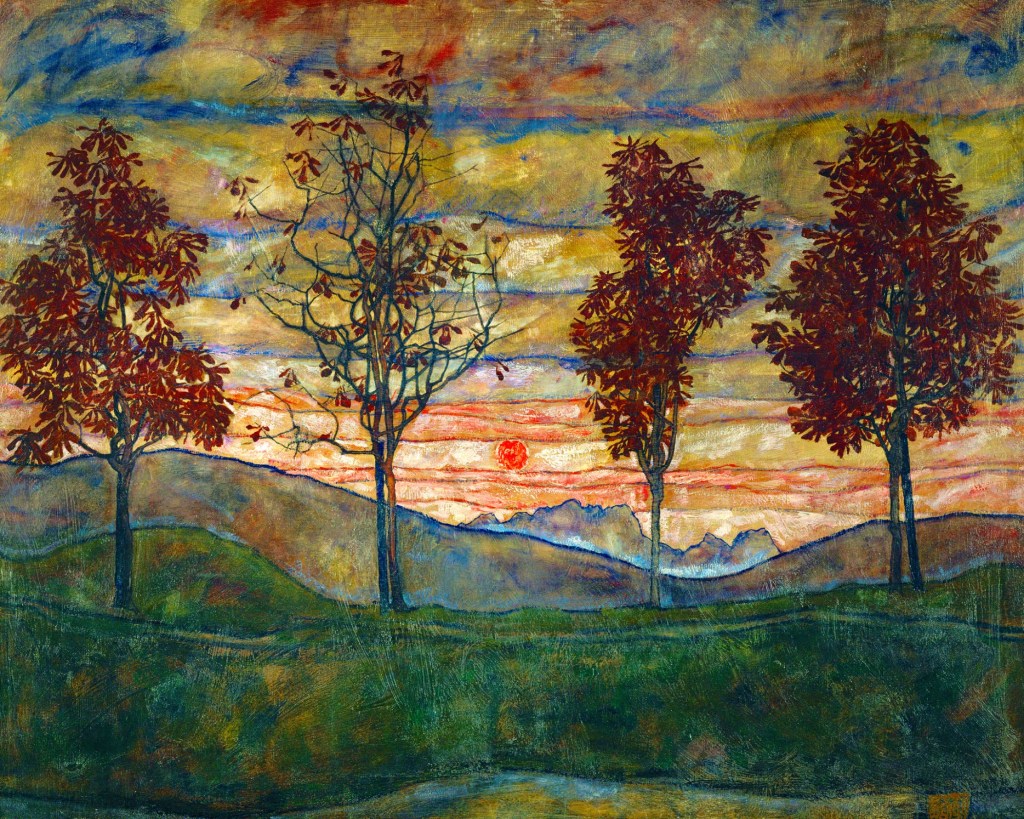
Four Trees, (1917. Oil on canvas) by Egon Schiele. Belvedere, Vienna.
Earlier this week, I took some time to review several hundred works by Egon Schiele (1890–1918), the Austrian Expressionist painter renowned for his intense and raw depictions of the human form. Schiele’s art, with its distinctive distorted body shapes and expressive lines, often explores themes of sexuality and self-examination, particularly in his numerous self-portraits, including nudes. Personally, I am more drawn to his other works—those that portray buildings, landscapes, and more formal sittings—not out of prudishness, but because of his unique ability to capture such scenes with an aesthetic that I appreciate. His mentor, Gustav Klimt, played a significant role in shaping Schiele’s artistic development. A broader collection of his works can be found here: Egon Schiele Overview and at the YouTube video gallery below.
While Schiele’s style is compelling, his biography is troubling, and he is not someone I would have wanted to know personally. Nonetheless, many of his works possess an undeniable aesthetic appeal, although others do not resonate with me as deeply. Two pieces that I find particularly captivating are included in this post—one featured above, and the other below (which reminded me of myself researching for an article or post).
Dr. Hugo Koller (1918, Oil on canvas) by Egon Schiele. Belvedere, Vienna.
For the record, The Cleveland Museum of Art possesses two works by Schiele, neither on display. The more interesting is below.
Portrait of a Child (Anton Peschka, Jr.), [1916, gouache, watercolor, and graphite] by Egon Schiele. The Cleveland Museum of Art, Cleveland.
From an early age, I have been captivated by the notion that all that exists now, has ever existed, and will ever exist, exists presently. This idea, which first took shape in my mind during high school, has remained a persistent thread in my reflections on the nature of reality and time. It suggests that the entirety of existence—every moment in history, every event in the future, every possibility—coexists in a single, timeless present. This perspective naturally leads to the contemplation of a deeper truth: that nothing and everything are, in essence, one and the same.
As I continued to explore this idea, I encountered theories in both mathematics and physics that resonated with this intuition. In particular, my fascination with the mathematical constant π, with its infinite and non-repeating decimal expansion, led me to consider the vast potential contained within what seems at first glance to be a simple number. However, π is far from simple—its endless digits imply the existence of all possible sequences, and by extension, all possible information, encoded within its infinite expansion.
The Pi Notion: Infinite Possibilities Encoded in a Number
My contemplation of π and its infinite, non-repeating decimal expansion served as a key influence in shaping my thoughts on the nature of existence and possibility. Mathematically, π is an irrational and transcendental number, meaning its decimal representation goes on forever without repeating. Within this infinite sequence of digits lies a tantalizing possibility: if π is a normal number (as many mathematicians believe, though it has not been proven), then every possible finite sequence of digits will appear somewhere within its expansion.
This concept led me to speculate that within the digits of π could be encoded every conceivable piece of information—every possible sequence of numbers, every text, every image, every story. In this sense, π becomes a metaphor for the infinite potential of the universe. Just as the digits of π contain endless possibilities, so too might the fabric of reality contain every possible outcome, every possible narrative, existing simultaneously within a vast, unchanging structure. This realization brings me to the philosophical contemplation that within this infinite expanse, nothingness and everythingness are not distinct; they are, in fact, two sides of the same coin, if not indistinquishable. And as π exists now, calculated or not, proven or not, this infinite expanse exists now.
After reflecting on these thoughts, I discovered that this line of reasoning has been explored by mathematicians and philosophers alike. Notably, Gregory Chaitin, in his work “Meta Math!: The Quest for Omega,” discusses how the digits of π encode an infinite amount of information, much of which is incompressible and represents the vast potentiality inherent in mathematical infinity. His insights offer a rich foundation that parallels my own contemplations.
Introducing the Block Universe Theory
After contemplating the infinite potential embedded in π, I began to reflect on the nature of time and existence more broadly. If π can encapsulate all possibilities within its infinite expansion, might time itself also contain all moments—past, present, and future—within a single, cohesive structure? This led me to speculate that perhaps all of time is not sequential but exists simultaneously, with past, present, and future all residing within an eternal present.
Realizing that such a thought might not be unique, I turned once again to the vast resources of the internet, seeking to uncover how this idea might have been previously articulated. Through my search, I encountered the block universe theory—a concept in the philosophy of time and physics that proposes exactly this: all moments in time exist simultaneously within a four-dimensional space-time continuum.
This concept was rigorously developed by the mathematician and physicist Hermann Minkowski, whose work in the early 20th century laid the groundwork for the idea that time and space are interwoven into a single continuum. Minkowski famously stated, “Henceforth space by itself, and time by itself, are doomed to fade away into mere shadows, and only a kind of union of the two will preserve an independent reality.” This union of space and time, known as space-time, forms the foundation of the block universe theory.
In the block universe, time is not a flowing river but a dimension similar to space. Every event—past, present, and future—is fixed within this structure, existing as a permanent part of the universe. This challenges our conventional understanding of time as a linear progression and instead suggests that every moment is eternally present, much like the infinite possibilities contained within π. The block universe theory, therefore, provides a framework that aligns closely with my earlier contemplations about the nature of time and the interconnectedness of all possibilities.
Time as an Illusion and Memory as Accretion
This speculative journey naturally brought me to question the nature of time itself. If time is merely a dimension, with all moments existing simultaneously, might it not be an illusion? Our experience of time as flowing may be nothing more than a feature of our consciousness navigating through this block universe. This perspective challenges the reality of time and positions it as a subjective construct rather than an objective truth.
This questioning of time also led me to reflect on the nature of memory. Drawing from both my engagement with Jungian psychology and historical studies on collective memory, I began to see memory not as a static record of the past but as a dynamic, evolving process. Jung’s exploration of the collective unconscious suggests that memory is deeply intertwined with the symbols and archetypes that shape our understanding of the world. Similarly, historians emphasize that memory, especially at the societal level, is often a “struggle”—a contested and mutable narrative rather than a fixed truth.
Each time we recall a memory, we do so through the lens of everything that has occurred since the original event. Our memories are, therefore, subject to revision, an accretion of subsequent experiences and reflections. In this way, memory is not bound by the linear progression of time but is instead a fluid interaction with the present.
As Carl Jung once noted, “Memory is the way we keep telling ourselves our stories—and telling them to others.” This fluidity of memory mirrors the infinite possibilities encoded in π and the simultaneous existence of all moments in the block universe. Just as every possible sequence exists within π, every possible interpretation of an event exists within our consciousness, shaped by the ongoing accretion of experience. This brings to the fore the idea that the boundaries between what is and what is not, what has been and what could be, are inherently blurred; nothing and everything are interwoven in the fabric of existence.
Possibilities Within the Block: A Multiverse of Reality
Expanding on this idea, I posit that not only do all moments in time exist simultaneously, but so do all possibilities—not as mere potentials, but as realities. This notion finds a parallel in the concept of modal realism, as articulated by philosopher David Lewis in his seminal work “On the Plurality of Worlds.” Lewis argues that all possible worlds are as real as the actual world we inhabit. He writes, “I advocate a thesis of plurality of worlds, or modal realism, which holds that our world is but one of a plurality of worlds, all of which are equally real.” Every potential scenario, every possible outcome, exists in its own right, much like how every sequence of digits might be encoded within the infinite expansion of π.
When combined with the block universe theory, this leads to a vision of reality that is not just a single block, but a multiverse—a vast collection of blocks, each representing a different possible world. In this multiverse, every possible version of events, every conceivable reality, exists simultaneously. This intertwining of time and possibility suggests that our universe is not just a static collection of events, but an infinite, dynamic interplay of all that is and could ever be.
Lewis further elaborates, “The world we are part of is but one world. There are many others, of a size and complexity to rival that of our world, or perhaps exceeding it. The difference between a world and an isolated aggregate of unconnected things is just that: in a world, the things are unified; in a mere aggregate, they are not.” This perspective on the unity of worlds within the multiverse reinforces the idea that each possible world is not merely an abstract notion but a fully realized reality, interconnected with others in the vast tapestry of existence.
This concept of a multiverse where all possibilities are already realized challenges our conventional understanding of reality. If every potential outcome is actualized in some version of the universe, then the very notion of choice, causality, and individuality becomes more complex. What does it mean to make a decision if every possible decision is already realized in some version of the multiverse? Are we, in some sense, experiencing all possible lives simultaneously, or have we experienced all possible lives simultaneously already, with our consciousness merely navigating one path among many?
Furthermore, this multiverse of realities aligns with the concept of quantum mechanics, particularly the Many-Worlds Interpretation (MWI), which was initially proposed by Hugh Everett III in 1957. The internet, with its vast resources, led me to this theory, which posits that every quantum event results in a branching of the universe, creating multiple, parallel realities. In this context, the block universe theory and modal realism together suggest that these branches are not mere theoretical possibilities but actualized realities, each existing in a parallel block within the greater multiverse.
This vision of the universe as a vast, interconnected web of realities also resonates with philosophical notions of determinism and free will. If all realities exist and are equally real, then our sense of control over our destiny may be an illusion, with every possible outcome playing out (or already played out) across the multiverse. Yet, this also imbues our existence with a sense of infinite breadth, where the boundaries of what is possible are limited only by the scope of imagination and the structure of the universe itself.
In such a reality, the concepts of nothingness and everythingness converge, underscoring the idea that these distinctions are mere illusions born of our limited perception. Every moment, every reality, every conceivable existence is woven into this intricate tapestry of the multiverse, challenging our understanding of what it means to exist and what it means to choose.
Conclusion: A Journey of Exploration
As I contemplate the ideas I’ve developed, it becomes clear that my early intuitions about the nature of existence and time likely, if not certainly, echo certain themes in literature and philosophy. While thinkers like Jorge Luis Borges, Gilles Deleuze, and others have explored related concepts—such as the multiverse, the virtual, and the interconnectedness of all realities—the particular convergence of nothingness and everythingness, as I envision it, may warrant further reflection. Clearly, I have much more reading to do. Then again, if my earlier thoughts hold true, perhaps I’ve already done the reading, and these ideas have already been articulated—just in another part of the multiverse.
As I move forward, I recognize the importance of deeper literary and philosophical inquiry. The works of David Lewis, Hugh Everett, Jorge Luis Borges, Hermann Weyl, Albert Einstein, and Gilles Deleuze—each of whom has engaged with aspects of the themes I am exploring—offer valuable insights that I intend to study further. By engaging with these thinkers, I hope to refine and articulate a coherent philosophical perspective that unites these seemingly disparate threads into a unified vision of reality—one that embraces the infinite complexity of the universe and the timeless present in which it all resides.
At this stage, I find myself at the beginning of this journey, eager to explore these works and discover how my ideas might be expanded, challenged, or affirmed. Through this process, I hope to contribute a unique perspective to the ongoing discourse on existence, time, and possibility—even if that perspective has already been articulated in another part of the multiverse, or here, just waiting to be rediscovered, perhaps only by me.
Author’s Note
Before embarking on the exploration above regarding my thoughts on the eternal now and all that it entails, which some friends have heard me attempt to explain verbally before, I must acknowledge a crucial aspect of my research process: in attempting to articulate my thoughts more formally for this essay, I have relied, in a way that I rarely do, on the assistance of modern technology—specifically Google and AI—to help me identify existing scientific and philosophical theories that likely align with my ideas. My education was thorough, and my readings have been deep, but I freely confess that I would not have stumbled upon concepts such as modal realism or the block universe theory without this digital assistance. These tools have helped me shape my raw, unformed thoughts into a more coherent exploration of the nature of reality as I understand it.