

Toward an Unsaying: Contemplation of Faith in the Shadow of the Ineffable

A meditation on the limits of theological language and the mystery of the Divine, this contemplative essay explores apophatic mysticism, the inadequacy of creeds, and the symbolic power of maps—blending poetic introspection with a life lived in scholarship, service, and creative expression.

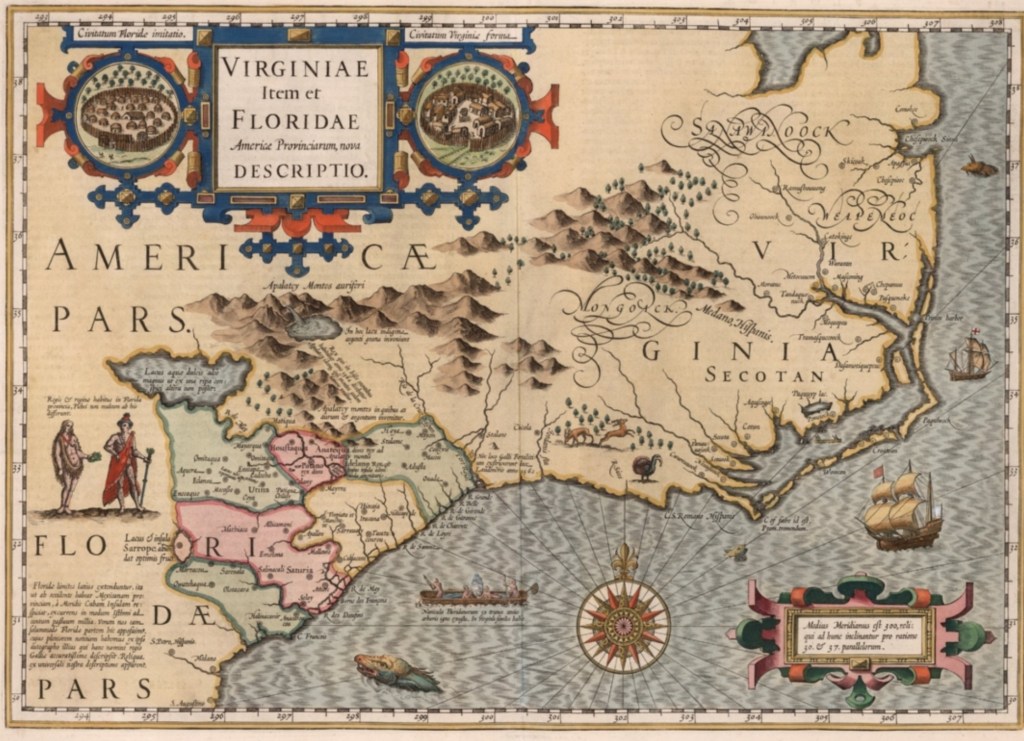
Virginiae Item et Floridae Americae Provinciarum, nova Descriptio.
Map by Gerard Mercator (1512–1594), Jodocus Hondius (1563–1612), and Hendrik Hondius (1597–1651).
Virginiae Item et Floridae Americae Provinciarum, nova Descriptio.
Map by Gerard Mercator (1512–1594), Jodocus Hondius (1563–1612), and Hendrik Hondius (1597–1651).
Published in 1623 by Hendricus Hondius, Amsterdam.
Image courtesy of the David Rumsey Map Collection, David Rumsey Map Center, Stanford Libraries.
Licensed under Creative Commons CC BY-NC-SA 3.0.

Raised within the Romano-Byzantine tradition—formed by both the Roman and Byzantine Catholic rites—I was shaped by a confluence of liturgical beauty, theological depth, and mystical reverence. From that upbringing, there remains not merely memory, but a lasting affection for the rhythm and substance of the faith of my youth. It is not simply a cultural inheritance, but a formative lens through which the sacred, the communal, and the mysterious first revealed themselves. Yet, it would not be accurate to describe my present stance as that of a lapsed Catholic, nor as an atheist, nor as one alienated from the Church. Alienation implies disaffection or estrangement born of expectation unmet or betrayal suffered. What remains is neither rejection nor rebellion, but something quieter and more reflective—a posture of reverent detachment that neither clings nor condemns.

Any attempt to articulate my position must begin by acknowledging the futility of articulation itself—at least in matters concerning the Divine. The belief that the Divine wholly exceeds the bounds of human comprehension and articulation grows only firmer over time. All creeds, revelations, and theological systems—however earnest or inspired—are, in the end, efforts to sketch with a cramped human lexicon and limited imagination that which lies beyond even the highest powers of conception. Far from illuminating the Divine, such efforts only obscure its immensity by imposing upon it our narrow symbols and forms.

Better to liken our theological endeavors to the drawing of maps—maps sketched by explorers who had never seen the coasts they sought to chart. Just as early cartographers filled the margins with dragons, saints, and imagined cities, we adorn the unknown with creeds, cosmologies, and commandments. These are sincere efforts, yet they more often reflect our hopes and fears than reveal any transcendent truth. The more intricate the system, the more seductive the illusion that the map is the territory. But the Divine is not a line upon a page. It is the sea beneath the sea monster, the silence beyond the compass rose, the continent whose very existence remains unknown. To name the Divine is already to misname it; to describe is to distort.

Such a perspective finds its truest expression in apophatic mysticism—the via negativa, the way of negation—a tradition articulated by Pseudo-Dionysius the Areopagite, a Christian thinker of the late fifth to early sixth century whose writings permeate the Catholic tradition through the works of Thomas Aquinas, Bonaventure, and the Spanish mystics, reminding us that the path of unknowing is not a break from faith, but one of its most ancient and revered expressions. In this light, God is not wise, not good, not just, not loving—not because the Divine lacks these qualities, but because our highest notions of them remain shadows cast by a light we cannot behold. Whatever we say of the Divine, however conceived, the most faithful statement is this: our words fall short.

Even so, human beings remain kataphatic creatures as well—creatures who long to speak, to name, to worship, to relate. Thus arises a kataphatic-apophatic tension, a profound and permanent unease between the impulse to speak of the Divine and the recognition that all speech fails. Hymns, liturgies, cathedrals, and doctrines are all human responses to this tension—not to capture the Divine, but to reach toward it, however falteringly. These gestures deserve neither scorn nor uncritical assent. They should be honored, but held lightly, cherished as poems rather than mistaken for proofs.

This tension extends beyond the realm of theology into the very nature of being itself. In a moment of quiet reflection, I found myself asking: “Where is Am I?”—caught between breath and thought, a question turning circles in the hollow of my chest. Am I the echo, or the voice that trembles back? A fragment drifting through the hour, a flicker in the endless light, unsure if I was ever whole or if the pieces were ever mine to find. Such a question is not mere existential uncertainty, but a recognition that the self, like the Divine, eludes definitive capture.

No formal creed or written revelation authored by man commands my assent, however noble or inspired it may be. Faith is not placed in these constructions, though the sacred yearning from which they arise is deeply respected. They are echoes of an original voice no longer heard directly, outlines of a presence glimpsed but never grasped. Like the adornments on ancient maps, these expressions are beautiful and sincere, but they are not to be mistaken for the thing itself.

To some, this may resemble agnosticism, though that word has become burdened with meanings it was never intended to carry—meanings of indecision, skepticism, or apathy. What is expressed here is none of those. It is not a shrug of the shoulders, but a bow of the head. Not the silence of the indifferent, but of the reverent. Not ignorance, but a conscious unknowing—a sacred refusal to impose limitation upon that which exceeds all bounds. This is why I eschew agnostic labels in favor of mystical ones—for the mystic does not claim ignorance of the Divine but acknowledges that true knowledge of it transcends conventional understanding.

What remains, then, is a life lived in contemplation of the ineffable—a contemplation that finds expression through creative work. In poetry, music, and essay, I reach toward that which cannot be directly named. When I write of the “eternal now” where “yesterday, tomorrow, and today collapse,” or compose lyrics that honor Humilitatem Initium Sapientiae, I am not merely creating art but engaging in a form of contemplative practice. These creative acts serve as bridges, not only between myself and the ineffable, but also between myself and others who share this reverent space, regardless of their formal religious affiliations or φιλοσοφίαι (philosophies or wisdom traditions).

The path ahead is not marked by certainty but by awe, not by declarations but by listening. Mystery is not something to be solved, but something to be honored. Years of formal study—first in history and religious studies as an undergraduate, then as a teacher of both subjects, and later through a long career in civil rights law and public service—have only deepened the awareness that human systems, whether intellectual, doctrinal, or legal, ultimately encounter their limits at the threshold of the sacred. In this, the apophatic tradition offers a spiritual home—a dwelling place where reverence begins precisely where language ends. If there is a guiding light for such a path, it is humility—humilitatem initium sapientiae—not merely as a moral posture, but as a metaphysical necessity. That teaching, which echoes throughout Thomas à Kempis’ The Imitation of Christ, remains not only a personal motto, but a settled conviction: that wisdom begins when one ceases to pretend to possess it.

Near the staircase in my front hallway hangs an early map of the New World—an artifact I have long cherished. Its artistry is matched only by its courage, for it dares to depict what was not yet known. Near the region now recognized as Virginia and the Carolinas, a sea monster rises from the ocean’s depths, signaling peril or wonder—perhaps both. On the land itself, figures of “natives” stand, imagined by a hand that never walked those coasts. That map does not record the world; it records what the world dared to imagine. So, too, do our theologies populate the margins of metaphysical uncertainty with monsters and angels, commandments and visions. They are imaginative acts—sincere, flawed, luminous. And like that map, they are to be cherished not for their precision but for what they reveal of the human longing to reach into mystery with word and symbol, with ink and awe. In their earnest striving, they remind us: we are always sketching the edge of the unknown, even when we know we cannot cross it.

The Danger of Literalist Thinking in the Face of Rising Authoritarianism in the United States

The Perils of Legalistic Literalism

Throughout history, authoritarianism has rarely invaded democracies through dramatic coups but rather through the gradual erosion of norms and institutions. This erosion is often enabled by what might be called “legalistic literalism”—a mindset that fixates on procedural adherence while remaining blind to broader patterns of democratic decay. This approach creates a dangerous paradox: by the time literalists acknowledge an authoritarian threat has crossed their arbitrary legal threshold, democratic safeguards have often already been fatally compromised.

The United States offers a compelling case study of this phenomenon. From the normalization of anti-democratic rhetoric during the current president’s first campaign to the institutional paralysis surrounding the January 6th insurrection and subsequent Supreme Court decisions expanding presidential immunity, literalist thinking has consistently undermined effective resistance to democratic deterioration. Now, with the current administration’s return to office, the administration has embraced an explicitly authoritarian approach. It has weaponized the Justice Department and haphazardly dismantled government agencies without required Congressional authorization—at times so maliciously and haphazardly that certain closures had to be reversed. Public servants have been fired, impeding the delivery of essential services to senior citizens, veterans, those seeking enforcement of their civil rights, and other citizens. Some, identified as the “other,” have been sent to what can only be described as concentration camps (in the British historical tradition thus far) in foreign countries or literally “lawless” territories under U.S. control (in the American historical tradition alas) pending their final disposition. Meanwhile, Congress has been marginalized, and executive orders are treated as beyond the oversight of Congress or the judiciary under the novel unitary executive theory propounded by the administration.

This pattern follows a recognizable trajectory observed in other democracies that have declined into authoritarian rule. What makes the American case particularly instructive is how adherence to procedural norms—supposedly the safeguard of democracy—has paradoxically accelerated democratic erosion by delaying meaningful resistance until institutional damage becomes nearly irreversible. Examining this process reveals not just the mechanics of democratic decline but also potential strategies for arresting it before critical democratic guardrails are wholly destroyed.

This essay examines how literalist thinking enables authoritarianism by exploring these key moments of institutional failure and draws lessons for preserving democratic systems against such threats.

The Warning Signs: Early Responses to Authoritarian Signals

The Normalization Phase (2015-2016)

When he emerged as a political figure, his rhetoric displayed clear authoritarian tendencies: praising dictators like Vladimir Putin and Kim Jong-un, threatening political opponents with imprisonment, attacking the press as “enemies of the people,” and suggesting he might not accept election results. These statements represented textbook warning signs familiar to scholars of democratic decline.

Yet the response from most institutional actors was profoundly literalist. Major media outlets normalized his rhetoric by treating it as conventional political hyperbole rather than dangerous authoritarianism. Legal scholars reassured the public that constitutional guardrails would hold. Political opponents dismissed him as unserious. The common refrain—“take him seriously, not literally”—embodied this literalist fallacy, suggesting that dangerous rhetoric was inconsequential until manifested in specific legal violations.

This response ignored historical lessons from democratic backsliding in countries like Hungary, Turkey, and Venezuela, where authoritarian leaders signaled their intentions through rhetoric long before implementing institutional changes. The literalist mindset demanded concrete proof before acknowledging threat—effectively demanding democracy show fatal symptoms before allowing preventative treatment.

Constitutional Optimism as Denial (2017-2019)

Once in office, he tested democratic guardrails through actions that challenged norms without clearly violating laws: firing FBI Director James Comey while citing the Russia investigation, demanding loyalty from law enforcement officials, attacking judges who ruled against him, and claiming “absolute immunity” from investigation.

The literalist response from many institutions was to examine each action in isolation rather than as part of a pattern of democratic erosion. This compartmentalization prevented the recognition of the cumulative threat. Many mainstream legal scholars maintained that since each action could be technically defended through creative legal interpretation, the system was holding.

This faith in procedural safeguards reflected a fundamental misunderstanding of how democracies die in the 21st century. As scholars Steven Levitsky and Daniel Ziblatt note in How Democracies Die, modern authoritarian leaders typically dismantle democracies through legal channels—exploiting ambiguities in legal systems rather than openly violating them. The literalist’s insistence on clear legal violations as the threshold for concern thus creates a perfect blind spot for detecting authoritarian encroachment.

This blindspot would prove particularly damaging as his presidency progressed, setting the stage for increasingly bold challenges to democratic norms that would eventually culminate in the events surrounding the 2020 election.

Institutional Paralysis: January 6th and Its Aftermath

The events surrounding January 6th, 2021, represent perhaps the clearest example of how literalist thinking enables authoritarianism. For months, he and his allies laid groundwork to overturn the election: filing dozens of baseless lawsuits, pressuring state officials to “find” votes, attempting to manipulate the Justice Department, and promoting alternative slates of electors.

The Failure of Preventative Response

Despite these clear warning signs, many institutions remained paralyzed by literalist reasoning. Political leaders insisted on waiting for an unambiguous “red line” to be crossed. Law enforcement agencies, despite intelligence warnings about violence, hesitated to prepare adequately for January 6th partly due to concerns about appearing to take sides in what was framed as a “political dispute” rather than an attempted coup.

This paralysis extended to Congress, where even after the Capitol was breached, a significant number of legislators proceeded with objections to electoral votes—adhering to a procedural approach even as the violent consequences of that approach unfolded around them.

The Accountability Gap

In the aftermath, literalist thinking continued to impede accountability. Criminal prosecutions moved at a glacial pace, constrained by procedures designed for ordinary criminal cases rather than threats to democracy itself. The impeachment process failed when many senators cited procedural objections about impeaching a former president—a literalist reading that ignored the purpose of impeachment as a safeguard against future threats to democracy.

Perhaps most concerning was the judiciary’s response. Courts processing January 6th cases often treated them as ordinary criminal matters rather than components of an attempted coup, focusing on specific statutory violations while avoiding broader questions about democracy and insurrection. This procedural compartmentalization helped normalize an unprecedented assault on democratic transition.

As Daniel Ziblatt observed, the January 6th attack and his subsequent pardoning of rioters highlighted two cardinal rules of a healthy democracy: You have to accept election results, win or lose, and you cannot engage in violence or threaten violence to hold onto power. The failure to enforce these principles further illustrates how literalist hesitation in addressing democratic threats emboldens authoritarian actors.

This failure of accountability created a dangerous precedent, setting the stage for the next phase of democratic erosion: the judiciary’s formal expansion of executive power beyond democratic constraints.

Judicial Complicity and the Supreme Court’s Role

The Supreme Court’s decision in Trump v. United States (2024) exemplifies how literalist legal reasoning can provide cover for authoritarianism. By granting unprecedented immunity to presidents, the Court elevated a narrow textual reading over consideration of how such immunity would affect democratic accountability.

The ruling effectively places presidents above the law, making future accountability nearly impossible. While meticulously parsing eighteenth-century texts and precedents, the Court showed remarkable blindness to the real-world impact: a president who had already attempted to overturn an election was being granted expanded immunity just as he prepared to potentially retake office with explicit promises of retribution against opponents.

This decision represented the culmination of a years-long process of judicial capture that extended well beyond this single ruling. Justices Samuel Alito and Clarence Thomas had been implicated in significant ethics scandals, including undisclosed luxury vacations, private jet travel, and real estate deals with billionaires who had interests before the Court. Rather than addressing these clear conflicts of interest through meaningful ethics reforms, the Court responded with voluntary, unenforceable guidelines that preserved the appearance of judicial independence while allowing substantive corruption to continue.

These ethics scandals revealed a deeper problem: the Court’s legitimacy was being undermined not just by individual rulings but by both the perception and reality that justices were entangled with wealthy interests seeking to reshape American governance. The corruption evident in these scandals aligned key justices with the very oligarchic forces backing authoritarian politics—creating a dangerous alliance between judicial power and anti-democratic wealth.

The Oligarchic Capture of Democratic Institutions

The literalist approach fails not only through procedural blindness but also by ignoring the economic power dynamics that increasingly shape American governance. The same oligarchic network supporting judicial capture has also backed authoritarian political movements and organizations, such as the Federalist Society, recognizing that an authoritarian turn benefits economic elites through deregulation, tax policies, and suppression of labor rights.

Congress’ failure to act against judicial corruption stems not merely from procedural timidity but from financial entanglement with the same oligarchs and corporate interests that have corrupted the courts. This same timidity was on display in Senate Minority Leader Chuck Schumer’s decision to support a Republican-crafted Continuing Resolution (CR) to extend government funding, despite opposition from within his own party and others opposed to authoritarian encroachment. His rationale—that blocking the bill would allow the president and his oligarchic side-kick to seize more power through a government shutdown—illustrates how institutional leaders often capitulate to authoritarian pressure rather than risk direct confrontation. This type of preemptive surrender, justified through procedural pragmatism, ultimately facilitates democratic erosion rather than preventing it.

The assumption that democratic institutions operate independently of economic influence is a dangerous literalist fallacy. The reality is that concentrated wealth has created a feedback loop where economic power translates into political influence, which in turn creates policies that further concentrate wealth. This cycle has accelerated democratic erosion by ensuring that institutional responses to authoritarianism remain weak and ineffective, constrained by the same economic interests that benefit from democratic decline.

The Road Ahead

Democracy in the U.S. is at a precarious moment. The literalist approach to democratic defense has repeatedly failed to prevent authoritarian encroachment. The path forward requires:

  1. Recognizing that democracy dies through legal channels, not just through obvious coups.
  2. Understanding that economic oligarchy and political authoritarianism are mutually reinforcing threats.
  3. Prioritizing substantive democratic values over procedural formalism.
  4. Building coalitions willing to take political risks to preserve democratic governance.

For citizens, this means moving beyond the assumption that legal procedures alone will protect democracy. For institutions, it means developing the courage to defend democratic principles even when doing so challenges conventional interpretations of their role.

Effective resistance to authoritarianism requires not just procedural vigilance but moral courage—the willingness to recognize patterns of democratic erosion before they manifest in unambiguous legal violations. It requires understanding that democracy depends not just on rules but on shared commitments to democratic values that transcend legalistic interpretations.

By the time an authoritarian breaks the law, they have already rewritten the rules. The fight for democracy must begin long before that point.

The Dismantling of the U.S. Department of Education: A Calculated Assault on the Nation’s Future

Abandoned classroom. Photo by Pixabay on Pexels.com

The destruction of the U.S. Department of Education is not merely a bureaucratic restructuring or an attempt at governmental efficiency. It is, rather, a brutal, ideologically driven attack on public and higher education itself—an assault decades in the making. The immediate consequences, such as the callous firing of over 1,300 employees and the gutting of its Office for Civil Rights, are alarming, but they are only symptoms of a broader effort to delegitimize and dismantle the tradition of public education in America. This is no accident; it is a deliberate and malicious campaign waged by reactionary forces who have long sought to annihilate the very concept of education as a public good.

Before addressing the broader catastrophe, it is essential to recognize the dedicated public servants whose careers have been abruptly and callously ended. These were not faceless bureaucrats but individuals who dedicated their lives to ensuring access to quality education, protecting civil rights, and supporting students, parents, and teachers. They are the ones who worked tirelessly to administer federal student aid, enforce anti-discrimination laws, and uphold policies meant to ensure that education remained a pathway to opportunity rather than a privilege of the few. To see them falsely maligned and slandered while being discarded so cruelly is an injustice, not only to them but to the nation they so nobly served.

To understand the scope of this travesty, one must acknowledge that public education in the United States has been under sustained assault—not from bureaucrats, not from educators, and certainly not from the imagined “woke” enemies that conservative demagogues irrationally scream about—but from the anti-public education, anti-higher education agenda of the right-wing forces that have festered in the American political landscape since Brown v. Board of Education so deeply outraged the bigoted sensibilities of many Americans. This movement, which cloaks itself in deceptive terms like “school choice” and “parental rights,” is nothing more than a long-running campaign to dismantle public education in favor of a reactionary, privatized system that siphons resources from the many to enrich the few.

Milton Friedman, the sinister patron saint of the libertarian free-market fantasy, provided the economic blueprint for this war on public education. His advocacy for school vouchers was never about “improving education” or “empowering parents”—it was about facilitating the exodus of white children from integrated schools while redirecting public funds into private, often exclusionary institutions. The modern conservative attack on public education is a direct continuation of this shameful tradition, now infused with fresh venom as it seeks to erase any federal coordination, civil rights protections, and guarantee of equal access to education.

And now, with breathtaking ruthlessness, this agenda is reaching its culmination at the hands of pusillanimous politicians hiding behind false narratives. The elimination of nearly half the workforce of the Department of Education within the first two months of the second reign of incompetence is an unmistakable step toward the total obliteration of the department. The Office for Civil Rights, already struggling to process the nearly 25,000 complaints of discrimination it receives from the public yearly and one of the last remaining institutional bulwarks against discrimination in schools—has been slashed to the bone, ensuring that students with disabilities and others who are discriminated against, whether on sex or race or national origin, will have nowhere to turn for timely relief when their rights are trampled. This is not accidental; this is the plan.

The current Education Secretary, in the grand Orwellian tradition of this administration, has assured the public that these cuts will somehow improve “efficiency” and “accountability.” Such statements are not merely disingenuous—they are outright lies, designed to mask the true intent behind this evisceration: to dismantle any federal structure that protects education as a right rather than a privilege reserved for the wealthy and well-connected.

Adding further insult to this grievous injury, the most aggrieved one has handed the reins of this demolition project to none other than our billionaire tech overlord. This grotesque display of plutocratic interference sees our billionaire tech overlord—who has no experience in education policy but plenty of experience in exploiting workers—granted unfettered access to sensitive government data and decision-making power over federal agencies. Under the laughable guise of “efficiency,” his Technokratische Jugend has set about dismantling the very institutions that serve as the backbone of public education, further centralizing power in the hands of the ultra-rich while leaving working Americans to suffer the consequences.

But let us be clear: this is not just an attack on those in public service. It is an attack on the very principle that education should be accessible to all, that an informed citizenry is essential to democracy, that knowledge should not be hoarded by the privileged few. It is an attack on the American future, a calculated and malevolent act of national sabotage designed to entrench ignorance and subjugation. Presently, the enlightened pro-choice anti-education agenda of our political elite has delivered unto us a nation where 54 percent of adults read only at the 6th grade level—imagine a decade hence where we will be!

Public education is not a luxury; it is the foundation of an equitable society. The destruction of the U.S. Department of Education is not about “efficiency” or “streamlining” government—it is about ensuring that the levers of power remain in the hands of a select few while the masses are kept ignorant, powerless, and too overwhelmed to fight back. This is a crisis of democracy, and it will have consequences that reverberate for generations.

The wreckage of this assault will be vast and far-reaching. Higher education costs will continue to increase as many institutions shutter their doors, vocational training programs will wither, and civil rights enforcement in schools will become an afterthought, if it exists at all. Meanwhile, a handful of oligarchs and right-wing ideologues will gloat over their victory, having successfully reduced one of the last bastions promoting American progress into a smoldering ruin. And continue to pay attention to the war on institutions of higher education, our overlords are not done reducing our heirs into ignorance.

A Handful of Dust, A Handful of Light

Detail highlighting the dust motes from “Støvkornenes dans i solstrålerne” (Dust Motes Dancing in the Sunbeams, 1900)
By Vilhelm Hammershøi (1864-1916)
Oil on canvas, 70 cm × 59 cm
Ordrupgaard Museum. Photograph Public Domain.

Dust lingers in the ruins of empires, in the fading footprints of the past. It clings to the forgotten, settles upon the broken. T.S. Eliot’s The Waste Land declares “I will show you fear in a handful of dust,” evoking a profound existential dread—the terror of insignificance, the finality of death in a world where nothing endures. Shelley’s Ozymandias presents the cruel irony that even the mightiest fall into dust, their ambitions erased by time. Shakespeare reinforces this democratic nature of mortality in Cymbeline, reminding us that: “Golden lads and girls all must, / As chimney-sweepers, come to dust” (Act IV, Scene 2). The biblical refrain, “For dust you are, and to dust you shall return” (Genesis 3:19) serves as a humbling reminder of human mortality—our bodies fated to mingle with soil and ruin.

This narrative of dust as dissolution has dominated our cultural consciousness for millennia. Yet beneath this interpretation lies a profound irony: the very science that revealed our cosmic insignificance also offers us a path to transcendence.

As we began to understand the origins of matter itself, a counternarrative emerged. The spectrographic analysis of stars, the discovery of nucleosynthesis, and the mapping of elemental creation within stellar lifecycles revealed an unexpected truth: the dust of our being is not merely the residue of life lost but the particulate remnants of stars long dead.

This scientific revelation transforms our relationship with dust. No longer just the symbol of our inevitable decay, it becomes evidence of our cosmic lineage. In this expanded understanding, we are made of elements forged in stellar cores—carbon, oxygen, nitrogen, iron—the ashes of ancient supernovae. As Carl Sagan elaborated: “The nitrogen in our DNA, the calcium in our teeth, the iron in our blood, the carbon in our apple pies were made in the interiors of collapsing stars.” (Cosmos, 1980)

The death of those stars gave birth to us. Thus, when our bodies return to dust, they are not returning to nothingness, but to the infinite. This is a poetic inversion of the traditional dread associated with dust. Instead of entropy as a reduction to meaninglessness, it becomes a return to something larger than the self.

Where Eliot shows us fear in dust, Carl Sagan tells us: “The cosmos is within us. We are made of star-stuff.” Lawrence M. Krauss echoes this sentiment: “Every atom in your body came from a star that exploded…. You are all stardust… the carbon, nitrogen, oxygen, iron …. They were created in the nuclear furnaces of stars.” (A Universe from Nothing, 2009)

The Paradox of Cosmic Fear

If one understands oneself as a finite being, bound to decay, dust is terrifying—it signifies loss. But if one understands oneself as an ephemeral expression of the universe, momentarily coalesced and destined to dissolve back into the great celestial flow, then there is no reason for fear. The end is not the end, but a return to origins.

So why does existential dread persist? Perhaps it is the ego’s reluctance to let go of selfhood. Perhaps it is the mind’s inability to accept that individual consciousness does not endure. Perhaps it is because dust, unlike stars, is silent. A ruined city, a forgotten name, a scattering of bones—all speak of oblivion, not grandeur.

As William Blake advised in The Proverbs of Hell, we “Drive [our] cart and [our] plow over the bones of the dead,” suggesting our instinctive fear of becoming that which is trampled and forgotten. Jorge Luis Borges captures this anxiety when he writes that “time is a river which sweeps me along, but I am the river”—we are both the eroder and the eroded, the dust-maker and the dust.

Yet, as a poem once attributed to Emily Dickinson but now considered of uncertain authorship reminds us: “Ashes denote that fire was; / Revere the grayest pile / For the departed creature’s sake / That hovered there awhile.” Dust does not truly vanish. It transforms.

Yet if the erasure of self is what we fear, we must ask: is selfhood truly lost, or merely transformed? If dust dissolves, does it vanish—or does it scatter into something greater?

From Dust to Light: The Redemption of Stardust

Yet if we understand dust not as an annihilation of self but as the very fabric of renewal, the fear dissolves. The metaphor itself must be rewritten: From dust we are made, from stardust we are formed. To dust we return, to the stars we return.

Walt Whitman intuited this cycle when he wrote: “I bequeath myself to the dirt to grow from the grass I love.” (Song of Myself, LII) His biological understanding of transformation prefigures our cosmic one—matter recycled through systems larger than ourselves.

If the metaphor itself shifts, then the meaning shifts with it. We do not fall into dust; we rise into radiance. We do not vanish into the void; we dissolve into the cosmos, as much a part of the next great supernova as we once were of the last. Even in knowing that we return to the stars, a quiet unease remains: what of the self? If I dissolve into light, is there still an “I”?

This cosmic transformation demands a new poetic language—one that recasts the traditional imagery of dust not as a symbol of loss but as a promise of renewal. If we are to truly grasp this shift in understanding, we must reimagine the very metaphors through which we comprehend our mortality. In the spirit of this reframing, I offer these verses that trace our journey from stardust to dust and back again:

From dust we are made—
  Not of earth, but embered light,
  Forged in stellar furnace bright,
  A whisper of stars in the cosmic shade.

To dust we return—
  Not to silence, not to loss,
  But scattered bright across the gloss
  Of galaxies that twist and burn.

Fear not the handful of dust—
  It is not death, nor mere decay,
  But embers cast upon the way,
  To rise once more in cosmic trust.

Thus, the fear in Eliot’s handful of dust dissolves when we see it not as an end, but as a beginning of something else. In the vast cosmic cycle, there is no finality—only motion, only transformation. The Rubaiyat of Omar Khayyam gestures toward this understanding when it speaks of being “Star-scatter’d on the Grass”—our elements returning to the cosmos from which they came. If all that we are, all that we love, all that we create ultimately returns to the stars, is that not immortality?

The Choice of Understanding

We return to the beginning, as dust does. The words of Genesis remind us: “For dust you are, and to dust you shall return.”

Yet now, having traced the journey of dust from earth to stars, we hear these words anew. Through the narrow human lens, we interpret them as a grim certainty—dust as ruin, silence, and the erasure of memory. We see only decay, the dissolution of self, the inevitable fading of all things into oblivion.

But through the enlightened cosmic lens, we recognize a deeper truth. Dust is not an end, but a transformation. It is not absence, but renewal. It is potential, energy, and the foundation of new worlds.

As Jorge Luis Borges reflects in We Are the Time:

“We are the time. We are the famous
metaphor from Heraclitus the Obscure.
We are the water, not the hard diamond,
the one that is lost, not the one that stands still.
We are the river and we are that Greek
who looks himself in the river.”

Borges, invoking Heraclitus’ ever-flowing river, offers a vision of existence as movement, dissolution, and renewal. We are not fixed, immutable beings; we are the water, ever-changing, ever-returning to the whole. If we are dust, then we are not the dust that settles, but the dust that travels—the dust that, like the stars, finds itself scattered only to be reshaped into something new.

To understand this is to grasp something beyond the immediate and the visible. It is to move past fear into recognition: that what was once bound into form returns to the vastness, not in loss, but in continuation. That what dissolves is not diminished but remade, part of a cycle stretching beyond human time. What Yeats called “a terrible beauty” is born in this transformation—terrible in its finality, beautiful in its cosmic potential.

Perhaps it is our task, then, to choose how we understand our own dust—not as the extinguishing of life, but as its return to the great fire from which it came. In this cosmic understanding, we are not merely dust returning to dust, but light returning to light—briefly kindled, then scattered again, not into oblivion, but into reunion with the luminous whole from which we emerged.


Exploring Wistfulness: The Weight of Longing and the Lightness of Dreams

The completion of my poem Whispers of the Waning Light left an impression lingering in my thoughts, a quiet meditation on the nature of longing, time, and the elusive quality of memory. In reflecting on that poem, I found myself drawn to the word wistful—a word that seems to stretch between the weight of longing and the lightness of a dream. The following brief essay is an exploration of that thought.


Støvkornenes dans i solstrålerne (Dust Motes Dancing in the Sunbeams, 1900)
By Vilhelm Hammershøi (1864-1916)
Oil on canvas, 70 cm x 59 cm.
Ordrupgaard Musuem. Photograph Public Domain.

An audio recitation of the essay by the author.

The Weight of Longing and the Lightness of Dreams

Wistful is a wonderful word in our lexicon. It has slender shoulders but a muscular frame, and with each passing year, it grows, paradoxically enough, in vigor—able to inspire more ably imagination, poetry, memory, and vivid recall. The language with which we write, think, and contemplate is most remarkable indeed.

There is a paradox at the heart of wistfulness. It is a longing imbued with both the weight of the past and the lightness of the dream. Unlike simple nostalgia, which binds one to memory with a chain of sentiment, wistfulness carries a certain buoyancy, a gentle drift between what was and what might have been. It is not an emotion of mere loss, but rather one of continued yearning—an ache that does not wound but instead stirs, provokes, and enlivens.

Across centuries, wistful has carried shades of longing, attention, and awareness—never merely a passive sigh but a reaching toward what shimmers just beyond our grasp.

It is the mind’s way of grappling with the ethereal, of shaping dreams from recollections, of crafting possibilities from the echoes of what has already passed.

This duality—the weight of longing and the lightness of dream—has long been explored in poetry and literature. Keats’ Ode to a Nightingale shimmers with this very tension, the desire to dissolve into beauty while being tethered to the mortal world. Proust’s In Search of Lost Time captures it in the way a madeleine dipped in tea can summon an entire universe of memory. Even T.S. Eliot, in The Love Song of J. Alfred Prufrock, wrestles with the wistfulness of unlived potential, of questions left unanswered and paths left untaken.

Yet wistfulness is not purely literary; it is deeply personal, shaping our thoughts in quiet moments of reflection. It is the fleeting recognition of something beautiful that has passed, or the sudden awareness of an almost-forgotten dream. It is the feeling of standing at the edge of a vast, metaphorical ocean, where the horizon shimmers with the unknown, both beckoning and receding at the same time.

Perhaps this is why wistfulness endures, growing not weaker but stronger with time. It is an emotion that deepens as we collect more moments of beauty and loss, as we come to understand that our longings are not burdens but invitations—to reflect, to remember, and to dream anew.