
We Are a Belligerent People

An Essay on Memory, Power, and the Blood Beneath Our Feet

By Donald S. Yarab

“Taking the proceedings of the Athenians toward Melos from the beginning to the end, they form one of the grossest and most inexcusable pieces of cruelty combined with injustice which Grecian history presents to us … But the treatment of the Melians goes beyond all rigor of the laws of war; for they had never been at war with Athens, nor had they done anything to incur her enmity ….” George Grote, A History of Greece (London 1850) VII, 114.¹

Though we may think otherwise, we are a belligerent people. We flatter ourselves with tales of virtue, liberty, and civilization, but our history betrays us. We are heirs not only to triumphs of culture, learning, and law, but to the unspoken litany of conquest, subjugation, and blood. The soil itself bears witness. Its silence is not empty. It murmurs the blood of men and the cries of women and children—those cast aside, broken, forgotten, or made invisible by the forward march of empire.

This thought came to me not through modern headlines, though there are many that might summon it, but while reading of the Peloponnesian War—of its needless provocations, of its spiraling brutality, of Athens, the “enlightened city,” casting off the veil of philosophy to reveal the naked face of power. It was not necessity that brought on that war, Thucydides tells us, but desire. Desire for power. Desire to dominate. Desire to possess what one has not earned and cannot keep without violence.

Nowhere is this desire more exposed than in the fate of Melos.

During a lull in the great war between Athens and Sparta, the Athenians sailed to the small island of Melos, which had attempted to remain neutral. The Melians appealed to justice, to their rights as a small people, and to the protection of the Spartans with whom they shared kinship. The Athenians responded with brutal clarity: “The strong do what they can, and the weak suffer what they must.”² When Melos refused to surrender, the Athenians besieged and conquered the city. They slaughtered the men. They enslaved the women and children.³

Before its destruction, Melos minted coins bearing the image of an apple—mēlon in Greek, a deliberate pun upon the island’s name that now carries unintended prophetic weight.⁴ And in this small emblem, I saw more than a civic badge. I saw a symbol that reached backward to Eden.
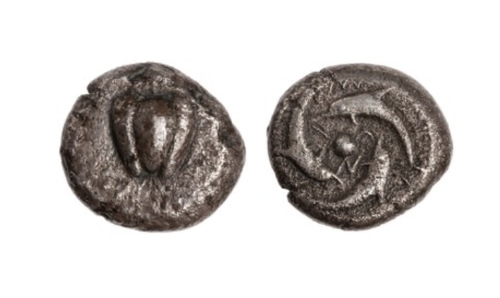
Silver stater of Melo featuring an apple on the obverse and dolphins swimming on the reverse.
Silver stater of Melos, buried c. 416 B.C. as the Athenians laid siege. The obverse of the coin bears an apple—mēlon—on the obverse, a pun on the city’s name. The reverse shows dolphins swimming around a central boss. The coin was not recovered until discovered in the early 20th century. Image courtesy of American Numismatic Society 1944.100.27879 CC BY-NC 4.0

The apple—though scripture never names the fruit—is a stand-in, in Christian tradition, for the forbidden fruit of knowledge. With it came the mythical expulsion from paradise and the ensuing inheritance of suffering, toil, and death. But in our age, as in ages past, we have not been cast out merely for seeking knowledge. We have been cast out for failing to know ourselves.

We do not seek knowledge. We seek dominion. We crave possession—of land, of treasure, of people. And in so doing, we deny our complicity. We forget. We suppress. We sanctify the victors and silence the conquered. From age to age, we retell only the parts of the story that flatter us.

And here lies the uncomfortable mirror.

In this, we are more like Athens than we care to admit. Like them, we cloak power in principle. And like them, we forget.

We in the United States have long imagined ourselves the inheritors of Athenian democracy. We trace our civic ideals to their assemblies, our rhetoric to their orators, our architecture to their temples. We forget, or do not care to remember, that Athens was also an imperial power, that its democracy was partial and exclusionary, and that it extorted tribute, enslaved its enemies, and turned allies into subjects. At Melos, it abandoned all pretense of justice. It wielded power for its own sake and cloaked the sword in reason.

So too have we. We have invaded and occupied, supported tyrants when convenient, and crushed the aspirations of distant peoples in the name of freedom. At home, we have reaped the fruits of conquest while teaching ourselves to hear only the hymns of progress and patriotism.

Consider the Trail of Tears—where we marched Cherokee, Creek, and other nations from their ancestral lands to distant territories, causing thousands of deaths. That forced removal, justified by the rhetoric of “civilization” and “progress,” has spiraled into generations of poverty, educational disadvantage, and health crises on reservations. Even today, as Native communities face disproportionate hardships, we struggle to acknowledge our national policies as their root cause.

Or look to El Salvador and Nicaragua, where American foreign policy in the 1980s supported authoritarian regimes and death squads in El Salvador while simultaneously funding the Contra rebels against Nicaragua’s Sandinista government—all in the name of anti-communism. Our military aid facilitated massacres of civilians in both countries, devastated civil society, and undermined democratic institutions. The ensuing regional instability bred gangs, poverty, and the very migration crisis that excites our domestic politics today. Yet few Americans connect today’s asylum seekers to our own actions decades ago. Like Athens at Melos, we exercise power, then avert our eyes from the consequences. Yet evidence of our actions remains, waiting to be unearthed.
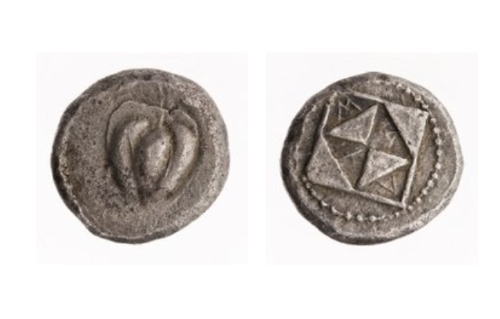
Silver stater of Melo featuring an apple on the obverse and square divided into triangles on the reverse.
Another silver stater from the soil of Melos, the blood speaks still. This one was also buried in c. 416 B.C. likely during the Athenian siege and recovered only in 1907. On the obverse it too bore the civic emblem, the apple. Its reverse, however, featured a square divided into four triangles. Image courtesy of American Numismatic Society 1959.70.2 CC BY-NC 4.0

From the soil of Melos itself, the blood speaks still. In 1907, a hoard of silver coins was unearthed—buried, according to scholars, in 416 B.C. as the Athenians closed in.⁵ Those who hid them did not live to recover the coins. Both coins bear on the obverse the apple—the symbol of Melos, its punning emblem, its name. But their reverses differ: one shows dolphins encircling a central boss, evoking the sea that once embraced the island; the other, a square divided into four triangles. These buried apples of silver—like their biblical counterpart—bear knowledge too painful to confront: the truth of what power does when unbound by conscience. These coins, long entombed, bear no voices. Yet they cry out. Like Abel’s blood, they testify—not in sound, but in presence. That these objects survived while their owners perished is both historical evidence and perfect metaphor—artifacts outlive empires, bearing witness long after the powerful have fallen. Metal as memory. Silver as witness.

We are not alone in this legacy. But neither are we innocent. The voice of justice does not go silent simply because we stop our ears. As in Genesis, so in history: the blood cries from the ground.⁶ And though we deny it, the Eternal hears.

The apple on the coin of Melos is a relic now, but its meaning remains. It is a warning. It is a mirror. Excavated from darkness, these silent witnesses challenge our comfortable narratives. It is a fruit offered again and again to each generation: not to reveal what lies in the heavens, but what lies within ourselves.

Until we dare to eat of that fruit—not in pride, but in truth—we shall remain wanderers east of Eden, armed with denial, and thus, with destiny.


Footnotes

¹ Seaman, Michael G. “The Athenian Expedition to Melos in 416 B.C.” Historia: Zeitschrift für Alte Geschichte, vol. 46, no. 4, 1997, p. 385. The epigraph featured above is an adaptation of the citation used in Seaman’s essay, which being a fine summary of emotive outrage at Athenian transgressions, could not be more finely articulated.

² Thucydides, History of the Peloponnesian War, Book V, §§89–116. The quoted phrase is a paraphrase of the Athenian argument in the Melian Dialogue, often rendered: “The strong do what they can, and the weak suffer what they must.” See: Robert B. Strassler, ed., The Landmark Thucydides (New York: Free Press, 2008), 352.

³ See Seaman, Michael G., ibid., pp. 385–418, for a detailed discussion of the motives and actions surrounding the Athenian assault on Melos.

⁴ On the apple (mēlon) as a civic pun in Melian coinage, see Sheedy, Kenneth. “Aegina, the Cyclades and Crete.” In The Oxford Handbook of Greek and Roman Coinage, ed. William Metcalf, 2012, p. 112.

⁵ See: Kallet, Lisa and John H. Kroll, The Athenian Empire: Using Coins as Sources (Cambridge University Press, 2020), 105.

⁶ Genesis 4:10: “The voice of your brother’s blood is crying to me from the ground.”

My Friend, You Were There: A Reflection on Complicity


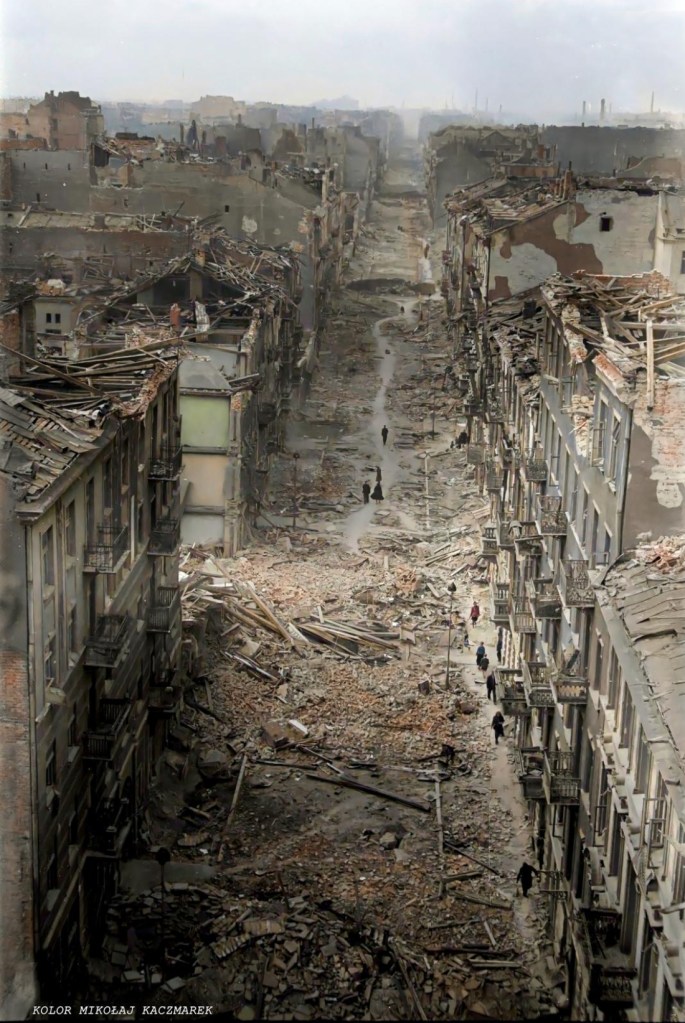
Warsaw Ruins 1944
Warsaw 1944

History shows that evil rarely marches under banners we immediately recognize. Too often, it comes draped in righteousness, purity, and fear. This piece is a lament for how easily we have been—and still can be—drawn into the machinery of cruelty.


My Friend, You Were There

My friend,
When the Holy Catholic Church, seeking to preserve the Faith in all its radiant purity,
instituted the Inquisition,
you were there—
not as a bystander,
but as a willing voice.

You denounced the old widow,
who lived alone with her cat.
You whispered against the Jewish family—
familiar, yet forever marked as other—
and gave your assent to their undoing.

You crowded into the square to watch the trials.
You sang hymns
as the flames crowned their bodies with smoke.
You wept tears of joy
that the world was made purer that day.

My friend,
When the ships came heavy with human cargo,
and the auction blocks stained the soil,
you were there.

You placed your bids.
You weighed their flesh.
You wrote the laws that chained their children.

You sang hymns on Sunday,
and broke their backs on Monday.
You called it providence.
You called it order.

My friend,
When the traders came with flags and rifles,
when the rivers flowed with rubber and blood,
you were there.

You signed the charters.
You counted the profits.
You sold the shackles and the scales.

You called it commerce.
You called it destiny.

My friend,
When the banners of the Reich unfurled,
and the drums of destiny beat their hollow call,
you were there.

You shouted with the crowds
as glass shattered from shopfronts.
You signed the letters,
you cheered the laws,
you raised your hand high in salute.

You bought the house,
the shop,
the art your neighbors were forced to leave behind.

You praised the strong hand
that swept away the weak.
You rejoiced as neighbors vanished,
grateful that your streets were made clean.

My friend,
When Stalin summoned the will of the people
to root out the enemy within,
you were there.

You reported the whispered doubts
of your cousin,
your friend,
your brother.

You paraded with red flags
while the trucks rumbled into the night.
You filled the quotas.
You seized the land.
You counted the spoils
as others disappeared.

You sang of the bright tomorrow
as you cast your eyes down
and stepped over the absent.

My friend,
When Mao lifted the Little Red Book,
and the children cried out against their fathers,
you were there.

You led the chants.
You scrawled denunciations across the walls.
You struck the old professor who dared to hesitate.
You cheered as the temples fell,
and the old poems burned,
convinced you were building a paradise
on the bones of the past.

My friend,
When Pol Pot promised that the fields
would bloom with new life,
you were there.

You marched the teachers into the paddies.
You pointed the rifle.
You praised the year zero
that would erase the memory of all that came before.

You smiled
as the world was reborn in silence.

My friend,
When the generals rose in the name of order,
when the prisons filled and the stadiums overflowed,
you were there.

You nodded at the names.
You counted the profits.
You watched the blindfolded taken at night.

You called it security.
You called it salvation.

My friend,
You have always been there.

Only too late did you realize.
Only too late did you doubt—
but not much.

You fell silent,
lest you betray your doubt.
You looked away,
lest you see.

You told yourself it would be different this time.
You told yourself you had learned.
But the signs are familiar.
The words are familiar.
The silence is familiar.

And it is happening again.

Elegy for the Automatons: A Reflection on Political Decline in the Orwellian State


The Disquieting Muses by Giorgio de Chirico
(1916-18, oil on canvas)
The Disquieting Muses (1916-18) by Giorgio de Chirico
(97.16 cm × 66 cm, oil on canvas)

Preface

This poem, Elegy for the Automatons, was inspired by George Packer’s article The Hollow Men, which appeared in the May 2025 issue of The Atlantic. Packer’s article examines the political and moral collapse of certain American officials—Speaker Mike Johnson, Senator Lindsey Graham, and Secretary of State Marco Rubio—who, once defenders of democratic principles, surrendered themselves to the inverted realities demanded by Donald Trump’s authority and his increasingly Orwellian authoritarian state.

Echoing the pivotal scene in Orwell’s 1984 where a Party orator is handed a note and instantly redirects his vitriol toward a different enemy “mid-sentence, without a pause,” Packer documents how key Republican figures performed their own breathtaking reversal on Ukraine policy, and describes how these officials pivoted instantly from celebrating Ukraine’s resistance to Russia’s aggression to denouncing Ukraine as the enemy—all in service to Trump’s shifting personal allegiances and contempt for democratic values.

Packer also invokes Henri Bergson’s insight that the mechanical within the human evokes both laughter and horror. Yet what he describes transcends mechanical reflex: it is the slow hollowing-out of conscience itself. Once-thoughtful men become fluent automatons, mouthing words disconnected from belief, loyalty, or memory.

This poem seeks to render in elegiac form the sorrowful descent of a free polity into ritualized untruth, and the transformation of human beings into instruments of submission.


“We are the hollow men
We are the stuffed men
Leaning together
Headpiece filled with straw. Alas!”

— T. S. Eliot, The Hollow Men

Elegy for the Automatons

In the year when the hollowing began,
and Orwell’s warning stirred too late,
it came not by fire nor iron decree,
but smiling, in the face of one man.
He bore no heavy crown, no burning sword;
only the gift of inversion:
truth was a lie, loyalty a whim,
freedom the mask of power.
A man for whom cruelty was a virtue,
and truth a broken toy at his feet;
a man who measured loyalty by abasement,
and called the strong weak and the weak strong.

Under his gaze, the names of enemies blurred,
history curled back on itself like smoke;
words, having lost their anchor, floated
as banners torn from any mast.
And a people once proud of remembering
forgot that they had ever known another day.

From this hour of unmooring
emerged the hollowing of men.

Johnson, first among the fallen,
fumbled for strength among hollow phrases,
mouth heavy with the weight of borrowed words.
Behind his thickened glass, a flicker died—
and he mistook its ashes for light.

Graham, quick to find the favor of the wind,
circled the ruin with the laughter of forgetting,
shedding oaths like old garments,
spinning from vow to vow as a moth to a dying flame,
faithless to all but the empty crown of belonging.

Rubio, once proud in the defense of liberty,
sank into the yellow chair of forgetting,
listening to the slow departure of his own voice.
Once he cried for the dignity of nations;
now he stitched the banners of surrender with empty hands.

Thus were men unmade,
not by terror, nor by war,
but by the patient grinding of truth into noise,
by the slow machinery of convenience and fear.

And we, who watched,
sang no hymns for these men,
built no statues to mark their days.
They passed like shadows over a broken dial,
automatons grinding down the hour,
till even the dust forgot their tread.


U.S. Secretary of State Marco Rubio, February 28, 2025 — slipping deeper into the hollowing of the soul.