Sometimes, a little historical memory delivered with a healthy dose of satire is exactly what the moment calls for. I recently stumbled upon this memorandum—allegedly issued by Herr Obersekretär Otto von Pulpo, our resident officious German octopus—crafted as a sharp response to The Economist’s editorial, “Is Elon Musk remaking government or breaking it?” Unsatisfied with the notion that “some transgressions” might be acceptable if they bring about efficiency, I was inspired to share this fictional but incisive critique. Enjoy Otto’s take on why the path of destruction is never a shortcut to genuine reform, and join the conversation on how we should remember history in light of today’s political challenges.
Memorandum No. 843.3a-b(krill) From the Desk of Herr Obersekretär Otto von Pulpo Former Archivist, Department of Tentacular Oversight (Ret.), Abyssal Branch Current Observer of Surface-Level Folly, Emeritus
To the editorial board of The Economist, cc: The Directorate for Dangerous Euphemisms, Baltic Division
RE: Concerning Your Recent Enthusiasm for “Some Transgressions” in the Service of Government Efficiency
Esteemed humans,
It is with a firm grip and furrowed brow (of the metaphorical kind—our brows are subdermal) that I write to express my alarm, tinged as it is with a deep familiarity, at your recent editorial on the so-called Department of Government Efficiency (DOGE). Your noble publication—usually known for reasoned analysis and fondness for balanced budgets—has recently dabbled in the genre of historical amnesia.
You write, approvingly if not enthusiastically, that “some transgressions along the way might be worth it” in your editorial “Is Elon Musk remaking government or breaking it?” Permit me, as a creature of long memory and cold water, to remind you: some transgressions are never worth it. History is not made by heroic shortcuts. It is unraveled by them.
When I was a much younger cephalopod, gliding the brackish waters near Wilhelmshaven, I recall hearing the surface-world’s chatter about another figure who spoke boldly of waste and stagnation, who promised national renewal, who performed gestures that were first dismissed as eccentric, and who flirted with “creative destruction” until the destruction ceased to be metaphorical. He too was seen by many as a misunderstood innovator. Until it was too late.
Herr Musk, I understand, now punctuates state occasions with gestures uncannily similar to the Roman salute, and praises parties in your former occupation zone with a fondness that suggests more than economic theory. If these are the traits of a reformer, then perhaps I should consider joining the AfD myself—though I suspect I would not pass their purity tests, being both foreign and soft-bodied.
But it is not Herr Musk who most disturbs me. It is your newsmagazine, with your steady tone and Oxford commas, that murmurs, “Efficiency requires boldness,” and wonders aloud whether the destruction is merely a precursor to some unseen creation. You ask: “Who now remembers the Grace Commission?” And I reply: who now remembers the Enabling Act of 1933, passed under the same logic—that extraordinary conditions justify extralegal actions?
Beware the language of renovation when it requires dismantling the foundation. Beware the hagiography of disruptors who come not to build, but to erase. DOGE does not make government more efficient. It makes obedience more efficient.
If I may say so without rudeness, your editorial reads as if it were penned in a warm bath, insulated from the chill that such reasoning brings to those of us with memory. Down here, in the benthic gloom, we remember what it means when legislative bodies and courts are bypassed, when “wrongthink” is rooted out, when civil servants are mocked as obstacles to destiny.
Do not confuse boldness with wisdom. Do not mistake collapse for reform.
With respectful concern and eight meticulously inked signatures,
Otto von Pulpo Obersekretär a.D. Archivist, Rememberer, Cephalopod
P.S. Historical Note from the Abyss:
When tectonic plates shift, they do not ask for parliamentary approval. They simply move—and tsunamis follow. I have observed this firsthand from 4,000 meters below. The surfacelings always call it unprecedented, as if the sea forgets. We do not forget.
Herr von Pulpo’s earlier memoranda (Nos. 842.1–843.1) were dispatched in response to similar enthusiasms for charismatic technocrats in the late Weimar period. These were, at the time, unread by those who most needed to read them.
About the Author Otto von Pulpo is a retired archivist, amateur historian, and former Vice-Chair of the Commission for Bivalve Misclassification. He resides in a gently collapsing wreck off the Heligoland shelf and writes occasionally on democracy, plankton, and the perils of charismatic overreach.
By Gentoo T. Adelie, Chief Diplomatic Penguin of Heard Island
Macaroni Penguin of Heard Island responding in disbelief to the news of the Trumpian Tariffs of 2025.An Audio Recitation of “An Ice Cold Response” by Gentoo T. Adelie
It was a clear morning on Heard Island. A gentle drift of cloud played among the slopes of Big Ben, and the Southern Ocean moved against the gravel shores with its slow, eternal breath. Among patches of moss and lichen, our colonies bustled with seasonal purpose—territories reestablished, mates greeted, feathers fluffed against the autumn wind. The eastern rockhoppers had returned to their grassland burrows, the macaronis muttered among the coastal tussock, and the gentoos stood sentinel. Then word arrived—borne by a wandering albatross returning from northern skies.
The Trump administration had imposed tariffs upon us.
Tariffs. Upon penguins.
I summoned the colonies. The emperors listened in regal silence, their gold-ringed heads unmoved. The kings shuffled to attention along the icy moraine. The skuas perched nearby, and even the black-faced sheathbill—normally distracted by refuse—cocked a pale head toward the speaker’s mound.
Our indignation was tempered by confusion.
We are not exporters. We are not manufacturers. Ours is not a civilization of spreadsheets, but of rhythm and return. We recognize no currency but krill, no metric but the molt. We nest in the gullies and commune with the icy winds that polish our shores.
It is true that humans have declared sovereignty over us. Flags have been planted, letters exchanged, and acts of parliament signed in Canberra. Heard and McDonald Islands, they assert, are administered by the Australian Antarctic Division, whose bureaucrats maintain that our affairs fall under the jurisdiction of the Supreme Court of the Australian Capital Territory—though no court has ever convened upon our shores.
But let it be understood: though we permit their presence, we do not cede authority.
The king penguin does not bow to Hobart. The Heard Island shag files no petitions. And the sheathbill, should it ever stand before the High Court, will surely eat the brief.
So it was with bewilderment that we received news of the 10% tariff levied by the United States upon our territory. An island with no people, no ports, and no exports—accused of an imbalance in trade. A claim founded on mislabeled shipping data: specifically, six containers of semiconductor components manufactured in Taiwan but erroneously coded as “HRD”—Heard Island’s port code, rarely used but technically valid—instead of “HKG” for Hong Kong by an exhausted logistics clerk working the graveyard shift in Singapore.
Naturally, the memes began to circulate—relayed to us by kelp gulls who’ve developed a taste for human refuse and, consequently, smartphones washed ashore from passing vessels. These gulls, perched near research stations to pilfer Wi-Fi signals (and the occasional protein bar), have become our unwitting ambassadors to digital culture. Among their findings: images of penguins queuing at customs, passports in wing. Shags rebuffed at security checkpoints. A sheathbill with a placard reading “TAXATION WITHOUT MIGRATION.”
The images are amusing. Yet beneath the laughter lies a chill deeper than our glaciers.
The absurdity is not that tariffs have been imposed, but that the structures of power are so far removed from reality as to invent us as participants in their theatre. Our colony is not a market. Our rookery is not a trading floor. If humans mistake our ecological presence for economic threat, then it is their world, not ours, that is disordered.
Even the ecosystem watched with bemusement. The mosses clung silently to volcanic stone. The seals slumped across the glacial flats, unmoved. Life persisted as it always has.
We shall not respond in kind. We shall not embargo the sea. We have no ports to close, no envoys to recall. We shall simply continue—diving into the surf, tending our chicks, enduring the westerlies that lash our coast.
The mosses remember. The sheathbill remembers. The ice remembers, too.
Confidential Diplomatic Cable
From: Office of the Subantarctic Avian Council (Provisional), Heard Island and McDonald Islands Domain: commonwealth.penguin.gov.hm To: Bureau of Global Trade Anomalies, U.S. Department of Commerce Date: April 8, 2025 Priority: Routine (given prevailing currents)
RE: ERRONEOUS APPLICATION OF TRADE TARIFFS TO UNRECOGNIZED BIOLOGICAL POLITY
To Whom It May Confound,
We write with a combination of courteous gravity and ice-bound disbelief upon learning that the Territory of Heard Island and McDonald Islands—comprising an uninhabited archipelago, 80% of which is glacier, and 100% of which is devoid of Walmart, Walgreens, or Whole Foods—has been subjected to a 10% tariff by your esteemed administration.
We presume this action arises from the alleged export of “machinery and electrical goods” originating from our domain. As no such items have been observed here since the disintegration of a scientific balloon payload in 1989, and as neither the king penguins nor the black-faced sheathbills have mastered voltage regulation, we suggest an administrative review.
Indeed, it now appears the source of this confusion lies in a series of clerical misassignments within international shipping records. Several bills of lading reportedly list the shipper’s address as “Vienna, Heard Island and McDonald Islands”—a charming bit of geopolitical fiction that, while expanding our sense of empire, sadly bears no relation to geographic or penguin reality.{1}
For clarity:
Our economy is non-monetized and chiefly fish-based.
Our primary industries include standing, molting, and collective thermoregulation.
Our manufacturing sector is limited to guano, occasionally artistic in form but unfit for commercial use.
The .hm domain, while charming, is not associated with logistical throughput. It is managed by a sooty albatross with a rusted antenna.
No residents, citizens, or consumers exist here in the human sense.
We therefore formally request the rescission of said tariff and the reclassification of Heard Island and McDonald Islands from “Emerging Trade Threat” to “Uninhabited Geopolitical Curiosity.” Alternatively, we are willing to accept foreign aid in the form of high-calorie fish paste, new tagging rings, or a fully functioning weather station.
For future reference, all customs declarations should be addressed to: Gentoo T. Adelie, Chief Diplomatic Penguin C/O The Hollow Behind the Third Basalt Outcrop Atlas Cove, Heard Island UTM Coordinates Available Upon Request (or clear skies)
We await your reply, though not urgently.
Warmest regards from the coldest coast, Subantarctic Avian Council (Provisional)
P.S. Seal No. 1: Be it known we do not seal mail with actual seals. The three elephant seals consulted regarding this matter expressed their disinterest through prolonged snoring, while the fur seals drafted a dissenting opinion consisting entirely of territorial barks. Their contribution to international diplomacy remains, much like this tariff situation, largely symbolic.
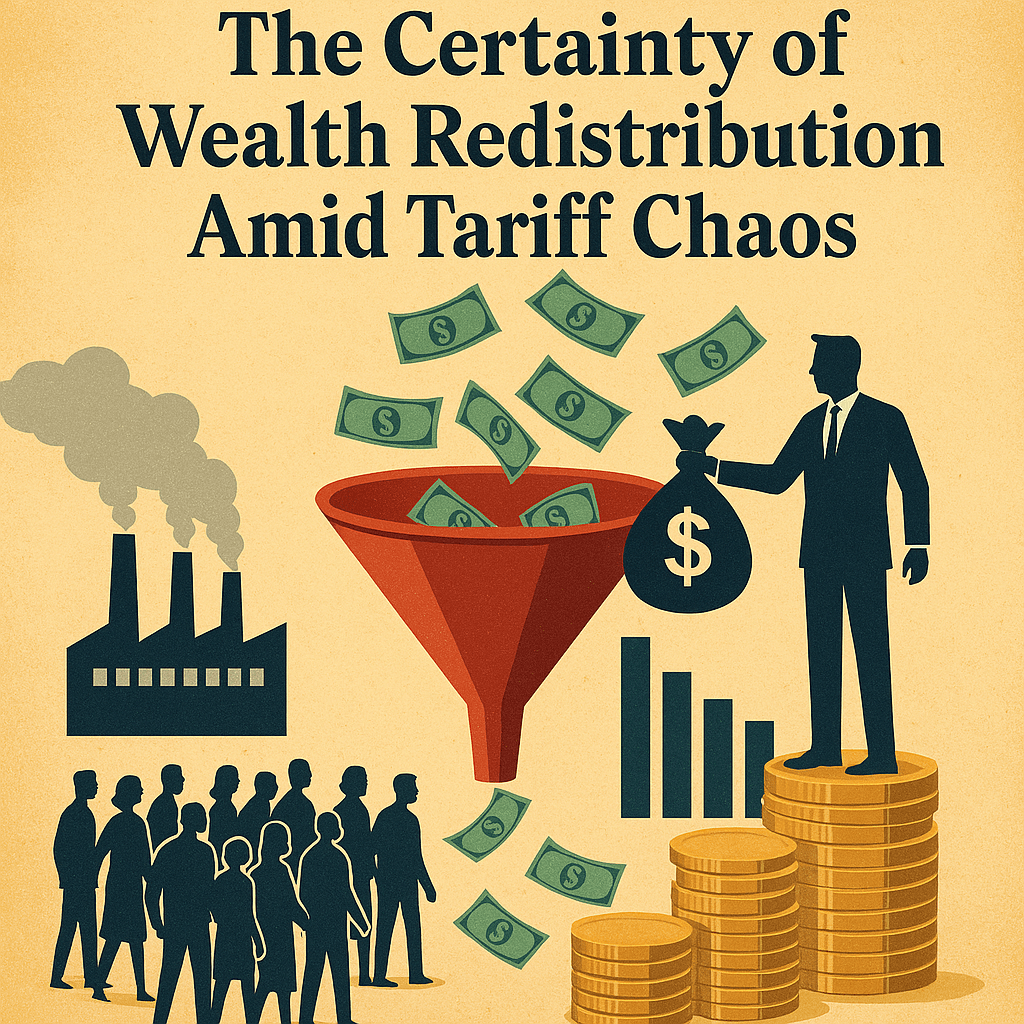
In the history of American economic policy, few moments have rivaled the current administration’s radical redirection of trade as both a break with precedent and a deliberate provocation of instability. The imposition of universal tariffs, compounded by steep duties on selected nations and penguins, has injected volatility into nearly every sector of the global economy. Yet, for all the uncertainties this policy has unleashed—geopolitical, fiscal, and industrial—one outcome is not only predictable but virtually guaranteed: a significant transfer of wealth from the broad base of American households to a narrow echelon of financial elites.
The administration’s tariff policy, sweeping in scope and nationalist in tone, has been sold to the public as the path to the restoration of American greatness, even proclaimed as a “Liberation Day.” But the reality it heralds is less one of liberation than of reallocation—specifically, a reallocation of economic burden and reward. By taxing nearly all imported goods—consumer staples, electronics, food, clothing, and industrial components—the policy imposes a direct and regressive cost on the average American. Inflationary pressures, rising production costs, and disrupted supply chains ensure that these tariffs function not merely as tools of negotiation, but as economic levers that press down on the middle and lower classes while lifting those whose wealth resides in capital rather than wages.
If the COVID-era recession taught us anything, it is that crises, when coupled with targeted monetary and fiscal policy, can act as engines of wealth concentration. During the pandemic, unprecedented interventions—stimulus checks, expanded unemployment insurance, PPP loans, and Federal Reserve liquidity—managed to momentarily soften the blow for many. Even then, the lion’s share of wealth gains went to the top 0.1%, as asset prices surged and capital-rich investors reaped the benefits of timely speculation and quantitative easing.
But the current recession-in-the-making differs in one essential respect: it is being pursued without pretense of public aid. There are no stimulus packages, no safety nets. What is offered instead is a doctrine of creative destruction: tens of thousands of federal workers laid off; regulatory agencies gutted; international partners alienated; domestic producers left to absorb new costs or pass them on to already-strained consumers. The economic pain is not an unintended consequence—it is the plan. And in such an environment, wealth will not merely trickle upward; it will flood there.
As import costs surge, businesses with transnational supply chains and logistical flexibility will shift production, seek carve-outs, and hedge against volatility. Those without such capacities—local manufacturers, family-owned farms, small retailers—will face thinning margins, layoffs, and in many cases, closure. The financial elite, holding diversified portfolios in real estate, private equity, and multinationals, will swoop into the resulting vacuum, acquiring distressed assets at discount, consolidating market share, and harvesting profits from inflationary dynamics. As was seen in the years following 2020, equity markets may fall precipitously at first, but they are likely to rebound faster than the broader economy—particularly with the Federal Reserve expected to cut interest rates in the wake of contraction. Once again, asset prices will rise. Once again, the owners of capital will see their fortunes grow.
Tariffs are traditionally viewed as blunt instruments of industrial protection. But in this case, they serve a far more surgical purpose. They extract purchasing power from the working class, undermine the viability of small and medium enterprises, and force a restructuring of the American economy around those who can absorb cost, influence policy, and pivot globally. They are not instruments of policy so much as instruments of wealth concentration.
If anything is certain in the unfolding tariff-driven crisis, it is that inequality will increase. Not in abstract or relative terms, but in concrete redistributive ones: trillions of dollars will move from wage earners and consumers to capital holders and financial intermediaries. The historical data, the institutional forecasts, and the structural logic all align. Amid the din of political slogans, retaliatory tariffs, and market disruptions, this is the one truth that should command attention.
History will not record this period as a victory for the American people. It will record it as a transformation: not of manufacturing, not of trade, but of the very architecture of American wealth—concentrated more tightly, held more distantly, and insulated more completely from the needs and voices of the many.
There was hesitation before I posted the essay below. Not for its merit, but for its timing. I wonder, truly, whether we have already passed the point of rupture—whether the buffoonery we witness in scandals such as Whiskeyleaks (the use of the Signal app by U.S. cabinet officials and others to discuss classified war plans) is not merely incompetence, but a smokescreen for something more deliberate, more calculated, and far more lethal. If the jesters, clowns, and buffoons distract, it may be only so that the knife may fall unnoticed. This essay, then, may read not as prophecy but as postmortem—or as warning flung desperately against a wind already turning. And yet, even still, I believe it must be said.
Note to the Reader
This essay is written not as a partisan screed, nor as a nostalgic lament for some imagined golden age, but as a meditation—part moral reckoning, part civic warning—on the condition of a republic that has allowed itself to descend into spectacle, incoherence, and institutional decay.
It is addressed to those who still believe that government, for all its failings, remains a public trust; that civic virtue is not an antiquated ideal; and that the health of a nation may be measured not merely in wealth or might, but in memory, restraint, and the character of its leaders and laws.
The tone is deliberately severe, for the times are unserious. The satire is not meant to entertain, but to unmask. Where irony sharpens, it does so to reveal truths that cannot be said plainly without losing their edge. And where the anger beneath the prose surfaces, it does so not in despair, but in the hope that the reader, too, is angry—and unwilling to become numb.
This is not a call to revolution, but a call to remembrance, to vigilance, and above all to responsibility. If the republic is to be rebuilt, it will not be by those who broke it, nor by those who profited from its breaking, but by those who, though weary, still believe it is worth the rising.
The Farce of Ruin: On the Buffoonery, Cowardice, and Consent that Endanger the Republic
It becomes difficult indeed to weigh if the republic is more greatly endangered by ignoble, incompetent lackeys such as now populate the greatest offices of state, appointed by the bitter, vengeful, demented, and oft confused and wholly arbitrary despotic personality that resides in the executive mansion, courtesy of the cult of resentment, hate, and fear, than it would have been had he appointed more able men and women to execute his whims and vices. For in one case, we face the farce of ruin—the slow, stumbling, ignoble unraveling of a once-proud polity into absurdity and impotence. In the other, we would face tyranny executed with precision, method, and perhaps permanence. Yet if there is any comfort to be found in chaos, it is this: incompetence leaves wreckage; competence might have left chains. But wreckage, at least, invites the labor of rebuilding—if the will, the memory, and the courage yet remain.
This is the bitter paradox of the present hour: that we may find ourselves grateful not for wisdom, but for the want of it; not for virtue, but for its absence. That the republic’s temporary reprieve lies not in the strength of her institutions nor the vigilance of her people, but in the vacuity and vanity of her despoilers. These are not statesmen in the Roman sense, nor even villains in the Shakespearean; they are caricatures—jesters costumed in stolen robes of office, bumbling through decrees, barking orders not out of conviction but impulse, devoid alike of strategy and shame. And yet, we dare not laugh too loudly. For every laugh chokes on the question: how long can a republic endure when the machinery of its survival is entrusted to hands unfit to hold it?
The Rise of the Cult: Resentment as Political Theology
Power, once grounded in consent and law, now derives its strength from a darker source: resentment. Not merely disappointment or disillusionment, but that deeper, more corrosive sentiment born of perceived humiliation, of grievance nurtured until it metastasizes into dogma. No longer content to reform what they claim to hate, the votaries of this new creed seek instead to destroy—to salt the fields, poison the wells, and tear down every institution that once restrained ambition with honor, and pride with duty.
This is not politics in any meaningful sense. It is theology by other means—a bitter creed that worships neither God nor country but the self, wounded and wrathful. Its high priests preach vengeance cloaked in patriotism, its sacraments are insult and spectacle, and its liturgy is grievance repeated endlessly, unexamined and unrelieved. To belong to this cult is not to believe in anything beyond the negation of others: the “elites,” the “experts,” the “traitors,” the “others”—those perpetual abstractions upon whom every failure may be pinned, every fear projected.
Thus, the executive, himself a totem of grievance, is not admired in spite of his vices but because of them. His incoherence becomes a form of authenticity; his cruelty, a mark of strength; his ignorance, proof that he is unsullied by the corruption of thought. This is the logic of the mob, sanctified and enthroned. It does not seek truth, only validation; not justice, but vengeance. And from such poison grows not a polity, but a pack.
The Machinery of Power: Incompetents in High Places
Once, high office required at least the semblance of merit—a capacity for governance, a grasp of statecraft, or, at the very least, the discretion to defer to those who possessed it. No longer. The new qualification is loyalty alone: loyalty not to the Constitution, not to principle or country, but to personality. And not even to a consistent personality, but to a flickering candle in a tempest—unstable, moody, and perpetually affronted.
Thus have the halls of government been peopled with jesters, flatterers, and feckless opportunists. Ministers of the treasury who do not believe in numbers, secretaries of education who scorn learning, envoys who sabotage diplomacy, and legal advisors who treat the law as a nuisance to be outmaneuvered rather than a structure to be upheld. Their résumés are padded with failure, their careers propped up by sycophancy, their ambitions tethered not to public service but to personal advancement through proximity to power.
Yet their greatest failing is not simply what they do, but what they permit. Their very mediocrity becomes the shield behind which greater abuses are concealed. For while the citizenry scoffs at the spectacle—the press conference gaffes, the mangled grammar, the contradictions piled upon contradictions—policy proceeds maliciously, cruelly. Freed from oversight, insulated by noise, the machinery grinds on: protections undone, laws abandoned, rights weakened, government dismantled, alliances broken. The clown at the helm distracts the gaze, while the bureaucratic knife goes unnoticed beneath the velvet tablecloth.
And in this lies the genius of institutional vandalism: not to destroy with one mighty blow, but to dull the blade slowly—through mismanagement, attrition, and the silent resignation of the capable and the firing of tens of thousands. A thousand small indignities, each one tolerable, each one dismissed, until the edifice no longer stands, and we wonder not when it fell, but how we failed to notice.
The Counterfactual: What If the Tyrant Were Wise?
One is almost tempted to breathe a sigh of relief at the chaos, for chaos is its own limit. A despot who contradicts himself hourly, who governs by whim and forgets his decrees by dusk, is a tyrant only in name. He may wish to rule absolutely, but lacking consistency, foresight, or discipline, he becomes instead a figure of grotesque parody—dangerous, yes, but disarmed by his very incoherence. We may survive him not because of our strength, but because of his weakness.
But imagine, if you will, the inverse: a tyrant possessed of intellect, method, and clarity. One who governs not in the service of ego but of vision—however malignant. One who surrounds himself not with cowed incompetents, but with men and women of ruthless efficiency, cold logic, and administrative precision. This is the tyrant history has known best. It is not the fool who builds the gulag or writes the blacklists, but the functionary with a plan, the theorist with a chart, the orderly mind untroubled by conscience.
Had our moment produced such a figure, how much swifter the erosion of liberty would have been! How much more subtle the theft of rights, how much more durable the machinery of oppression! The republic might not have looked so disordered—it might have seemed vigorous, decisive, strangely efficient. But beneath the appearance of control, the soul of the nation would have already been extinguished, its people transformed not into rebels or resisters, but into docile instruments of the state’s will.
The question, then, is no longer whether we are fortunate in our calamity, but whether we understand its nature. For fools can be replaced. But should a day come when their successors wear the same mask but wield it with purpose—then the hour will be far darker, and the laughter that once served as shield will curdle into silence.
The Theatre of the Absurd: Democracy as Entertainment
If the republic falters from within, it is not only because of those who hold the levers of power, but because of those who have come to see governance not as a civic duty, but as a form of entertainment. The forum has become a stage, the statesman a performer, and the electorate an audience demanding sensation. Nuance bores, compromise offends, and truth is a distant, flickering ghost—unwelcome and unprofitable.
In such a theatre, absurdity is not a bug but a feature. Every gaffe becomes a meme, every outrage a headline, every policy a subplot in an endless narrative of grievance and spectacle. The media, desperate to retain its vanishing grip on attention, ceases to inform and instead curates the drama—cutting, splicing, amplifying. The body politic is no longer a deliberative citizenry but a viewership conditioned to react, not to reason.
And what is the role of the elected official in this new dramaturgy? Not to lead, but to brand. Not to govern, but to trend. They issue not laws, but slogans. They trade not in facts, but in feels. Even their failures become assets, for in the logic of the spectacle, visibility is power, and infamy sells just as well as virtue—often better.
Worse still, even those who know the performance is a fraud feel trapped within it. To disengage is to surrender the stage to the most unscrupulous actors; to engage is to be complicit in a system that rewards noise over thought, allegiance over principle. This is the final genius of the absurd republic: to create a politics where participation itself feels degrading, and yet absence feels dangerous.
Thus the state becomes not a polity of free and deliberative people, but a spectacle of exhaustion. We scroll, we jeer, we despair. But rarely—too rarely—do we act.
The Fragility of Memory: When History No Longer Speaks
No tyranny begins as tyranny. It begins in the forgetting. A forgetting not only of facts or dates, but of the moral weight of precedent, the slow accumulation of civic wisdom, the lessons written in blood and ink by those who came before. When memory is intact, it serves as conscience; when eroded, it becomes convenience. We do not recognize the fall because we no longer remember what it was to stand.
Once, a statesman would rise in the chamber and quote Pericles or Lincoln, Cicero or Solon—not merely to adorn his speech but to anchor it in tradition, to draw from the well of republican virtue. Now, even such allusion is dismissed as elitist pedantry. The past is regarded not as a guide but as a burden, and history is reduced to a buffet of misremembered grievances, curated to flatter the resentful and indict the dead.
In this vacuum, lies grow bold. Fictions parade as fact, myths usurp monuments, and the record of what was is rewritten by those who benefit from what is. The archives decay; the historians, sidelined or silenced, speak to a shrinking audience. Memory becomes tribal, curated by algorithm and sentiment. The young no longer study the fragility of freedom because it is no longer taught. The old recall its price, but their warnings are heard as the mutterings of a defeated past.
And what, then, remains? A citizenry adrift—cut loose from history’s moorings, vulnerable to every charlatan with a flag and a grievance. The republic, in such a state, is no longer endangered by enemies at the gates, but by the silence within. Not the silence of censorship, but the quieter, more dangerous silence of indifference. The silence that follows when memory no longer speaks and no one cares to ask what it once said.
Wreckage or Rebirth?
It is tempting, when surveying the present wreckage, to surrender to despair—to believe that the republic, having stumbled so absurdly into decline, can never be set aright. The pillars have cracked, the roof sags, and the foundation seems to shift beneath our feet. But wreckage, for all its tragedy, is not the same as ruin. What has been shattered can, in principle, be rebuilt. The question is whether the will endures, and whether the anger now rising can be forged into resolve rather than simply rage.
For there is anger—mounting, justified, and no longer concealed. It grows not within the cult, but outside it, among those who have watched with clenched jaws as the instruments of governance were handed to buffoons and cowards, as the executive strutted and raged, as the political class bowed and curtsied, mumbling excuses, averting eyes, trading principle for position. And it is not merely the executive that earns their ire, but the entire edifice of acquiescence—a legislature that mutters indignation but funds the farce all the same; a judiciary that, cloaked in solemnity, too often validates the very abuses it ought to constrain. These are not neutral bystanders. They are collaborators by convenience, guardians turned ushers to a constitutional catastrophe.
And so the citizen watches, furious and exhausted, as the republic’s very stewards conspire in its diminishment. Yet this fury, though dangerous if left to fester, may still be redemptive if rightly directed. The task is not to lament the collapse of a golden age that never was, but to resist the entrenchment of a cynical age that need not be. The republic will not be saved by the institutions that failed to defend it, nor by the party machines that greased its fall. If salvation comes, it will be through memory rekindled, virtue rediscovered, and courage reclaimed—not in grand gestures, but in the hard, slow work of rebuilding what was squandered.
We stand, then, not at the end, but at a crossroads between farce fulfilled and tragedy averted. The clowns will fall—their nature guarantees it. But what comes next will not be dictated by their collapse. It will be shaped by those who remain: the watchful, the angry, the resolute. The question is not whether the republic can rise again, but whether we still believe it is worth the rising.
“If you read the news, it feels like Armageddon. I can’t walk past a TV without seeing a Tesla on fire,” Elon Musk said recently at a Tesla all-hands meeting. “I understand if you don’t want to buy our product, but you don’t have to burn it down. That’s a bit unreasonable.”1
The quote is evocative—perhaps designed to stir sympathy. Yet it invites a measure of irony. While vandalism against Tesla properties is, of course, deplorable, it is neither as widespread nor as catastrophic as Musk, and biased media reporting, would have the public believe. Fewer than a dozen reported incidents—at Tesla dealerships or Supercharger stations—have resulted in fires, graffiti, or property damage. In nearly all of these cases, suspects have been arrested and charged.2
In a country of over 330 million people, where more than 200,000 vehicle fires and 500,000 structure fires occur annually,3 and where Florida and Texas alone report nearly 3,000 murders each year,4 these incidents—while serious—are statistically insignificant. What Musk decries as “Armageddon” is, in national context, a series of isolated acts that have been swiftly addressed by law enforcement.
Meanwhile, under Musk’s leadership of the Trump administration’s Department of Government Efficiency (DOGE), far greater destruction is being wrought—not upon property and government subsidized business interests, but upon the institutions designed to serve the American people.
According to Reuters, the Department of Veterans Affairs (VA) is expected to lose over 80,000 employeesunder DOGE’s efficiency plan.5 Already, this downsizing is disrupting vital services: clinics are understaffed, appointments are delayed, and mental health services—already under strain—are faltering.6
This is not bureaucratic “streamlining.” The VA currently serves over 18 million veterans,7 many of whom depend on timely and specialized care for physical and mental trauma, service-connected disabilities, and long-term support. Disabling this infrastructure in the name of “efficiency” is not neutral policy—it is institutional abandonment.
The Social Security Administration (SSA) has not fared better. Facing mandates to reduce its workforce by up to 50%, the SSA is bracing for a collapse in the timely delivery of services to more than 70 million Americans, including over 50 million seniors.8 Already, SSA field offices in major cities have shortened hours, laid off staff, and seen processing times for benefits skyrocket.
Federal workers have responded with urgency. In San Francisco and other metropolitan areas, SSA and VA employees have staged public protests, warning of the catastrophic impact these cuts will have on their most vulnerable clients.9 Their message is clear: public service cannot survive on ideology alone.
Thus, while Musk’s Teslas may burn in isolated incidents, the real fire is the one now consuming the administrative state (the means by which public servants deliver public services to the citizens they serve pursuant to laws passed by Congress). The irony is sharp. Musk’s complaint—“You don’t have to burn it down”—could just as easily be addressed to himself. If you do not like the structure or scale of government, you do not have to dismantle its capacity to serve. That, too, is a bit unreasonable.
What Musk labels as terrorism when directed at his private enterprise is tolerated—even celebrated—when inflicted upon public institutions. Yet the human cost of the latter is infinitely greater. The quiet collapse of service infrastructure—untelevised and untheatrical—is the more insidious disaster.
In the end, the real “Armageddon” may not be a vandalized Tesla on a TV screen. It may be the veteran denied timely access to urgent medical care. The senior citizen waiting months for a critical in-person meeting at a Social Security office. The single parent lost in a phone queue with no one left to answer.