
Thin Books Are Dangerous


Samuel van Hoogstraten, Perspective View of a Corridor, 1662, oil on canvas
“Every door leads deeper. Every step farther from certainty.”
(Samuel van Hoogstraten, Perspective View of a Corridor, 1662, oil on canvas)

Prefatory Note

In my youth — now roughly four decades past — while studying the slender yet profound Itinerarium Mentis in Deum of St. Bonaventure, there arose in my mind a simple observation: “Thin books are dangerous.” By their brevity, they conceal depths which the unwary may mistake for shallows. By their compactness, they pierce more swiftly, and leave marks more enduring than tomes of a thousand pages.

The small variations presented below draw their form, though not their genius, from the fictions of Jorge Luis Borges — that master of mirrors, labyrinths, and forgotten libraries. If there is any virtue herein, it is owed to his example; if there is error, it is mine alone.

May the reader proceed with care, for the thinnest books, and perhaps the thinnest tales, are those most difficult to escape.


“The shortest books require the longest penance.”
— Anonymous marginal note, Biblioteca Laurenziana


I. The Library of Thin Books

In the city of Aram, whose streets no cartographer has ever agreed upon, there was once a secret library known only to a few scholars and fewer fools. It was said to contain the sum of human knowledge, but organized strangely: the thick books were shelved in dusty catacombs, seldom touched, while the thin books were kept in a bright chamber at the center, on shelves of polished cedar.

The Keeper of the Library explained this arrangement to all who entered: “The thick books are for forgetting. The thin books are for believing.”

Each thin book contained a single idea, expressed so perfectly that it resisted all argument. Sovereignty Belongs to the Strong was one book. The World is a Dream of the Gods was another. Still another was simply titled Obey.

Visitors who read the thick books emerged thoughtful and burdened, full of hesitations, counterexamples, and second thoughts. Visitors who read the thin books emerged transformed: resolute, fervent, certain.

Over time, it was not the heavy tomes that shaped Aram’s kings, priests, and scholars, but the thin volumes, read once and carried forever.

It is said that the city of Aram fell, not through invasion, nor famine, nor pestilence, but because, in the end, its citizens each lived by the idea of a different thin book, and could no longer understand one another.

The Library still stands, or so the story goes, though its doors are sealed and the books grow thinner by the century.

There is a final book, the thinnest of all, placed at the highest shelf where none but the Keeper can reach. It contains no words at all.

Its title is: Certainty.


⁂


II. The Shadows of the Books

There is a city — it does not matter which — where it is rumored that a second library exists beneath the great Library of Learned Tomes.

The surface library, the Library of Learned Tomes, is a noble place: its corridors are vast, its tomes heavy with ink and argument, and its readers slow, uncertain, weighed down by the burden of complexity. No truth is simple there; every assertion is marked and belied by a hundred footnotes, every conclusion bruised by rebuttal.

But below, beneath stone and time, there is another library. It is said to be vast but weightless. There, one finds only thin books — so thin they seem at times to flicker in the light, as if they might vanish.

Scholars, sensing the rumors, sometimes descend. They find books titled with dangerous simplicity: Justice is the Right of the Victorious, History is the Story We Tell Ourselves, The Future is Written.

Each thin book feels familiar. And well it should. For these thin books are the shadows of the thick books above¹: each vast, tangled treatise, compressed into a single, unassailable maxim.

The discovery at first seems marvelous. Why wrestle with a thousand pages when the essence can be grasped in a sentence? Why debate, when the answer can be carried in one’s pocket, ready for all occasions?

But the thin books are not summaries; they are distortions. They are what remains when doubt, nuance, and contradiction are stripped away. They are the husks of thought — seductive because they seem lighter, easier, final.

In time, those who read only the thin books come to mistrust the thick ones. They grow impatient with questions, contemptuous of ambiguity, zealous for a clarity that admits no appeal.

Some say that it was not neglect but the rise of the thin books that doomed the upper Library. That the heavy volumes grew dusty because the city’s rulers and citizens alike began to prefer the glimmer of certainty to the slow, earned labor of understanding.

In the end, the Library of Learned Tomes collapsed inward like a drained well. And the shadow library, weightless and triumphant, remained.

Somewhere, perhaps, it still remains.

Somewhere, perhaps, it is growing.


⁂


III. Coda: A Reflection in the Labyrinth

Some say that even the tale you have just read — the account of the thick and the thin, the surface and the shadow — is itself no more than a thin book: a single idea, polished to gleam, shorn of its necessary doubts.

If so, it is but one more glimmer in the labyrinth.

One more reflection upon reflections, cast by a candle already guttering.

One more danger to remember, and to forget.


IV. Scholium

¹ Cf. the lost Tractatus de Umbris Librorum (“Treatise on the Shadows of Books”), attributed to the forgotten scholar Balthasar of Istria (fl. late 13th century), who wrote: “The greater the volume, the more labyrinths it contains; the thinner the shadow it casts, the more swiftly it pierces the heart.” No complete manuscript survives, though fragments are said to be embedded in certain marginal glosses of the Biblioteca Laurenziana. Some dispute the existence of Balthasar himself, suggesting he is merely the invention of later compilers seeking to dignify their own thinness with the patina of lost antiquity.

Exploring Wistfulness: The Weight of Longing and the Lightness of Dreams

The completion of my poem Whispers of the Waning Light left an impression lingering in my thoughts, a quiet meditation on the nature of longing, time, and the elusive quality of memory. In reflecting on that poem, I found myself drawn to the word wistful—a word that seems to stretch between the weight of longing and the lightness of a dream. The following brief essay is an exploration of that thought.


Støvkornenes dans i solstrålerne (Dust Motes Dancing in the Sunbeams, 1900)
By Vilhelm Hammershøi (1864-1916)
Oil on canvas, 70 cm x 59 cm.
Ordrupgaard Musuem. Photograph Public Domain.

An audio recitation of the essay by the author.

The Weight of Longing and the Lightness of Dreams

Wistful is a wonderful word in our lexicon. It has slender shoulders but a muscular frame, and with each passing year, it grows, paradoxically enough, in vigor—able to inspire more ably imagination, poetry, memory, and vivid recall. The language with which we write, think, and contemplate is most remarkable indeed.

There is a paradox at the heart of wistfulness. It is a longing imbued with both the weight of the past and the lightness of the dream. Unlike simple nostalgia, which binds one to memory with a chain of sentiment, wistfulness carries a certain buoyancy, a gentle drift between what was and what might have been. It is not an emotion of mere loss, but rather one of continued yearning—an ache that does not wound but instead stirs, provokes, and enlivens.

Across centuries, wistful has carried shades of longing, attention, and awareness—never merely a passive sigh but a reaching toward what shimmers just beyond our grasp.

It is the mind’s way of grappling with the ethereal, of shaping dreams from recollections, of crafting possibilities from the echoes of what has already passed.

This duality—the weight of longing and the lightness of dream—has long been explored in poetry and literature. Keats’ Ode to a Nightingale shimmers with this very tension, the desire to dissolve into beauty while being tethered to the mortal world. Proust’s In Search of Lost Time captures it in the way a madeleine dipped in tea can summon an entire universe of memory. Even T.S. Eliot, in The Love Song of J. Alfred Prufrock, wrestles with the wistfulness of unlived potential, of questions left unanswered and paths left untaken.

Yet wistfulness is not purely literary; it is deeply personal, shaping our thoughts in quiet moments of reflection. It is the fleeting recognition of something beautiful that has passed, or the sudden awareness of an almost-forgotten dream. It is the feeling of standing at the edge of a vast, metaphorical ocean, where the horizon shimmers with the unknown, both beckoning and receding at the same time.

Perhaps this is why wistfulness endures, growing not weaker but stronger with time. It is an emotion that deepens as we collect more moments of beauty and loss, as we come to understand that our longings are not burdens but invitations—to reflect, to remember, and to dream anew.

The House of Azag: A Contemporary Lamentation

The text explores the myth of Ninurta and the contemporary retelling of Azag’s story, emphasizing themes of power, complicity, and the consequences of forgetting history, blending prose and verse to convey a timeless lamentation.

Cuneiform tablet: nir-gal lu e-NE, balag to Ninurta
Seleucid or Parthian Period, ca. 2nd–1st century BC
Mesopotamia, probably from Babylon (modern Hillah)
Clay tablet inscribed with a hymn of praise to Ninurta, the storm god and vanquisher of Asag, the demon of disease.
The Metropolitan Museum of Art, Object No. 86.11.349
(Public Domain Image – Courtesy of The Metropolitan Museum of Art)

On the Inspiration for The House of Azag: A Contemporary Lamentation

Inspiration often comes suddenly and from unexpected sources. While rereading Samuel Noah Kramer’s The Sumerians: Their History, Culture, and Character (1963/1971), I came across a passage recounting the myth of Ninurta, “the god of the stormy south wind,” who in battle destroyed Asag (Azag), “the demon of sickness and disease, whose abode is in the kur, or netherworld” (p. 151).

This passage immediately sparked a question: How would the story of Azag’s heir unfold in the modern age of plague and divisive politics? And how might it be told in the style of a Sumerian lamentation or myth?

The result is a hybrid of prose and verse, a structure reminiscent of ancient lamentations, epic chronicles, and prophetic texts. The prose sections serve as a narrative scaffold, unfolding the events and guiding the reader through the cycle of tyranny, reckoning, and return. The verse distills the emotional and symbolic essence of these events into stark, prophetic utterances, in keeping with the brevity and weight of traditional lamentation poetry.

By blending these forms, The House of Azag mirrors the ancient mode of storytelling in which history, myth, and warning are inseparable. It is both a retelling and a foretelling, a meditation on the cycles of power, complicity, and ruin—and the price a people pay when they forget the past.

An Audio Reading of D.S. Yarab’s The House of Azag: A Contemporary Lamentation


The House of Azag: A Contemporary Lamentation

Part I: The First Reign

The Time of Pestilence

In the days of turmoil, when truth was cast into the dust and the air itself grew thick with sorrow, there arose a ruler from the House of Azag—Azag, the demon slain by Ninurta, yet never truly vanquished. His tongue dripped venom, his hand withered the harvest, and his breath carried pestilence upon the wind. The multitudes, fevered and blind, hailed his coming, for they had forgotten the old warnings. They did not recall the tale, the curse, the name:

From the House of Azag, Azag, the demon slain by Ninurta.

And so, in his first reign, he set forth a sacrifice—one not of fire nor incense, but of breath and blood, of silence and mourning, that the land itself might wail beneath his shadow.

The Reign of Plague

He, of the House of Azag, heir to ruin,
Crowned in blight and anointed in ash,
Raised his hand, and the heavens grew silent,
Breathed his word, and the earth was unmade.

Fevered winds bore his whispered decree,
A covenant sealed in the shroud of the dead.
And they, the lost, the beguiled, the willing,
Bowed before the plague-born throne.

His altars dripped not with oil nor myrrh,
But with breathless sighs and broken names.
And still they called him savior, still they knelt,
Though the air itself was thick with wailing.

The Judgment

Thus was the land cast into shadow,
And the wise were scorned, the healers undone.
Not by sword nor by fire, but by silence,
Did the House of Azag reign.


Part II: The Fall and the Interregnum

The Elder Warrior’s Time

And so it came to pass that after the years of pestilence, when the land was burdened with sorrow and the cries of the forsaken rose to the heavens, an old warrior took up the mantle of the fallen city. He was a man of the elder years, not swift but steadfast, not mighty in arms but resolute in purpose. And he stood against the darkness, bearing the weight of the withered earth upon his back.

He drove out the ruler of the House of Azag—not by blade nor by fire, but by the will of the people, who in their suffering turned against the master of plague. The temples of deception cracked, the halls of power shuddered, and the great beast was cast into exile, retreating to the shadows of the wastelands.

Yet the abominable beast does not slumber.

The Warrior’s Triumph

He, the warrior of elder years, stood firm,
His hands worn, his voice a beacon.
And the people, weary of death and despair,
Turned from the House of Azag.

The tyrant fell, his name a whisper,
His throne an empty husk of ruin.
And for a time, the land breathed free,
And the winds carried no plague.


Part III: The Second Reign

The Return of Wrath

But the abominable beast does not die. Even as the warrior sought to mend the broken walls, the deceiver’s voice slithered through the ruins. He whispered of old glories, of stolen kingdoms, of vengeance against the weak. He promised dominion to the cruel, riches to the corrupt, and absolution to the faithless. And in the dark corners of the land, where grievance festered, where truth was forgotten, and where justice was mocked, they listened.

And the warrior—burdened by years, by the weight of a land divided—fought not with sword or fire, but with weary breath and reasoned word. And they laughed, for reason had no purchase in the ears of the blind.

Thus, through falsity and oath-breaking, through fear and fury, the House of Azag rose once more. And this time, not in sickness, but in wrath.

The Return of the Abominable Beast

He, of the House of Azag, whisperer in shadow,
Spoke in silvered lies, and the deaf gave answer.
He stirred the dust, and the bitter took arms,
He spread his hand, and the oath-breakers swore.

Not by plague, but by vengeance, he came,
Not with fever, but with fire.
The halls of wisdom he razed,
The scribes he silenced, the truth he unmade.


Part IV: The Willing Hands

The People’s Bargain

And when he, of the House of Azag—Azag, the demon slain by Ninurta, called forth his name from the abyss, they who had once trembled at his touch did not recoil. They did not remember the pestilence, nor the wailing of their own dead. Instead, they gathered at the gates, voices raised in fervor, hands outstretched not in defiance, but in welcome.

For he did not come as he had before, cloaked in sickness and ruin. This time, he came bearing gifts—promises of glories unearned, of burdens lifted from their shoulders, of enemies cast into the void. He did not call them to serve, but to rule. He did not ask them to sacrifice, but to consume.

And so they bent the knee, not in chains, but in hunger. Not from fear, but from desire.

And the warrior, standing upon the walls, cried out: “Have you forgotten?”

But they turned their faces from him.

The Willing Betrayal

He, of the House of Azag, called to the lost,
And they answered, not with dread, but with praise.
For he did not come with pestilence,
But with crowns of dust and golden lies.

He whispered: “The land is yours.” And they rejoiced.
He promised: “The labor is no longer yours.” And they knelt.
He declared: “The past is a burden. Remember it not.”
And they cast their own memories into the fire.


Epilogue: The Consequence

The Reckoning to Come

Thus, the gates were flung open, not by the tyrant’s might, but by the hands of the desperate and the blind. They, who had suffered under his reign, now lifted him upon their shoulders, crying, “He is the chosen! He will restore what was stolen!”

But there was nothing to restore. What they had lost, they had cast away.

And when the reckoning came, they wailed once more,
Crying out, “How could we have known?”

But their hands were not clean.

For they had built the throne, brick by brick.
They had paved the way, stone by stone.

And when the monstrous beast took his seat,
He did not need to command them.
They carried out his will before he spoke it.

The Magpie in Winter: A Fable told by Lysander Aesopides

The Magpie (Oil on canvas, 1868) by Claude Monet (1840-1926). Musée d’Orsay, Paris.

In a quiet land where the world often rested beneath a thick blanket of snow, a lone magpie perched on a wooden gate. The magpie, with its striking black-and-white feathers, was accustomed to the stillness and calm that the cold season brought.

One day, as the magpie foraged for food, it noticed a small bird struggling in the snow below. It was a young robin, shivering and weak, its bright red breast a stark contrast to the white landscape.

The magpie flew down to the robin and asked, “Why do you struggle here alone? This is no place for those unprepared for the cold.”

The robin, trembling, replied, “I lost my way in the snowstorm and now I am too weak to continue. I fear I won’t survive much longer.”

The magpie, though known for its cleverness and keen eye for survival, had a kind heart. Seeing the robin’s plight, the magpie said, “Come, I will help you. We must look after each other in difficult times.”

The magpie led the robin to a sheltered spot under a thick hedge, where the snow had not yet reached. It shared its small store of seeds and nuts, collected with care for such harsh times.

As the days passed, the magpie and the robin found warmth in each other’s company. The magpie taught the robin how to spot food even in the bleakest of landscapes, and in return, the robin shared songs of hope, lifting the magpie’s spirits.

In time, the robin’s strength returned, and she knew it was time to fly back to her own home. She thanked the magpie for her kindness and promised to return when the snow melted, to sing for her new friend the songs of spring.

The magpie, watching the robin take flight, felt a warmth in her heart that even the coldest winter could not freeze. She understood that while the snow had brought silence and stillness to the land, it had also brought them together, reminding her that even in the quietest moments, there is life, warmth, and connection.

Moral of the Fable

Adversity and difficulty often give rise to beauty, strength, and connection. In challenging times, the support and kindness we offer to others not only help them but also reveal our own inner resilience.

An Additional Treat – Lyrics based on the fable set to music

Lyrics by Donald S. Yarab, inspired by the fable “The Magpie in Winter,” set to music.

The Farmer and the Unknown Seed: A Fable told by Lysander Aesopides

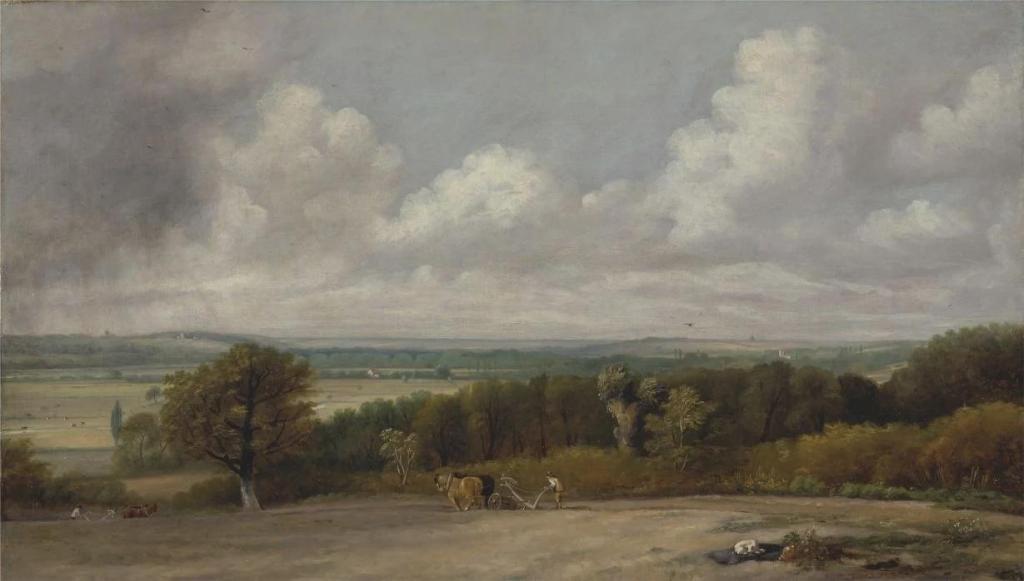
 Ploughing scene in Suffolk (oil on canvas, 1824-1825) by John Constable (1776-1837). Yale Center for British Art, New Haven.

In a quiet village, there lived a diligent farmer who worked tirelessly on his land. He took great pride in the crops he grew, ensuring that each seed was planted with care and nurtured with patience. His fields were always bountiful, feeding not only his family but also the entire village.

One day, as he was plowing a new field, the farmer unearthed a strange, dark seed. It was unlike any seed he had ever seen, and though he was curious, he was also wary. The farmer considered casting the seed aside, fearing it might bring misfortune, but a voice within urged him to plant it.

After much deliberation, the farmer decided to plant the seed in a secluded corner of his field, where it could grow without disturbing his other crops. He tended to it with the same care as his other plants, watching as it sprouted and grew into a tall, sturdy tree, its leaves a deep, rich green.

As the seasons passed, the tree bore fruit—small, round, and gleaming like gold. The farmer, unsure of the fruit’s nature, hesitated to taste it. But one day, during a terrible drought that withered his other crops, he had no choice. He bit into the fruit, and to his surprise, it was not only delicious but also quenched his thirst and filled him with strength.

The farmer shared the fruit with the villagers, and soon they all marveled at its miraculous properties. The tree continued to bear fruit, regardless of the weather, and the village never again knew hunger or thirst. The farmer realized that by trusting in the unknown and nurturing it with care, he had uncovered a hidden blessing.

Moral of the Fable

Sometimes the greatest rewards come from taking risks and nurturing what is unknown or unexpected. The fable emphasizes the value of curiosity, patience, and the willingness to embrace uncertainty.